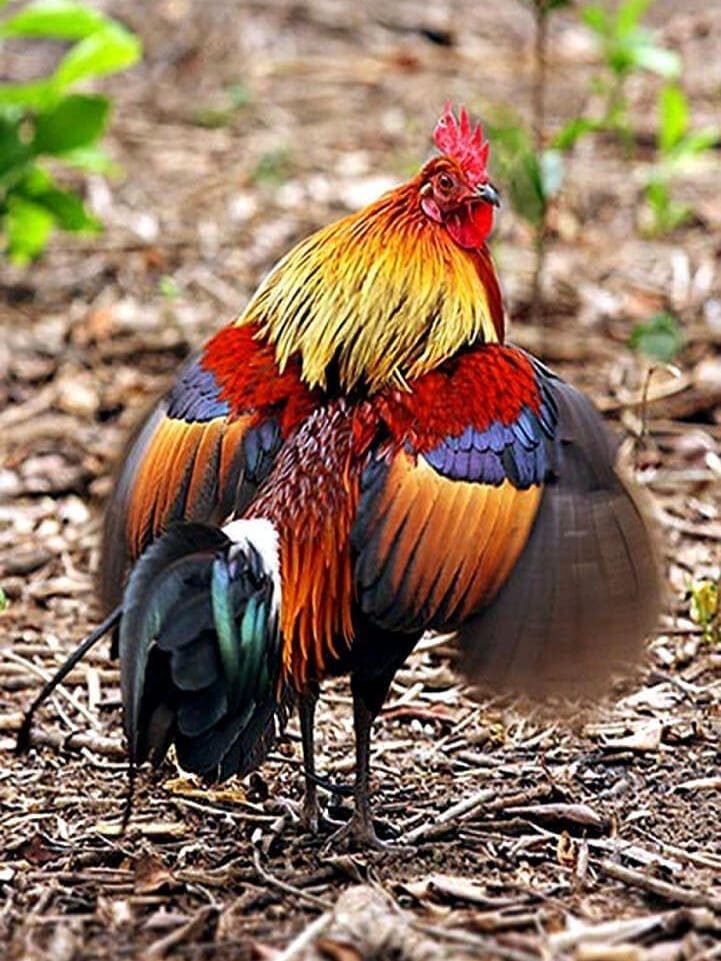
The Selection in Poultry, how can we define it? Selection means choosing the best from among all the good ones. Naturally, any poultry farmer who manages or operates a farm must engage in selection and conclude that all—or at least most—of the birds are the offspring of breeding stock that has been previously selected.
And fixing in their descendants the external and internal characteristics that have been deemed worthy of preservation and perpetuation, and eliminating those others that constituted defects, whether physiological, pathological, etc.
That is why we can say that most of the birds in a poultry flock are of good quality; they all possess a minimum set of genetic traits that we strive to preserve. However, among them, there are some that stand out for their characteristics.
Selection involves precisely choosing these outstanding birds, then using them to form breeding flocks, and—by applying the various procedures we know regarding inbreeding—perpetuating those remarkable traits that we also know are hereditary.
“Selección,” though it may not seem so, is a Spanish word that has been filtered through the English language. It is a variant of “elección,” from which it undoubtedly derives and with which it has become conflated, with one being used interchangeably for the other—a phenomenon undoubtedly stemming from the fact that, regardless of which term was used, the intended meaning was the same.
Selection is preceded by the process of choosing something from among its peers, and it is followed by the actual selection that separates the chosen items from the rest, conferring upon them the status of favorites. What results from selection carried out in this manner is the “select”—a term that is synonymous with exquisite, superior, superb, excellent, magnificent, etc.—set apart from its peers by characteristics that make it worthy of any of these descriptions.
And you might ask, “What’s the point of all this?” Simple: to constantly improve our breeding stock. The best produce the best, and consistently breeding the best leads to success in refining our hens’ characteristics—both physiological and morphological—in line with the breed standard.
When a poultry farmer, hobbyist, or anyone aspiring to be one takes charge of a flock or several flocks of hens in their chicken coops or barns, the first thing they should do is examine them to set aside those they consider useful and cull those with any defects.
We call this “entresaca,” from the verb entresacar (to pick something out from among others), and here are some examples of what to look for to do it right.
The health of our birds: at the slightest sign of illness, discard them.
Chickens with a clearly defined biotype (in terms of their characteristics, species, variety, or breed); we will select them based on color, size, comb shape, feathered or bare legs, etc., always in accordance with the breed or variety standard.
To carry out the practice of inbreeding, we draw upon the experiences advocated by the American Feleh, or Anderson. And we obtain strains of higher layers, which have the genetic factors dominant, transmitted by inheritance.
This selection can be of two types: First, phenotypic selection, that is, based on the birds’ external appearance, ensuring that they possess all the external characteristics typical of the breed being bred and that have previously been defined in the breed standard.
Such as the color of the beak, earlobes, and tarsi; the shape of the head, back, and tail, etc. These external factors determine, at a glance, the degree of purity of a bird. The beauty of the individual is a key characteristic within the breed.
This type of selection is within the reach of any amateur poultry breeder; however, there is another, far more interesting type of selection known as genotypic selection, which refers to the set of hereditary factors present in an individual and expressed in a dominant manner.
A bird may be phenotypically sound but not genotypically so; in other words, it may be perfect in appearance but possess hereditary traits that are detrimental to our objectives. The primary goal of selection is to produce a type of individual that is considered outstanding both phenotypically and genotypically.
You may be wondering if you need to know something about genetics to do this; that’s right—without that knowledge, we won’t be able to interpret the results or use the tools at our disposal to classify laying hens based on their fertility.
In my view, there are two methods we can use: the one developed by Oscar Smart, based on experiments conducted at the U.S. Experimental Station in the state of Maine by Dr. Raymond Pearl, the discoverer of genetic factors; and the one developed by the English geneticist Hunts.
Which of the two systems is better, given that they are very similar but have some differences, since both deserve recognition as pioneers of this type of chicken, which Hurts called ideal?
But I believe the English method is more comprehensive, as it more accurately determines the fertility characteristics of a hen. Both procedures achieve the same goal; however, the American method classifies the hen as good, average, or poor, using the letters L2, L1, and L0. The English method, in addition to this, determines the degree of each of the seven genetic steps that determine the phenotypic value—or, in other words, the performance of a laying chicken.

It is clear that it is not the same for a good poultry farmer to know that a layer is L2, even though this indicates that she is a good layer who has reached sexual maturity at a good age, has good winter and annual egg production, and has an egg average that is acceptable according to the breed standard.
All of these are genetic factors dominant and transmissible by inheritance.
But if that same chicken we have selected the procedure English, we will know what degree does each of these seven passes of genetic factors that determines Thomas Hunt Morgan.
Through a careful study of the individual records we keep for each bird, we will clearly see that among the good ones there are others that are even better, depending on their grade and percentage; and there is no doubt that those exhibiting the maximum number of dominant traits and the minimum number of recessive traits will be identified as the undisputed breeders.
Now: do you just need to gather a lot of good breeding to get a good and numerous offspring, with all the genetic factors that have acquired by inheritance? Of course not.
This can only be achieved with a close reproduction, accompanied by a smart selection. By close reproduction, we understand the blood.
The foundation or starting point will be the pair consisting of the son and his mother; once we are certain that she is a good layer, she will be mated with a rooster from the same bloodline.
Always trying to choose between which they are ascendants of the best terms, deposit, and postage, we will obtain in this manner offspring with three-quarters of maternal blood, which is the order we want to preserve and propagate.
This practice has a long history here in Spain; it’s a tradition among cockfighters—that is, among the great breeders of Spanish fighting cocks—who know and employ many techniques that even the most knowledgeable enthusiasts are unaware of. And since we need to learn these things, we’re both delighted and surprised when they come to us, as if they were some English or American innovation.
The rooster plays a crucial role—far more important than many poultry farmers realize. The genotypic classification of the rooster is a matter of great importance; indeed, it determines whether the chicks will inherit the same fertility traits as their mothers.
The cock inherited these same factors of their parents, and although of course there were shows like the chickens, they are checked if they are or not carrying them through the examination of their descendants.
It is not enough to know that he is a good person on the surface, nor that his parents, grandparents, and so on were also good and considerate; therefore, as L2, consult Pairings, hens, and roosters Oscar Smart.
This needs to be verified to determine whether he does, in fact, carry the Hurts genetic traits, and this verification is simply the classification of his daughters once they have completed their first year of laying.
Once we have reviewed the flock and determined that all or at least the majority of his daughters exhibit the desired phenotypic and genotypic characteristics, we can then say that we have a breeding rooster whose genetic and economic value is enormous.
It is true that it takes a certain amount of time to reach this stage, but we have the advantage that in poultry farming this period is relatively short—two and a half years—broken down as follows:
A 1-year-old rooster, to be used for breeding.
It will take 6 months for the hens to lay their first egg.
1 year from the position of the first egg to your rating.
Total 2 and a half years.
Of course, we might ask ourselves this question: Is he already old after all this time? Will the rooster still be able to fulfill his reproductive role?
Of course not. If well-fed, well-cared-for, and so on, it can continue for another 2–3 years producing outstanding offspring—both females and males—and once that is achieved, we have laid the foundation for the pedigree breeding of our lines.
Natürlich nicht. Wenn es gut gefüttert und gepflegt wird und so weiter, kann es noch weitere zwei bis drei Jahre lang hervorragende Nachkommen hervorbringen – sowohl Weibchen als auch Männchen –, und sobald dies erreicht ist, haben wir den Grundstein für die Zucht unserer Linien gelegt. inseminated with sperm eines ausgewählten Hahns, wobei zu beachten ist, dass dies wie beim natürlichen Geschlechtsverkehr abläuft, d. h., dass jede Ejakulation die Eier 15 Tage lang befruchtet.
Zudem ist allen Geflügelzüchtern und Liebhabern bekannt, dass der sehr hohe Anteil an blassen oder unbefruchteten Eiern in den ersten Monaten der Brutzeit (November, Dezember, Januar) darauf zurückzuführen ist, dass der Hahn beim Paarungsakt zurückhaltend ist, was durch einen Mangel an funktionellen Reizen und eine mangelhafte Durchblutung der Hoden verursacht wird.
By their genealogy (die Gesamtheit der Vorfahren einer Person oder eines Tieres). Die Vorfahren eines Tieres sind entscheidend für seinen voraussichtlichen Erfolg als Individuum und als Zuchttier; wir müssen sie zunächst als Ganzes, in ihrer Gesamtheit beurteilen, denn es besteht ein großer Unterschied, ob sie reinrassig sind, nur einen hohen Selektionsgrad aufweisen, gekreuzt, halbblütig oder einfach nur gewöhnlich sind.
In der Genealogie hängt der Wert eines Individuums jedoch vom Verwandtschaftsgrad ab. Ein bedeutender Vater oder eine bedeutende Mutter verdienen besondere Beachtung; ein Urgroßvater ist für sich genommen nicht so wichtig, und noch weiter zurückliegende Vorfahren müssen kaum als Einzelpersonen berücksichtigt werden.
Nach der Selektion setzt sich die Inzucht durch, die als Fortpflanzungsprozess unter Verwendung der Mitglieder einer Familie definiert werden kann. Kein anderes Fortpflanzungssystem hat jemals so hervorragende Ergebnisse erzielt. Die einzige Voraussetzung, um die in sie gesetzten Hoffnungen nicht zu enttäuschen, besteht darin, die individuelle Selektion nicht aufzugeben.
Was können wir daraus schließen? Ganz einfach: Es gibt ein Schlüsselwort, nämlich ¡Selection, selection, selection! It is what we need to do in our chicken coops or houses to get, not without effort, and time, have some excellent players, and finally having these lines as desired birds.
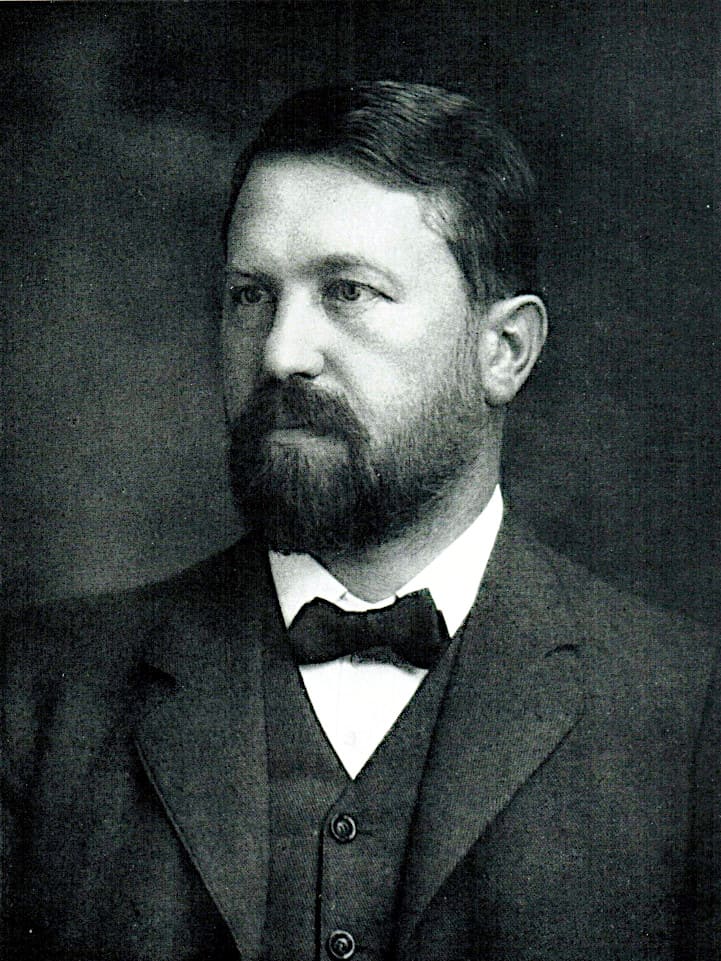
In 1902 and 1903, Sutton and Boveri published independent work which proposed what we now call the chromosomal theory of inheritance. This theory says that the individual genes are found in specific locations on chromosomes, individuals, and that the behavior of chromosomes during meiosis can explain why the genes are inherited according to the laws of Mendel.
The chromosomes, as genes of Mendel, come in pairs equivalent (homologous) in an organism. For genes and chromosomes, one member of the pair comes from the mother and the other comes from the father.
The members of a homologous pair separate during meiosis, so that each sperm or egg receives only one member. This process reflects the segregation of alleles in gametes in Mendel's law of segregation.
Members of different pairs of chromosomes are distributed into gametes independently in meiosis, just as the alleles of different genes on the law of distribution independent of Mendel.
The chromosomal theory of inheritance was proposed before there was any direct evidence that the traits are carried on chromosomes, and at the beginning was controversy. In the end, was confirmed by means of the work of the geneticist. Thomas Hunt Morgan und seine Studenten, die sich mit der Genetik von Fruchtfliegen befassten; lieferte den ersten Beweis für die Chromosomentheorie.
Morgan discovered that a mutation affecting the eye color of the fly. Observed that the mutation was inherited differently by the different flies, male and female.
Bibliography
IV National Assembly of Chicken, rabbit breeders and Beekeepers and Exhibition (November 1948)
Poultry, 1904. S. Castelló. Adm. and Network. “The Poultry Practice”, Barcelona.
Journal of Menorca. August 1922. “The Minorcas, such as regenerating our Castilian, Andalusian or Menorca. S. Castelló. Publication of the Ateneo Scientific, Literary and Artistic of Mahon. (Taken from World Poultry, may 1922).
World poultry, may 1902
S. Castelló. Real Escuela de Avicultura, Arenys de Mar.
Poultry, 1931. (Vol. 1). B. Dürigen. Edit. Gustavo Gili, Barcelona.
Hen and chicken Coops, 1933. (Vol. 1). Ramón J. Crespo. Edit. Espasa Calpe.
World poultry, November 1902.
Real Escuela de Avicultura, Arenys de Mar.
Topics poultry. nº 56. “The Race Castellana Negra”. Real Escuela de Avicultura, Arenys de Mar
Spain Avicola magazine, a century ago, José Antonio Mendizabal
Industrial Poultry, 1943. J. Rubio and M. Villanueva. Editions Memphis, SL, Barcelona, Spain.
Book, Spanish patterns of poultry, 1953. C. E. A. S. Editions GEA, Barcelona.
You may be interested in these other sections