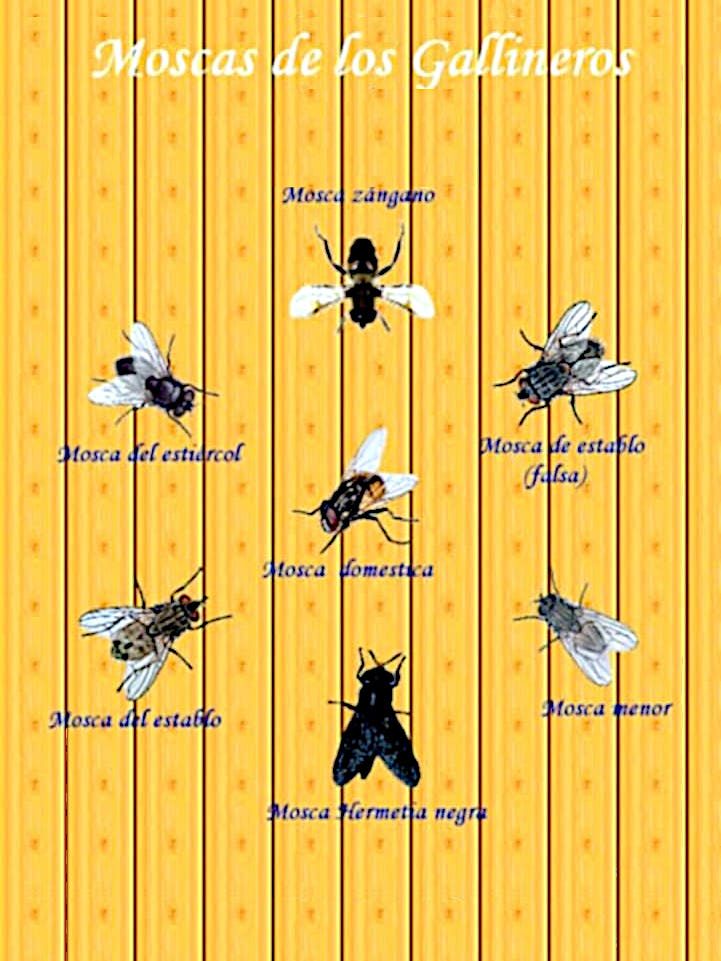
Parasitic diseases:
In general, the name of pediculosis It is caused by a number of diseases transmitted by insects belonging to the following groups:
These types of parasites are very common, with malophages being particularly prevalent in chickens. From a pathological standpoint, it is important to note their debilitating effect, whether they feed on blood or live off skin scales and feathers.
The term “pediculosis” refers to any contagious external parasitic disease caused by various species of lice, which affects animals and humans in either acute or chronic forms.
Lice are one of the most common parasitic diseases in chickens. You can learn more in our comprehensive guide on diseases in chickens.
The main effect of lice is irritation and restlessness; as a result, the birds do not sleep or eat well.
They may injure themselves or damage their feathers by pecking or scratching at the irritated areas, and their body weight and egg production may decline.
All lice that infect domestic birds are of the chewing type. Mites can be confused with the lice, but the first ones are blood suckers.
In general, each species of louse is restricted to a particular type of bird, although some can jump from one species to another if they are closely associated, and can also infect different species.
For some time now, the term “pediculosis” has become widely used, and even today it continues to be used to refer to any parasitic infection caused by any species of lice, regardless of the host.
External bird parasites live permanently on the skin or feathers. Similarly, insects that complete their life cycle in feces, dead birds, and waste are also significant, as they pose health risks.
Modern poultry farming has reduced its prevalence; however, it could resurface, particularly due to the inevitable presence of workers or other people who may have infected birds at home.
Becoming carriers when you go to work, and they are provided with clean clothes, and do this, if you exclude the disinfection routine of the place of moves. The major influence of the parasitic disease is recorded in the middle of winter, so that it can be categorized as seasonal disease.
As these parasites take advantage of the heat radiation of the body of the host, the external temperature has little influence on its development. This is not the case with humidity, which is essential for their development; in fact, it is precisely during periods of high humidity and low temperatures that they thrive.
Lice, of which there are more than forty species, are among the most commonly found ectoparasites today. Fleas, which are very difficult to control or eradicate, and others, because they are rare pests.
Some consider Alphitobius diaperinus to belong to this group, even though it is not typically found inside the bird’s body, except when it consumes food deposited on it; it is usually found in the nest, and is believed to be a carrier of certain viruses.
All live continually in the feathers the host and die soon out of their habitat. The eggs are attached to the feathers. The young resemble the adults, except for their color and size. They prefer to live in specific sites, resulting in the specific names that are mentioned.
At least nine species of lice, biting or chewing infest birds. A single individual may be infested by multiple species, each of which often occupies a treasured place in the host.
Bird lice (avian pediculosis) are tiny, wingless insects that live in feathers. They are found primarily on feathers and on the surface of the body.
They have strong chewing mouthparts and feed on feather debris or exudates; they may even consume blood.
All lice that infest domestic birds are chewing lice. Mites can be mistaken for lice, but mites are bloodsuckers. In general, each species of louse is restricted to a particular type of bird, although some can move from one species to another if they are closely associated, and can also infest different species.
Head lice can be divided in:
Lice chewing:
Taxonomically, they can be categorized as follows:
In lice, chewing is frequently present in parthenogenesis, although the reproduction is sexual, because the number of males is very small.
They are more active during winter. They measure approximately 1 to 2 mm in length. They are characterized by having mouthparts in the form of toothed jaws on the ventral side of the head. The head is more or less semicircular or triangular and generally as wide or wider than it is long.
The antennae are short, filiform or terminated in club, formed by 3 to 5 artejos and exposed or embedded in a cavity cephalic. The maxillary palps may be present or absent.
The thorax is narrower than the head and consists of three distinct segments: the first segment (prothorax) is free; the other two are fused.
The thoracic spiracles are located on the ventral side. The abdomen is oval-shaped and has seven visible segments, each with six or seven spiracles on either side: one prothoracic and five or six abdominal; it consists of 11 segments, the last two of which are fused. It is longer than the head and thorax combined and has 1 to 3 rows of setae on each segment.
Los espiráculos respiratorios abdominales son ventrales y no son más de 6 pares. Poseen patas finas, medianas o cortas, terminadas en una uña (si parasita mamíferos) o en un par de uñas pequeñas (si parasita aves).
Members of this genus move quickly; their legs are adapted for grasping and for walking.
Lice-sucking:
Taxonomically, it can be categorized as follows:
These lice measure approximately 3.5 to 5 mm. This suborder is characterized by a rostrum-shaped mouthpart adapted for piercing and sucking. The head is narrower than the thorax and is elongated, rhomboidal, subtrapezoidal, or hexagonal.
The antennas are exposed and formed by 5 artejos (segments). The thorax has three segments more or less fused together, and is shorter and wider than the head.
The abdomen has 6 to 9 segments visible, with spiracles respiratory dorsal root of each side: a thoracic and six abdominal. The legs are robust and terminated in a strong nail or finger mobile. The species that make up this group are slow-moving.
Next, we'll look at the ones considered to be the most harmful of all.
Chicken lice.
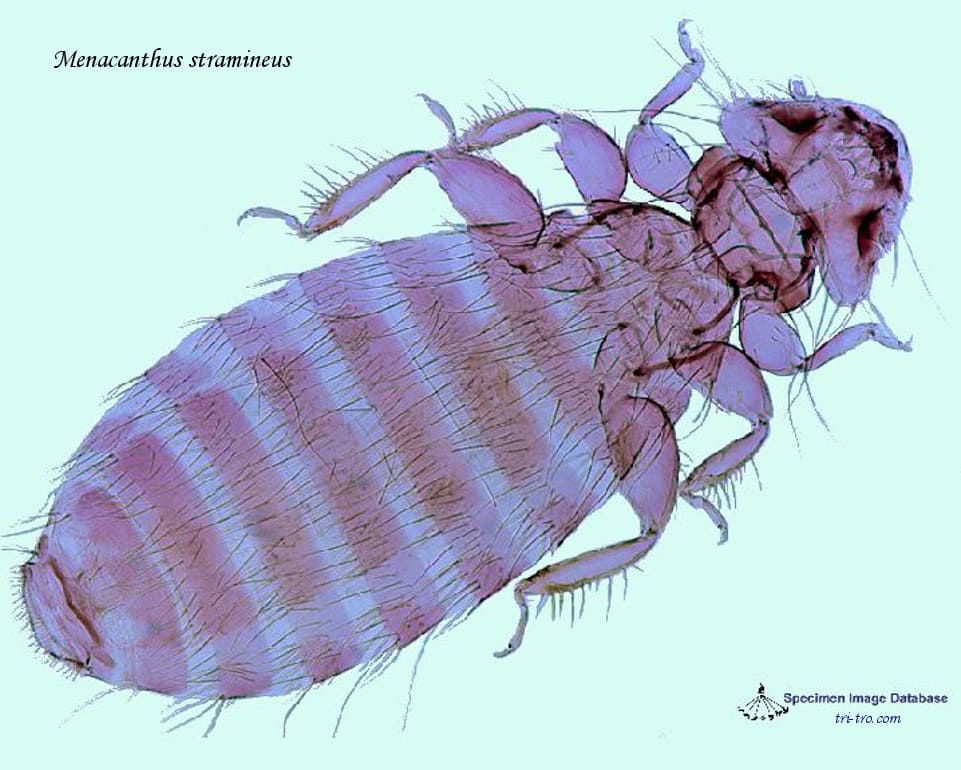
Menacanthus stramineus It is the most common and destructive of the lice found on chickens. It is found worldwide and often reaches epidemic proportions. Adults are 3–3.5 mm long.
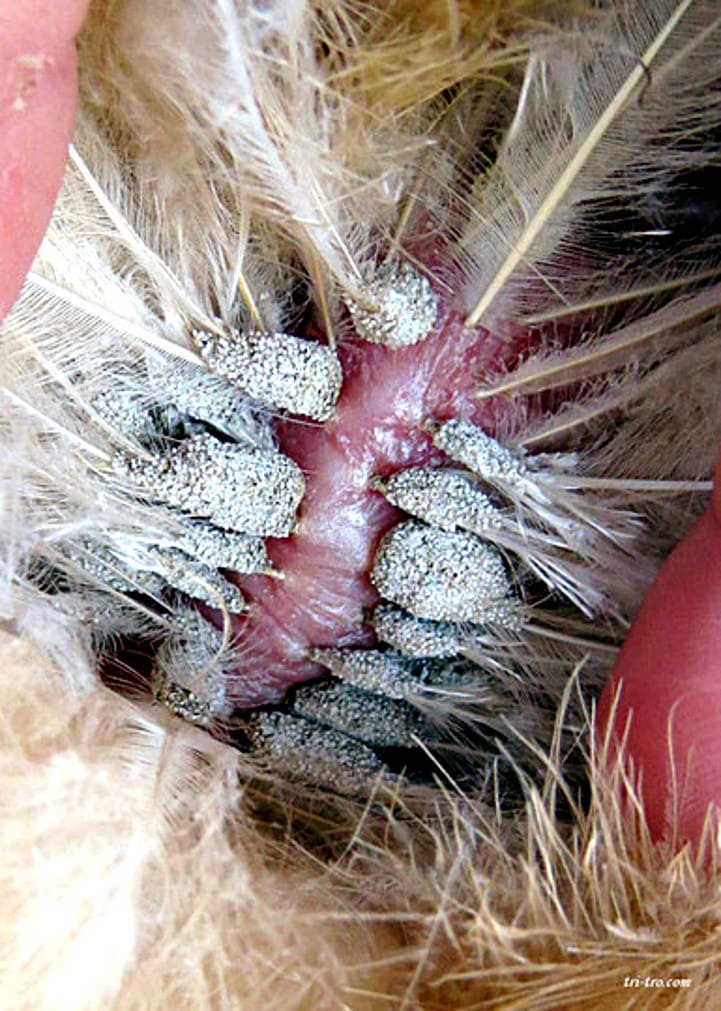
Females lay one or two eggs per day, sticking them in groups at the base of the feathers.
Eggs typically hatch in 4–5 days; each generation lasts about 3 days, and a full generation takes 13–14 days.
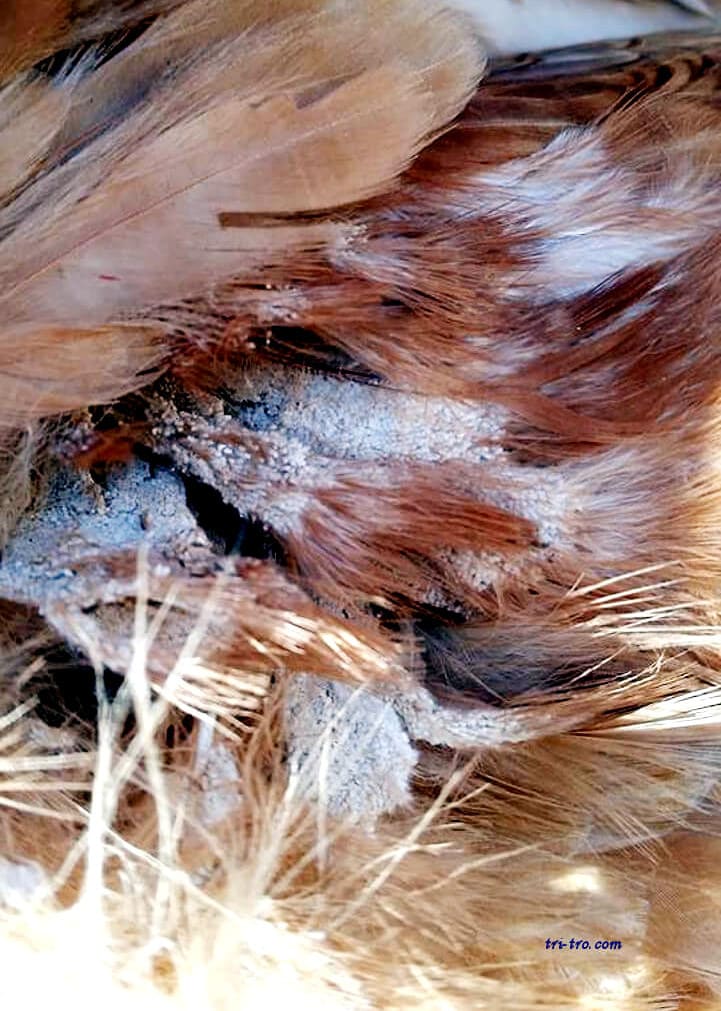
It is most commonly found in the area below the cloaca, although in heavily infested birds it can be found on the chest, back, hips, and under the wings. It can feed on blood by piercing soft feather shafts near the bases and nibbling through the layers of skin covering them. It primarily parasitizes chickens, but can be found on turkeys and other birds that may live alongside infested chickens.
The chicken body louse prefers to stay on the skin rather than in the feathers. It chooses areas with few feathers, such as the area below the vent (abdomen). In severe infestations, they can be found on the breast, under the wings, and in other areas, including the head.
When you part the feathers, you can see it—a straw-colored creature darting quickly across the skin before hiding again.
The egg is deposited in groups near the base of the feathers, especially below the cloaca.
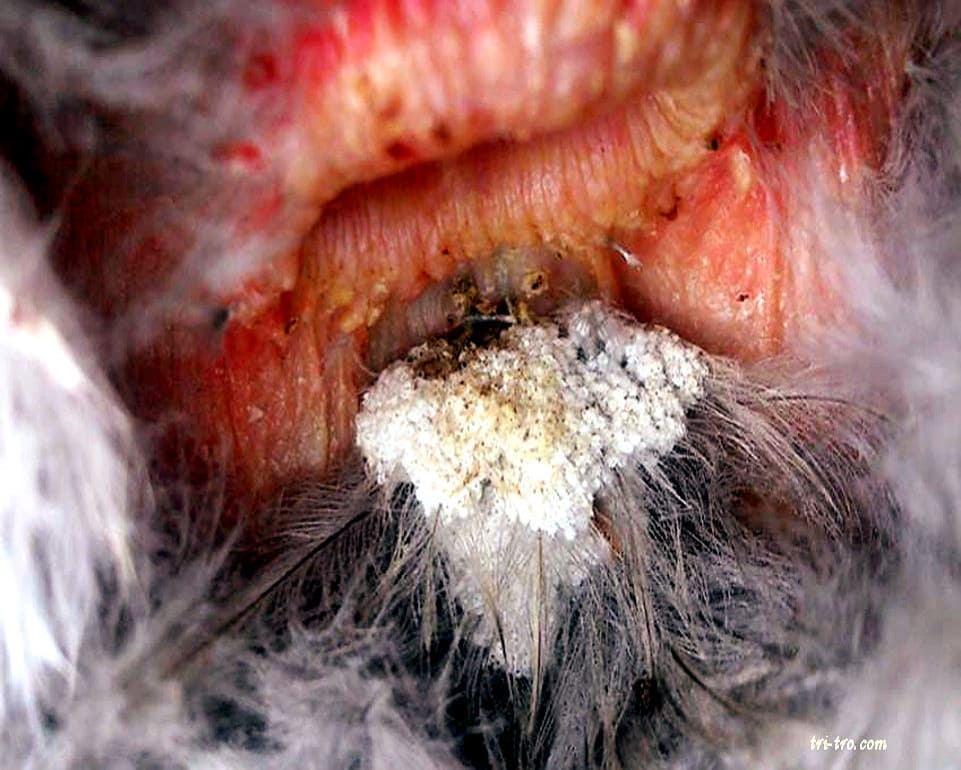
This is the louse that most commonly infests growing chickens. When present in large numbers, it causes severe skin irritation that can lead to scarring, especially around the cloaca.
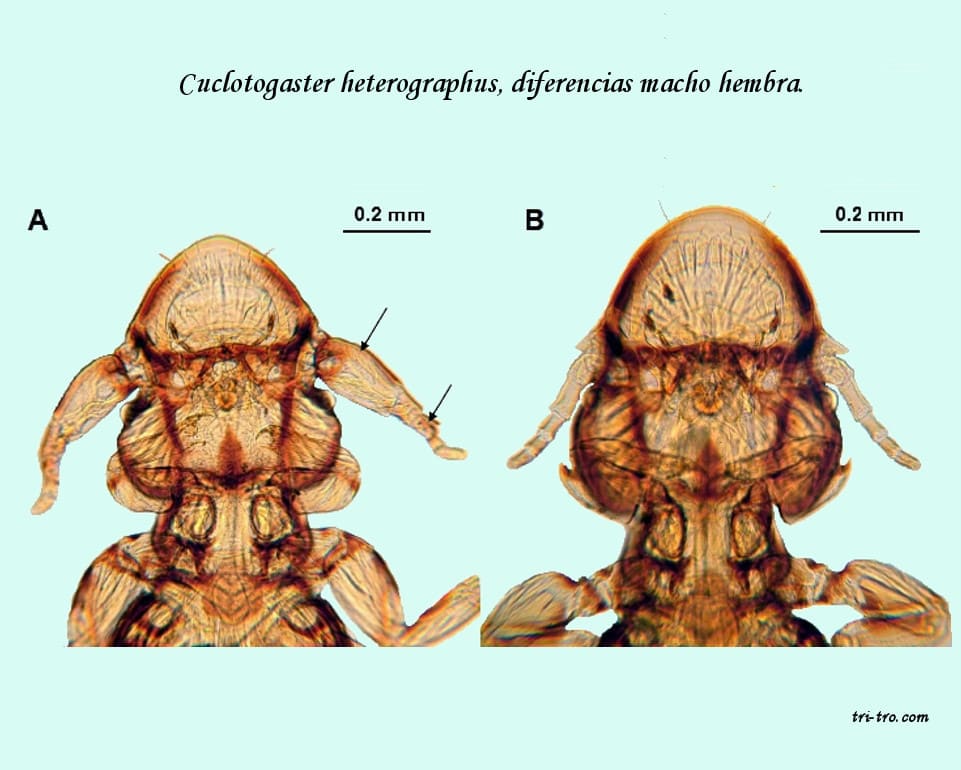
Difference between male and female Cuclotogaster heterographus
Photograph of the Cuclotogaster heterographus: (A) male; (B) female. Note that the basal segment of the antenna is larger in the male and has a hook or claw at its tip (arrows); this is a character indicative of sexual dimorphism.
It is known as the “chicken head louse” because it prefers to settle in the feathers on its host’s head and neck; the head louse is found primarily in that area, although it is occasionally found on the neck as well.
Usually, it is located near the skin, in the down or feathers, in the upper part of the head and below the peak. The head louse is found, at times, as close to the skin that the aviculturist can think of that is glued on to it, sucking blood.
Although this is not the case, it is very irritating and is considered a nuisance on the list. It feeds by nibbling on feathers and skin flakes, although some of them ingest blood by piercing the feather shaft or gnawing through the skin. When the chicks are fully feathered, the infestation on their heads subsides, but it can increase again once they reach maturity.
Biting lice bother their hosts, mainly due to the irritation they cause on the skin's surface. Most lice are generally well tolerated, but heavy infestations can cause severe irritation, leading to self-inflicted injuries.
Female Cuclotogaster heterographus head lice attach their eggs to the base of the down feathers. The eggs hatch after 5–7 days, and each nymph takes 6–14 days to reach maturity; the generation time is 35 days.
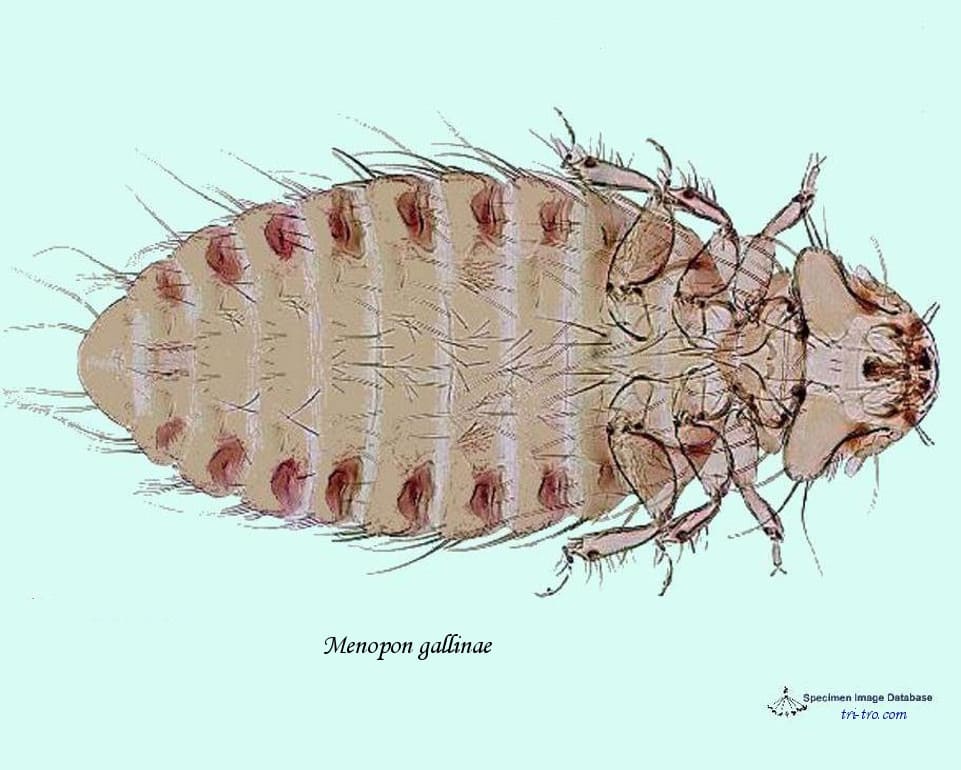
The Menopon gallinae is usually along the rachis of the feather, and it does not stay on the skin of the host at any time. It is also very common in chickens, but it has much less importance than the body louse because the greater part of his life is on the feathers, and not on the skin, and seems to feed on the bárbulas and barbs of the feathers.
He has not been found in birds of a young age, and can live for some time about feathers shed from the body of the bird.
The adult louse of the pen (Menopon gallinae) are 2 mm long and the females deposit eggs, one at the base of the pen in the areas of hip and breast.
Louse canyon of the feathers or small louse resembles the human body louse, but with a smaller size. Has a habit of resting on the barrel of the pens, where you can perceive running hastily to the body when we get away from the feathers suddenly.
They do not infest young birds until their plumage is fully developed. It is more important to apply insecticides to the bird's body than to the facilities.
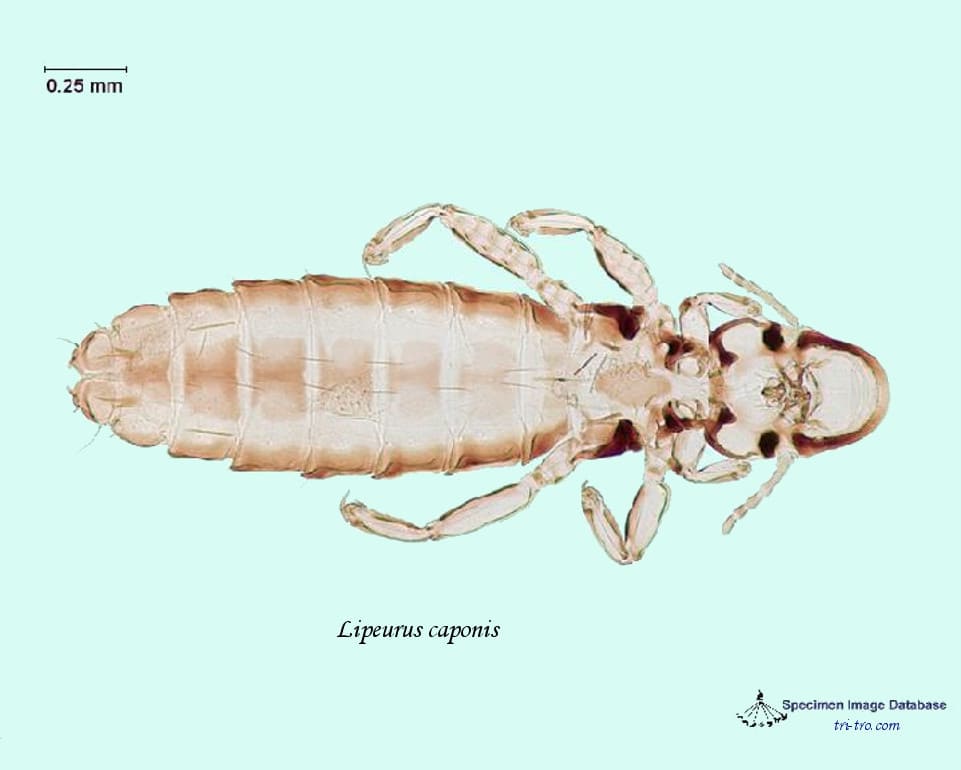
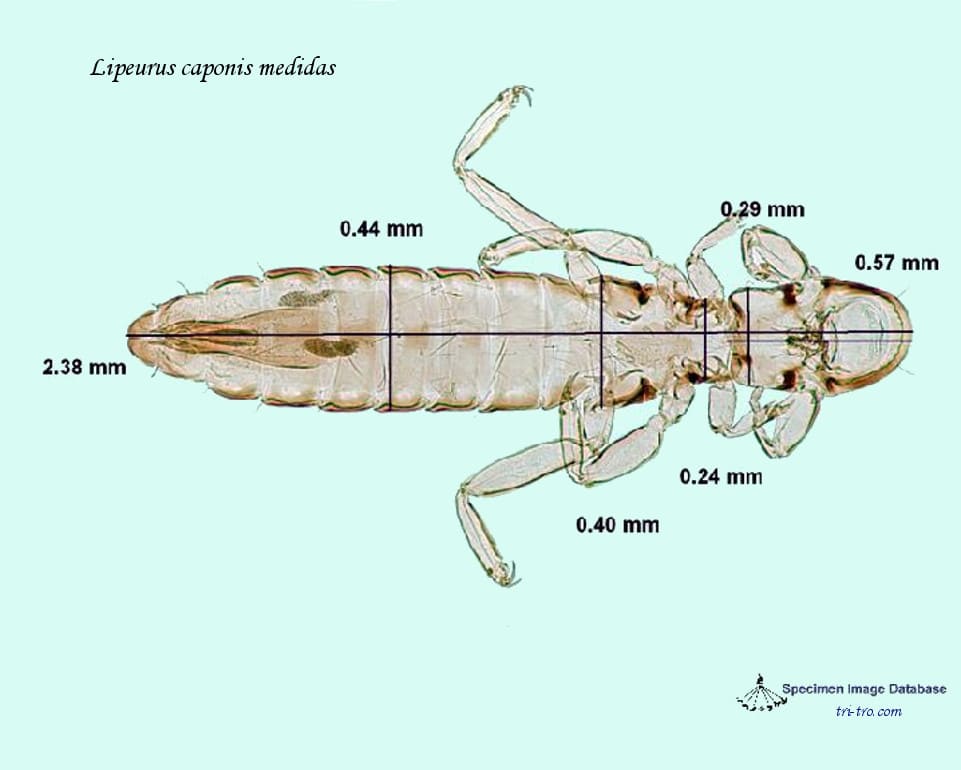
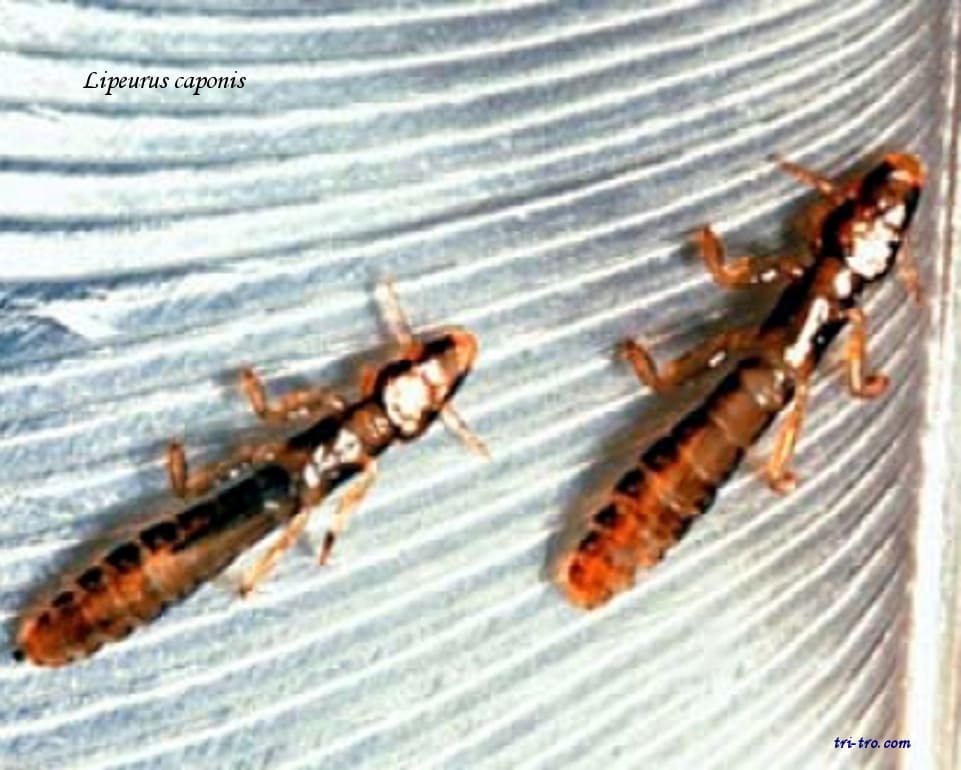
Lipeurus caponis
The eggs of the winged louse, Lipeurus caponis are closely related to head lice and are the only species commonly found on the large wing feathers of hens.
Lipeurus caponis defined in:
The band clipeal is pigmented evenly; the temporary, intensely pigmented, and the occipital, devoid of pigmentation.
The male's antennae have a large first segment bearing a curved, blunt apophysis; the third segment is clearly shorter than the second and has an apical apophysis.
The pterotórax, in females, it presents the silks marginal posterior arranged in two groups, one side and four stations long, database implementation juxtaposed and bordered by a zone pigmented.
In males, these groups consist of 1 lateral and 4.1 central spines, with the same pattern of arrangement, but the two central spines in the group of 4 are exceptionally long, extending to the 3rd abdominal segment. The eggs hatch 4–7 days after the female lays them at the base of a feather. Each nymphal stage lasts 5–18 days, the generation time is 18–27 days, and females live up to 36 days.
In general, lice are much more of a problem in young or weakened animals than in older, well-fed ones.
An infestation of head lice heavy can in itself be more than a symptom of some other underlying disease, such as malnutrition or chronic disease.
The animals often weakened, not acicalan and left that head lice are not disturbed.
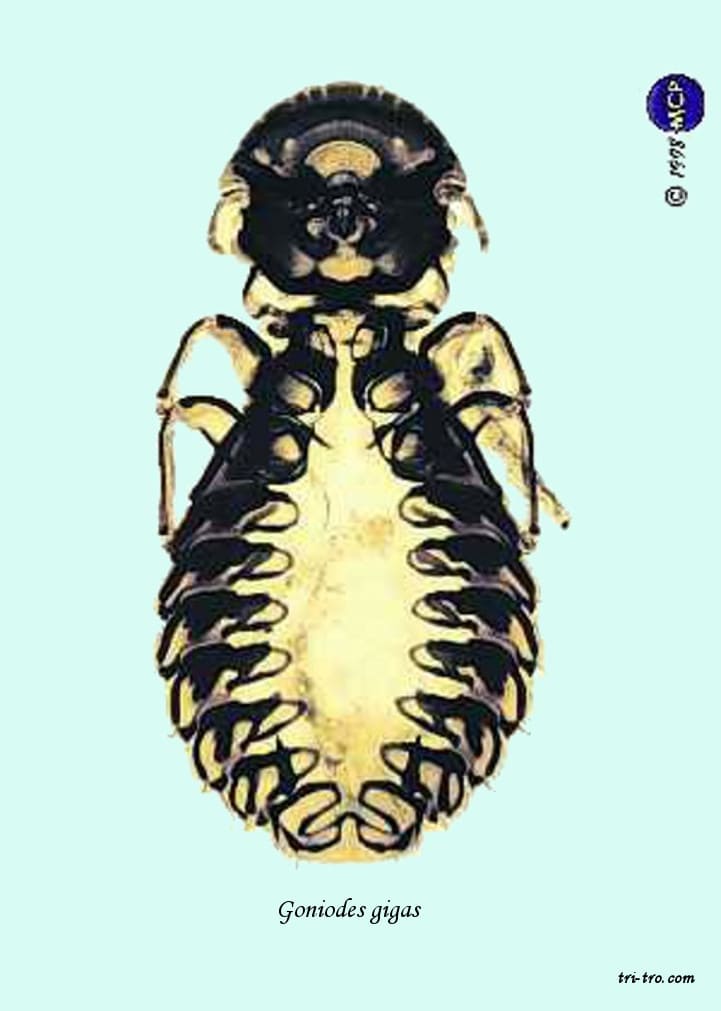
It is a louse with a broad body and a rounded, dark-colored abdomen; males measure 3.2 mm and females 5 mm.
It is located in the bird's body and wings.
The Goniodes gigas The clipeal band is widened in the middle. The male's antennae have a slightly widened first segment without an appendage; the second segment is longer, and the third segment lacks an appendage. The temporal angles are moderately prominent.
The pterotórax presents the lower edge provided of 10 silks arranged according to 2,2,1-1,2,2. It is a parasite of Gallus domesticus.
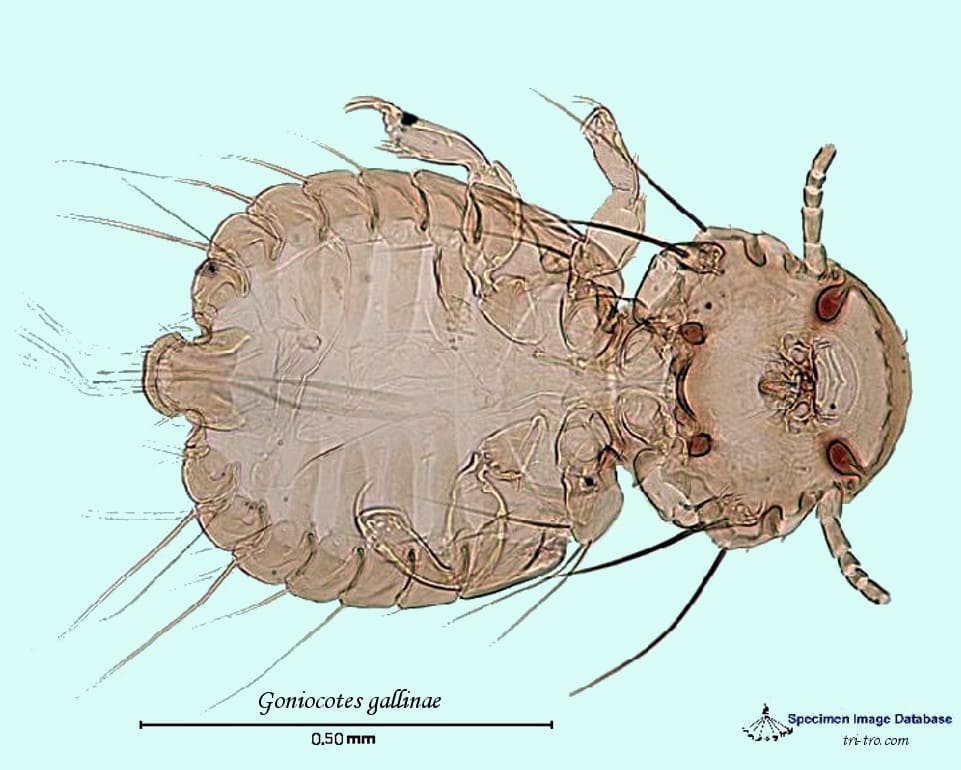
Goniocotes gallinae.
Down mite, previous photo
Goniocotes gallinae.
Down mite, rear view
Goniocotes gallinae. Down lice live in the down at the base of feathers; they are among the smallest lice found on poultry.
Goniocotes gallinae: The head has a rounded anterior margin. The antennal nodules are thick and pear-shaped. The prothorax is fusiform with protruding lateral angles.
The pterothorax has a smooth, evenly rounded posterior margin. The abdomen is oval; only the intersegmental sutures of the first three segments are distinct.
Knemidokoptes gallinae. The mite causing the plucking.
These mites are even smaller than those found on the scales of the legs; they live at the base of the feathers, where they cause a condition known as “plucking scabs.”
The intense irritation caused by the mite causes the bird to boot the feathers.
In severe cases, the bird can be almost devoid of feathers on the body.
Usually, you do not lose the large feathers of the wings and the tail.
The louse pardo the chicken Goniodes dissimilis.
Bird lice are typically transmitted to new hosts through direct physical contact. However, since they can survive outside the host for hours or even days, they can also be transmitted through the use of cages and vehicles that have not been disinfected. Therefore, every effort must be made to prevent this from happening.
Remember that lice in pets is caused by a complex parasite in the intervening two orders, families and genera, and many species of lice, morphology, and different habits, caused by two different groups of lice, chewing and sucking, differ from one another by their biological characteristics and anatomical.
The female lays eggs in clusters on the base of the feathers and attached with a kind of cement.
These are oval-shaped and off-white in color (between 200 and 300 eggs in total over their lifetime).
The egg is the form of resistance of head lice and are called nits.
The process takes 4–5 days for incubation. The newly hatched larvae are white and fragile and need a reasonable amount of time to harden and begin feeding on their hosts; they resemble adults but are smaller.
During their life cycle, they undergo up to four simple molts without leaving the host. They go through three nymphal stages, each lasting three days, before becoming adults. Adult females are able to lay nits as early as 10–12 days after hatching, and can lay between 1 and 6 eggs per day.
When they reach the adult stage, the sexes will mate and the females mated immediately begin laying eggs.
A single pair of lice can produce 12,000 offspring in just a few months, but outside of birds, they only survive for 5 or 6 days.
They spend their entire lives on birds. They are hemimetabolous insects, meaning they undergo incomplete metamorphosis. Adult females lay eggs (nits) at the base of the feathers in the form of whitish masses.
The preferred location is around the opening of the cloaca. The larvae emerge from 4 to 7 days after, and progressively develop into nymphs and adults. The life cycle lasts between 3 and 4 weeks. The life of head lice lasts for several months, but outside the host does not survive more than a week.
Lice are obligate parasites, species-specific, apterous (no wings), small but visible to the eye. In addition, they are parasites permanent and seasonal, as there are more number during the winter. It is characterized by segments' of chest more or less fused, and the presence of a single blowhole breathing in the chest.
In the head, have antennae short, with 3 to 5 artejos, with eyes reduced or absent. Chest out three pairs of legs that end in 1 or 2 nails.
A distinctive feature of this species is the prehensile loop formed between these claws—either with each other or with the last segment of the leg (tibial process or spur)—whose diameter is similar to that of a feather from the bird species it parasitizes. The abdomen consists of 9 to 11 segments, each with a pair of respiratory spiracles.
The major influence of the parasitic disease is recorded in the middle of winter, so that it can be categorized as seasonal disease. As these parasites take advantage of the heat radiation of the body of the host, the external temperature has little influence on its development.
This is not the case with humidity, which is essential for their development; in fact, it is precisely during periods of high humidity and low temperatures that they thrive.
When birds are heavily infested with parasites, it is common to see them scratching or preening their feathers.
There is clear skin irritation, but in the early stages of the parasitic infection, the symptoms may go unnoticed. The following factors can help identify them: unexplained deterioration in posture, increased food consumption, weight loss, pallor, nervousness, etc.
Formation of erythema, vesicles, and crusts is obvious; it can also form pustules in case of bacterial contamination secondary opportunistic. Scratching leads to an even greater injury.
The itching caused by black fly bites is usually intense, due to the constant irritation caused by the saliva they secrete. It should be noted that the bites themselves are not serious.
Irritation and stress cause animals to eat less and suffer a consequent decline in productivity, particularly in young animals, as well as in older animals and those at immunological risk.

External parasites (lice and similar) are frequent under conditions of poor hygiene, staff clothing without washing and without disinfection, repeated use of sacks for food, etc.
Serious consideration must be given to the presence of rodents or wild birds, which can act as mechanical vectors. Cleaning, as well as the application of insecticides and disinfectants, are essential to prevent the spread of pests from one lot to another.
External parasites may be confined for their entire lives to the host or by passing from one bird to another. The greatest efforts must be devoted to preventing lice from entering a chicken coop, thereby avoiding reinfestation.
Nests of scavenging birds, such as sparrows, should be destroyed in the same area or around the chicken coops.
To prevent the spread of disease between chicken coops, you must disinfect egg trays or cartons, boxes, cages, baskets, and any other materials that are moved from one coop to another.
As for non-chemical control methods, thuringin, the exotoxin produced by Bacillus thuringiensis, can be applied directly to infested hens. Lice always remain on the host. Therefore, chemical control should not be applied to the facilities, but directly to the infected birds.
It can be done by spray, dip, or powders. The powders allow you to treat your chickens indirectly, that is to say, trying to arenas or the container with powder insecticides and letting the chickens empolven with the product when they make sand baths themselves.
However, roosters are not powder themselves as the chickens, and are a source of re-infestation.
Laying chickens should be treated directly; various organophosphates, pyrethroids, and pyrethrins can also be used to control various species of lice.
Treatment depends on the number of birds in the affected coop, the type of parasite present, and the rearing system, etc., because the methods differ—whether they are applied on a large scale or individually, with a set number of applications, the type of insecticide used, etc.
Any control and eradication program we implement must also address nests and bedding, as well as food containers when they are reused, staff clothing, vehicles, feed facilities if they are located within the farm’s perimeter, etc.
Insecticides are effective, but they must be used according to the product's instructions and as needed; here are some examples.
In any case, you should consult your veterinarian or a specialty store.
Literature review:
MERCK & CO. (1995). Manual Merck de Veterinaria. Rahway, N. J., EE. UU.
BUXADÉ, P. (1987). The laying hen. Ed. Mundiprensa. Madrid.
DORN, P. (1987). Manual of avian pathology. Ed. Acribia. Zaragoza.
HOFSTAD, M. S. (1984). Diseases of Poultry. Iowa State University Press, Ames, Iowa.
ZARZUELO, E. (1982). Vade mecum of the pathology, infectious poultry. Ed. Aedos, Barcelona.
CASTELLÓ, F. and CASTELLÓ, J. A. (1960). The New Art of Raising Chickens. Aedos, Barcelona.
OROZCO, F. (1989). Breeds of chickens Spanish. Ed. Mundiprensa. Madrid.
LACADENA, J. R. (1998). Genetics. Ed. AGESA
PUERTAS, M.J. (1992). Genetics: Fundamentals and Perspectives. McGraw-Hill Interamericana.
SANCHEZ-MONGE, E. (1969), Genetics. Espasa-Calpe S.A.
OROZCO, F. and ROBLA, F. (1986). Genetic aspects of the León rooster. 24th Symposium of the WPSA (Spanish Section): 199–212.
HILL, J. L. (1973). Genetics, general and applied. Ed. UTEHA.
CASTELLÓ, J. A., LLEONART, R., FIELD, J. L., OROZCO, F. (1989). Biology of the chicken. Real Escuela de Avicultura.
LLEONART, F., ROCA, E., CALLÍS, M., GURRI, A., PONTES, M. (1991). Poultry Hygiene and Pathology. Royal School of Poultry Science.
STURKIE, P.D. (1968). Fisiología aviar, Ed. Acribia. Zaragoza.
LOHMANN ANIMAL HEALTH (2012)
You may be interested in these other sections