Hatching eggs: how to choose the right ones

We know choosing eggs for hatching:

Many breeders understood advise you to choose for the incubation of the eggs thicker, because they are more bulky chickens that are born from them.

But there are plenty of people who have deeply studied the question, that will ensure that the eggs thicker are not always produce the chicks are older, but the ones that have egg yolks larger.

This is demonstrated by the fact that the Cochinchin hen, which lays the smallest eggs relative to its size, produces chicks with the largest body mass, because its eggs contain a very large yolk compared to those of ordinary hens. The same is true of the Black Castilian hen, which also has a large yolk.

Eggs intended for incubation should be selected from chicken coops where there are plenty of roosters to fertilize the hens, or from our breeding flocks, because there is no reliable way to distinguish a clear, unfertilized egg from a fertilized one.

However, eggs from hens whose breed is of interest for breeding purposes will be used for incubation, either because of the beauty of their shape, size, and plumage, or because they are good layers or produce excellent meat.

Picking up the effect as you go putting, and writing with a pencil, in each one of them, the date of the posture and the race that they come from.

Should be preferred, especially for ship them out, those who don't have fifteen days, because in this period there is no time to evaporate the clear.

These eggs should be stored in crates filled with bran, wood shavings, or sawdust, in which they should be completely wrapped to prevent them from bumping into each other and to protect them from air exposure; nowadays, they are usually kept in egg cartons designed for this purpose.

The crates or egg trays filled with eggs should be placed in a dry, clean location, protected from both cold and heat.

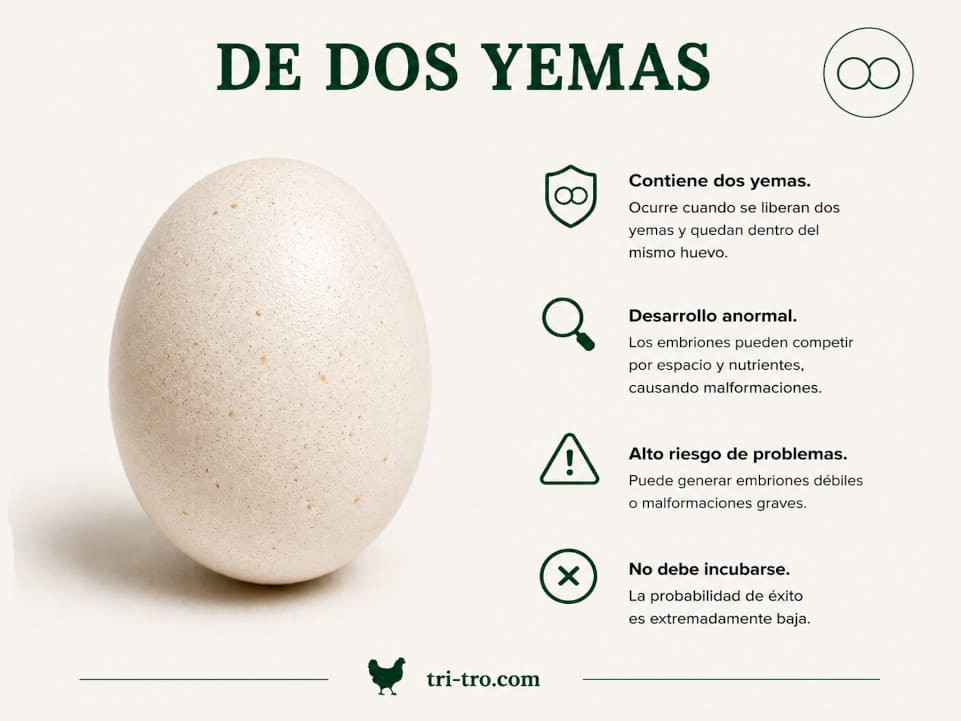
—Eggs with two yolks should be discarded, because either the chicks die within fifteen days, or they hatch into deformed chicks.

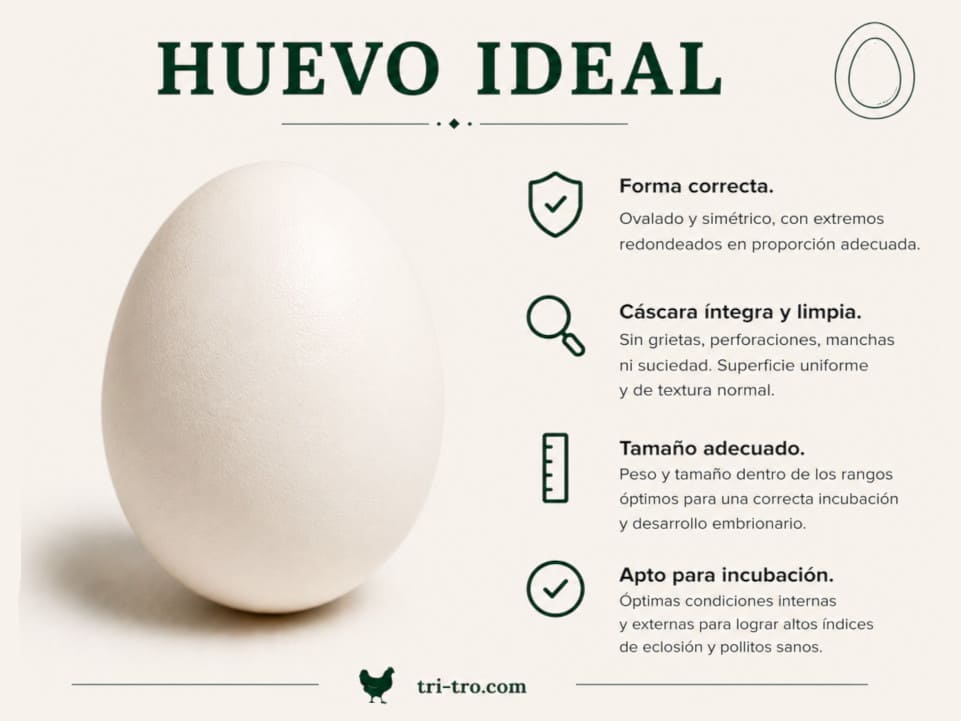
Care should be taken to ensure that the shells of eggs intended for incubation are uniform, hard, and durable.

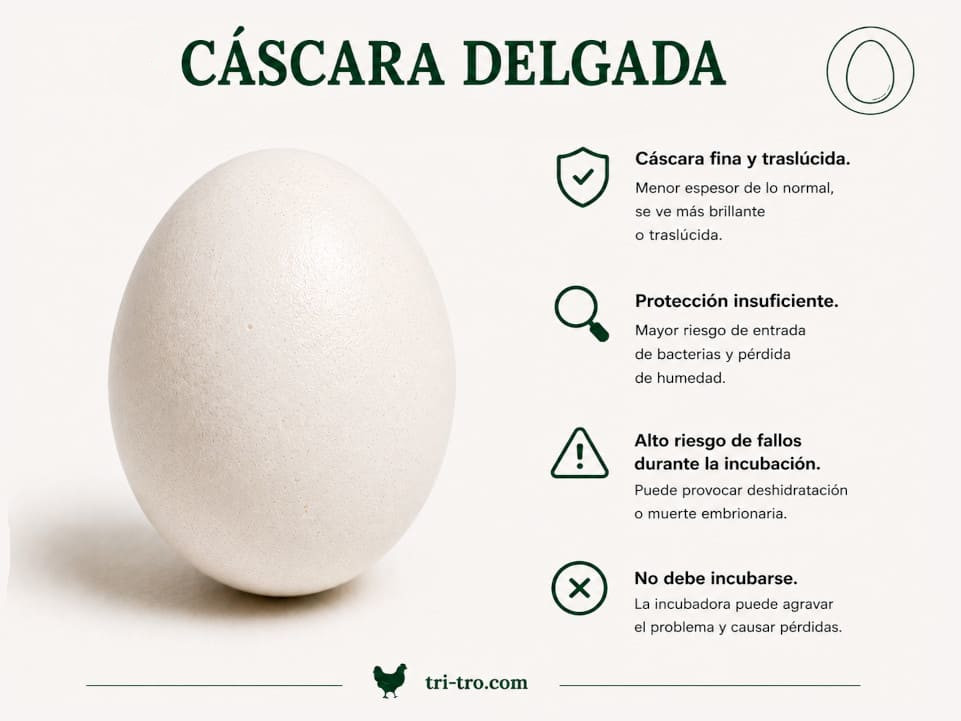
Discard the thin-shelled eggs, as the egg white—which contributes to the formation of the egg—can evaporate easily and quickly.

Some choose to eggs thin shellin the persuasion of, the chick breaks more easily than when it is hard; but this is a mistake.

It is known that between the shell of the egg and the chick mediates a membrane; when that is hard, this is thin; and on the contrary, when the skin is thin, the film is thick.

The chick pecks and easily bore a shell brittle and tough, and can not, however, pass through a skin laminated.

The eggs, which have a shell irregular, should be removed as well, because they produce chickens all insane.

To ensure that incubation takes place under optimal conditions, the eggshell must allow air to enter, as this is essential for the chick’s development; to facilitate this process, some people wash the eggs with a little warm water if they are not clean before placing them in the incubator.

Eggs from young hens and roosters produce chicks that are easy to fatten; this trait is passed on to older birds.

In summary, hatching eggs (stored at temperatures between 16°C and 17°C) must have high-quality shells. Storing eggs at higher temperatures stimulates embryonic development.

In many countries, it is difficult for rural poultry farmers or breeding centers to store eggs under ideal conditions. At high temperatures, eggs can sweatfacilitating the dissemination of bacteria through the shell.

Relative humidity should be maintained at around 75% in the room used for incubation, and a temperature of 25 °C yields optimal results. However, the tropical climate in many countries makes it difficult to keep the incubation room in good condition.

 Higher humidity levels promote fungal growth in eggs. 

Storage and position of the egg:

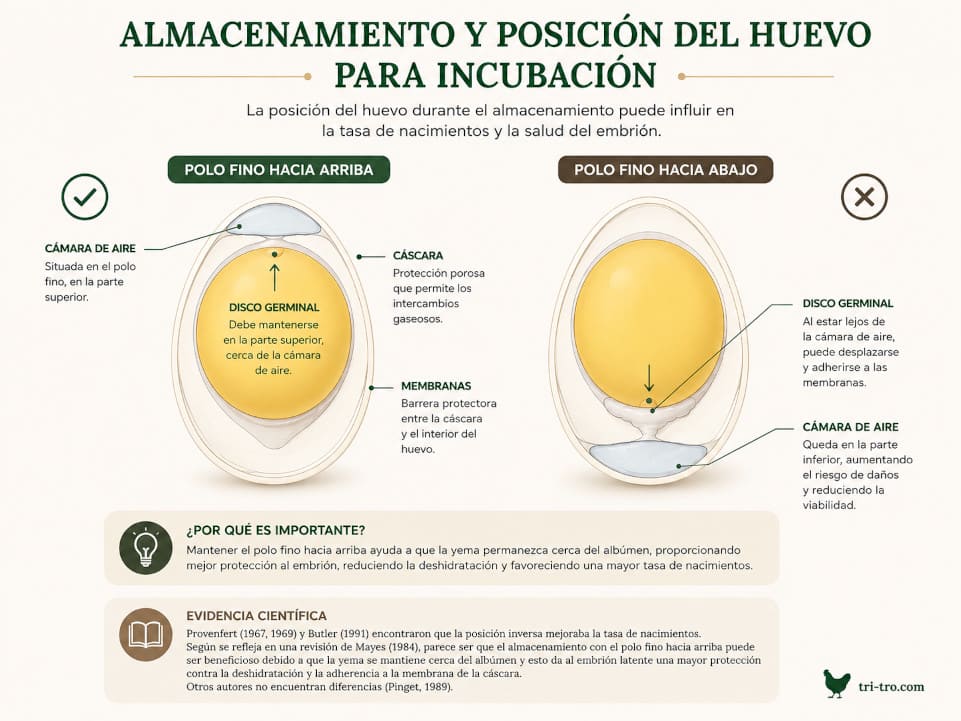
Storage and position of the egg for hatching

Against the traditional belief Although hatching eggs should normally be stored with the fine end down, Provelfert (1967, 1969) and Butler et al. (1991) found that storing them upside down improved the hatch rate, particularly during prolonged storage, making turning unnecessary.

This last operation is recommended when the eggs are stored with the polo slim down, and for more than two weeks, although other authors did not find differences (Pinget et al., 1989).

As reflected in a revision of Mayes (1984), seems to be that the storage with the pole fine upwards may be beneficial due to the fact that the egg yolk stays close to the albumen, and this gives the embryo latent greater protection against dehydration and adhesion to the membrane of the shell.

Now, it’s important to understand that this alternative method is for storing eggs before incubating them or letting the hen sit on them; they need to be kept in a cool, dark place, not placed in the incubator as described here.

There are only three ways to position eggs for storage: the one we know as the air chamber uplying just like the hen has them and tip. I I've tried them all, and even if they're defective, they've worked perfectly in the incubator.

See this section: Our Fertile Eggs: How to Ship Them; There you'll see how to arrange the eggs in the cardboard egg carton and how to store them until we have enough to place them under a brooding hen or put them in the incubator.

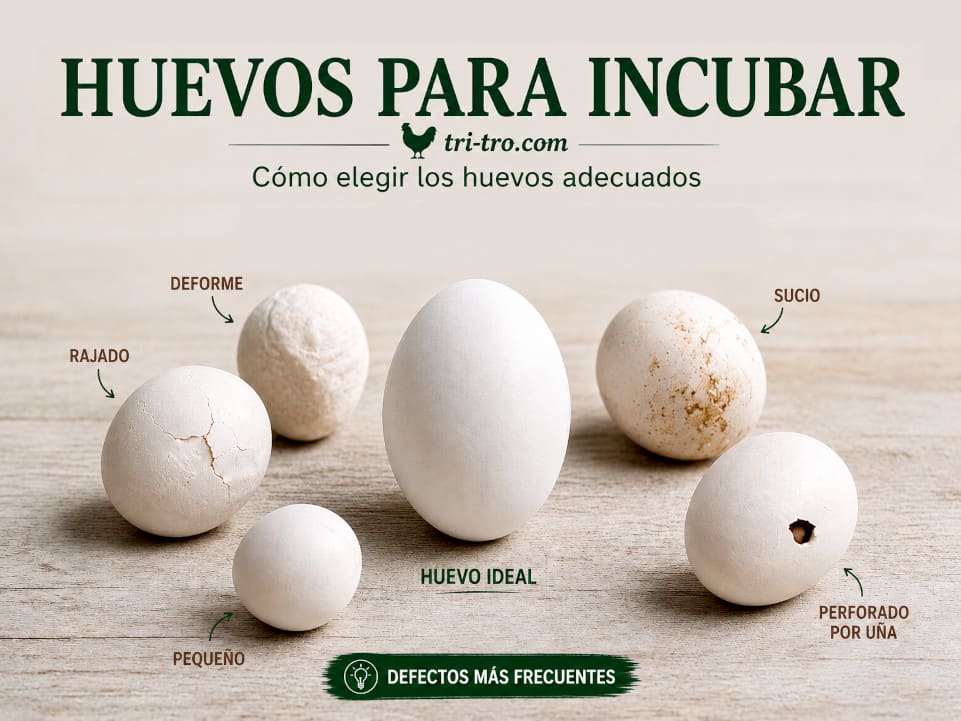
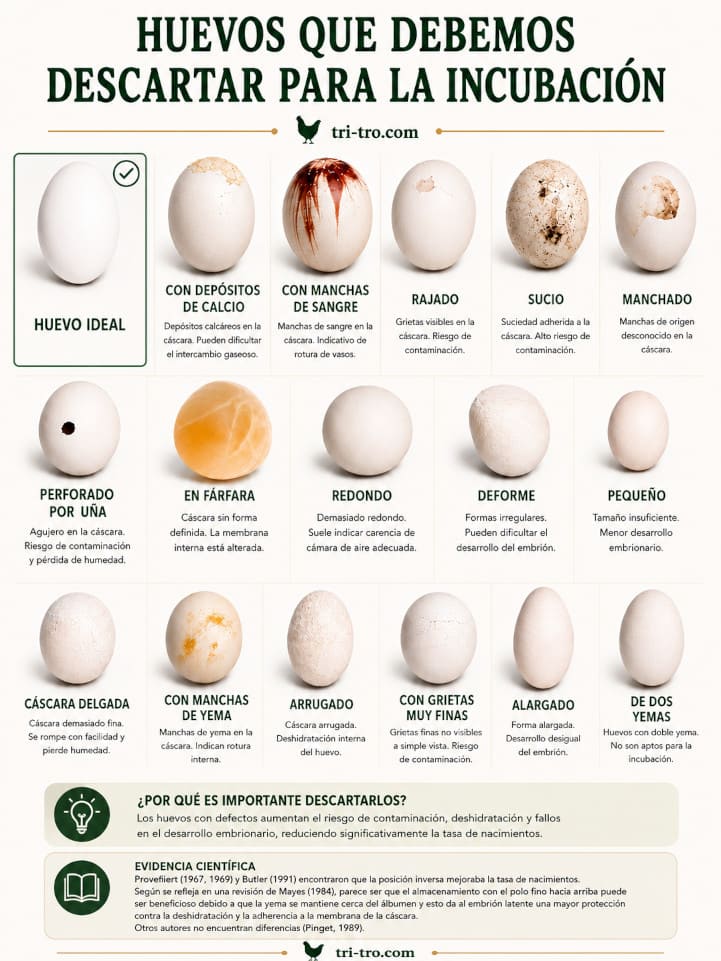
Now I’ll list the eggs we should discard for incubation; we should make this a rule, with the exception of the optimal egg.

Eggs that should be discarded for incubation.

An ideal egg for hatching, with a white shell, a well-balanced oval shape, and a clean surface.

Structural defects

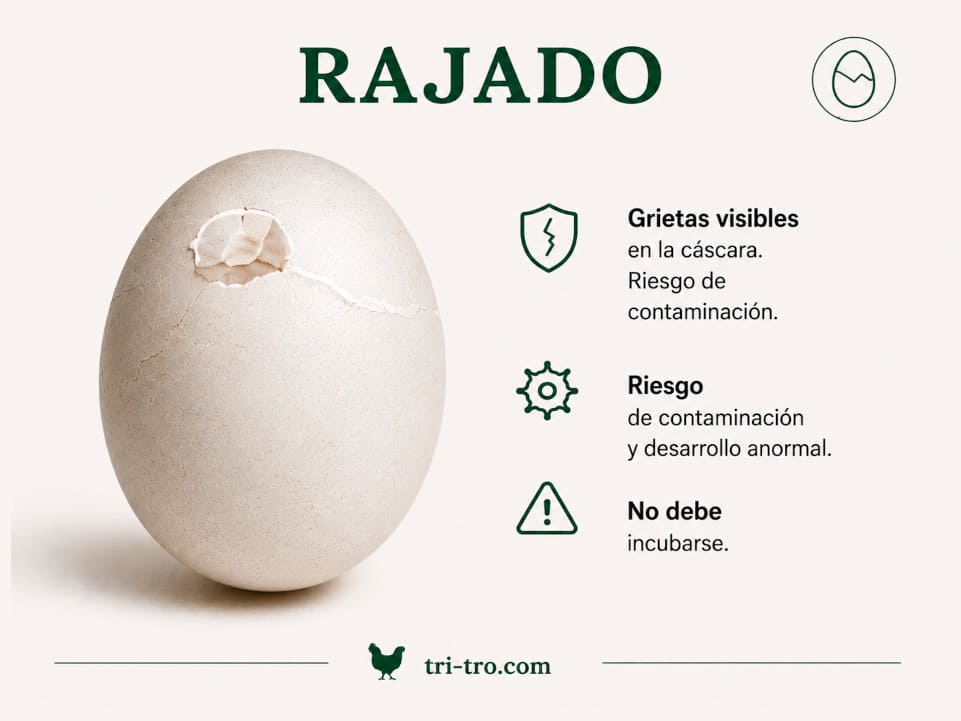
White egg with visible cracks and a cracked shell.

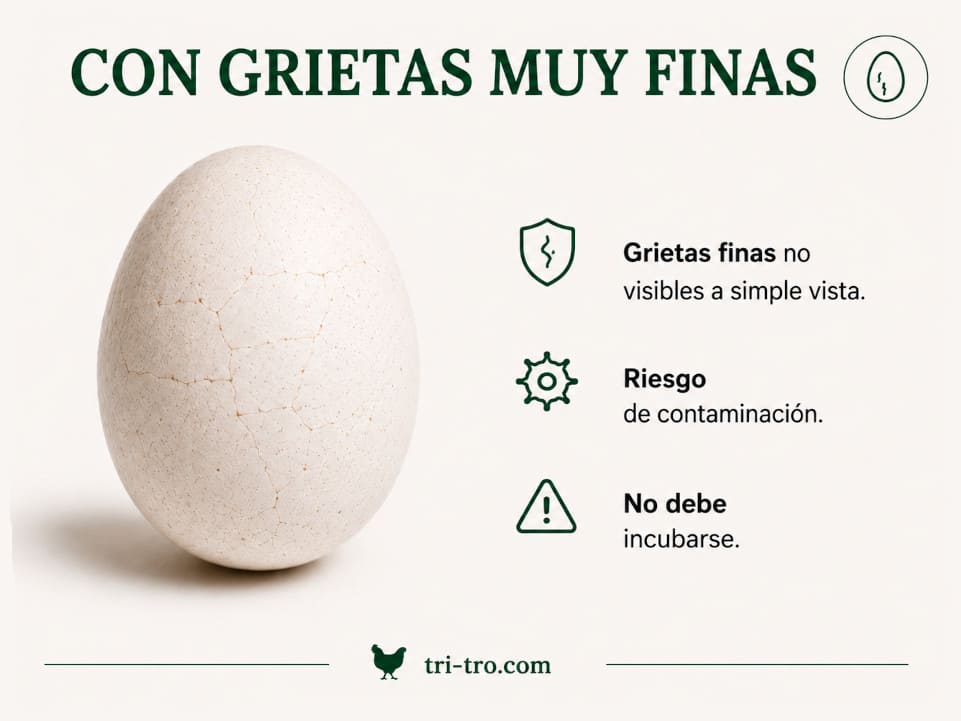
White egg with fine, almost invisible microcracks in the shell.

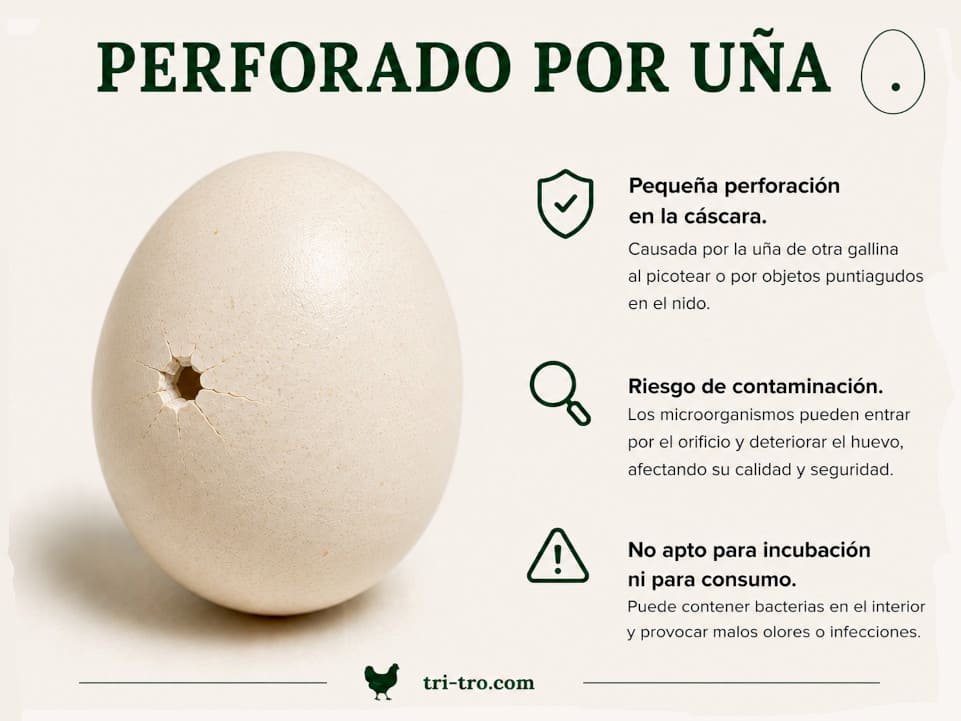
A white egg with a hole in the shell caused by a peck or a fingernail.

A white egg with a thin, fragile shell and superficial cracks.

Procedural defects

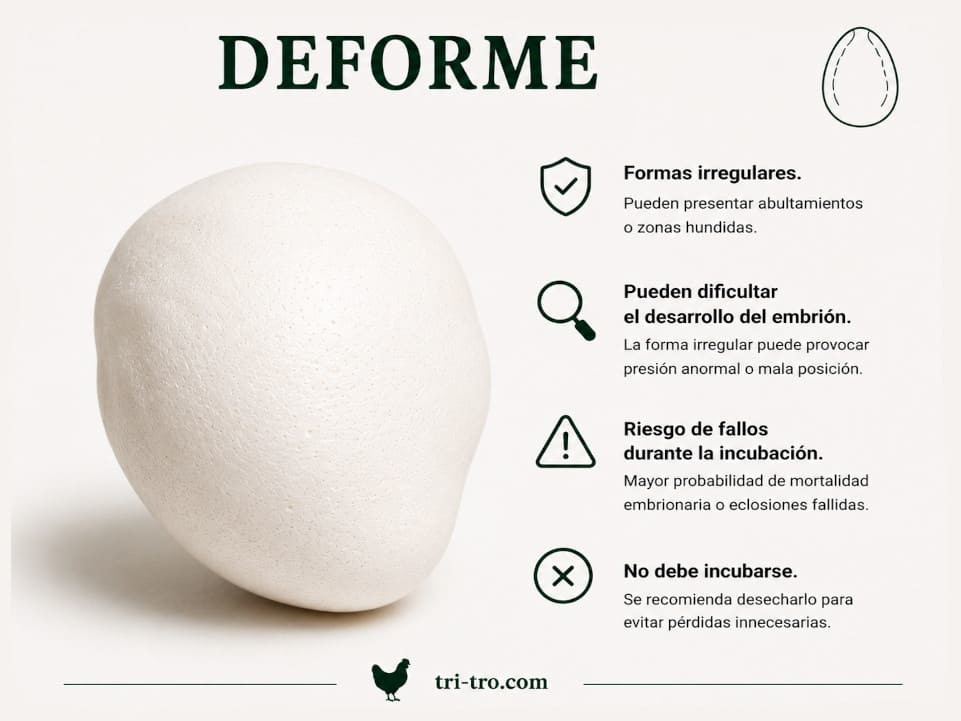
A misshapen white egg with an irregular shape and an uneven surface.

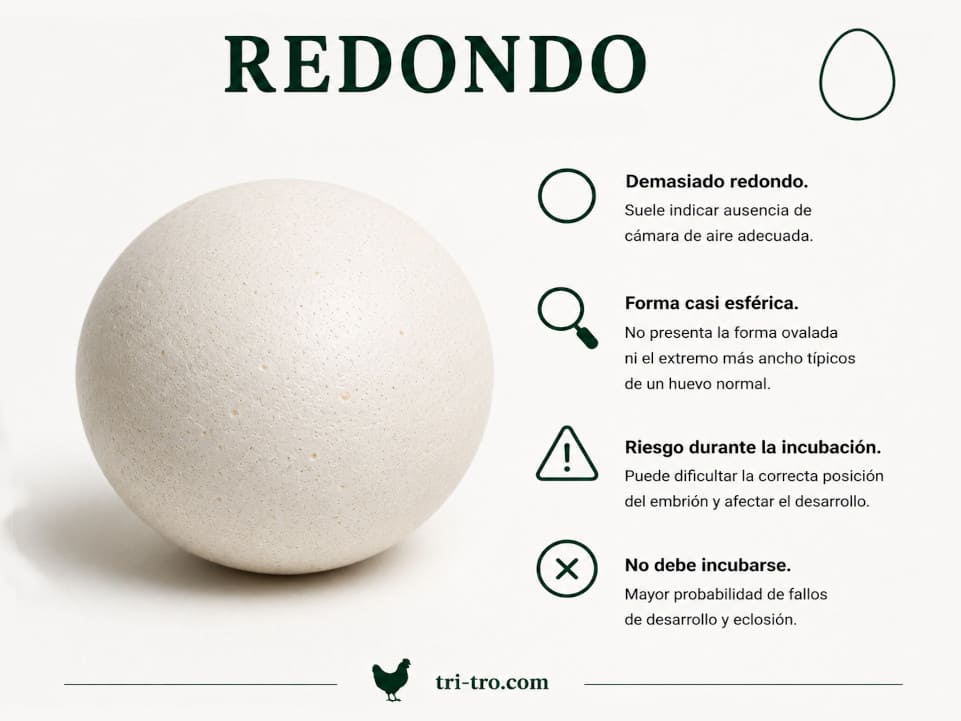
A white egg that is too round and unsuitable for incubation.

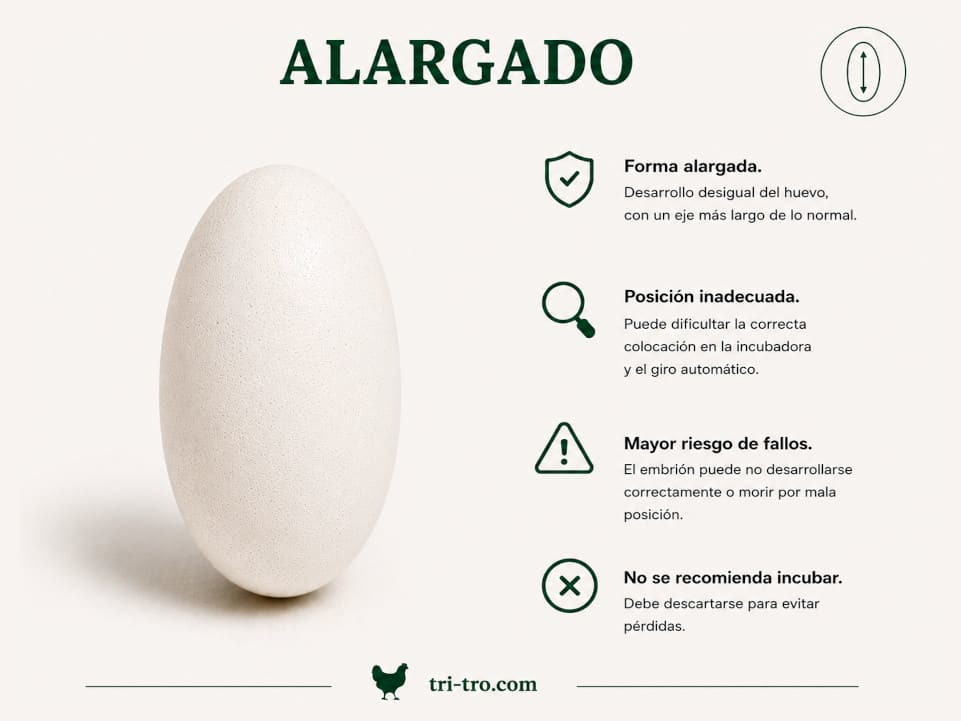
An elongated, narrow white egg with an irregular shape, intended for incubation.

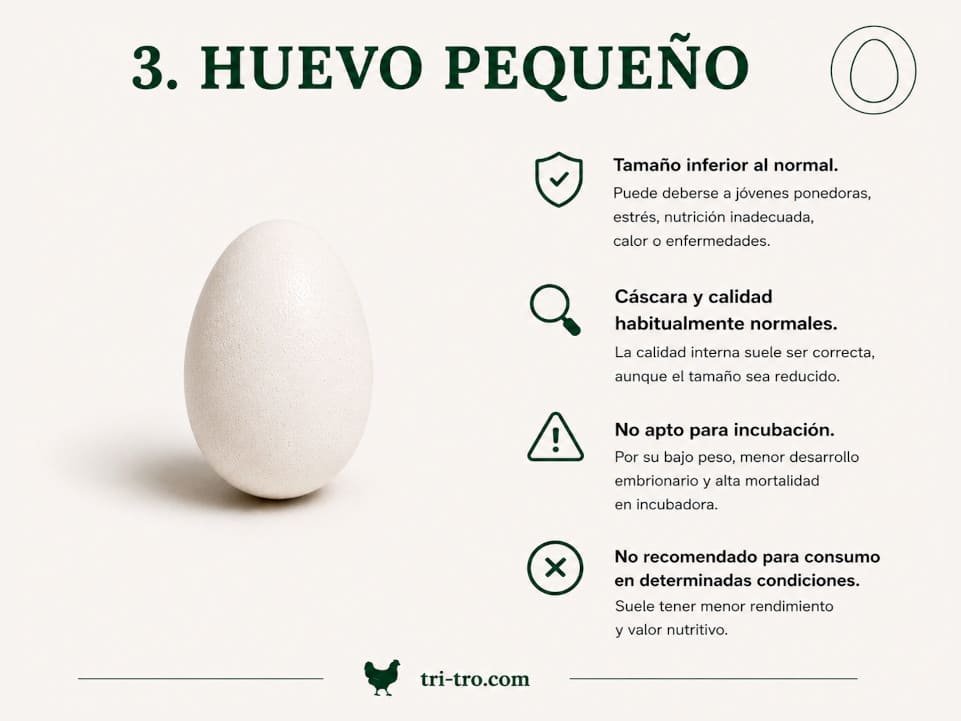
A small white egg that is too small to incubate.

Surface defects

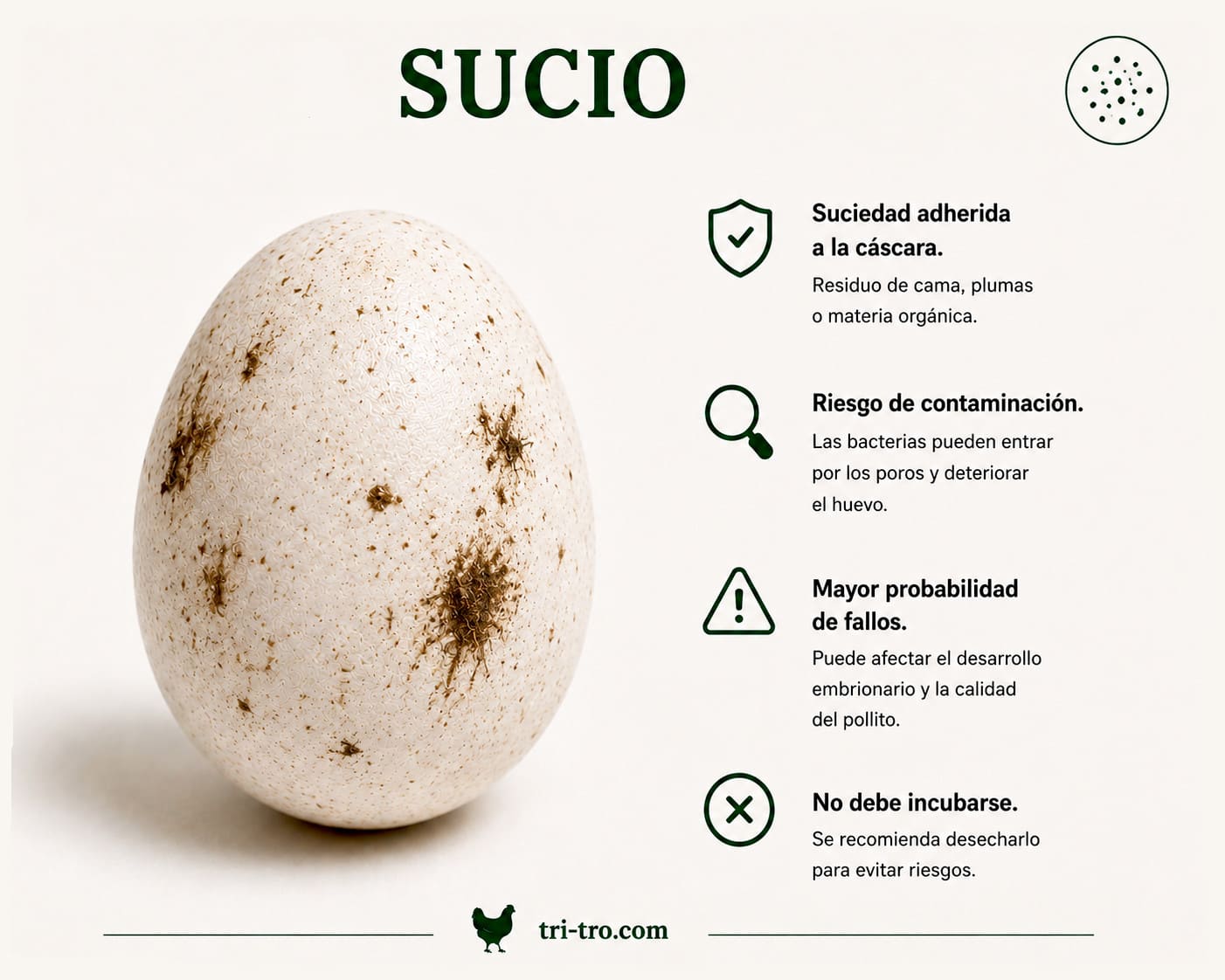
An off-white egg with bits stuck to it and dirt spots on the shell.

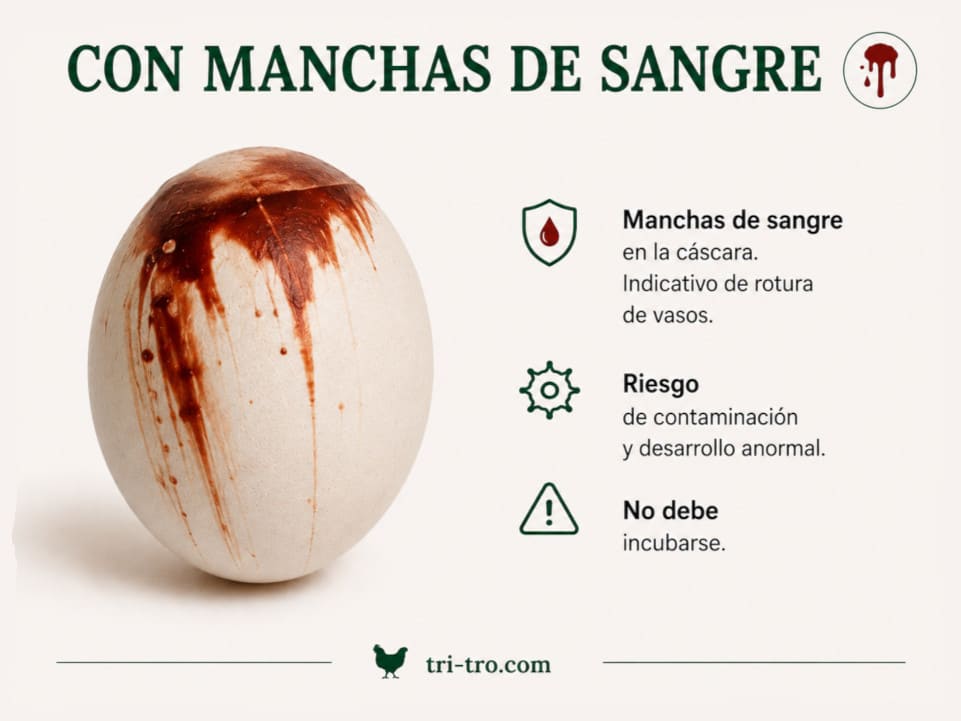
A white egg with dark bloodstains on the shell.

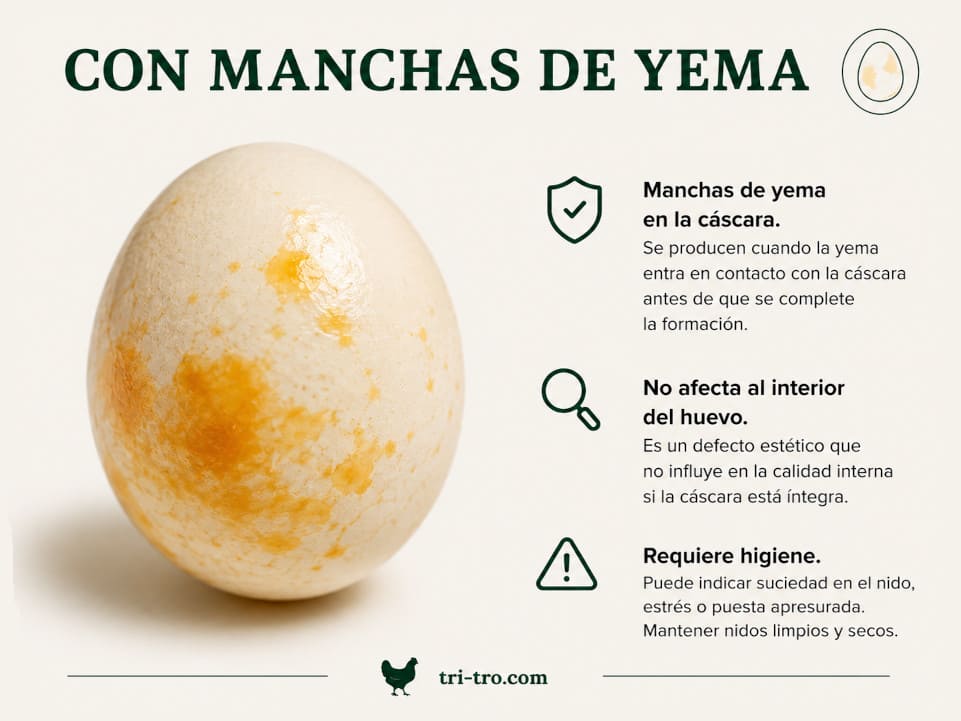
A white egg with yellow yolk stains stuck to the shell.

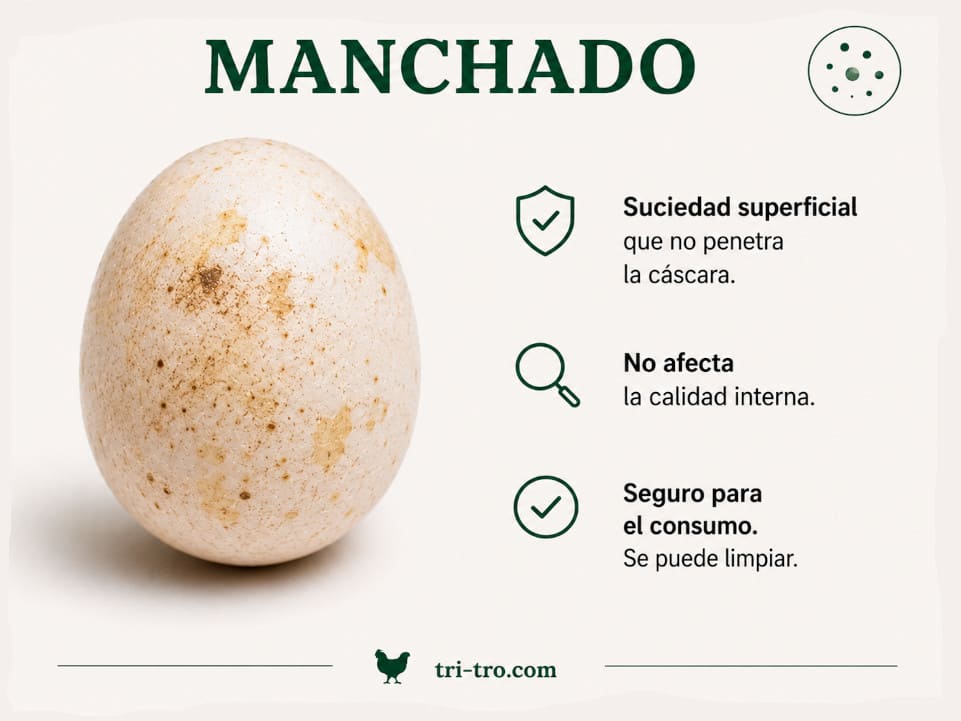
A white egg with irregular brown spots on the shell.

Serious/abnormal defects

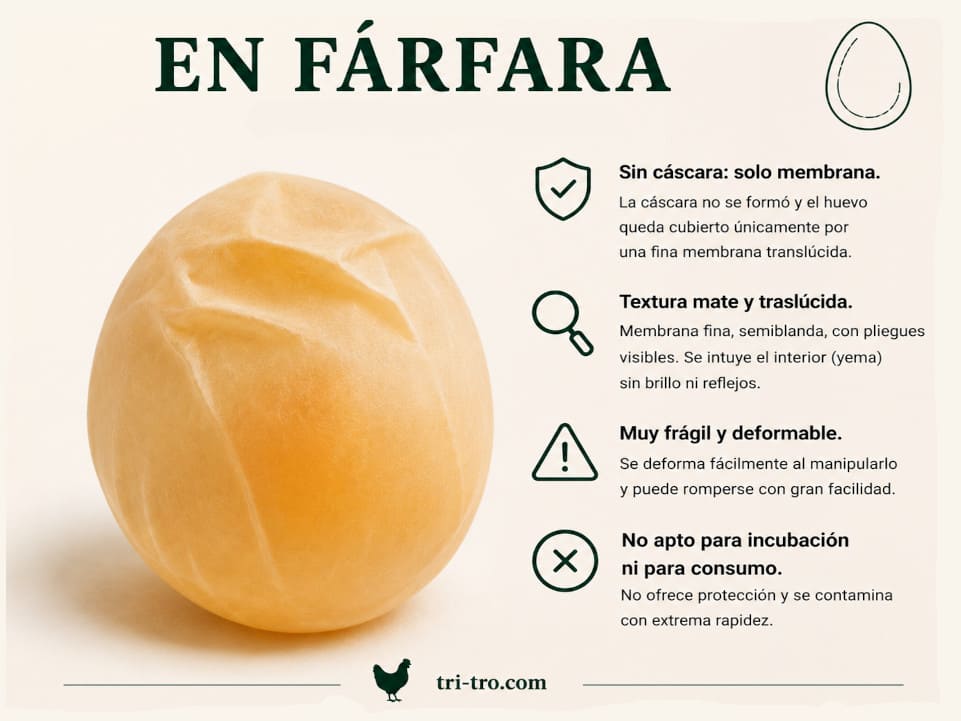
An egg in a shell-like membrane without a hard shell, covered only by a translucent yellowish membrane.

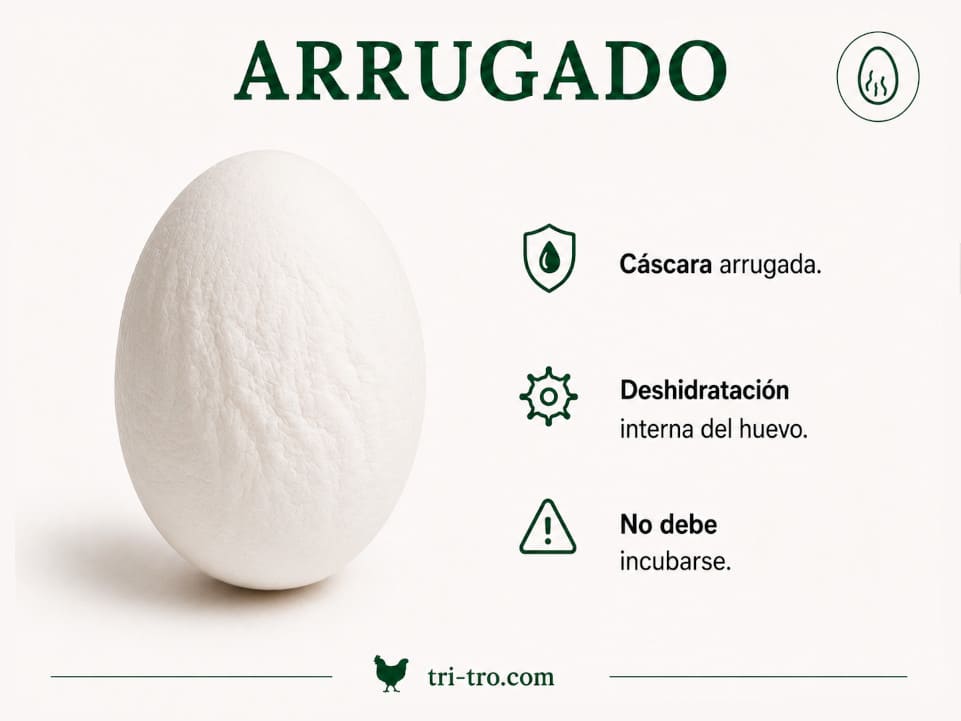
A wrinkled white egg with a rough shell and signs of dehydration.

White egg with two yolks, not suitable for hatching.

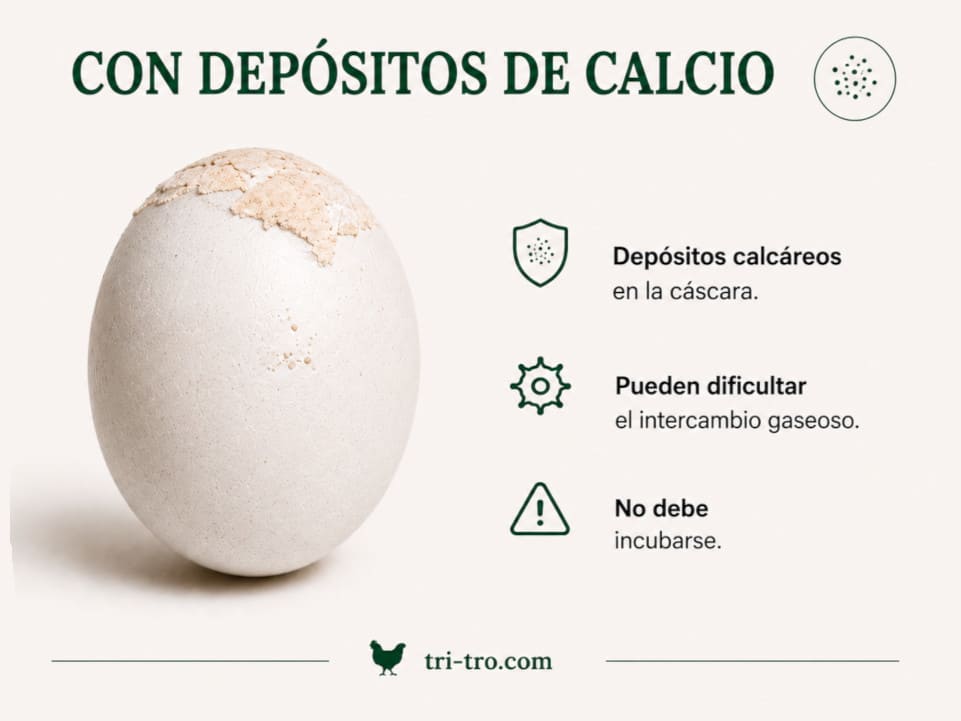
White egg with calcareous deposits and calcium buildup on the shell.

Six or seven days During the incubation period, an examination should be conducted to remove clear or infertile eggs; since these eggs do not contain a live embryo, the fermentation that occurs within them can lead to the loss of many embryos.

To perform the examination, simply place the egg between a bright light and a special device called an ovoscope.

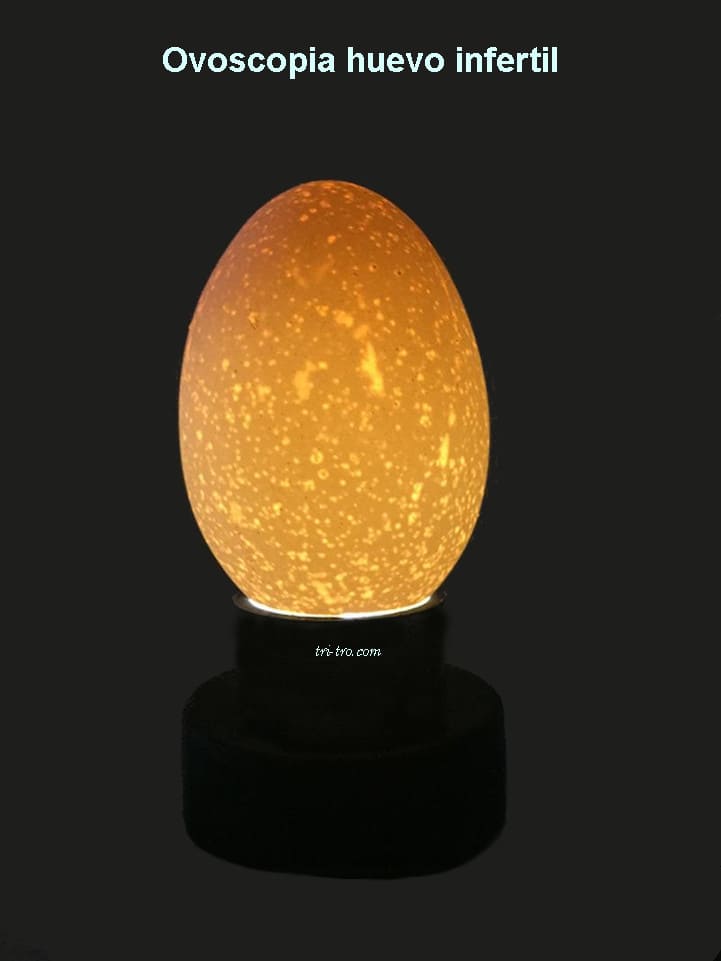
When the egg is clear—that is, unfertilized—only a small area in the center appears darker than the rest; when it is fertilized, a spider-like structure can be seen floating, surrounded by blood vessels.

In addition to preventing highly probable losses and significant damage, examining the eggs will be very useful to us, since sometimes eggs are placed under several brooding hens; once the examination is complete, the fertilized eggs can be redistributed so that one hen is left free, to which a new batch of eggs can then be given.

Infertile egg candling

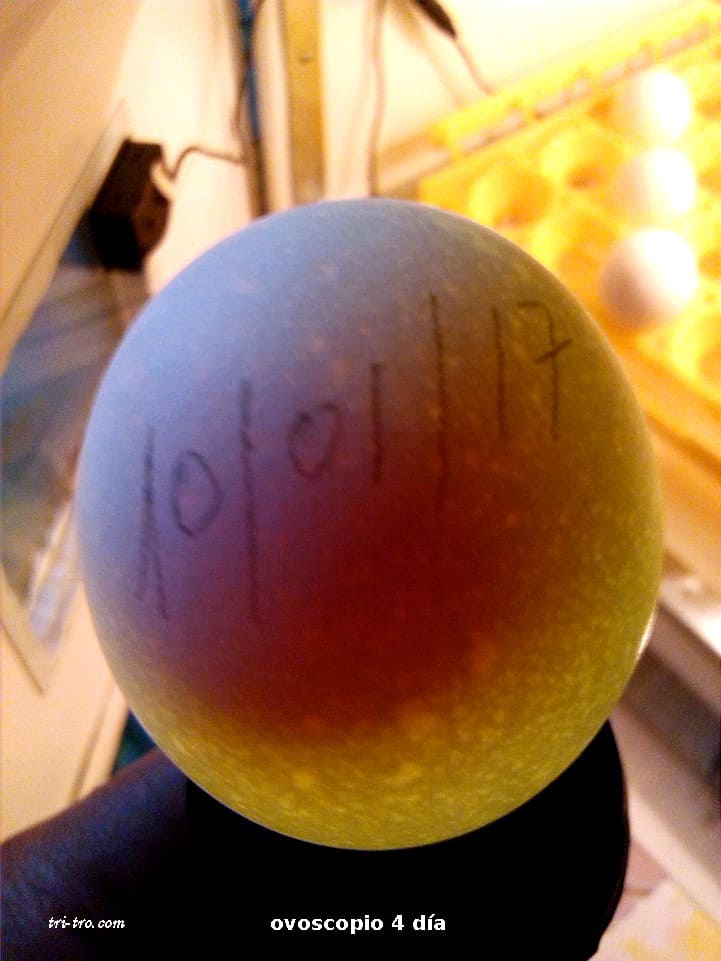
Egg candling 4 days fertile egg

Care that demand the Broody and eggs:

When the brooder deals the nest to incubate, you can cover it with a piece of wool fabric, leaving it in this state for two days. He pulls out once a day to eat, drink and do a little exercise.

If it is docile and remains calm in the nest, the lid of the basket should be lifted to set it free; food and water should be placed nearby, where it can easily reach them, so that it may rise whenever it wishes and satisfy life’s most basic need—that is, to eat; however, this method has serious drawbacks.

Some broody hens would rather starve to death than be separated from their eggs. When the henhouse has a special area designated for brooding hens, their food is placed in the surrounding pen; the henhouse door is opened once a day and left open for a while, ensuring that all the brooding hens get up to eat and drink; otherwise, those that have not done so spontaneously are removed and fed.

It shall be ensured that no broody is out of the nest more than half an hour, the time needed for that not to cool the eggs.

When the hens lack the instinct to stand up on their own, they must be taken out every morning and given food and water, especially during the last three or four days of incubation.

Just a single once-a-day; but if the llueca it was too ardent in the incubation and seems stuffy, which is very frequent, it will be removed twice a day and let it run.

Some hens are so preoccupied with incubation that when they are placed on the ground to feed, they refuse to eat, showing no desire to satisfy this basic need, and defecate with great difficulty; it is necessary to give them lettuce and sorrel, finely chopped and mixed with bran or moistened flour, making sure the mash is well blended. Spinach and other garden greens are also suitable for them.

You have these incubators more time out of the nest to cool off a bit, covering the eggs with the piece of fabric of coarse wool.

You should not enter the area where the hens are kept unless necessary, because they greatly value peace and quiet; you should also avoid at all costs allowing roosters and hens that are not brooding to enter, as they would cause disturbance and disorder.

When removing the broody nest, care should be taken to open the wings to avoid that surrounds the eggs and let them fall.

The number of eggs placed under each brooding hen varies depending on the size of the incubator, but it usually ranges from 13 to 18. For bantam or Kika breeds, such as the Flor D’Ametller, the number is 6 to 8 eggs, provided they are well covered.

There are those who believe that eggs should be turned during incubation, but this belief has no basis in fact, because the hen takes care to move them from the edge to the center to distribute the heat, which is greater at the center than at the edge. Once the eggs are laid under the hen, they should not be touched.

After the tenth day of incubation, you need to inspect the eggs—that is, check which ones are sound—so you can remove the bad ones. 

To this effect, it is checked with a egg candler

On the morning of the eleventh day, while the hens are out foraging, check the eggs from the first clutch; this should be done slowly. 

A family member or friend approaches the nest of the first brooding hen, carefully removes two eggs, and hands them to the person who is supposed to check them.

This gets one with the palm of the right hand or the left, to his choice, and with the tips of the fingers of the same hand take the other for the tip, as if it were placed in an egg basket.

He places his other hand along the lower edge over the top of the egg—or the thicker end—and holds it up to the light; a little experience quickly reveals whether the egg is fertilized or unfertilized, and whether the embryo is alive or dead.

When the egg is fertilized and the embryo is alive, the egg appears opaque, except for a small area that stands out due to its clarity and appears transparent. If the embryo dies in the early days, the egg appears more or less cloudy. All eggs that are in good condition will be returned to the family member or friend to be placed in their proper place, while the bad ones will be used for testing or discarded. 

Assuming we had six cluecas and that each clueca incubates 13 eggs, the result would be:

  • 3 misses on the first shot.
  • 2 in the second,
  • 1 in the third,
  • None in the fourth.
  • 4 in the fifth and
  • 3 in the sixth,

We have 13 bad eggs in total; the eggs from the sixth hen will be distributed among the first five, and the sixth hen will be given new eggs, after we have observed that she incubates the test or fake eggs placed on her previously without hesitation. 

Of course, this is just a rule, and we might have two or three broods at a time, so we’ll do the same thing.

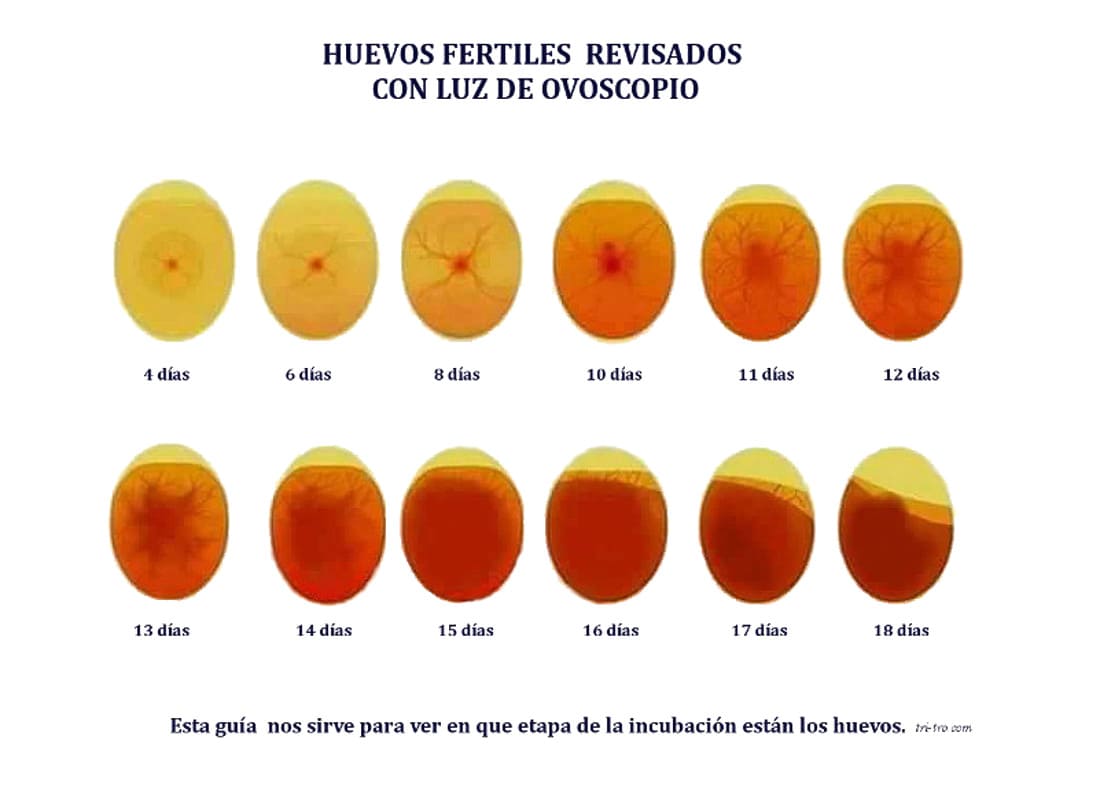
I put this guide ovoscopio that will serve you to control whether the embryo is forming or not, to remove it and replace with another egg.


Ovoscopia. Display internal egg:

This guide ovoscopio, helps us to see in which stage of the incubation are the eggs.

The ovoscopia is a method which is based on the translucency of the shell and the differences in the internal structures of the egg due to light transmission, all depending on the number of days the embryo has been incubated, or if it is not fertilized.

Place the egg upright, either directly in the beam of light or in the egg holder of the ovoscope. The interior of the egg will be fully illuminated, and the shell will reveal its porous structure; depending on the shell’s color, different shades will be visible. A fresh egg appears light pinkish-yellow when viewed through the ovoscope.

In the shell with the ovoscopio, we can see the cracks, stains, and defects of calcification, lime deposits and calcifications defective. The blood stains internal appear as shadows or dark reddish. 

The egg is enclosed in a calcareous shell; in chicken eggs, the most common colors are white and yellow or brown; there are also eggs from other breeds that are blue, green, and pink. The shell is lined on the inside by two membranes, an inner one (which protects the white and the yolk) and an outer one (which covers the inside of the shell), forming a lining that separates at the broad (obtuse) end of the egg to form the air cell.

This camera, equipped with an ovoscope, will allow us to observe the egg as the incubation period progresses; it will grow larger and larger, filling with oxygen through its pores, so that when the chick needs to in the final days, it can break through the inner membrane and begin to breathe.

Well, if we look more closely, we can see a pink shadow in the center of the yolk that does not move; in a fertilized egg between the 1st and 4th day of incubation, we can observe the formation of small blood vessels around the germinal disc.

Starting on the 5th day of incubation, the embryo begins to become visible; this guide will help you track the embryo's development day by day.

Eggs with the yolk attached to the shell will appear stationary under an ovoscope, casting a darker shadow.

In the following photos, you'll see some very inexpensive egg candlers with LED lights (cold light), which you can easily find at big-box stores or retail shops.

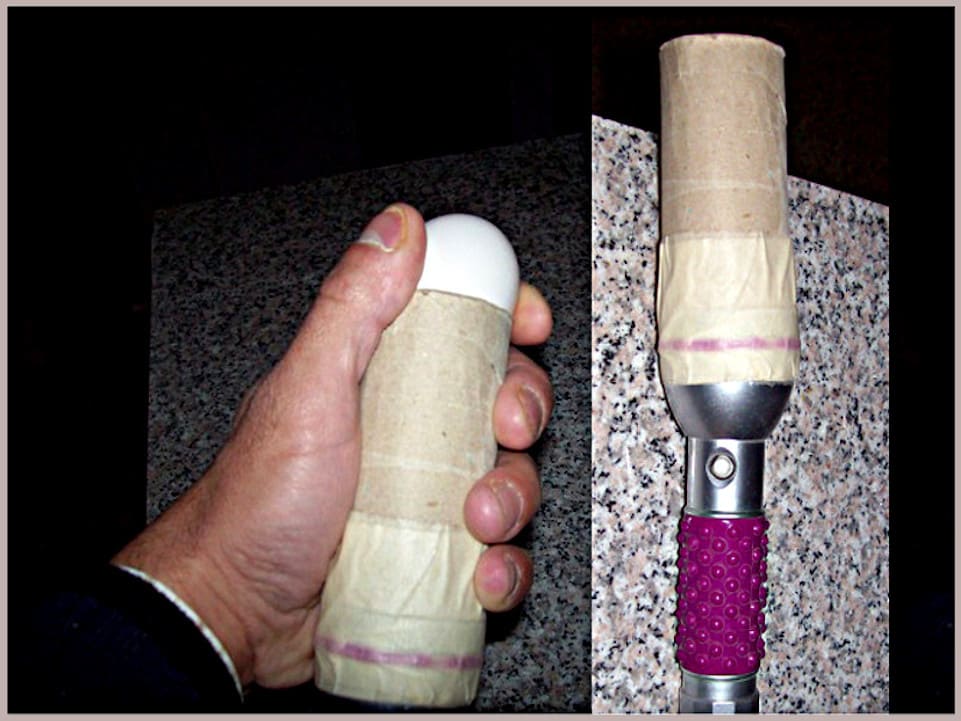
Or you can make your own using a toilet paper roll, some duct tape, and an LED flashlight; now you have no excuse not to keep one next to the incubator.

Ovoscopio home with flashlight

Ovoscopio led flashlight, rechargeable

Ovoscopio led flashlight


You may be interested in these other sections


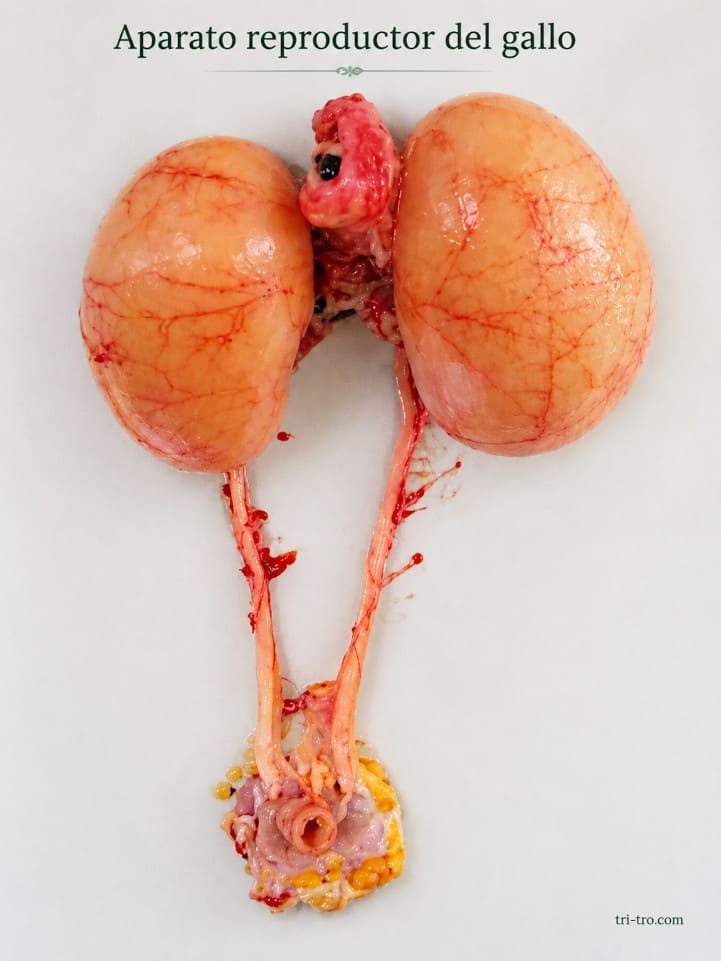
The Rooster's Reproductive System: Parts and Function

Gallus lafayettii: Origin and Characteristics of the Ceylon Fowl

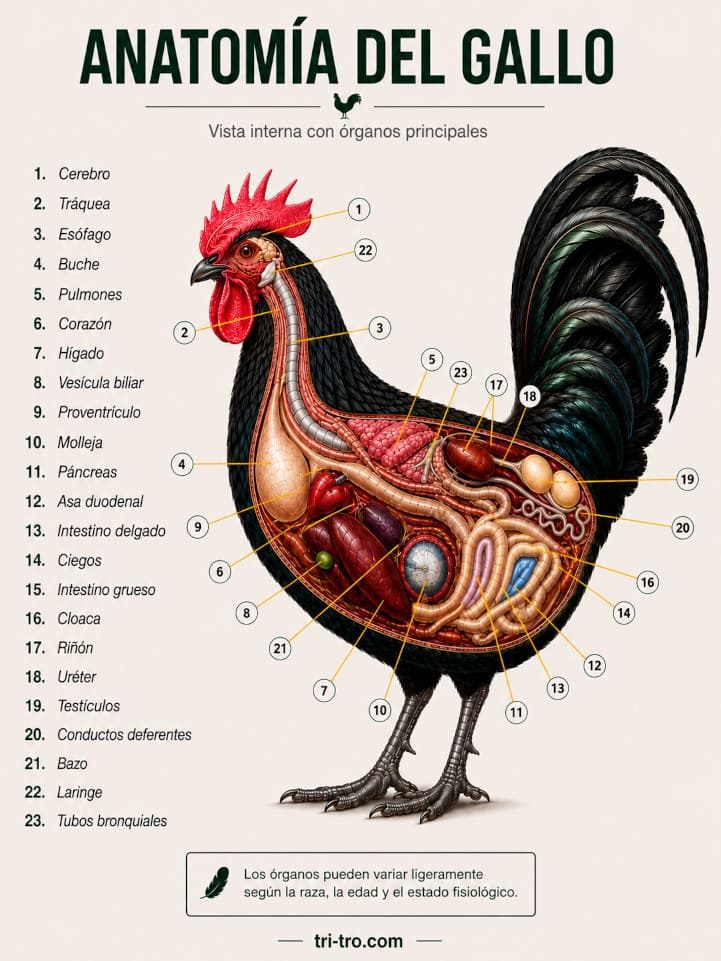
Exploring the Anatomy of the Domestic Rooster


Do you want to share or comment on your social networks

Scan to visit TRI-TRO
Escanea para visitar. TRI-TRO