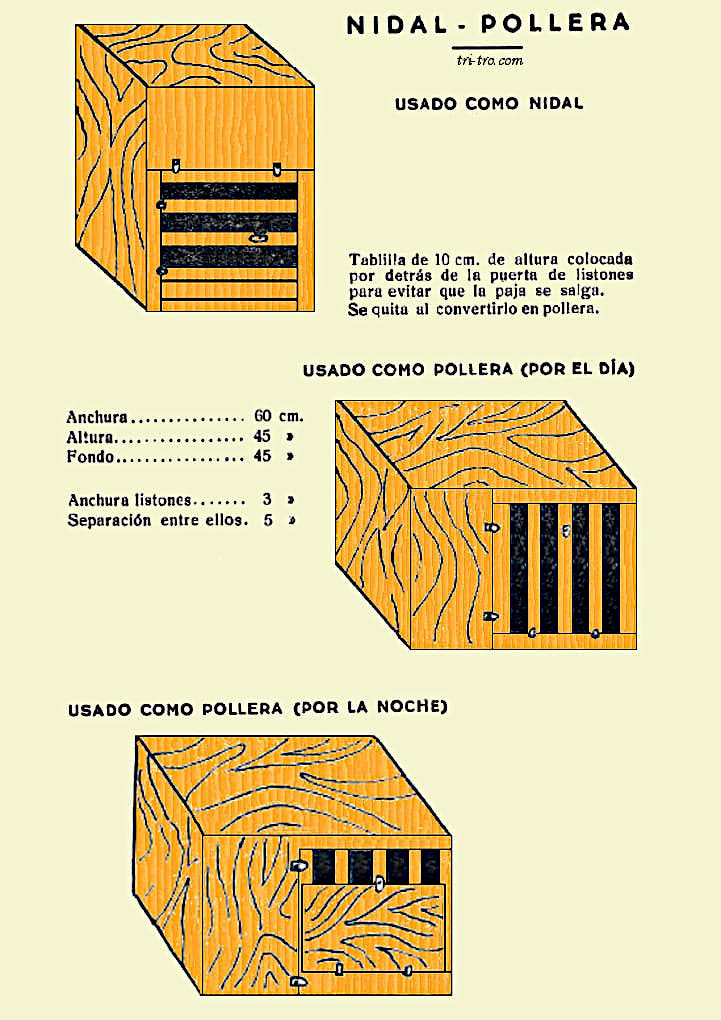
Is the skirt in a rectangular or square box, with a partition in the center. One side is closed at the front with slats, allowing the chicks to easily enter and exit, as well as allowing the mother to watch over them while remaining enclosed, and the other side is completely open.
The feeders and waterers for the chickens, which they can freely access from outside or from the partition where they eat, are connected to the first room through small openings in the partition.
Here are some different plans so you can build them; if you're handy, it's pretty easy.
In the evening, once collected the chickens with the mother, closes the skirt up the next day, which gives them freedom at different times of day, depending on the temperature and the state of the atmosphere.
The chickens must remain in these conditions until the age of one month or five weeks, especially in the rainy seasons, every time you pass the first crisis.
Motivated by the output of the feathers of the wings and of the tail, they would all die many, and, on the contrary, observing well, we will have the assurance that it will develop more rustic.
The staff is very rigorous to be observed constantly, because otherwise they would soon be felt, very soon, the effects of such abandonment.
Chicks reared in nearly this relative freedom is used to the captivity, that then has to be your life, and do not suffer from the abrupt change from one condition to the other to be locked up in the cages.
After five or six weeks at most, the broody hen will be removed and moved to the henhouse, where she will resume laying eggs. The chicks can continue to live in the same pen until they are three months old, at which point they will be moved to the henhouse designated for them along with others of their age group.
M. Jaeque, in his interesting work We Poulaillier, illustrated with engravings that aid in the descriptions, we will present here whatever best suits the plan we have in mind.
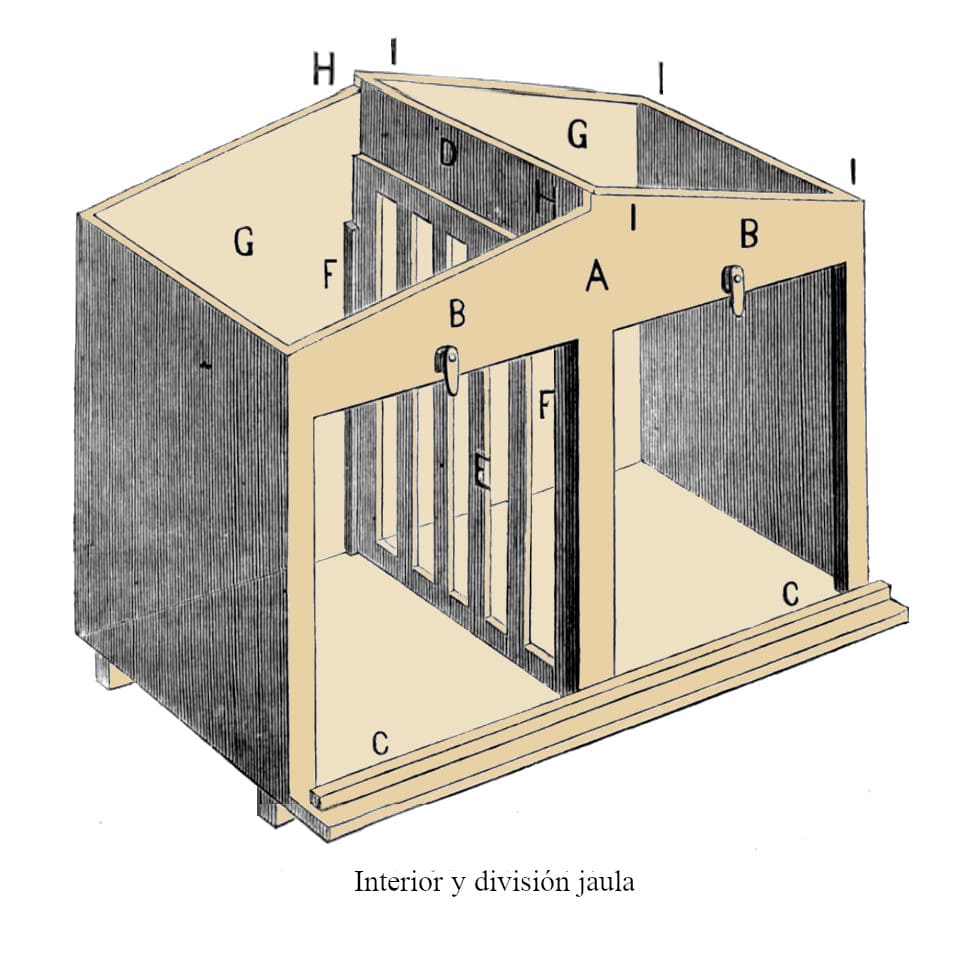
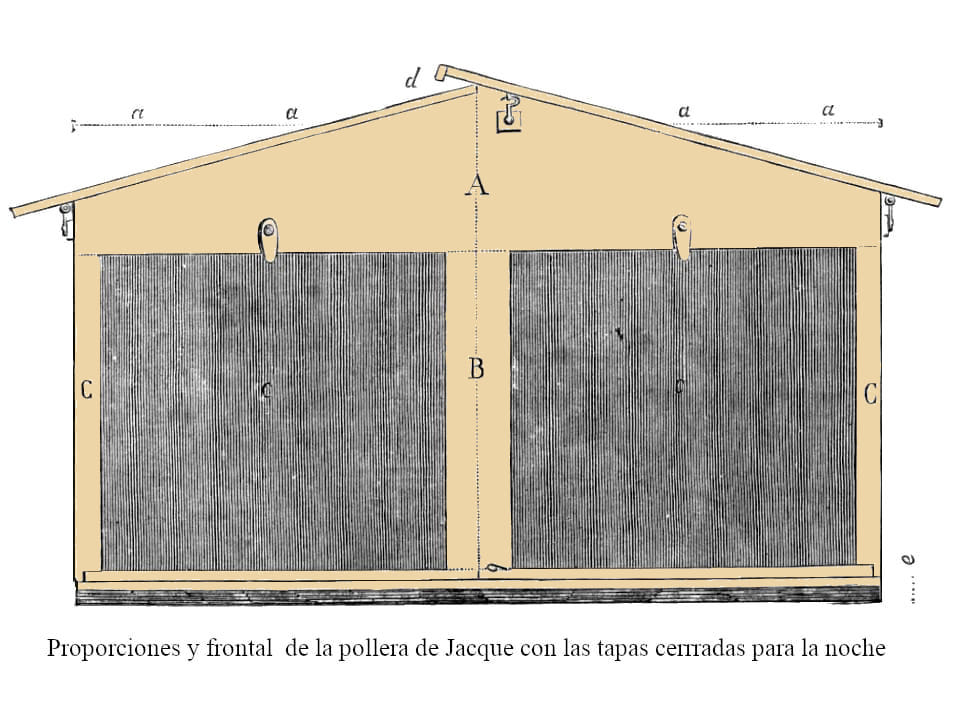
The Jaeque cage, shown in the illustration above—although many different systems have been used to house chickens during rearing—he naturally opts for the cage, as it has yielded the best results for him.
It consists of two divisions equal and nearly square, which separates a fence interior, with each department to a mother hen and her chicks.
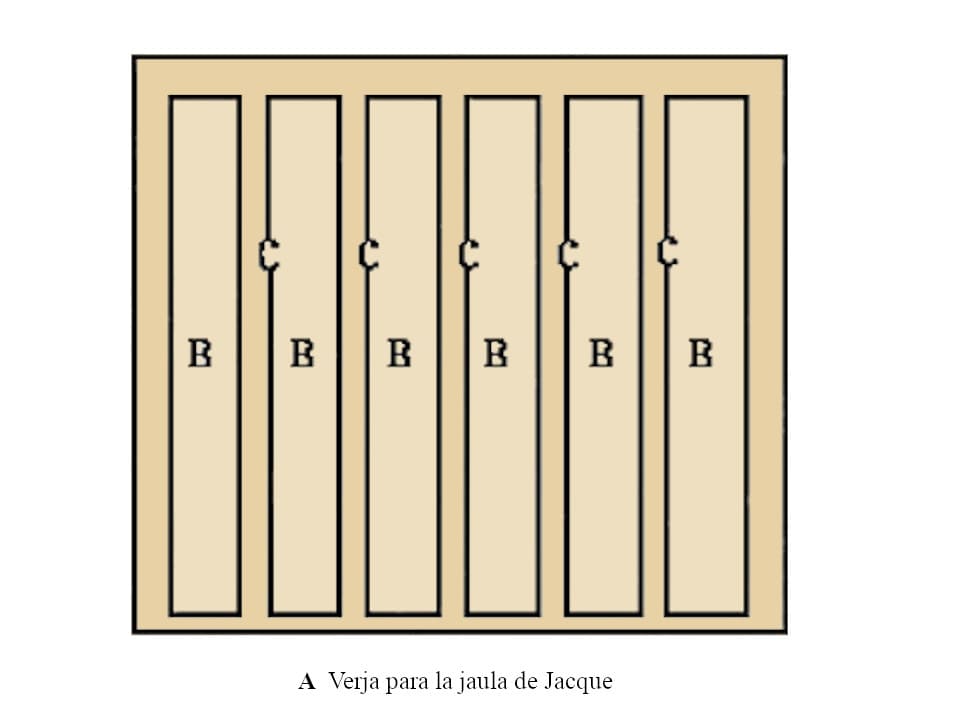
At the front, this cage is closed during the day with a wooden bar fence, the details of which can be seen, with sufficient separation between the bars of the fence so that the chicks can enter and exit without difficulty.
The separation B between bars C is 6 cm, and the width of the bars is 3 cm. The trellis must be proportional to the space it is to fill.
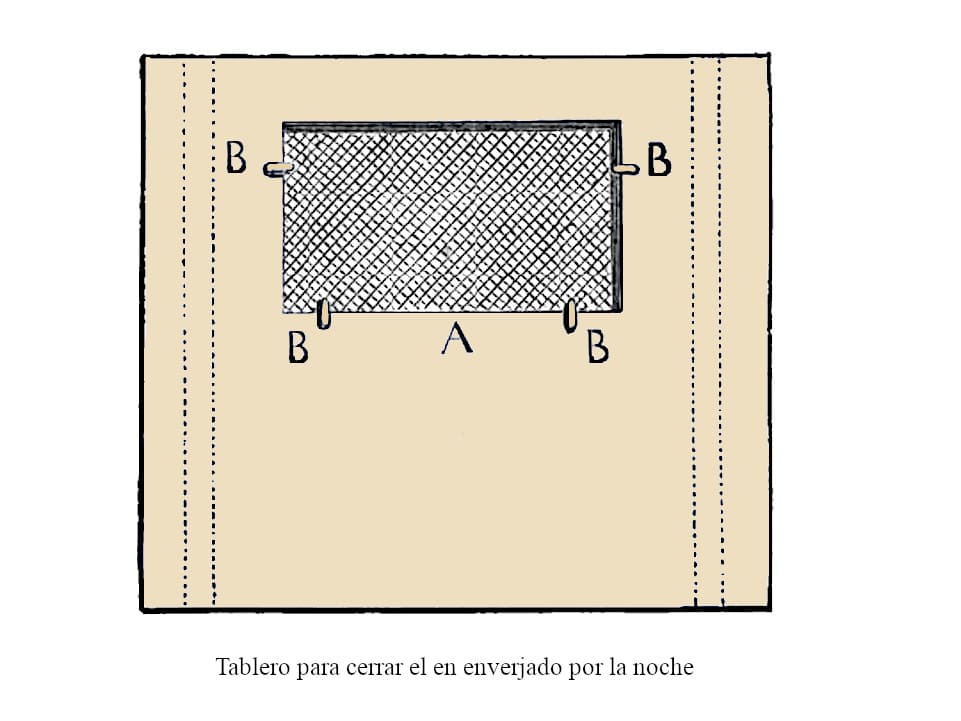
At night, this trellis is replaced with a board similar to the one in the illustration, to protect the chicks from the cold and any adverse accidents.
Light enters these cages through skylights in the roof and through louvers in both compartments, which help create air currents. To fully understand the role these cages or huts play, I will provide some details to help clarify the illustrations.
The entire cage is made of wooden planks or wicker, with the planks being 16 millimeters thick, secured, tied, or nailed to oak or similar bars for added strength.
The cage measures 1,28 m wide, including the thickness of the boards of coastal, but not counting what stands out the armor of the roof or deck; from the highest part of the easel to the fund B earns 78 cm, not passing from the angles superior to those of the fund, 63 cm in height.
The top that form the front and studs, meant to give consistency to the cage, are of oak or similar and 3 cm thick.
If it is added to the interior height, from the top of the easel to the floor, the 3 cm that juts out of the ceiling and the 8-cm thickness of the fund and of the two bars on this, you will have a total height abroad, from the ridge of the easel to the floor, 89 cm front to back.
The front, the back, and the sides do not have any hole, or bars or rails.
The roof consists of two movable sections of different sizes, which rest one on top of the other and extend 3 cm beyond the cage at the front and back, and 10 cm on the sides. At the front, two latches secure the panels, which rest on an oak beam at the bottom.
At the top and on the inside, the crossbar supports the partition and fills the space between the ceiling and the middle lattice, which can be removed and replaced as desired by sliding it between two boards—one mounted on the front jamb and the other on the inside of the back wall.
Double-glazed windows measuring 50 centimeters long by 25 centimeters wide are installed in the ceiling.
It is of the utmost importance that the wood used be completely dry and that the cages not be left in the sun for long periods of time, to prevent cracking; for this reason, it is advisable to treat them with linseed oil mixed with a drying agent or an exterior varnish.
Ideally, place them among small groves of plants or trees; this will help ensure that these coops last a long time. If you plant vegetation specifically for the coops, all the better.
Care will also be taken to ensure that they are bathed in sunlight only for a few hours in the morning.