It can be defined as an inflammation of the navel accompanied by abnormal persistence of the yolk sac; it is infectious but not contagious, and it has a high incidence and mortality rate in the hours following birth.
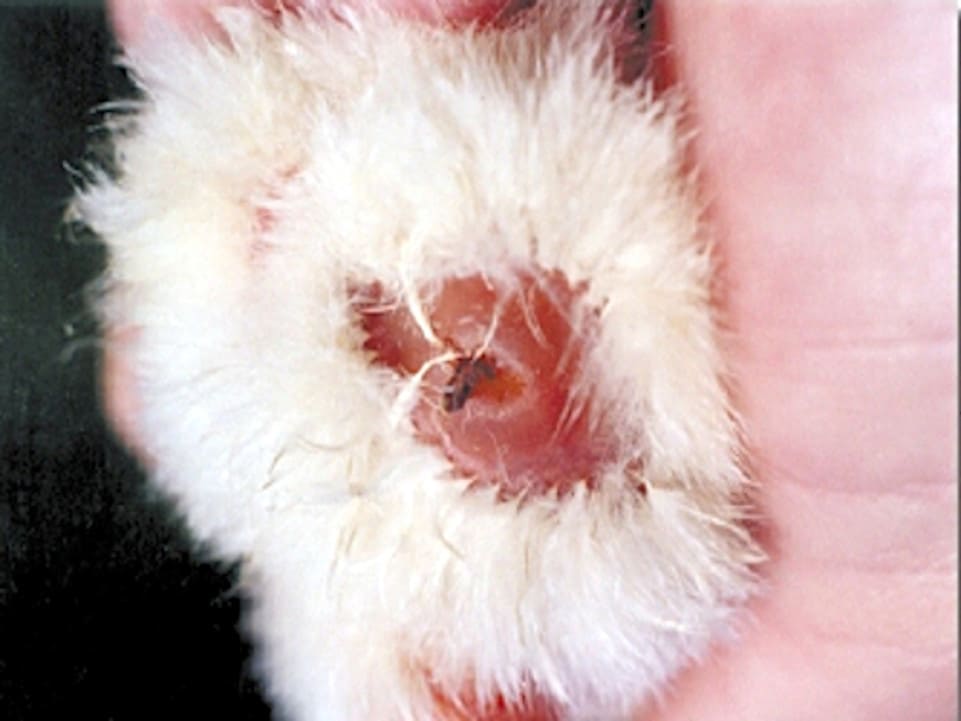
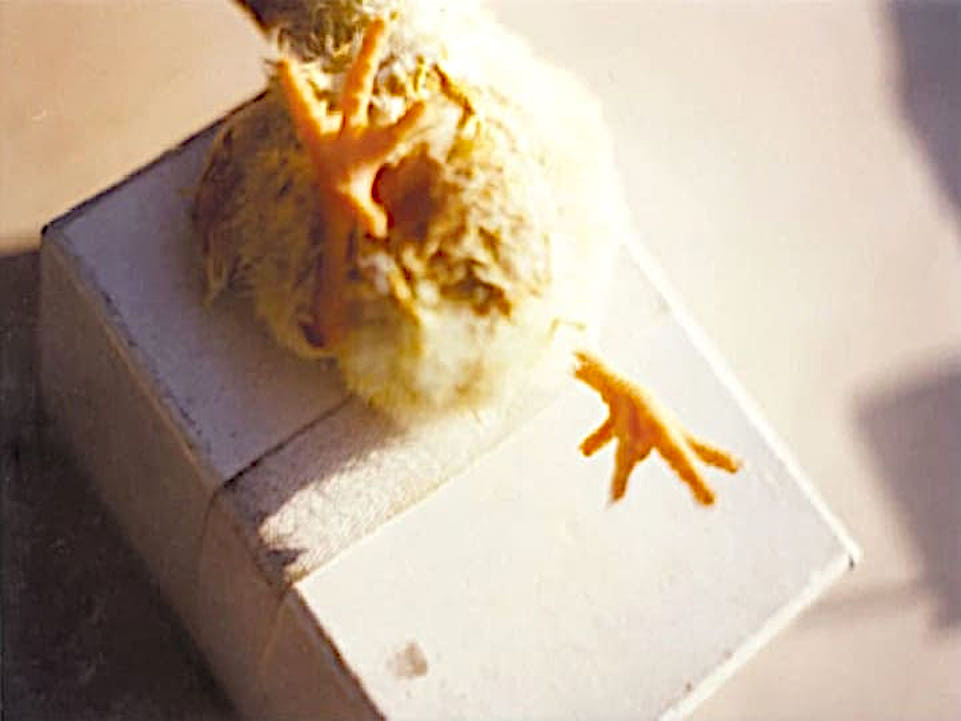
Volkmar (1929) and Brandly (1932) have described inflammation of the navel in young chicks. Volkmar concluded that, after hatching, the navel had not closed properly after the yolk sac had penetrated the abdominal cavity, allowing infection to enter through it. The birds he observed looked like swollen balls; they were lethargic and dazed.
A small scab formed over the navel, and when it was lifted, it revealed an ulcerated area. The yolk sac had never been fully absorbed, and some dried out on the outside. Volkmar notes that the increasing bacterial content in the incubator atmosphere during incubation may influence the development of the disease. For this reason, it is always emphasized that the incubator must be thoroughly disinfected each time it is reused.
Brandly noted that the bulk of the losses due to the omphalitis occur within seventy-two hours following the incubation. The course of the disease was always fast, with the death of the chicks in a period of two to eight hours.
Economic importance:
Constitutes, along with the salmonellosis and colibacillosis, the most important diseases in the baby. There are statistics that tell us that this disease causes two-thirds of the deaths recorded during the first week of age and between 50 % and 60 % in the second week.
Others estimate economic losses at 16%. In reality, it is a disease found in countries with developed poultry industries, since its primary cause is artificial incubation.
In addition, when considering the mortality rate, it is important to take into account the higher proportion of second-generation chicks, as well as growth retardation, which significantly increases mortality.
The yolk sac is one of the membranes that develop in extraembryonic birds; the other two are the amnion and the allantois.
The amnion is a thin, transparent sac filled with fluid in which the embryo develops; it is avascular.
The allantois appears on the third day of incubation; its function is to supply oxygen to the embryo until day 19, when the embryo pierces the air sac and begins pulmonary respiration; it also serves as a waste disposal system.
The yolk sac is a membrane that develops over the embryo; its function is to nourish the embryo along with the egg white. It is attached to the embryo's body by the yolk stalk, which connects to the middle section of the intestine.
Through this pedicle spend the veins and arteries of yolk.
Until the sixth day, it is also an organ of respiration.
The yolk sac reaches its maximum weight at 17 days; by the end of incubation (20 days), this sac, along with the remnants of the yolk, enters the abdominal cavity, where it is subsequently completely reabsorbed. Remnants of the yolk sac have been observed up to 10 days after the chick is born.
Etiology:
Omphalitis results from an infection of the yolk sac or an unhealed navel. At hatching, the navel is still moist and can become infected either in the incubator trays or later, upon contact with the floor.
The yolk sac provides an excellent culture medium for pathogens; from there, they travel to the liver via the yolk veins; death results from toxin-induced infection.
It is not a matter of specific pathogens; any minor infection that causes the abnormal persistence of the yolk sac has the same effect.
Pueden existir Clostridium; en estos casos son infecciones más agudas. En otros casos pueden aislarse colibacilos, estafilococos, estreptococos; la evolución entonces es más lenta.
The infection appears to be the cause of the omphalitis.
Although in some cases it checks for the presence of microbial agents in other crops show no seed, so that it would be necessary to raise the matter in other terms, even in cases where there was microbial infection.
If your navel is infected, it is possible that this is merely the result of the scarring late and that the yolk sac yet have a volume which is quite considerable at the time of hatching. Whether or not infection, the anomaly can be more of a symptom and proceed from various causes.
In some cases, this may be due to improper incubation (temperature, ventilation, humidity). In others, it may be caused by a diet lacking in vitamins. It may also be due to the failure of diastases to properly break down the yolk sac.
It can be concluded that omphalitis requires two main factors for its development: first, a defect in embryonic development that disrupts normal embryonic growth and, consequently, delays the healing of the navel; second, the presence of poorly controlled pathogenic microorganisms.
The combination of these factors will result in chicks with severe navel infections, with bacteria spreading to the yolk sac and leading to subsequent septicemia, which will cause the chicks to die.