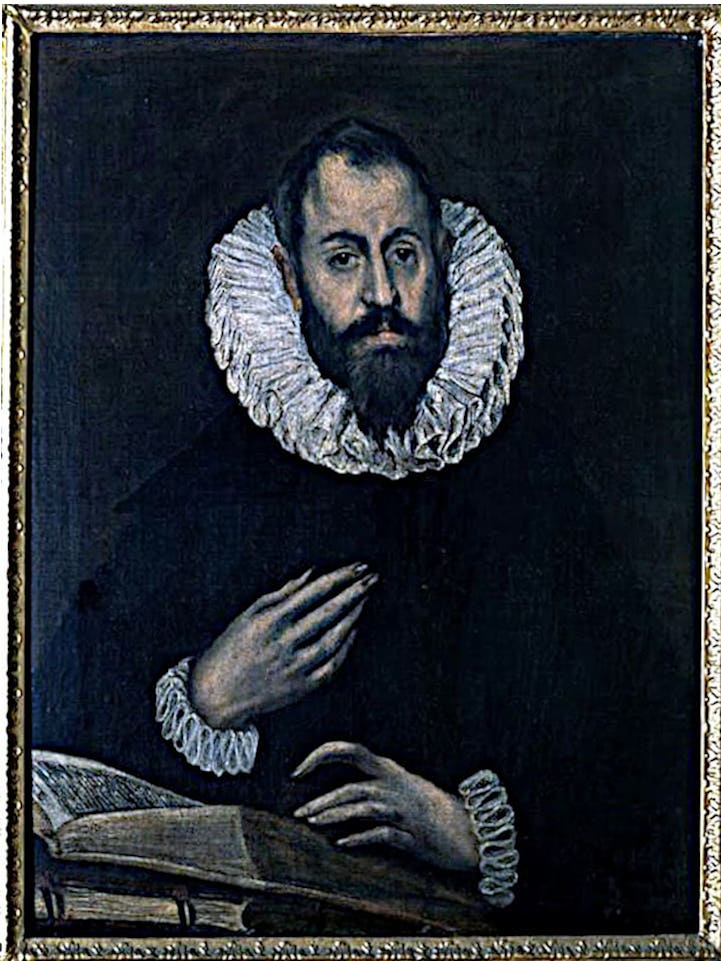
Gabriel Alonso de Herrera, 1595–1605. El Greco. Amiens, France.

The Agricultural Treatise by the Wise Geoponic Priest

Author of the book most famous agriculture in our country. Gabriel Alonso de Herrera was born in Talavera de la Reina around 1460 or 1470 and lived in Granada, protected by Hernando de Talavera, who certainly knew it, and we can only say that he died after the year 1539.

In this city, he had a reputation as an expert on agricultural matters; it consists of attesting documents from 1503 and 1528 and is in the vicinity of Granada and Guadix.

I learned and practiced the skills taught by the Spanish arab and, on estates near both cities, he planted trees, vegetable plants, and fruit trees; his knowledge of arboriculture and horticulture soon rivaled that of many of the Moors who had taught him.

From the year 1500 to 1512, he travelled crossing many regions of spain, Vizcaya, Aragon, Pyrenees Mountains, Valencia, Cordoba, Almeria and Malaga, spain, Italy and France, in order to gather information and to acquire practical skills for your book. The importance of this work is to capital in the agricultural development of Spain.

He studied at the historical city of Granada; in his ecclesiastical career, he was chaplain of the illustrious cardinal and archbishop of Toledo, Fray Gonzalo Ximénez de Cisneros, and priest of the parish of San Miguel in his hometown. Herrera had two brothers, no less notorious than him in his time.

Hernando Alonso de Herrera, the elder, was the first professor of rhetoric at University of Alcalá, and Diego Hernandez Herrera, the second, excelled in music and was the first organist of the Church of San Ildefonso (Alcalá).

His family and personal connections placed him within the most select and progressive intellectual circle of the humanist movement of his time. His work emerged in tandem with the movement for a profound renewal of cultural frameworks and Cisneros’s reformist concerns; this would have a decisive influence on the way he expressed both his ideological and literary ideas. The work of the illustrious chaplain—who wrote in our native language, founded the University of Alcalá de Henares, and served as a disseminator, initiator, and patron of the first work of agriculture.

After the first printed edition of his work, he made other trips that allowed him to make a considerable addition to his previous publication.

His eminence, Cardinal Cisneros, who had so many initiatives for the achievement of the aggrandizement of Spain, with the understanding that the main foundation of prosperity in a country such as ours should be farming and animal husbandry.

It was already known that Latin editions of Columella’s work existed, as well as Spanish manuscripts in Arabic by distinguished writers, as we have seen, but a translator was needed to gather these scattered elements and render them into Spanish so that agricultural problems and their solutions could be disseminated throughout the country.

Cisneros commissioned his learned chaplain, G. Alonso de Herrera, to write this work. Paid for by the distinguished cardinal, the first edition was published in Alcalá de Henares, and at his expense, free copies were distributed in all the cities, towns, and villages of his archdiocese of the agricultural work by the learned priest and geoponic expert, written in folio format, a volume of 354 pages; it contains a detailed account of everything a farmer must do on a daily basis and the goals he must pursue, and for this reason, this great book was preserved and passed down as a family heirloom.

It is true that, as the Count of Campomanes wrote, asking whether Herrera, just as he was familiar with the works of the Greek and Roman authors, or our Columela and some of the Arabs, he would have known Abu Zacaria Iahia; his work would have had more character of agriculture, national. 

As for ignorance, dispensed with crops that only in a few European countries, like ours, are given and which are a huge sum of wealth. Even with this capital defect, he held the book of Herrera, a great influence on the progress of agriculture and national livestock.

Another issue of interest, highly scientific, offers the work of Agriculture Herrera, giving it the common Spanish names of many plants that for the first time are given earlier than in any other book.


It consists of six books:

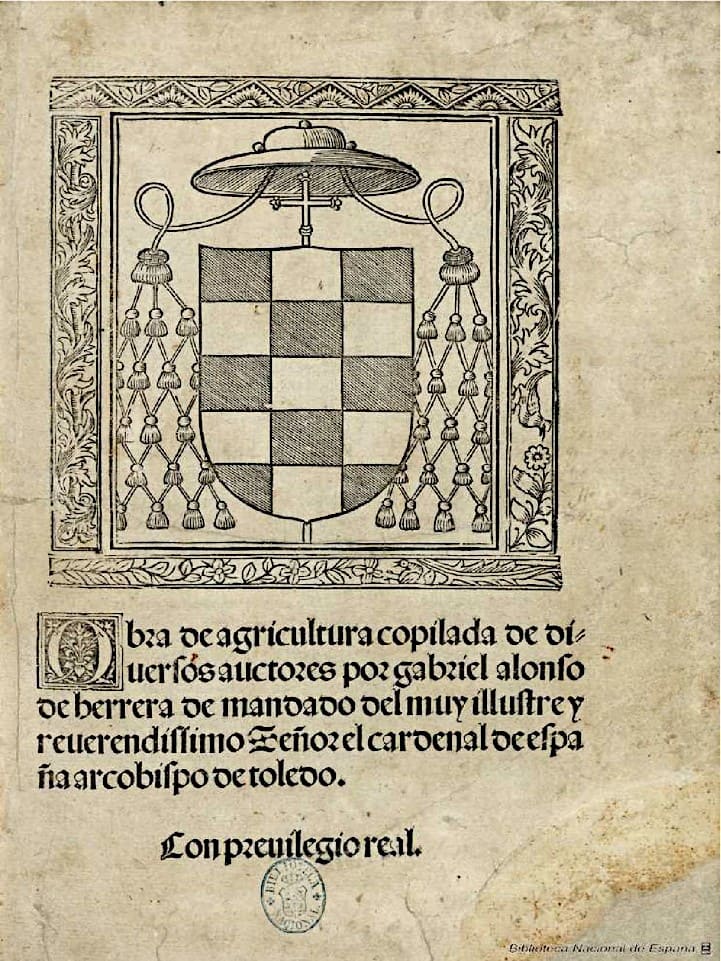
Gabriel Alonso de Herrera (1513) a Work of agriculture.

The cover features Cardinal Cisneros' coat of arms, stamped with a cap, within a border formed by four engraved initial ribbons and decorated with plant motifs.

Let us outline the contents of this work, published in 1513 in Talavera de la Reina and transcribed in 1818, which the author divides into six books:

(The copy scanned is from the National Library of Spain).

The book I this is the tillage and many other features and benefits of the field.

Book II takes care of the land, air, and sites that are good for the vines and appropriates each way of the land to its fate of vines.

Book III contains a study of the tree and first presents some general information on them, which are common to all or part of the same; later, he says he will speak more particularly of some.

Book IV about the orchards and their site, mode of being, manures, and mode of manuring; the fences and locks of the gardens; and the ways and times of watering some vegetables.

Book V deals offspring of certain animals (chickens, geese, ducks, pigeons, peacocks) and, first and foremost, bees. In these chapters, he discusses chickens.

  • Cap. XV: Of the chickens.
  • Cap. XVI: What if this has to be the place to make the chicken coop and how to do it?
  • Cap. XVII: What? This has to be the cock.
  • Cap. XVIII: What kind of chickens should they be?
  • Cap. XIX: The care that chickens need to receive in order to be prolific layers.
  • Cap. XX: Of times to take out the chickens and how they are removed.
  • Cap. XXI: How to castrate chickens.
  • Cap. XXII: Some Diseases of Chickens and Their Remedies.
  • Cap. XXIII: On Fattening Chickens.
  • Cap. XXIV: How to save the eggs, and some properties them.

The sixth book: This text briefly outlines the tasks that should be performed each month in the countryside. It is organized according to the waxing and waning phases of the moon, indicating which activities should be carried out during the waxing phase and which during the waning phase. Furthermore, the author states that we will include other indicators of certain changes in the weather so that they may be clearly understood, as well as some other necessary details.

The work, in its various editions in Spanish, it has been printed with different titles:

  • The work of agriculture.
  • Book of agriculture.
  • General agriculture.
  • Tillage Spanish.

Publications in various languages

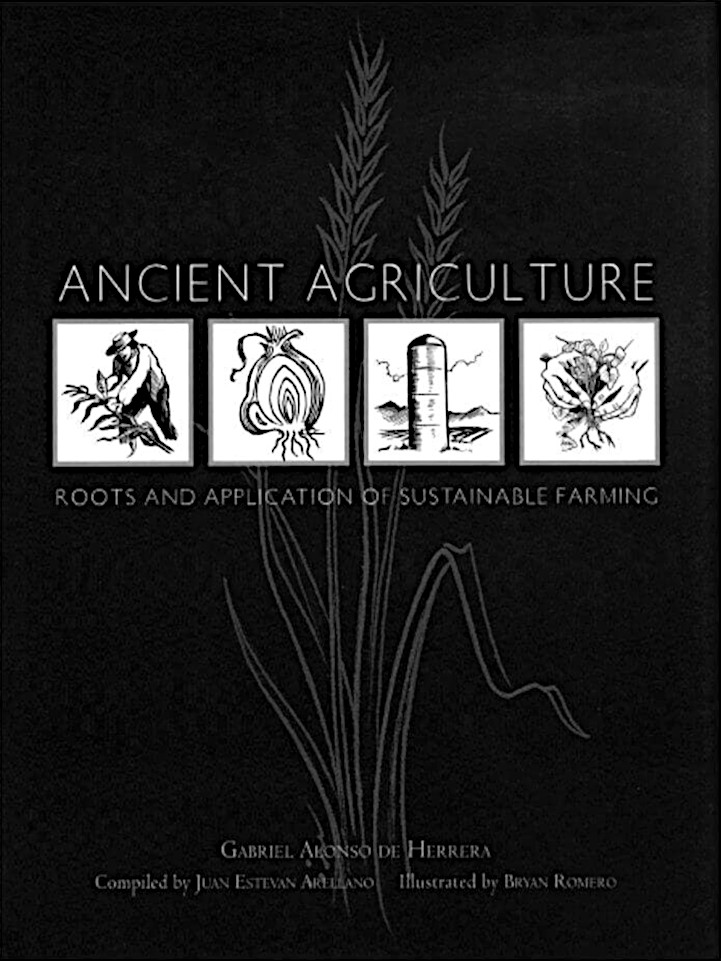
Ancient Agriculture, cover American.

Roots and implementation of sustainable agriculture—Gabriel Alonso de Herrera; compiled by Juan Estevan Arellano, in partnership with the National Center of Hispanic Culture; translated by Rosa Lopez-Gaston; illustrations by Bryan Romero. Layton, Utah.

English:

Ancient City Press, 2006

Digitized by Google Books.

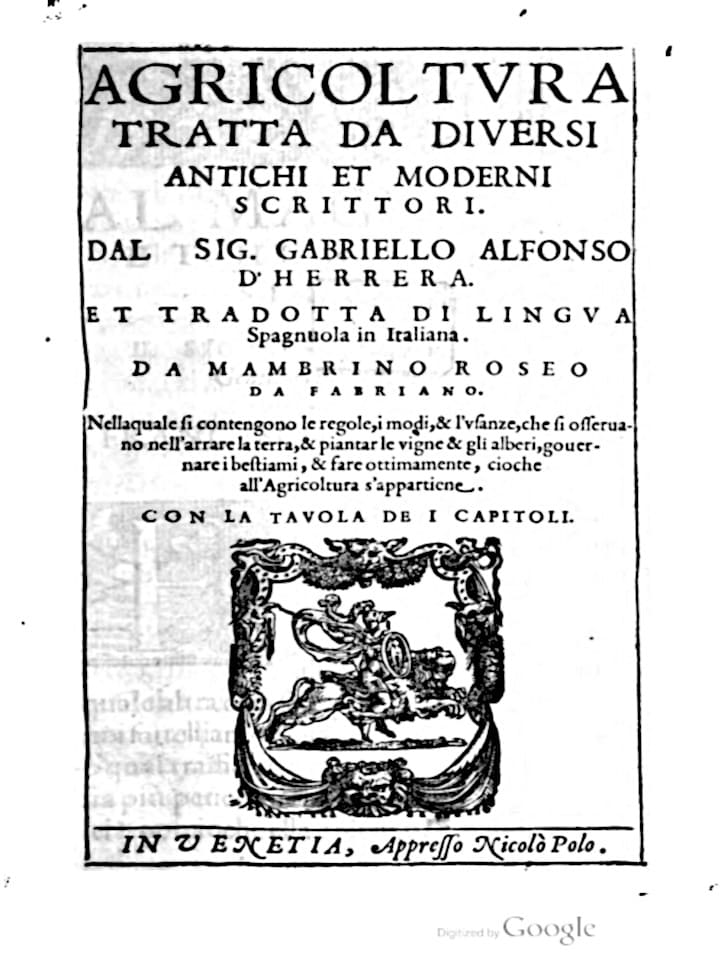
Tratta by various ancient and modern writers. By Mr. Gabriello Alfonso de Herrera. Translated from Spanish into Italian by Mambrino Roseo of Fabriano.

In which are set forth the rules, methods, and customs to be observed in tilling the land, planting vineyards and trees, tending livestock, and performing all tasks related to agriculture in the best possible manner.

With the table of contents. Venice: published by Nicolò Polo, 1592. *Agricoltura,* 1592, Venice (The scanned copy is from the Bayerische Staatsbibliothek Digital)

Italian:

Cover Agriculture 1592 Venice

Edition of 1849 Lisbon. Khronosbazaar

In 1841 in Lisbon and 1849 in Lisbon: the new art that teaches you to create, try, choose, and care for goats, lambs, sheep, pigs, oxen, and cows... By Gabriel Alonso de Herrera; translated from the Spanish by Antonio Gamarra. Lisbon: Typographia Nunesiana, 1849 (Data taken from the copy of the antiquarian Khronosbazaar of Lisbon)

Portuguese:

I have not found the scan.

Related historical authors


You may be interested in these other sections


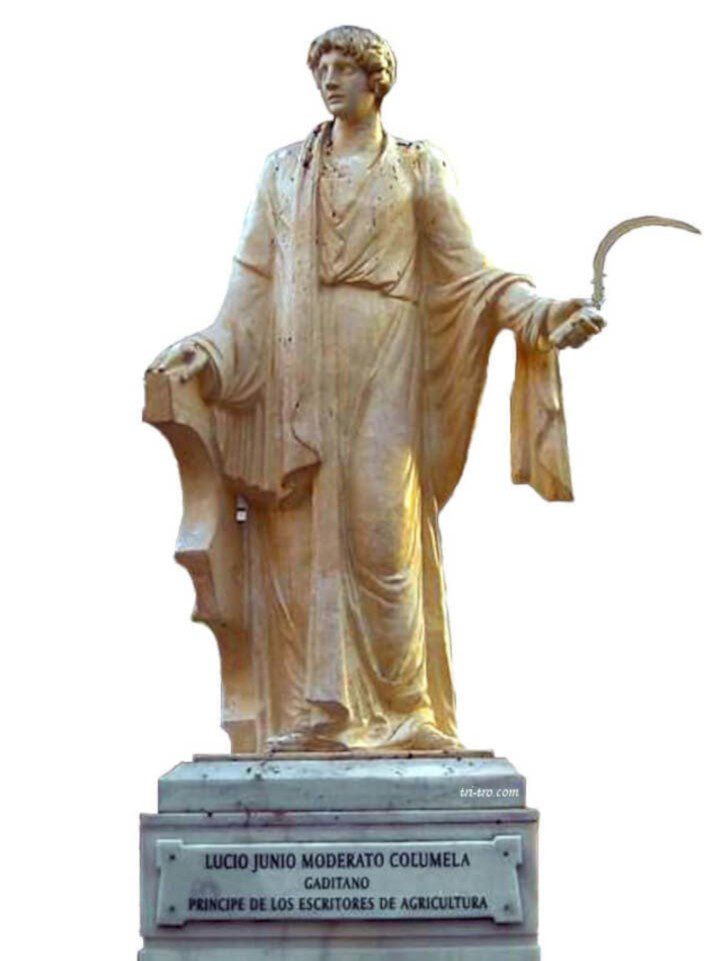
Lucius Junius Moderatus Columella, the master of Roman agriculture

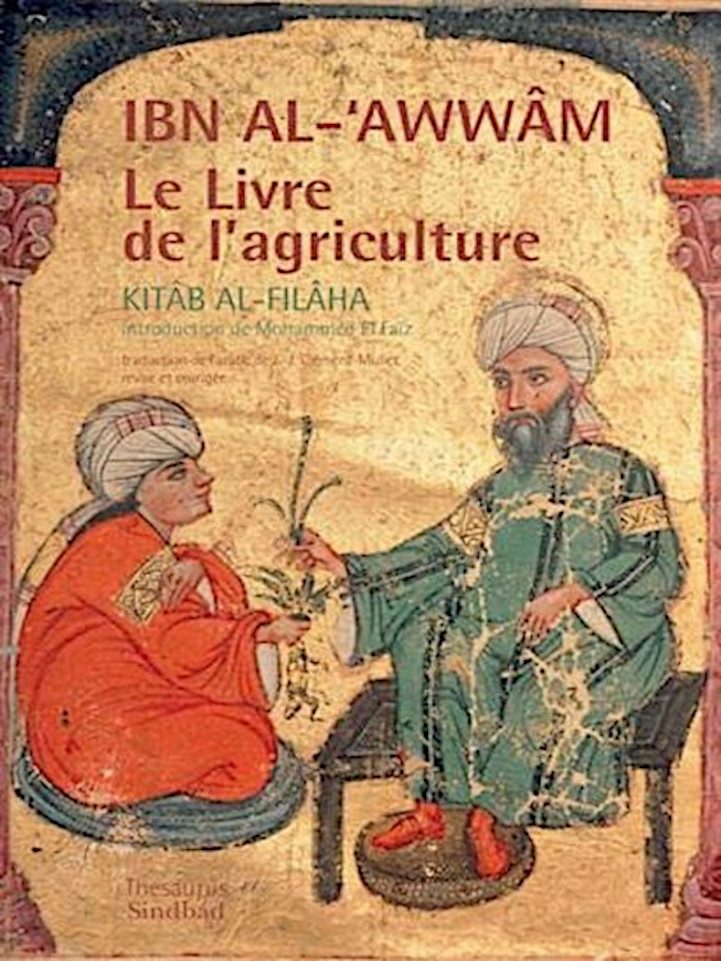
Abu Zacaria Iahia, an Andalusian agronomist

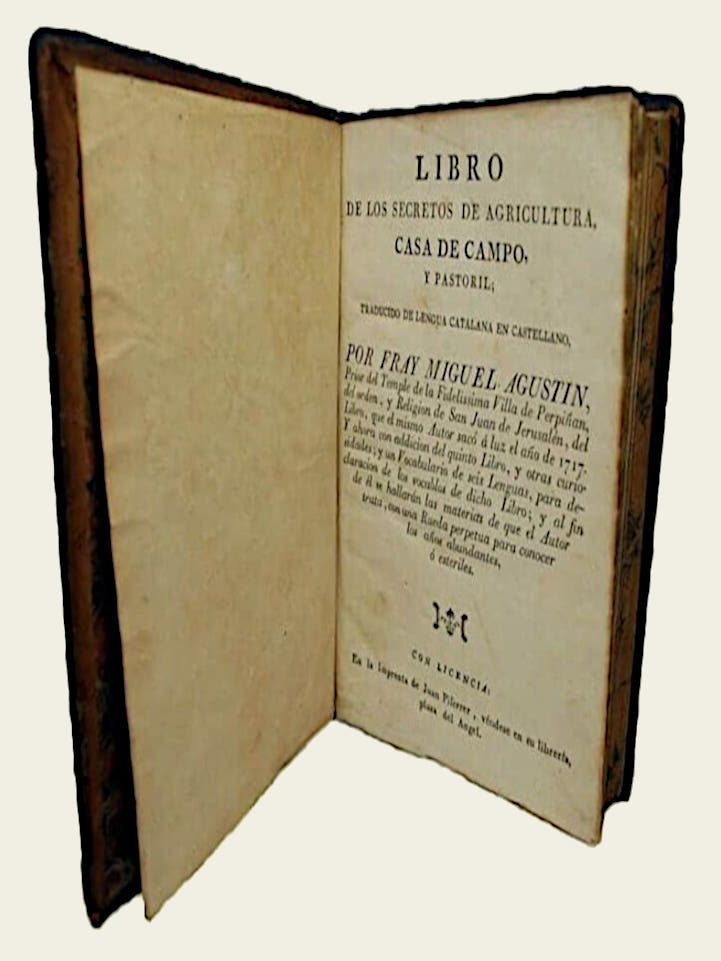
The life and work of Fray Miguel Agustín

 Do you want to share or comment on your social networks

Scan to visit TRI-TRO
Escanea para visitar. TRI-TRO