Sexing chicks II

Other methods of sexing chicks:

Continuing with chick sexing Part II, since in the previous section (Part I) we reviewed the concepts and systems most commonly used in modern poultry farming today, such as: Methods of chick sexing: A brief history of self-sexing breeding; Japanese sexing method: Types, males, variations (photo explanation). Types, females, variations (photo explanation). Method: Endoscopic sexing

There is currently a great deal of interest in chick sexing, as it allows us to separate the sexes or cull those not intended for breeding—due to the financial implications for the breeder or poultry farmer, as well as the resulting reduction in facility space and feed costs, such as feed, grains, etc.

In addition, it is highly recommended to separate the sexes early on to raise both males and females in isolation.

As it is stated that in this way the mortality of the chicks is highly reduced, because females, in these circumstances, do not suffer from the competition of the males, because they have more verve and vividness in search of food.

Attempts to determine the sex of chicks date back a long time, but it can be said that scientifically grounded research on the subject is a product of our century. Below, we will examine other methods and procedures—some more interesting or well-known than others—and describe how useful they may or may not be, with the aim of providing a better understanding for their practical application.

As we all know, it is impossible to verify fertilization in an unincubated egg by examining it against the light with an ovoscope. Nor can the egg’s external shape, the condition of the shell, its size, or its weight provide a definitive conclusion about the sex of the future chick, since a single correct prediction does not justify establishing a rule regarding the selection of eggs; the only way is when we crack some eggs to make an omelet; then we can tell if our breeders are doing their job and see if the egg has a yolk it is fertile or not prior to incubation.

Huevo infértil o fértil

One of the most widely held beliefs in rural areas has long been the age-old notion that elongated, pointed eggs produce males and rounder ones produce females; this belief is refuted or contradicted by the following arguments or reasons: The shape of the eggs (although not invariable) is an individual characteristic of the hen, and in many flocks or groups there are birds that lay only elongated eggs with pointed ends, yet they produce both male and female offspring.

At the same time, other hens produce male offspring even though they lay only round eggs, and vice versa; furthermore, there is no relationship between the formative organ (the section of the oviduct) and the constitutive factor (the germinal disc), and therefore one should not assume that the germinal disc influences the shape of the egg.

Our grandmothers used to put the eggs they wanted to hatch in water; the reason was to discard the ones that floated and use the ones at the bottom of the pot.

Here’s a logical explanation: back then, hens would lay their eggs anywhere in the yard—in the grass, in the loft or attic, in the hayloft, among the plants or hedges in the vegetable garden, under a cart or farm tools, and so on. 

The only way to tell if the eggs were fresh enough for hatching was this method—the one our grandmothers used—because as eggs age, air enters through the pores in the shell, causing the air chamber to expand, and they float in water, while the freshest ones sink to the bottom of the pot.

Sexing by the method touch the shell:

Also untenable is the discovery made by the Frenchman M. Genies in the early 1900s, who claimed that eggs with small folds or wrinkles at the narrow end produce male offspring, while those that are smooth and rounded at both ends produce females; if this were the case, very few males would be born. Because they are very rare, eggs that have the shell in the prescribed form.

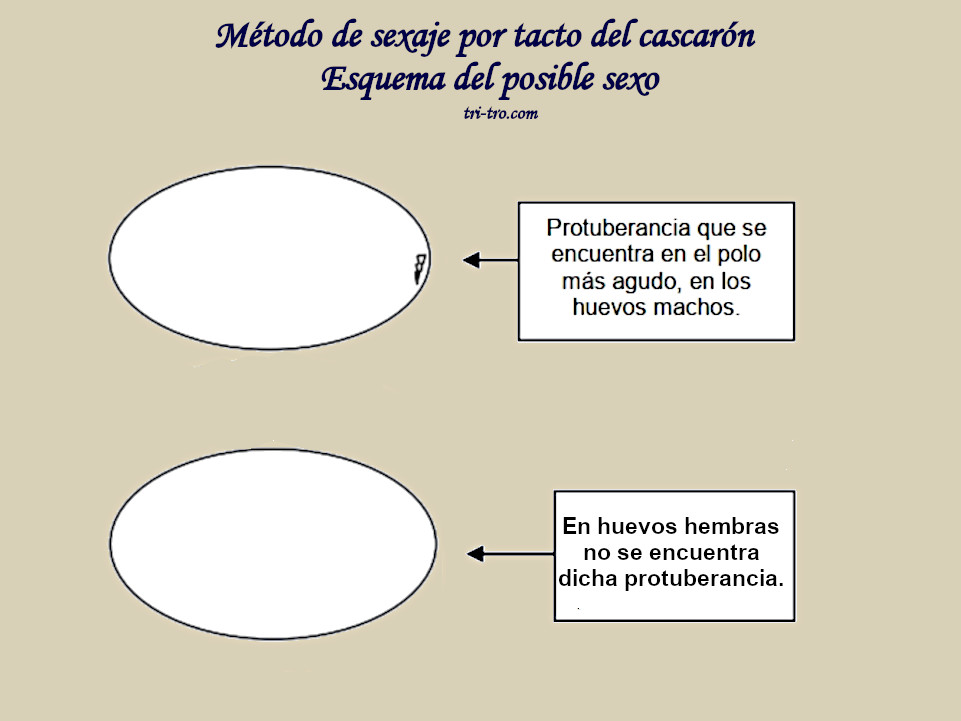
In that it is based on taking Hold an egg from any domestic poultry species in your hand, and then, using your fingertips, feel for a bump or indentation visible to the naked eye at the egg's sharpest end; if you find one, it means the egg is from a male bird.

Conversely, if the shell is smooth, with no bumps, it is a female. They clarify that this is not the circular spot at the poles of the shell that is sometimes found on eggs. This method is still being tested due to a lack of prior data, and its effectiveness must be demonstrated by comparing it with other sexing methods, such as the Japanese or English methods, or even by examining the sexual dimorphism of the birds.

Possible sex by the touch of the shell.

Finally, you can't holdNor is the theory of the German professor Harald Othmar Lenz (1798–1870) of Schnepfenthal of paramount importance; according to this theory, he claimed that heavier eggs hatch into males and lighter ones into females; he argued that within a breed, adult roosters, young roosters, and even chicks at a very early age are always heavier than hens, and he concluded that this difference must already exist in the egg “in which the sex of the bird is already determined.”

But he lacked a base of unassailable evidence, which is not given either in an experiment done by him in 1918 with 60 eggs Leghorns, in which he admitted the maximum weight of 70 g, the minimum 54 and the middle of 62 g. 

And he believed that roosters would hatch from eggs larger than average and hens from those weighing less than 62 grams; it didn't work out at all.

Further tests or experiments conducted by Cröllwitz in 1922, involving 1,132 eggs (98 of average weight, 560 of large weight, and 474 of small weight), also demonstrate that this opinion or theory is untenable; the figures are as follows:

560 eggs large weight gave 255 (= 45.5 %) males + 305 (= 54.5 %) females.

98 “medio” gave 44 (= 46.9 %) males + 54 (= 53.1 %) females.

474 “pequeño”: gave 228 (= 48.1 %) of males + 248 (= 51.9 %) of the females.

Consequently, females were slightly more numerous in all three groups, as would be expected given the typical sex ratio of 50%–50%; overall, there were 527 males (46.5%) and 605 females (53.5%), and the distribution was the same for both heavy and light eggs % of the two sexes. 

It cannot, therefore, speak of a relationship or reciprocity between the egg weight and sex (albumin around the yolk and disk germ), or the positivity of finding out the sex by the weight or size of the egg.

However, it is important to remember that the weight of eggs laid by the same hen on the same diet can vary by a few grams, and that egg size tends to decrease toward the end of the laying cycle.

Detector gender pendulum

The pendulum of the sexed

Several versions consisted of a “detector” suspended by a chain; the movement of the pendulum when placed over an egg was said to reveal the sex. Many devices were tested by the U.S. Department of Agriculture, which found them to be worthless. This led to the ban on such literature in the U.S., and mail-order companies went out of business. However, they were sold throughout Europe and South American countries, casting a cloud of suspicion over sex determination methods, the effects of which would be felt later on.

To demonstrate the foolishness of the masses and their willingness to be deceived, one needs no other arguments than those provided by the very manufacturers of these gimmicks or aphrodisiacs in their stupid advertisements—whether or not they were playing on the ignorance of the population at that time.

The two engravings appear in the brochure, published by a German manufacturer in 1933 and featured by Castelló in the magazine *Mundo Avícola*. One of them states that, when the little device is placed on the engraving depicting a hen, the pendulum (it is nothing more than a pendulum, with a silk thread and a small pin attached to one end; anyone can make one at home) will move in a circle, but if it is placed on the engraving of the rooster, it will swing in a straight line.

The manufacturer itself says this, thereby exposing the deception. For if the engraving contains neither male nor female reproductive organs, but merely the likeness of a rooster and a hen, the movement can only be produced by the imagination of the person holding the pendulum, influenced by what they are told and by the sight of the sex depicted in the drawing.

This attractive and ridiculous instrument with which it is said that you can know if the chick will be born of the egg will be male or to be female.

A single poultry shop in Barcelona sold more than 10,000 of them a year, at 2.50 pesetas each; this was in 1933, and the public was delighted with the toy and happy to be taken in.

As for revealing the sex of the egg, sometimes the Kikriki marks male or female. This depends on the pulse of the person holding it, but to prove that it does not have the power attributed to it, test a few clear eggs, that is, eggs laid by hens that did not have a rooster and therefore cannot contain either male or female sex. 

You’ll see how beautifully the sexogen works, sometimes indicating male and other times female. That is, provided the person holding it doesn’t know that the eggs are infertile; because if they do, the pendulum will remain still.

Method English sexing:

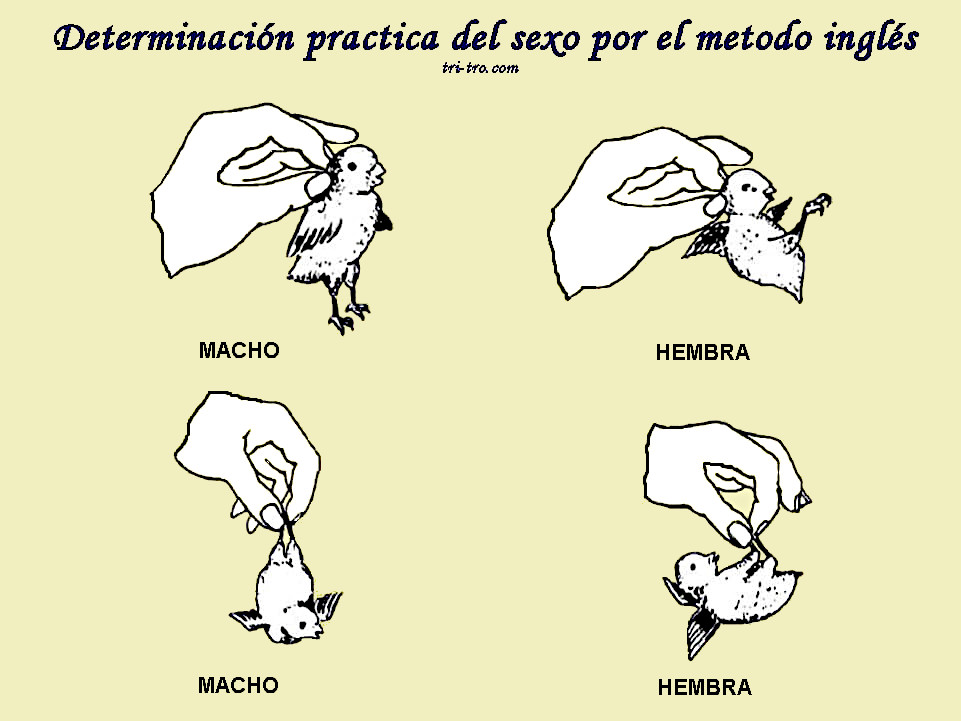
Determination of practice of sex by the English approach

Rather, by way of curiosity, but also thinking about their possible practical use, in the absence of the possibility of employing other procedures safer, briefly explain this method.

(Company, 1963; Paredes and Vaca, 2000) describe this technique, which originated in England in the last century. This method has a 70% success rate. It involves holding the chick by its legs or the skin on its neck and observing the position the bird assumes. Females are more restless and nervous; in contrast, males maintain a more relaxed posture when this method is used.

The accompanying diagram is sufficient to understand how to determine the sex of the birds. It is clear, therefore, that this method cannot be recommended as a commercial procedure, but for everyday situations in our chicken coops or barns, it is another option.

Sexing by wing feathers:

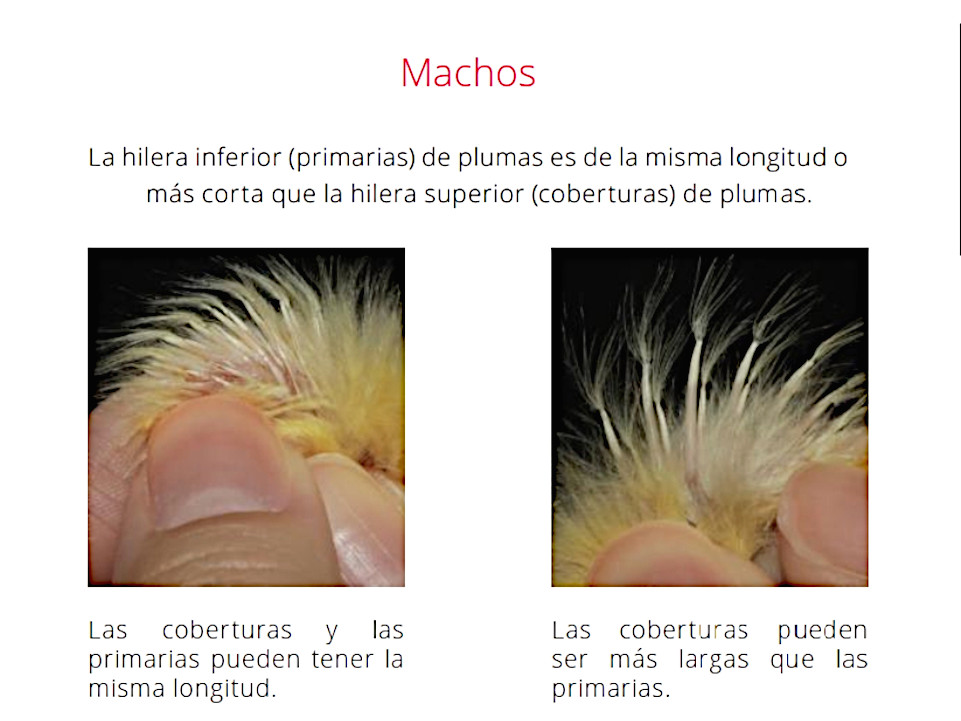
Sexing by feather of the wing males

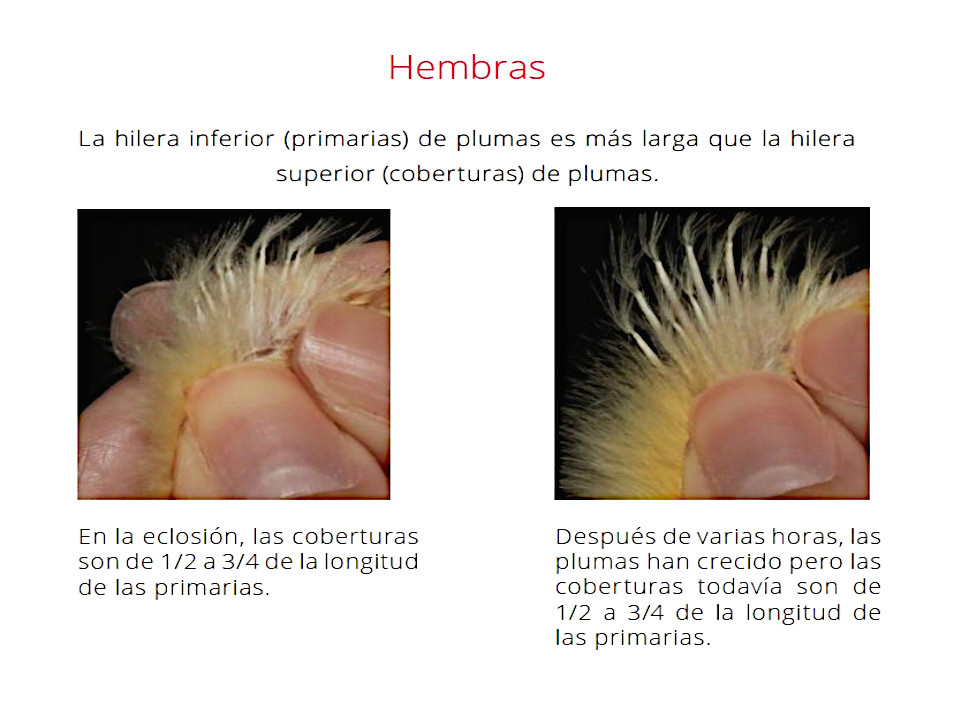
Sexing by feather of the wing females

Feather sexing is a quick and non-invasive method of differentiating chicks. Broiler chicks in the sexable feather format (slow feathering) can be sexed by feather at one day old, as shown in the photos.

In the sexable featherless format (rapid feathering), both males and females will show the same feather development pattern as the females shown in the photos.

Sexing by feathers should be in an area that is well lit. The chicks should be picked up, or lifting, placing the neck between the index and middle fingers and supporting the body of the chick with the pinky and ring fingers. Using a gentle pressure, stretching the wing as a fan, never pick up the chick by the wing. The feathers of the lower tier are the primary and the upper row of feathers are covering.

In Males:

The bottom row (primary) of the feathers is of the same length or shorter than the top row(coverage) of feathers.

  • The coverage and the primary may have the same length.
  • The coverages can be longer than the primary.

In Females:

The bottom row (primary) feather is longer than the top row(coverage) of feathers.

  • On hatching, the hedges are 1/2 to ¾ of a length of the primary.
  • After several hours, the feathers have grown, but the covers are still 1/2 to ¾ of a length of the primary.

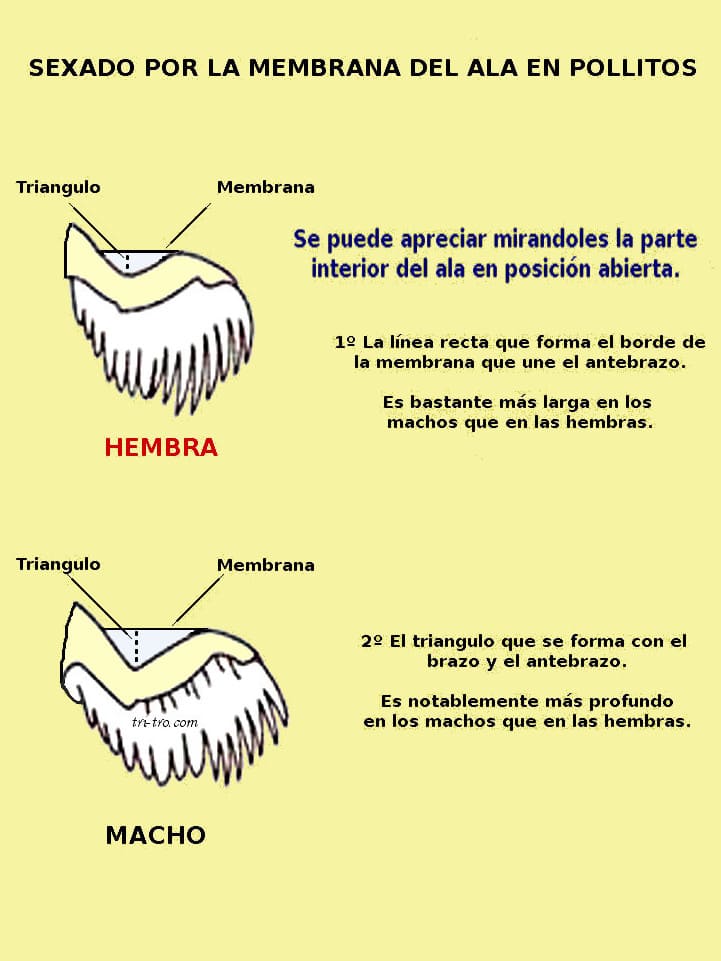
Sexing by wing membrane:

Sexing by the membrane of the wing on chicks

This can be seen by looking at the underside of the wing when it is spread open. The straight line formed by the edge of the membrane connecting to the forearm is significantly longer in males than in females.

In females:

1. – The straight line that forms the edge of the membrane connecting the forearm. It is considerably longer in males than in females.

In males:

2. – The triangle formed by the upper arm and forearm. It is noticeably deeper in males than in females.

Bibliography:

Kaleta EF, Redmann T. 2008. Enfoques para determinar el sexo antes y después de la incubación de huevos de gallina y de pollitos de un día Poult del mundo. Sci. J. 64 391399

Masui K., Hashimoto, J., Ono, Y. 1924: El órgano copulador rudimental de las aves domésticas masculinas con referencia a la diferenciación sexual de los pollos. Jpn. J. Zootech. Sci 1 153164

Masui K., Ito S. 1931. Estudios morfológicos y estadísticos sobre el proceso genital de los pollitos del día (White Leghorn) con especial referencia a la discriminación sexual en los pollitos del día. Jpn. J. Zootec. Sci 5 139162

Clinton METRO. 1994: Un protocolo rápido para sexar embriones de pollos (Gallus g. domesticus). Anim. Gineta. 25 361362

Grabados RJ 1996: Crecimiento y maduración sexual. 74105 Reproducción en aves de corral, CAB International, Wallingford, Reino Unido

System of endoscopes for the sexing of chickens TESALA (photos) to small animals, and laboratory animals, AE-C1, AVS, Tokyo, Japan

Makoto Otsuka, Osamu Miyashita, Mitsuru Shibata, Fujiyuki Sato, Mitsuru Naito, un método novedoso para sexar pollitos de un día utilizando el sistema de endoscopios, Poultry Science, Volumen 95, Número 11, noviembre de 2016, páginas 2685-2689, https://doi.org/10.3382/ps/pew211

Sex Determination of Day-old Chicks T.H. Canfield. University of Minnesota, St. Paul, Minnesota, 1939

Dyce K.M., Sack W.O., and Wensing C.J.G., 1991. Veterinary Anatomy. Panamericana Publishing

Ede, D. A., 1965. Anatomy of birds. Ed. Acribia.

Grasse, P. P., 1980. Zoology. Vol. 4: Vertebrates. Reproduction, biology, evolution, and systematics. Ed. Toray-Masson.

Grifols, J. and Molina, R. 1994. Manual of clinical exotic birds. Ed. Grass-Iatros.

Natural History, 1984. Vol. 1. Ed. Ocean-Institute Gallach.

King, G.M. y D. Custance. Colour atlas of vertebrate anatomy: The Pigeon. Pp.: 5.1—5.17. Ed. Blackwell Scientific Publications.

Krahmer, R., and Schröeder, L. 1979. Anatomy of the domestic animals. Ed. Acribia.

McClelland, J., 1992. Atlas in color of the anatomy of birds. Ed. inter-American.

Nickel, R., 1977: The Anatomy of the Domestic Birds. Ed. Paul Parey.

Sandoval, J., 1976. Veterinary Anatomy. Published by Imprenta Moderna (Córdoba).

Schwarze E. 1980. Compendium of Veterinary Anatomy. Volume V: Anatomy of birds. Ed. Acribia.

Shively M.J., 1993. Anatomía veterinaria, básica, comparativa y clínica. Ed. Manual Moderno.

Sturkie P.D., 1967. Avian Physiology. Acribia Publishing.

Dr. Francisco Gil Cano.

Professor H. Aguinaga.

 

You may be interested in these other sections


Castilian Black Chicks: Initial Care

Broody hens: a step-by-step guide to natural incubation

Embryodiagnosis: Analysis of Unhatched Eggs


Do you want to share or comment on your social networks

Scan to visit TRI-TRO
Escanea para visitar. TRI-TRO