Viral Diseases:
The original name was laryngotracheitis an infectious disease of chickens or birds; the name was later changed, and today it is commonly referred to as vaccine-associated laryngotracheitis or simply laryngotracheitis (commonly known as LTI). It was adopted in 1931.
This disease was reported in E. U. A. since 1924. The first record of the existence of the disease in Europe was in 1935 in Great Britain.
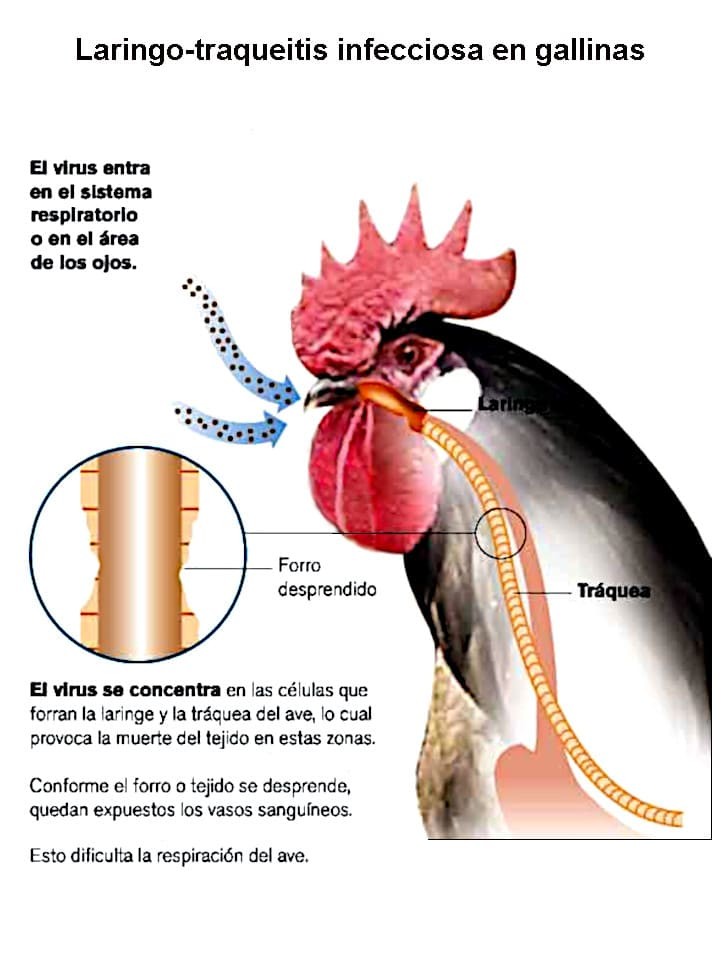
It is a viral infection of the respiratory tract that can cause major losses in production. Infection acute, highly contagious and caused by a herpes virus avian, it is usually transported between the birds by contact with contaminated droppings or secretions of the respiratory tract.
This virus has good species specificity, as it affects only chickens and pheasants; other birds do not contract the disease.
The disease is caused by a virus filter called Tarpeia avium. Beaudette (1930) stated that the cause of the “infectious bronchitis” was a germ filter and of his description of the disease, it follows that the condition he studied was the laringotraqueitis infectious. Beach (1930) established conclusively the nature of the germ.
There is only one antigenic type; it affects only the respiratory system, varies in virulence, and can survive outside the host for several weeks.
The virus appears to be naturally ineffective only in all breeds of domestic chickens, which are susceptible at any age, and occasionally also infects pheasants. However, clinical signs can be induced in turkeys under experimental conditions, and ducks can also be infected in the same way, though they do not show any signs.
Outbreaks occur mainly in chickens between three and nine months of age. In endemic areas, older birds are often immune, while the disease is rare or mild in very young birds.
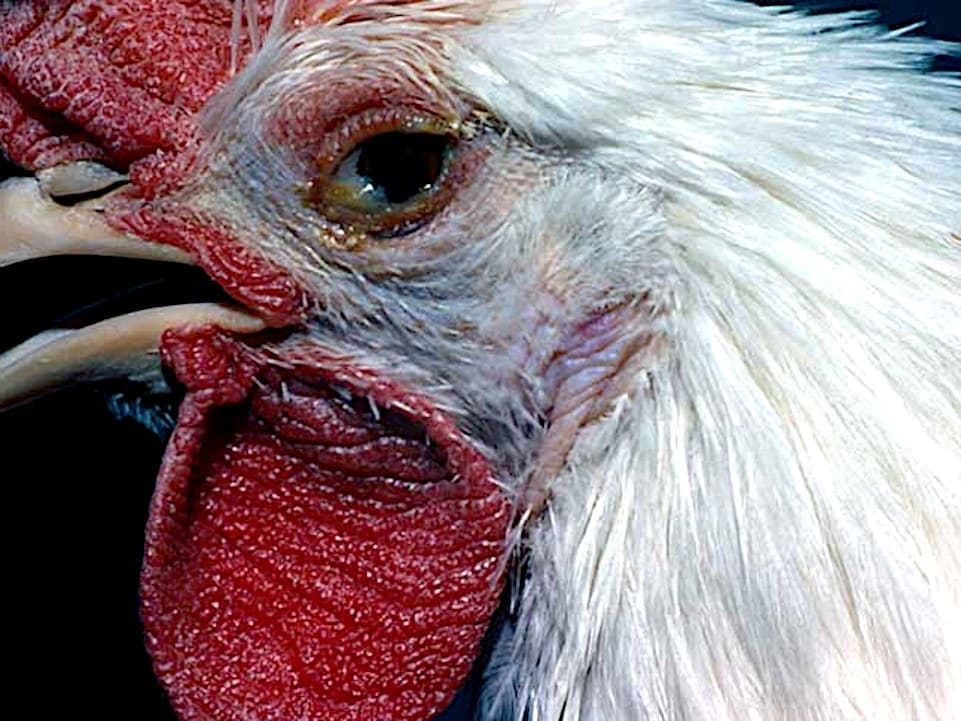
The first noticeable symptom of the disease is watery eyes and a tendency for the bird to remain motionless. These symptoms are soon followed by coughing fits and sneezing, during which the bird shakes its head vigorously to clear the irritating secretions that accumulate in the larynx and trachea.
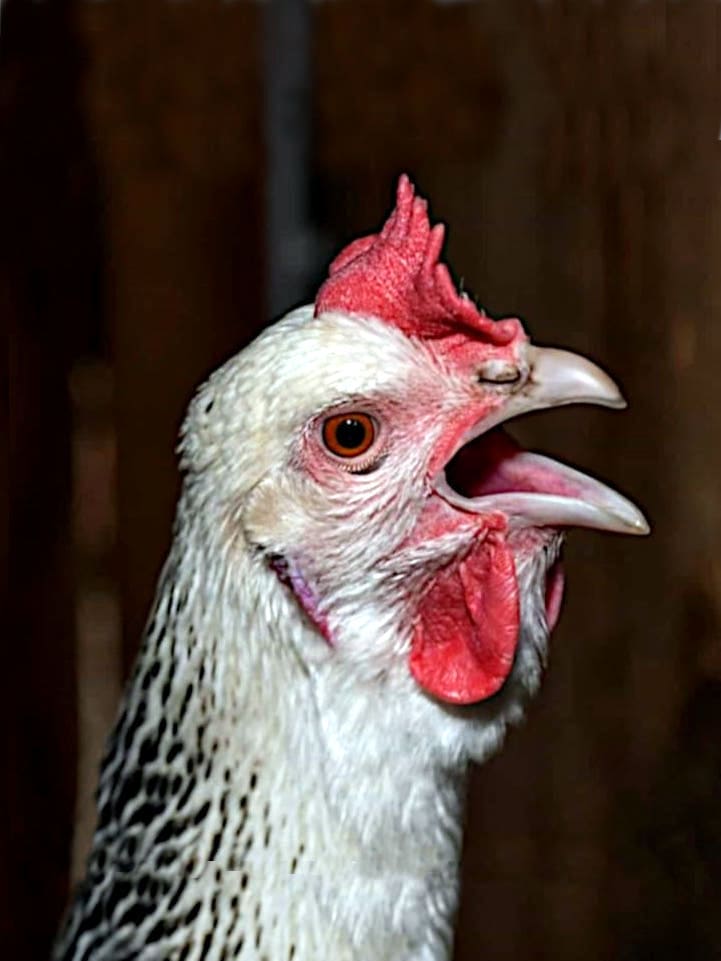
An infected bird usually perches with its eyes closed, and a rattling sound can be heard when it breathes. As it inhales, it raises its head and neck and stretches them out, opening its mouth, in order to take in as much air as possible.
Inspiration is often accompanied by a loud noise, gasping or wheezing, which causes them to give these birds the name of llamadoras.
During coughing or sneezing can be ejected masses mucus stained with blood or clotted blood, which temporarily relieves their difficulty breathing. As they exhale, the birds lower their heads, sometimes extending them until their beaks touch the ground.
The accumulation of exudate in the larynx or trachea may determine the sudden death of the bird by suffocation. In chicks attacked, the breath is extremely fast and the mouth is opened widely at each inspiration.
The course of the disease usually last from seven to fifteen days, although symptoms can occur up to a month. Birds that recover from the infection become gradually to apparently normal health, but still carrying the germ and they are carrying.
Gibbs (1932) found that birds can be carriers up to and during two years, found that the virus seems to be confined in any part of the larynx or trachea, and although some birds emit snoring when breathing is not an indication of confidence to recognize the chronic cases.
In summary, the common symptoms of this disease include breathing difficulties, abnormal breathing sounds, and the presence of mucus in the nostrils. The birds adopt an orthopneic posture, with their necks stretched out, heads tilted upward, and beaks open.
The birds gasp for air, often with their beaks open and necks stretched out, while emitting plaintive sounds. This type of dyspnea is often referred to as “staring at the stars”; they periodically make a noise or “whistle,” cough, or wheeze, and their feathers are stained with blood around the head and neck.
It is not uncommon for animals to expel bloody mucus while shaking their heads, sometimes spraying it onto the walls.
Under natural conditions, the incubation period ranges from 2 to 12 days; with intratracheal infection, it is shortened to 2 to 4 days. The acute symptoms are relatively characteristic of this disease: conjunctivitis and mild rhinorrhea are present; very soon, severe dyspnea, particularly during inspiration, becomes apparent.
The reduction in productivity is a factor variable. The disease spreads slowly through the herd and the mortality can be high, depending on the condition of the bird.
In acute cases, the beak, pharynx, larynx, and trachea are filled with bloody mucus. In some cases, the laryngeal and tracheal lumens are completely or partially obstructed by blood or grayish-yellow deposits, which initially cause dyspnea and eventually lead to death by asphyxiation as these secretions accumulate.
After recovery, they are still carriers and will become a source of infection for susceptible birds. In stress conditions, the latent virus can be reactivated.
There are two types of live-attenuated vaccines against laryngotracheitis available on the market:
to.— chicken embryo and b.— in cell cultures.
One or two doses of the vaccine (which do not provide lifelong protection) are usually sufficient to provide reasonable protection, provided that proper isolation measures are followed.
It is administered to chickens from 10 to 16 weeks of age or younger in the form of eye drops or as a spray, but also in the drinking water.
Scarification (incisions surface) of the cloaca with an applicator dipped into the vaccine also is used.
In outbreaks, apply the vaccine could control the spread of the virus among poultry and chicken coops, due to the spread is a slow process, and protect those that still have not been infected.

Literature review:
MERCK & CO. (1995). Manual Merck de Veterinaria. Rahway, N. J., EE. UU.
BUXADÉ, P. (1987). The laying hen. Ed. Mundiprensa. Madrid.
DORN, P. (1987). Manual of avian pathology. Ed. Acribia. Zaragoza.
HOFSTAD, M. S. (1984). Diseases of Poultry. Iowa State University Press, Ames, Iowa.
ZARZUELO, E. (1982). Vade mecum of the pathology, infectious poultry. Ed. Aedos, Barcelona.
CASTELLÓ, F. and CASTELLÓ, J. A. (1960). The New Art of Raising Chickens. Aedos, Barcelona.
OROZCO, F. (1989). Breeds of chickens Spanish. Ed. Mundiprensa. Madrid.
LACADENA, J. R. (1998). Genetics. Ed. AGESA
PUERTAS, M.J. (1992). Genetics: Fundamentals and Perspectives. McGraw-Hill Interamericana.
SANCHEZ-MONGE, E. (1969), Genetics. Espasa-Calpe S.A.
OROZCO, F. and ROBLA, F. (1986). Genetic aspects of the León rooster. 24th Symposium of the WPSA (Spanish Section): 199–212.
HILL, J. L. (1973). Genetics, general and applied. Ed. UTEHA.
CASTELLÓ, J. A., LLEONART, R., FIELD, J. L., OROZCO, F. (1989). Biology of the chicken. Real Escuela de Avicultura.
LLEONART, F., ROCA, E., CALLÍS, M., GURRI, A., PONTES, M. (1991). Poultry Hygiene and Pathology. Royal School of Poultry Science.
STURKIE, P.D. (1968). Avian Physiology. Acribia Publishers. Zaragoza.
LOHMANN ANIMAL HEALTH (2012)
You may be interested in these other sections