Nicolás Casas de Mendoza

A Guide to Poultry Farming and Profitable Chicken Farming:

Nicolás Casas de Mendoza was one of the most influential veterinarians and animal scientists of the 19th century. His works on poultry farming laid the foundation for the poultry farming modern in Spain, covering breed selection, feeding, incubation, and the economic viability of raising chickens.

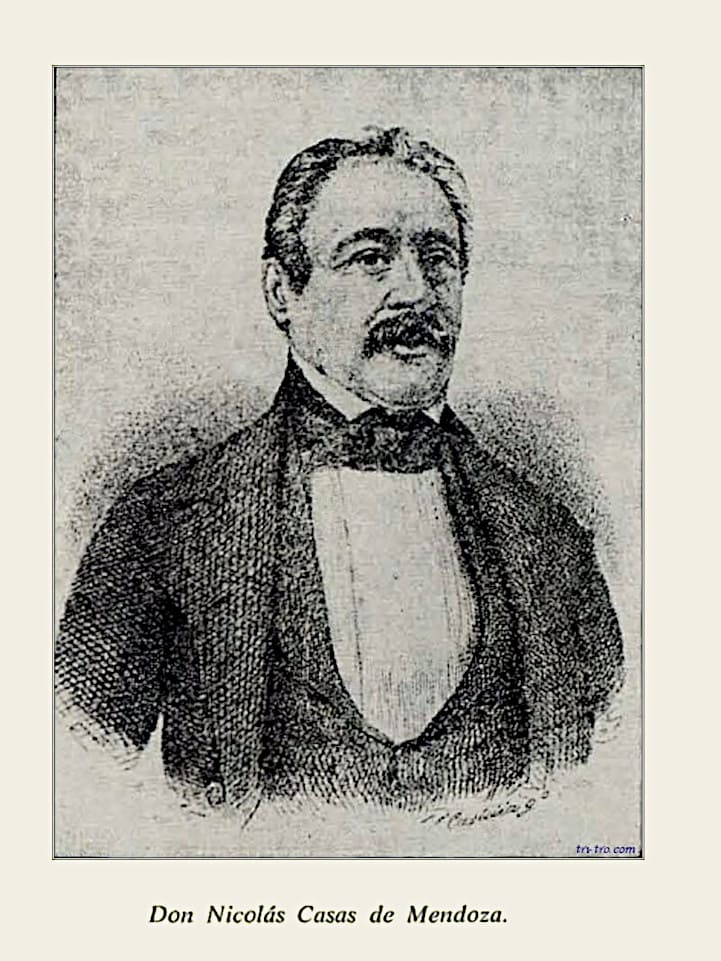
El veterinario Casas de Mendoza, born on December 6, 1801, led a life marked by perseverance and hard work; he died in Madrid on the last day of 1872, the victim of a stroke, which had gone undetected until then.

When Casas enrolled at the Royal School of Veterinary Medicine, he was a fifteen-year-old boy haunted by his orphanhood and poverty—circumstances that would have a decisive influence on his work. 

On October 7, 1816, Casas enrolled at the Royal School of Veterinary Medicine in Madrid. At that time, the school admitted two types of students: internal students—what we would now call scholarship students—who paid no tuition and received a stipend of 200 ducats to cover living expenses, uniforms, and other costs; and external students.

In May 1820, he brilliantly completed his studies, although it should be noted that his records show that he was a mischievous young man with a restless spirit who “sometimes stirred up the seeds of insubordination and discord among the students.” This restlessness, which was viewed negatively by his teachers, would later be responsible for his triumphs.

Nicolás Casas de Mendoza, who was the most prominent pioneer of scientific veterinary medicine, a true giant of the 19th century. Casas’s work serves as a tribute to the most fruitful period in the veterinary profession, beginning in 1821, the year he embarked on his tireless journey through a profession that was moving slowly without scientific ambition; he gave the profession fifty golden years, until 1871, the year he went down in history as the great reformer of 19th-century veterinary medicine.

He practiced for thirty years in rural areas and, shortly thereafter, following a successful competitive examination, was appointed to the chair of Zoophysiology at the Madrid School of Veterinary Medicine. Prior to that, he had served as an inspector for the Court of First Instance in the province of Cuenca and, years later, as an examining magistrate.

For many years, he served as a councilor for Agriculture and Health; he was a member of the board of directors for the 1857 Agricultural Exposition. For his work there, he was awarded a silver medal.

A Treatise on Poultry Farming

Prepared and published numerous papers on veterinary topics, culminating with his Treaty of animal Husbandry, branch in which he emphasized. He was a veterinarian, eminently scientific.

In 1861, he was appointed a full member of the Royal Academy of Medicine, occupying seat 35 and assigned to the sections of hygiene and physiological anatomy. He had already been admitted to the Academy of Natural Sciences years earlier, and when it was reorganized into the new Academy of Exact, Physical, and Natural Sciences, he was listed as a founding member.

He was a member of the American Order of Isabella the Catholic. His loss was deeply felt at the Academy.

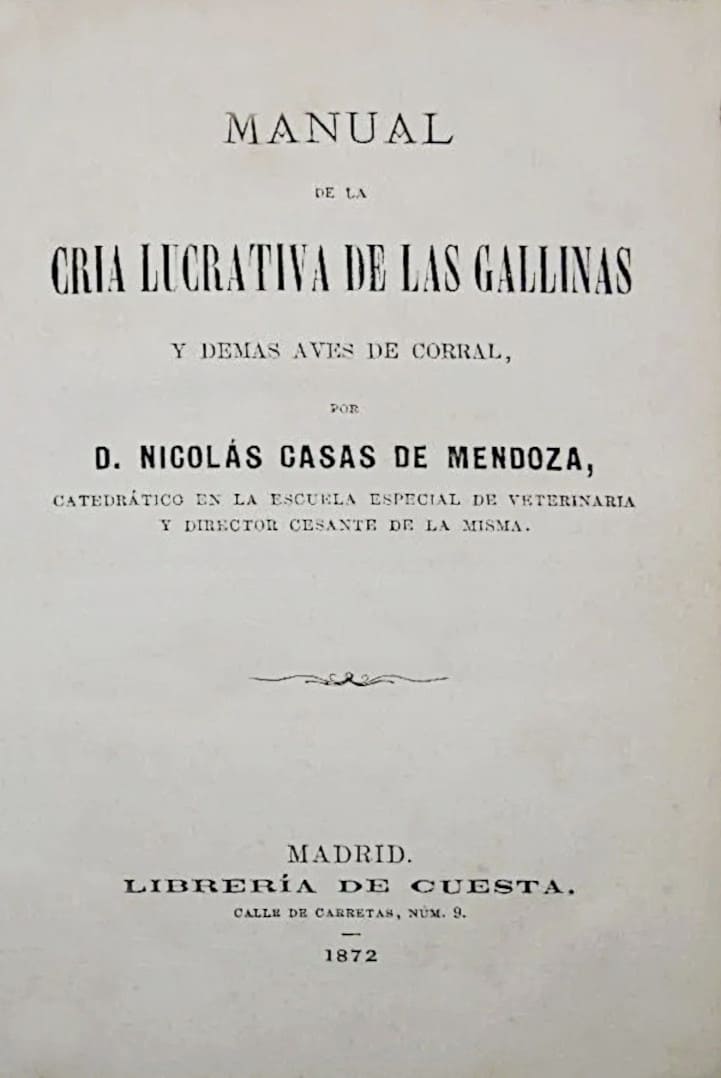
Extensive the work of Nicholas Houses with their Complete library of the rancher and the farmer. Within it, regarding the poultry, we find the Treaty of breeding poultry”, published in Madrid in 1844, as based on a few criteria zootechnical most complete, as well as their subsequent work “Profitable chicken breeding” 1872, trying Spanish breeds and the rest of the world, the egg, feeding, incubation, identification of the good egg laying, diseases, etc

Treaty Breeding poultry. Nicholas Casas Mendoza.

Profitable Chicken Farming. Nicolás Casas de Mendoza

Treaty of breeding poultry. See Volume 4 º

Profitable Chicken Farming

Nicolás Casas de Mendoza and Modern Poultry Farming

Etymologically, The term “zootechnics” refers to the “art of animal husbandry”; as such, the history of the use of animals that could be of benefit to humans is, in a way, the history of humanity itself, from prehistoric times to the present day.

The first paintings of this story show us the practices of primitive man to purchase the food that allowed him to survive.

Later, the first instances of domestication emerged. From that point on, “animal husbandry,” the formation of pastoral communities, and the development of centers of civilization became inextricably linked. Later, at the dawn of the Modern Era, the winds of spiritual revolution that shook the then-known world spurred the advancement of science in many different ways.

From that moment on, it has been a continuous and steady ascent along the path of scientific discovery.

The term “zootechnics” was first proposed in 1843 by the former minister, the Count of Gasparin, a former student of the Alfort School. We have seen, in broad terms, the historical evolution of a science that took shape as humanity's material needs grew.

Until then, its development had been based on experience accumulated over the centuries. It was necessary to chart a new course for this science in order to consolidate and accelerate its progress.

Today’s animal science pays tribute to those brilliant minds who, at such crucial moments, were able to achieve such great heights. And here, too, the figure of Nicolás Casas de Mendoza emerges once again.

It may be the field of animal husbandry that has contributed most to preserving our historical memory of Casas, given his significant work in this area. In 1847, speaking to schoolchildren and referring to the value of our profession, he described veterinary medicine as

“A branch of natural history whose ultimate goal is the conservation, breeding, and improvement of domestic animals,” but it also states:

“Veterinary medicine is more than just animal medicine; it requires a focus on livestock, or it will fade into obscurity.”

Casas’s contribution to animal husbandry represents, as a fitting culmination, the culmination of a long and intense professional career.

It's very interesting what you say about the brown chicken, which was brought over by the Arabs and is the ancestor of today's Spanish black chickens.

This is the original text of the work. Profitable Chicken Farming. Pages 60–52

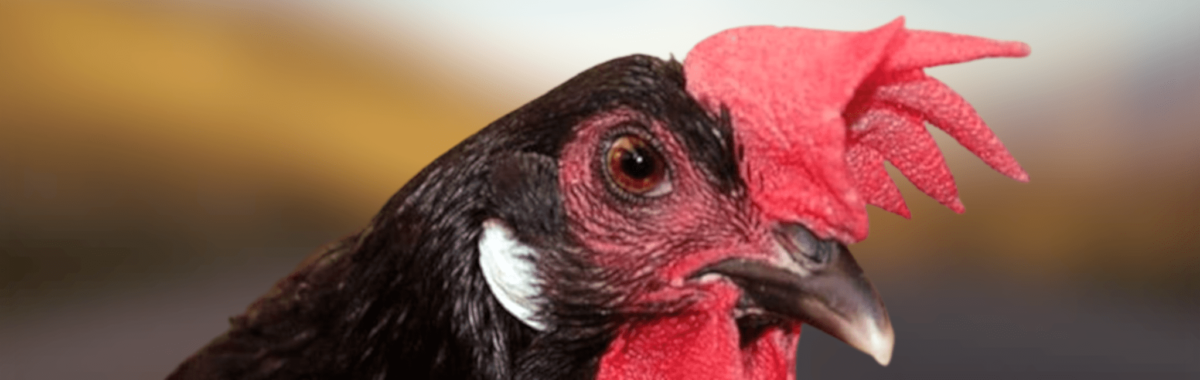
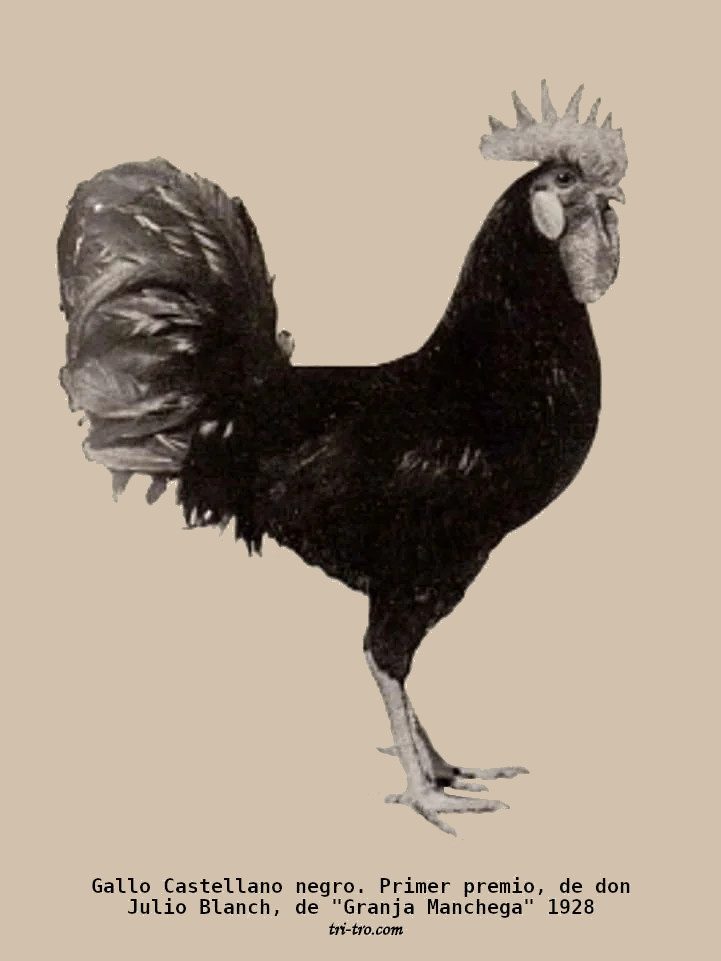
The black chicken described by Casas de Mendoza

Ancestral Black Castilian Chicken 1929

BLACK CHICKEN (black chicken) This breed is rarely found in its pure form in our region. In the province of Ciudad Real, and particularly in Alcázar de San Juan, they are often found in varying numbers, but mixed with the common varieties.

The former lords of the villages believed that the meat of black chickens was more delicate than that of other colored chickens, and perhaps based on this belief, they required tenants to provide black chickens as part of their rent.

If this belief is not based on the science of the physiology of taste, it is, at least, sanctioned by the story. This also refers to Aristotle's preferred raising chickens black for the excellence of its flesh.

Spanish gourmets say, "For the table, white goose and black chicken." 

The black chicken is larger than the common chicken and can be distinguished by a rudimentary comb with a small, horny base; in addition to its black feathers, its beak, nostrils, the rims of its eyes, and the skin on its legs are black.

At first glance, one might think it had rolled around in a pile of powdered coal. Its small crest and wattles are a darker red, speckled with tiny blackish spots; its wings and tail feathers are long; its legs are small, and its feet are slender and tall.

Almost all of them have a small collar of feathers encircling their heads. It is quite fertile; it lays large eggs of an extraordinarily bright white color, but it clucks almost constantly, just like the common chicken, and is just as roving. Its tendency to brood is somewhat below average.

The Importance of Nicolás Casas in the Spanish Poultry Industry

Other works left to us by Nicholas Houses of Mendoza is the Handbook of Spanish Agriculture and Livestock. Is scanned by Google of the original version of the books belonging to the library of the Complutense University of Madrid; it consists of four volumes, published by Calleja, Lopez & Rivadeneyra Editors in 1857; to view links.

Dictionary manual of agriculture and livestock, Spanish.

Nicolás Casas and the proto-albeiterato

The protoalbeiterato (Spanish veterinary tribunal) this was the typical structure of the Spanish boatmen's guild. It was an official tribunal that examined candidates for membership in the guild; without its approval, they could not practice their trade.

For three centuries, this institution set the standard for veterinary education. It weathered radical political upheavals and sudden professional shifts because it operated under the same guidelines and criteria and followed the same practices from its inception.

The foundation of the Veterinary School of Madrid predicted the total abolition of the Protoalbeiterato (Spanish veterinary tribunal), but it was not so, as it still lasted another fifteen years, slowing the development and expansion of the new scientific veterinary.

Casas was the first veterinary historian, and as such, he researched the long history of the proto-veterinary profession over the centuries. It was an institution that he himself, together with his mentor Risueño, brought down.

Casas, who is the true architect of the proto-labor movement, analyzes the reasons why this court remained in place for so long: the institution’s three-century-old prestige and the significant influence of Malats, who, along with Estévez, received scholarships in 1783 by royal decree issued by King Charles III to study at the Alfar School of Veterinary Medicine.

Both were responsible for organizing the Madrid School of Veterinary Medicine, and they took advantage of this opportunity to quickly join the proto-Albeiterato and serve on its governing board. Casas was an idealist and, as such, harshly criticized the actions of Malats and Estévez, who, driven by great ambition, tenaciously defended their candidacy to play an active role in the proto-Albeiterato.

Clear is the reason for the interest of the co-directors of the School of Veterinary medicine of Madrid al revisar sus primeras Ordenanzas. El tribunal en esta fecha lo integraban Segismundo Malats y José María Montero.

Attached to the position of the first director of this School shall be two posts of protoalbeitares, or examining magistrates, which, together with three marshals of the Royal Stables, shall make five, who shall constitute the tribunal of the protoalbeiterato, established at this Court, whether or not said directors are marshals of the Royal Stables, as resolved by the King in Royal Decree 36 communicated to the Supreme Council of Castile in April of the year 1795.

In a report of the owner Araştırmayıyapan, dated April 22, 1822, it said that the farriers pay 539 actual examination fees, and the albéitares farriers pay 576 real rights of revalidation.

“The proceeds were divided equally among the examiners, and I, as dean and by virtue of the seal affixed to the certificates and official documents, collected four reales for each one. This fee has been in place since time immemorial; that is how our ancestors did it, and that is how my colleague and I have continued to do it.”

About 400 people were examined each year at the proto-veterinary school; the mayor, who served as examiner, received more than 100,000 reales a year in examination fees. But Casas continued his research and sought to find more solid arguments to explain the persistence of the veterinary organization and to investigate the factors that prevented the expansion of veterinary medicine at the expense of traditional veterinary practices.

His magazine gives rise to new articles that provoke laughter in some and embarrassment in others. In 1845, he wrote about the reorganization of the School of Veterinary Medicine, stating:

To avoid greater evils (the presence of quacks and intruders) and to ensure the implementation of the only effective remedy proposed—namely, the abolition of internships (professional training with little or no pay)—it is absolutely necessary to establish two veterinary colleges where this science is taught using the same resources and methods currently employed at the college in Madrid.

Casas's efforts bore fruit, as after fifteen years of coexistence in the Faculty of Veterinary Medicine, the School stifled the proto-veterinary profession, abolishing veterinary examinations by decree on August 19, 1847.

On August 2, 1847, Nicolás Casas de Mendoza, then director of the Madrid School, said in his inaugural address, delivered at the opening of the veterinary studies program:

This memorable day will go down in the history of Spanish veterinary medicine. We can proudly boast of having known him; the satisfaction felt by all veterinarians and those aspiring to become veterinarians is immense, and the benefits that future generations will reap are immense.” Source: Luis Bascuñán Herrera. 

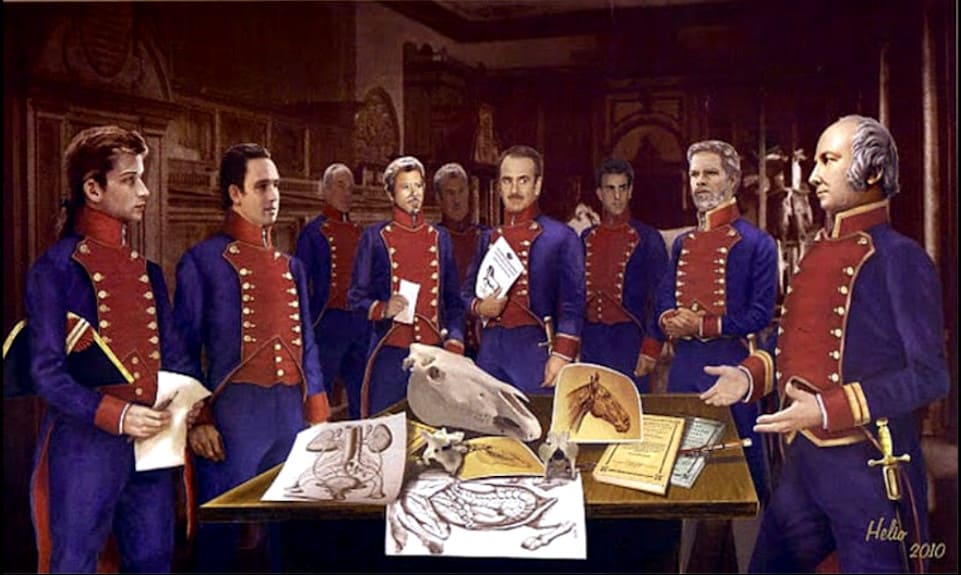
Military spirit and uniforms at the Veterinary School

Between Between 1845 and 1854, a section of his *Boletín de Veterinaria* was actively promoting military veterinary medicine. Casas was, according to his disciple Morcillo, a man of strong character, with a steely resolve and a slave to duty—virtues that characterized him from his youth and were further strengthened in the teacher under the influence of the military spirit that reigned at the School of Veterinary Medicine.

This was inaugurated on 18 October 1793 with the sole purpose of providing good quartered institutes, placing itself under the protection of the inspector general of the cavalry until 1825.

It admitted students, dividing them into military and civilians, the number of which is set at 96. The military should serve eight years, four of which would be in school and the other four in regiments for exercise science.

In the early days, the School of Veterinary Medicine of Madrid was so into the orbit of the military that he figured as a military officer, as he recounts in the State Military of Spain, 1806.

The School of Veterinary consisted of a company, created by the Royal Ordinance of 13 September 1800, of a commanding officer, two juniors, three sergeants, three corporals (in charge of the government economy), and 60 students.

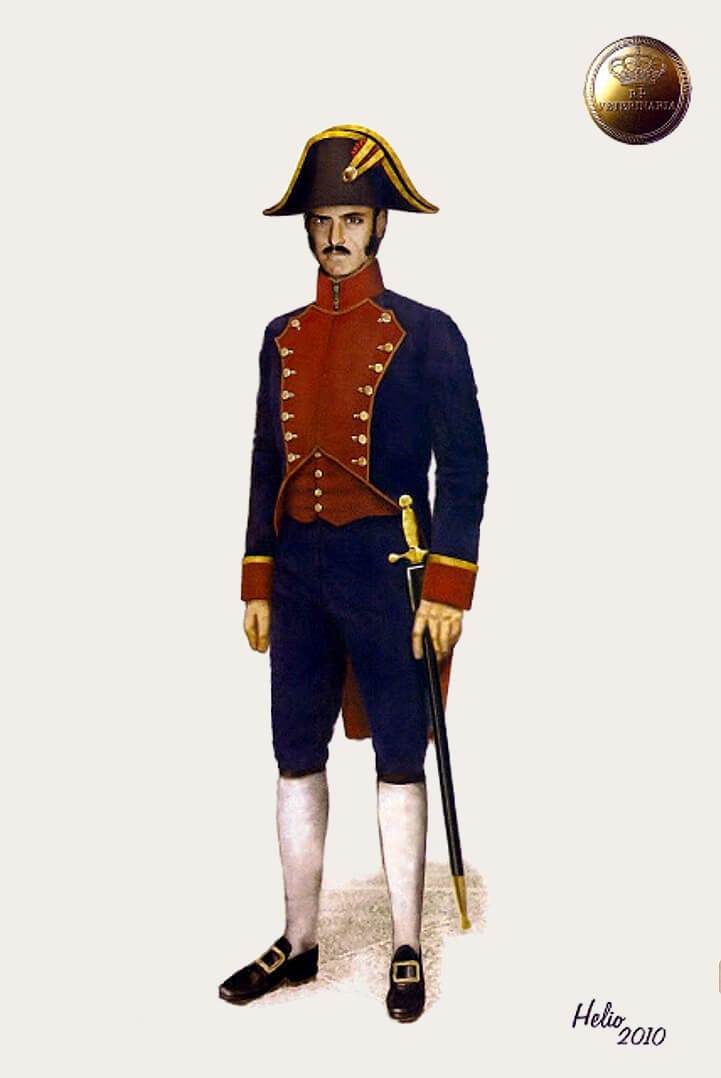
The Ordinance on the Organization and Administration of the Royal School of Veterinary Medicine in Madrid, referring to the director’s uniform, states:

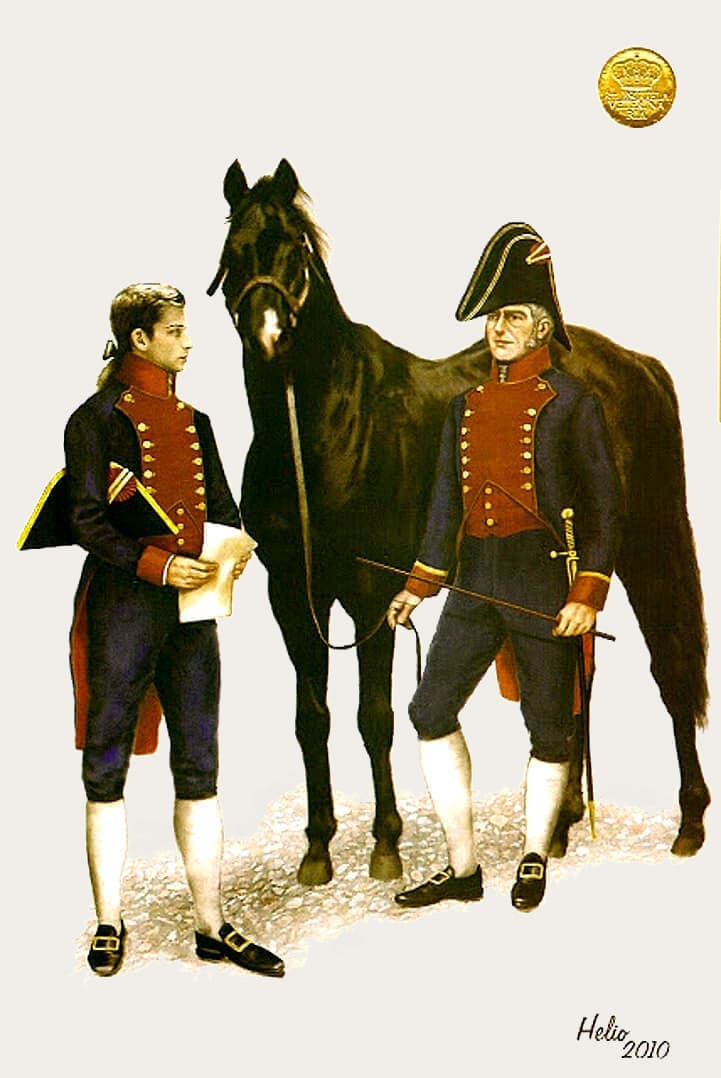
The uniform will bear the same insignia as the students’ uniforms, and to distinguish it from the teachers’ uniforms, it will feature a narrow gold embroidery strip, slightly more than a finger’s width, on the jacket and collar, and two such strips on the cuffs; and so that it is not confused with other uniforms, the lapel of the jacket shall be red, of the same cut, with gold thread buttonholes and a gilded metal button bearing the inscription “Royal Veterinary School.”

The staff of the director was the hallmark of command and carried a black wrist strap with two acorns, similar to the baton of the colonel's current.

Director of the Royal School of Military Veterinary Medicine. 1800

Professor and student at the Royal Military Veterinary School. 1800

Royal College, School of Veterinary Medicine of the Court.

Teacher explaining the lesson and students attending and taking notes in a hands-on class.

Uniform the students' uniform consisted of a blue jacket and trousers, with a red collar, lapels, and lining, accented with suede-colored trim and gold-threaded buttonholes on the lapels; it also included a gold button and a hat without braiding.

Professors at the Madrid School advocated for the creation of a military veterinary corps. Casas was a leading figure in this movement, using his writings in the *Boletín de Veterinaria* to defend the importance of military veterinarians.

During the fifteen years that this publication was in circulation, she produced countless works that helped elevate this military veterinarian to her rightful place in the scientific community. Her efforts were rewarded on June 15, 1845, when the formation of the Military Veterinary Corps was officially decreed.

By Royal Order, on September 5, 1856, the Military Veterinary Corps was granted a set of regulations governing its services, powers, and other matters and was granted the right to wear a uniform bearing the corps’ insignia: a sun in the center and the motto “Military Veterinary Corps” around the edge. On February 4, 1865, the first military veterinary corps regulations were published. They were approved.

A graduate of the Royal School of Veterinary Military, 1800

Students those who, through their continued diligence and hard work, successfully complete all the courses taught at this Royal School and pass the final examinations to be held at the end of the term shall be entitled to the following privileges: they may wear the school’s student uniform with gold braid on the lapels, like the assistant instructors, and shall carry a sword in the same manner.


You may be interested in these other sections


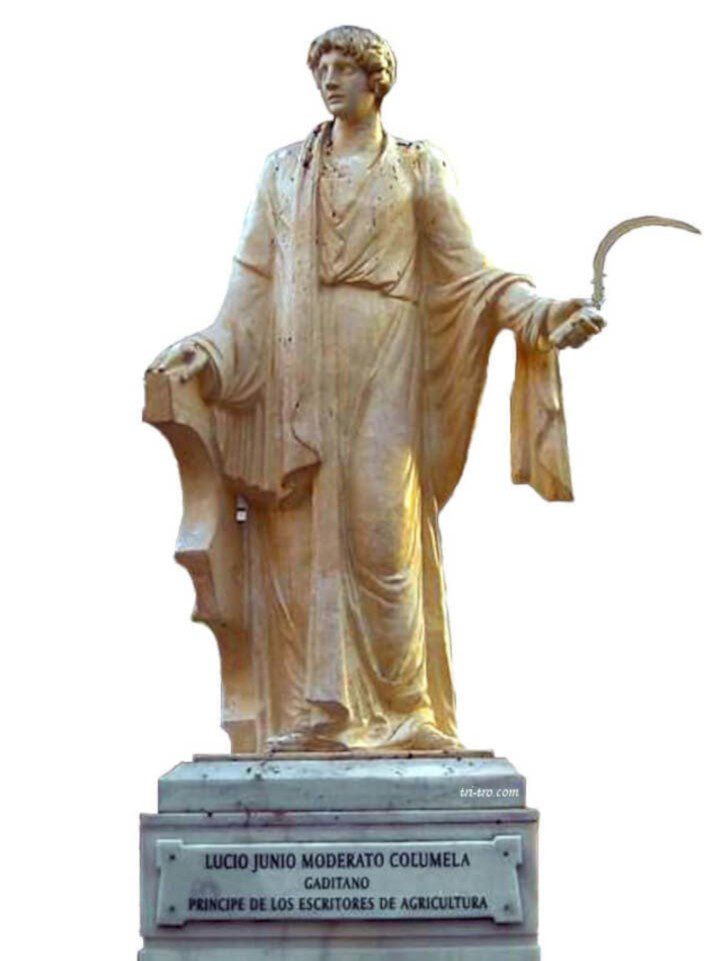
Lucius Junius Moderatus Columella, the master of Roman agriculture

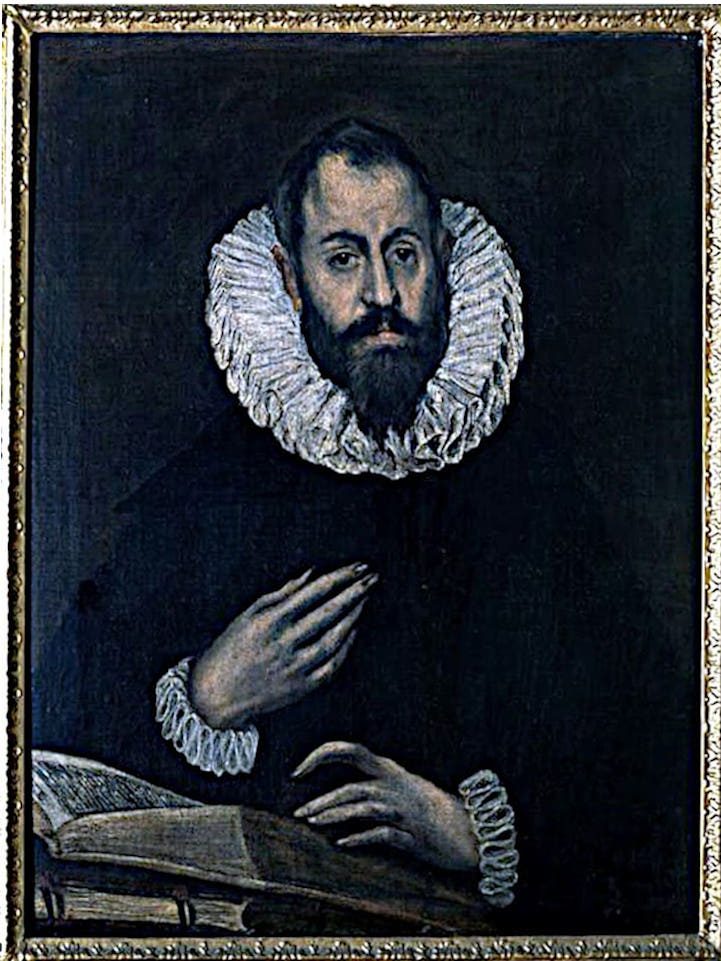
Legacy of Gabriel Alonso de Herrera 

Discover the history of the Castilian Black Hen


Do you want to share or comment on your social networks

Scan to visit TRI-TRO
Escanea para visitar. TRI-TRO