The natural process by which hens shed their feathers is known as molting. During this period, hens replace their old feathers with new ones, which requires a significant amount of energy and results in a temporary decrease in the number of eggs they lay.
This process typically occurs between late summer and fall and can last for weeks or months, depending on the hen and her specific circumstances.
The birds have The body is covered in feathers; each part of the body has the type of feathers best suited to its specific function. They protect and cover the body, help retain body heat, and enable flight, but they must be replaced; this process is known as molting.
Molting is a natural process in hens during which the birds shed their old feathers and grow new ones. During this period, hens shed their old feathers and grow new ones, which requires a significant amount of energy and results in a temporary decrease in the number of eggs they lay.
Our chickens and other birds have retained scales—which are modified feathers—as a remnant of their dinosaur ancestors; these scales are now found only on their metatarsals and toes, where they remain. The most distinctive feature of birds is their plumage.
It performs multiple functions, the most important of which is endothermy or homeothermy (which maintain their body temperature independently, regardless of the ambient temperature) and flight.
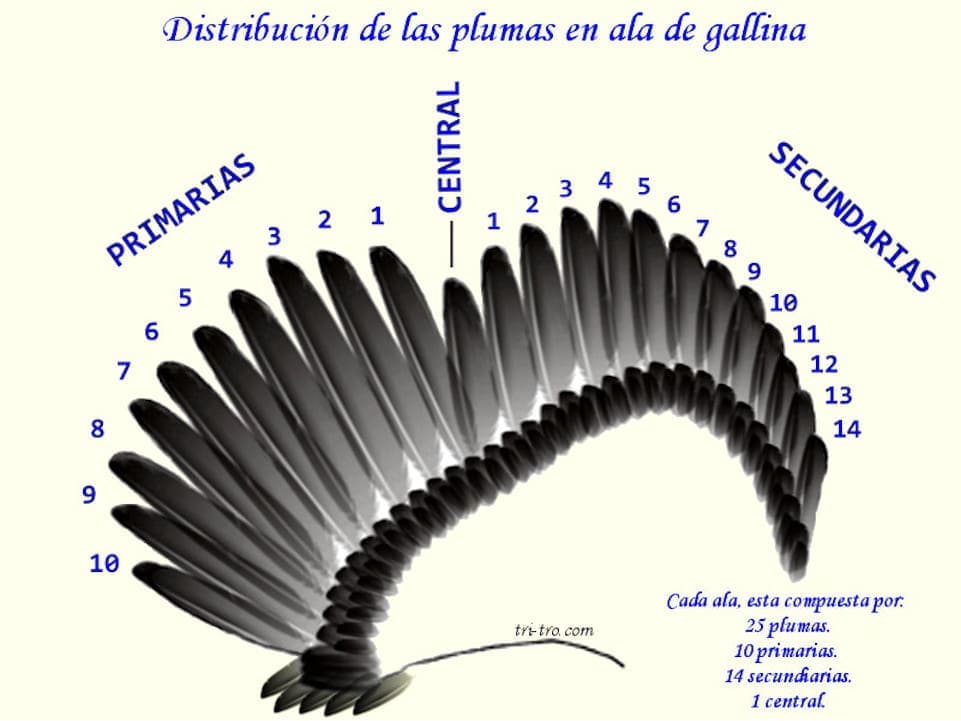
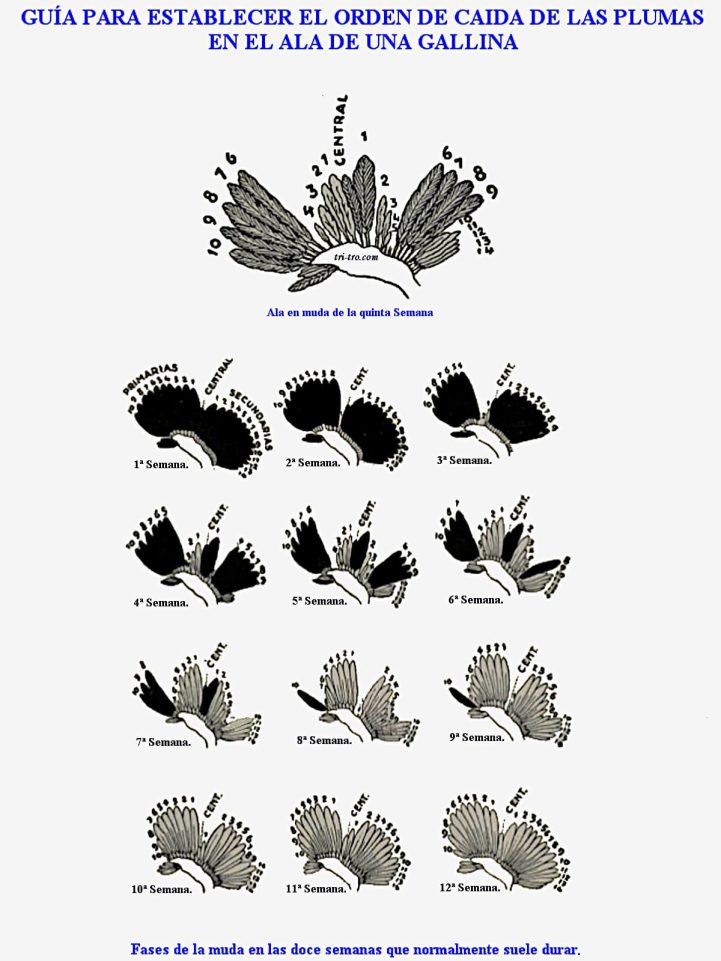
By observing the plumage of our hens, we can gather a wide range of information that we must take into account for their proper management—such as determining when molting begins, how long it lasts, and how it progresses—and noting the changes in the wing feathers as molting occurs.
Molting usually begins in late summer and continues mainly through the fall.
The fall and the birth of the pen will happen with a certain order, starting at the head and along the neck, chest, body, wings, and tail. Feather's new start to immediately leave that fall the old.
Depending on their structure and color, feathers exhibit varying degrees of resistance to wear and tear caused by environmental factors; naturally, to maintain their functionality, they must be replaced periodically; this process is called molting.
One of the main functions of molting is to replace worn-out feathers, but it also allows birds to adapt their appearance to different life stages—such as courtship and social hierarchy—which are vital to them and occur annually.
We can classify or divide bird molting into body molting and flight molting, which occur in different ways but are synchronized in terms of when feathers fall out and new ones grow in, so that there is no gap parts from the chicken's body, completely exposed.
The molting process in chickens takes place in different ways or phases; it all depends on the bird’s needs and age. They are forced to intersperse molting among the different phases of their annual biological cycle so as not to overlap it with other periods of high energy demand, such as reproduction.
During this period, the hens experience significant psychological stress and are prone to health problems due to appalling conditions, comparable to the scarcity of food or the cleaning of the premises.
New feathers are easily distinguished from old ones; to do so, simply note that they are wider, with large, full, and soft shafts, and appear clean and shiny, whereas old feathers are more pointed and look worn, with hard, small, and almost transparent shafts.
Persistent layers, which start molting late, produce more feathers at the same time: two, three, and four, depending on the speed of molting, and thus complete it sooner.
In this case, when we find primary feathers of the same length, they are considered as a single feather for the purpose of calculating the time since molting began. Furthermore, even good layers do not always molt all their primary feathers, which, combined with the rapid growth of the others, greatly shortens the molting period.
Molting is generally classified as early, intermediate, or late. In poor layers, molting occurs early, and the process is very slow and barely noticeable. They also do not resume laying any sooner than those that molt late, not beginning their second laying year until December–January, and thus remain unproductive for about four months. Raising hens that molt at an intermediate stage is generally beneficial.
Laying hens that continue to lay well into the summer begin their molting season late; they stop laying for only two to three months.
In these late-moulting birds, the feathers fall out quickly and their plumage appears coarse and disordered, with their bodies quickly becoming covered in rudimentary feathers.
In these chickens, the completion of molting and the start of egg production occur almost simultaneously, beginning just as soon as those that molted early. These birds are vigorous and have high production rates; they require careful attention.
In exceptional cases, among very good layers, hens go without laying for only four or five weeks, and they begin laying again before their new feathers have fully grown in.
When selecting laying chickens at the end of their first year, the condition of their plumage will give us an indication of their laying persistence. Highly persistent layers, due to their frequent visits to the nesting box and the fact that their feathers are still old, will appear worn, dry at the base, ragged, and dirty, whereas poor layers will have shiny, glossy plumage.
There are factors believed to influence molting, which can cause it to occur earlier, later, or outside the normal season. Poor nutrition and a lack of vitality cause molting to occur earlier, while a good diet delays it.

Chicken molting can be classified based on its origin and characteristics, as there are different types:
Molting cycles: The total number of molts a hen undergoes during its lifetime is referred to as such; this is characteristic of each breed, though variations may occur, either within a group or among individual birds of the same breed. Hens have several different plumages, which are characteristic of their age, sex, or time of year.
Juvenile plumage: Chicks hatch covered in down, which is quickly replaced by juvenile plumage. In many species, this juvenile plumage is replaced during the post-breeding season by a first partial molt, giving the bird an appearance similar to that of adults, which it will retain throughout the winter until spring, the pre-breeding season, when another partial molt will provide it with its breeding plumage.
Partial moulting: Most gallinaceous birds undergo another molt in advance of the breeding season. This typically affects only the body feathers, altering the bird’s appearance to prepare it for its role as a layer or breeder. At the same time, it allows the bird to adapt its plumage to seasonal climate changes.
Sometimes, chicks from early hatchings, which have reached sexual maturity early, begin laying eggs in the fall after a brief period of egg-laying; this often occurs in the Black Castellana breed because it is very prolific.
A partial molt occurs in the feathers of the neck, tail, and one or two primary feathers, which never fully develop. During this partial molt, egg production ceases. Therefore, efforts should be made to regulate both natural incubation (by broody hens) and artificial incubation in an incubator to prevent this molt from occurring.
Replacement due to wear and tear: To develop their breeding plumage, birds do not always need to molt. Many birds achieve this through the natural shedding of their winter plumage, during which no actual change in the feathers occurs. In our pens, we have noticed that in different areas of the bird, feathers have varying shades or discoloration, as well as differences in sheen, with noticeable wear or breakage at the tips; these are the feathers that will be replaced due to wear and tear.
Total change: Most hens molt their entire plumage at least once a year. When this complete molt occurs, the hen interrupts her laying cycle and devotes all her resources to the molting process.
In total or complete molting, each feather zone is renewed as a whole, at a programmed rate and duration; that is, each feather grows in the same spot as its predecessor, but with a certain time interval relative to the adjacent feathers.
In this way, we can intuit that a feather delays the growth of the adjacent one until it has grown a little, then falls out and allows a new one to grow. This results in a kind of renewal of the entire plumage, across all different parts of the bird's body.
In this condition, the bird needs its own resources as well as any additional food we can provide; in other words, we shouldn’t reduce the amount of food in its diet just because it isn’t laying eggs.
That is a mistake made by poultry farmers of the past; this process has significant effects on the hens’ metabolism. The production of new feathers requires a considerable amount of energy. The gradual loss of body feathers in hens reduces their insulating capacity, requiring more energy to regulate their body temperature.
That is why we must ensure their diet includes adequate nutrients, such as plenty of protein and fats (sunflower seeds, corn), as well as a vitamin complex to help them compensate for the depletion of their own reserves over the course of three months.
This molting period is the most important one for both our hens and us; the birds’ recovery and their performance during the new laying cycle and the breeding season depend on it.
In certain situations, analyzing a hen's molting pattern makes it possible to determine her reproductive capacity; this is a more technical procedure that you can examine in detail here.
Chickens typically molt once a year, usually between late summer and fall. This is linked to the decrease in daylight hours and the hormonal changes the birds undergo.
Molting can last anywhere from a few weeks to several months, depending on the bird's diet, age, and health.
It has always been highly debated the issue of the relationship between molting and the cessation of egg-laying. The reality is that there is a close connection between the two processes, which suggests that the nutrients the hen uses for egg production are diverted during molting to feather formation.
Generally speaking, stop the staging when the molting of the wing feathers begins, and it does not resume until the process is complete. Hence its importance in identifying good layers. The cessation of egg-laying can be explained by the fact that the bird’s condition is such that its body cannot simultaneously support both egg production and feather growth.
Molting requires a great deal of energy from the hen, which is used to grow new feathers; to give you an idea of this, consider that the weight of all a bird’s feathers accounts for one-fifth of its total body weight.
And it will not be able to function normally without deterioration of the organism if we do not provide it with the necessary building blocks for plumage through food or diet.
Experiments conducted by scholars in the field as early as 1940, such as Penquite, Thompson, and Heller, on the development of plumage in chickens, in which they used more than one hundred combinations of various grains in the diet, animal and plant proteins, vitamins, and minerals.
They demonstrated that feeding a single grain results in poorer plumage and that low-protein diets are unsatisfactory, with mixtures of proteins from different sources yielding better results than those derived from a single source.
It has been proven that, for the feather formation plume, an amino acid called cystine is required; when present in sufficient quantities in the feed, it results in reduced protein consumption.
Mineral salts must make up a significant portion of the diet, and we will ensure that vitamin intake is adequately maintained during molting, especially with regard to vitamins A, D and riboflavin.
Vitamin D requirements are estimated at 60 to 80 units per 100 grams of food, especially if they do not receive the beneficial effects of sunlight for much of the time. Riboflavin requirements are estimated at 130 units.
The form of administration of the food will be similar to the one used during other times, that is to say, on the basis of mixtures of grains and dry mixes, as is usually done throughout the year.
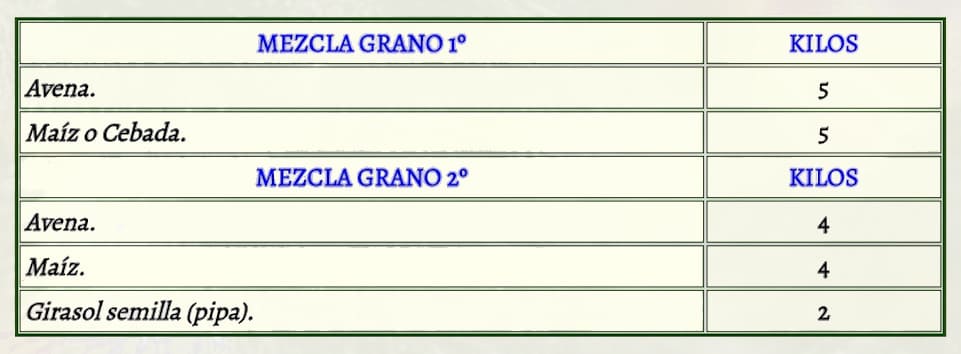
For example, grain blends can be composed as follows for 10 kilograms:
Grain mix in the diet
In the dry mix...the best thing we can do is provide our birds with a high-quality, balanced commercial feed mix, one that guarantees its composition and manufacturing standards, and which already contains all the necessary minerals, vitamins, proteins, etc.
As for how to distribute them, In the dry mix (feed) will be available to the hens throughout the day, and at midday they will be given a generous portion of greens, which is very important (dwarf clover, cabbage, alfalfa, etc.).
The grain mixture It is provided in small amounts in the early morning and in larger quantities in the evening, scattered over the bedding (shavings, straw); the hens will search for and scratch up the grains, getting some exercise in the process.
Feather loss in hens isn't always due to natural molting. There are other reasons why a hen might be losing its feathers:
To prevent more serious problems in the chicken coop, it is essential to identify the cause so that the appropriate solution can be implemented.
Chickens are often seen. or groups of plucked hens, and those who don't know about it think they are molting, but they are not always right.
Without having anything to do with the molt, hens, as all the domestic birds, can desplumarse at any time of the year by the effect of certain parasites, such as the feather mite and the feather moth.
They destroy the barbs of the feathers, leaving only the shaft and the rachis, and even causing the feather to fall out completely; naturally, it is replaced by another feather that grows in its place, which in turn is destroyed by the parasite, leaving the birds featherless for much of the year.
At other times, this fleecing is due to rearing, a very common vice among chickens that are kept confined in small spaces and without adequate food.
To pull or pluck the feathers to each other, and even eat the little bit of fat that is carried in the tube or the droplet of blood that can occur when trying to remove them.
This bad habit is terrible, because once it spreads throughout the chicken coop, there’s no stopping it.
The poultry farmer must isolate the first hen in which he observes this behavior as the only way to combat it; it is advisable to let the hens roam freely in the open field, not only because this keeps them apart from one another, but also because, as they enjoy foraging for grass and insects, they are distracted and thus lose this bad habit in a short time.
Another way to keep them under control is to hang up fruit or vegetable skewers to keep them busy or entertained so they stop plucking their fellow birds.
It is important to bear this in mind so as not to confuse normal, annual molting with plucking due to bad habits or as a result of parasitic infestations.
Chickens tend to stop laying eggs or drastically reduce their egg production during the molting process. This happens because the body prioritizes feather renewal over reproduction.
Each new growing feather is supplied with blood by tiny blood vessels that nourish it until it is fully developed. Once the feather is fully formed, these vessels atrophy. This process is very energy-intensive for the bird, which explains the drop in egg production during this period.
For this reason, it is essential to pay close attention to a hen’s diet during molting, avoiding any reduction in her food intake even if she stops laying eggs, as she needs an increased supply of nutrients during this period.
Once the process is complete, the hen gradually regains her ability to lay eggs, often with an improvement in egg quality.
Understanding the molting process in hens makes it possible to improve their care and prevent common mistakes during this important stage in a bird’s life.
Yes, that's completely normal. Molting is a process during which the bird's body prioritizes feather renewal, which causes a reduction or interruption in egg-laying.
They usually migrate between late summer and fall, when the days get shorter.
Molting usually lasts between three weeks and several months, depending on the bird's age, health, and diet
If the chicken is losing feathers gradually, without any injuries or signs of illness, it is most likely molting. If you notice any injuries or unusual behavior, it may be a different kind of problem.
Since the growth of new feathers requires a lot of energy, they need a diet rich in nutrients and protein.
You may be interested in these other sections