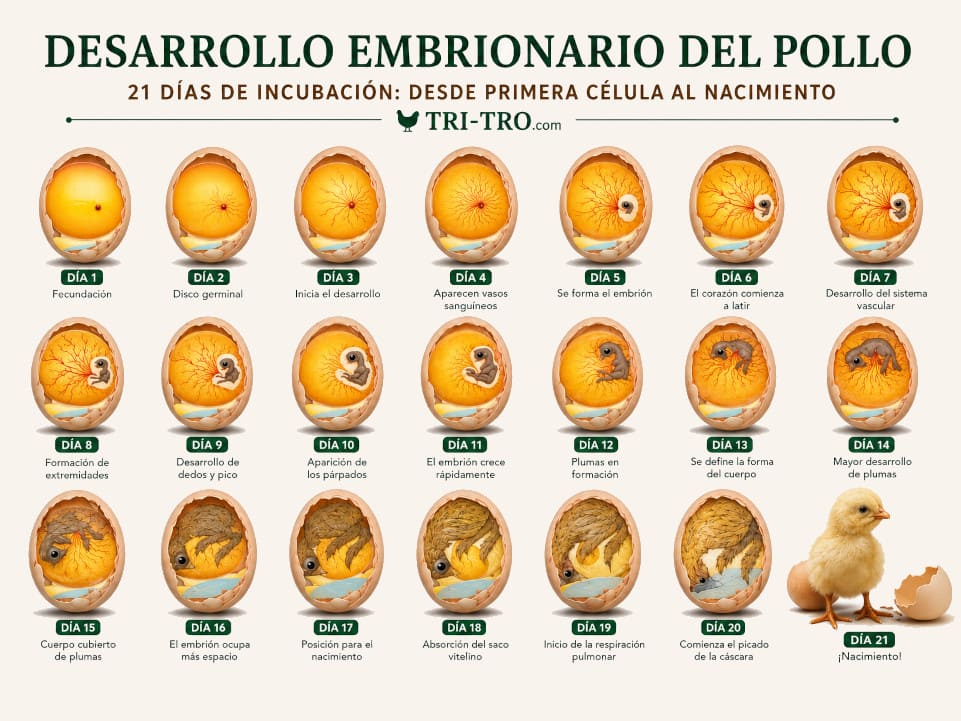
During the 21-day incubation period, one of nature’s most amazing biological processes takes place inside the egg: the transformation of a single cell into a fully formed chick.
Throughout this embryonic development, the organs, blood vessels, membranes, and structures necessary for the future chick’s life begin to form. Each day of incubation brings fundamental anatomical and physiological changes that help us understand how the embryo grows and prepares for birth.
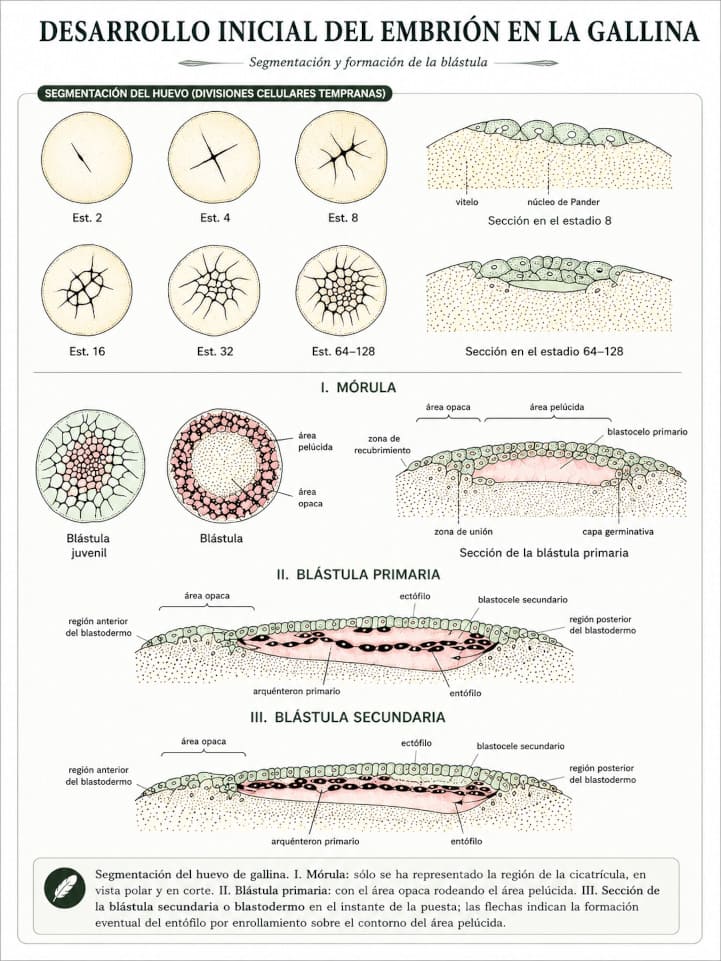
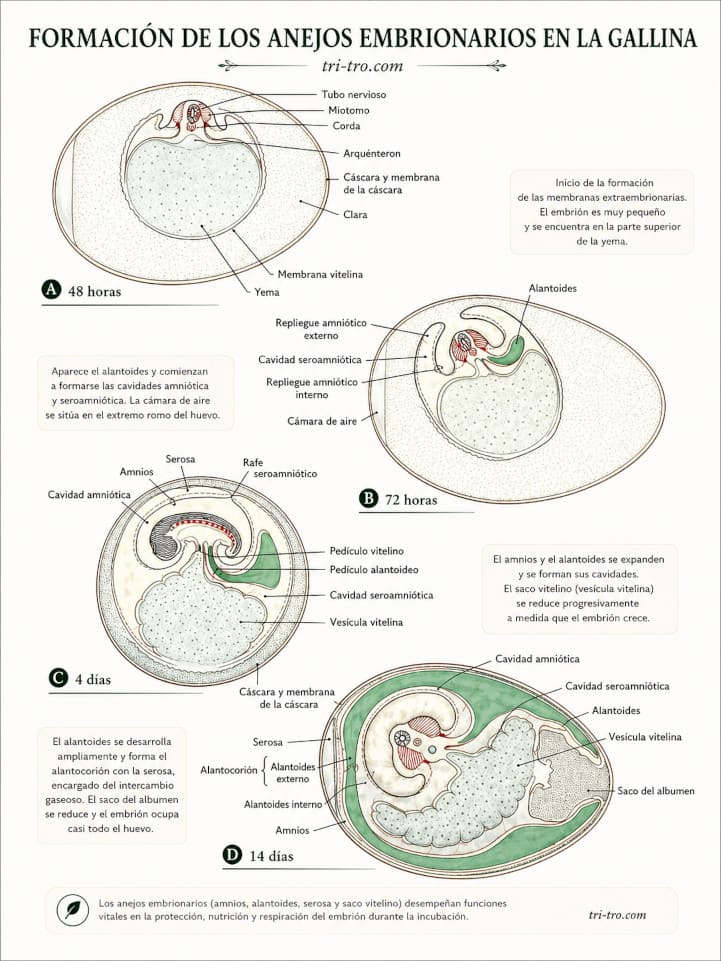
This visual guide provides a step-by-step illustration of the development of the chicken embryo from the first hours of incubation through to hatching. Real photographs and anatomical diagrams allow for a detailed examination of the formation of the blastoderm, the embryonic appendages, organ growth, yolk absorption, and the chick’s final position inside the egg.
Understanding these embryonic stages is essential for improving both artificial and natural incubation, interpreting hatching problems, performing embryo diagnosis, and understanding the causes of embryonic mortality in eggs that fail to hatch.
The difference between a fertile egg and an infertile egg can be seen in the structure of the blastodisc. In a fertile egg, a more distinct embryonic zone is visible, whereas in an infertile egg, a compact whitish spot is observed.
What is the visual difference between a fertile egg and an infertile egg?
In a fertilized egg, a more distinct ring or embryonic zone appears around the blastoderm, indicating that embryonic development has begun. In an unfertilized egg, however, only a compact white spot is usually observed, with no visible embryonic structures.
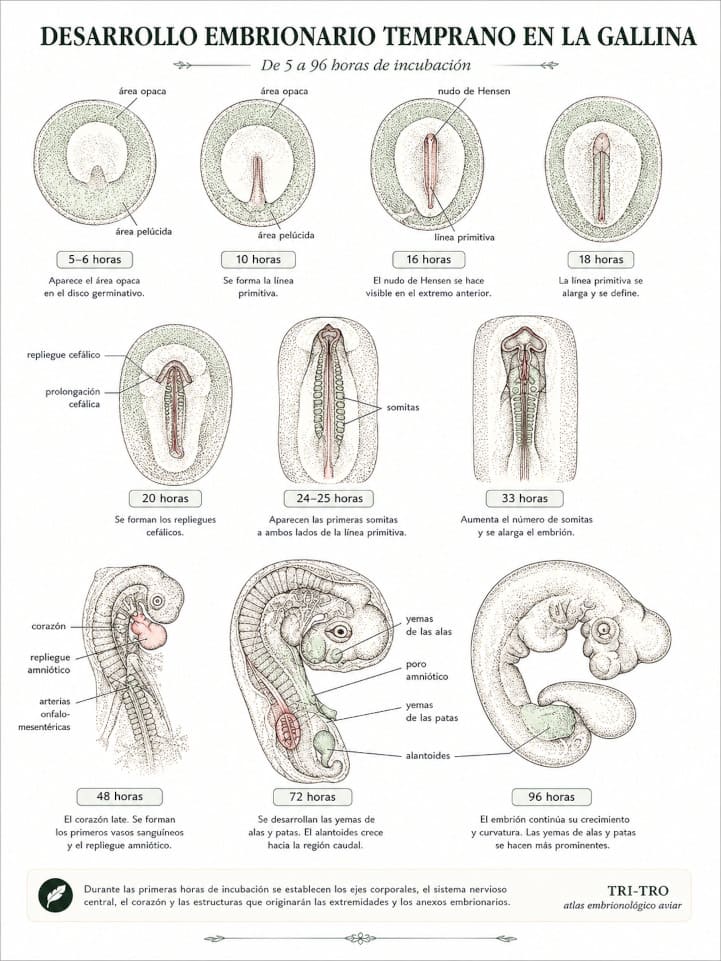
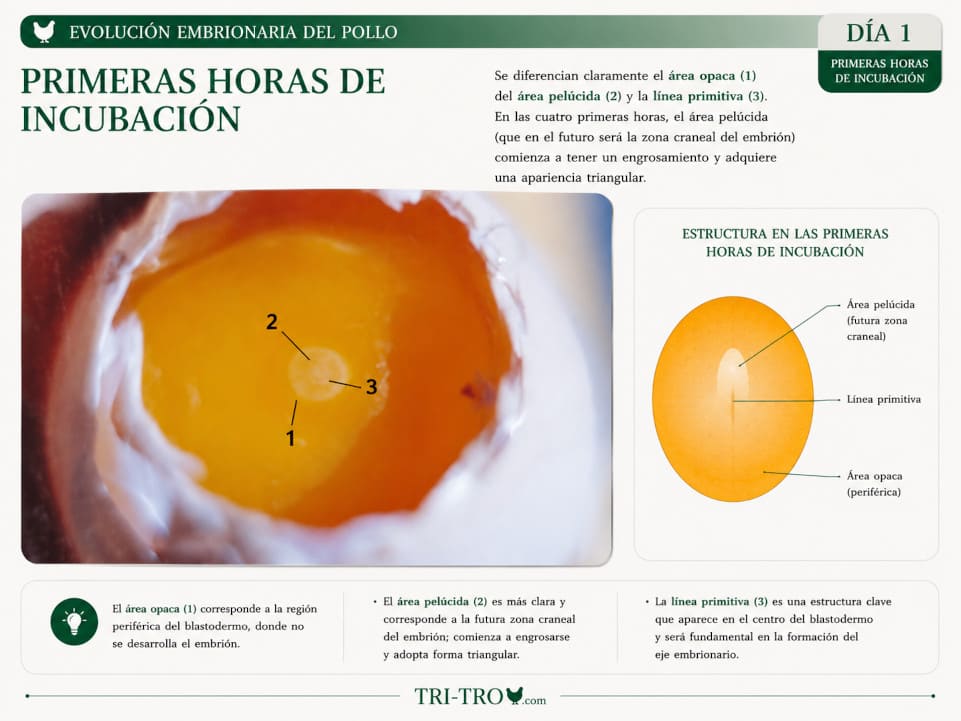
During the first few hours of incubation, the embryonic structures that will give rise to the future chick begin to form. In this initial phase, the opaque area, the chalaza, and the primitive streak appear, all of which are essential for the embryo’s development.
What happens during the first few hours of incubation?
The primitive streak marks the beginning of the embryo's development and is essential for the formation of the future chick's body axis. From this structure, the major embryonic tissues and organs will begin to develop.
⚠️ Important point regarding incubation: The first few hours of incubation are particularly sensitive to temperature. Significant fluctuations can disrupt the embryo’s proper early development.
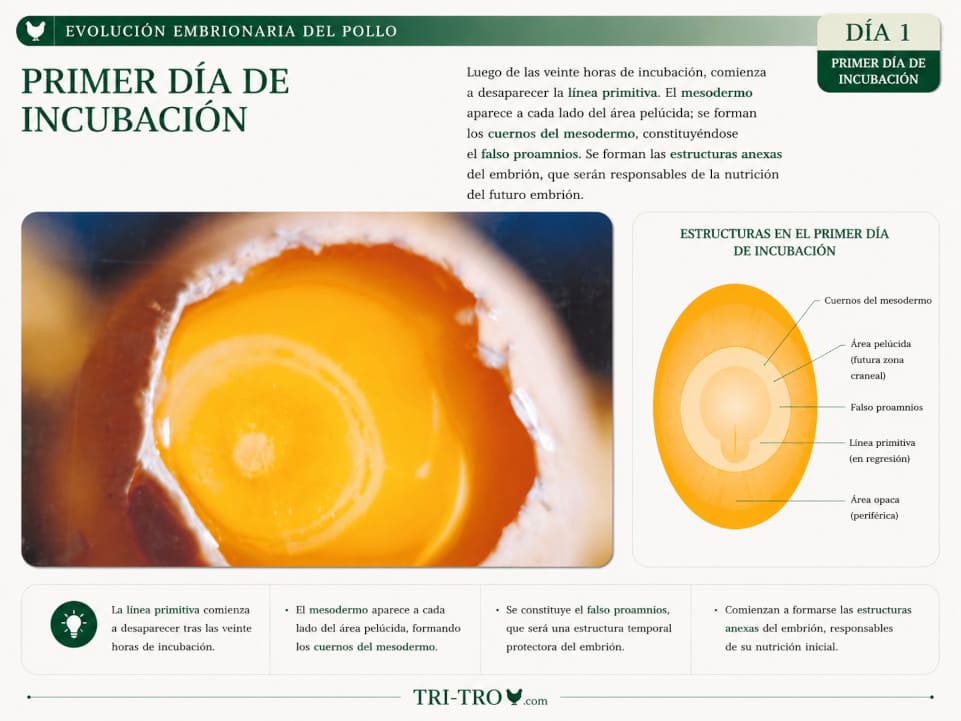
After the first few hours of incubation, the embryo begins to reorganize, and new embryonic structures essential for its development appear. The zona pellucida becomes more visible, and the embryonic appendages that will play a role in nourishing and protecting the future chick begin to form
What happens on the first day of incubation?
During the first day, the primitive streak gradually disappears, and essential embryonic tissues begin to differentiate. In this initial phase, structures develop that will later enable the embryo’s growth, nutrient exchange, and protection.
⚠️ Important point regarding incubation: A stable temperature on the first day is essential for the proper initiation of embryonic development and the formation of the embryo’s initial tissues.
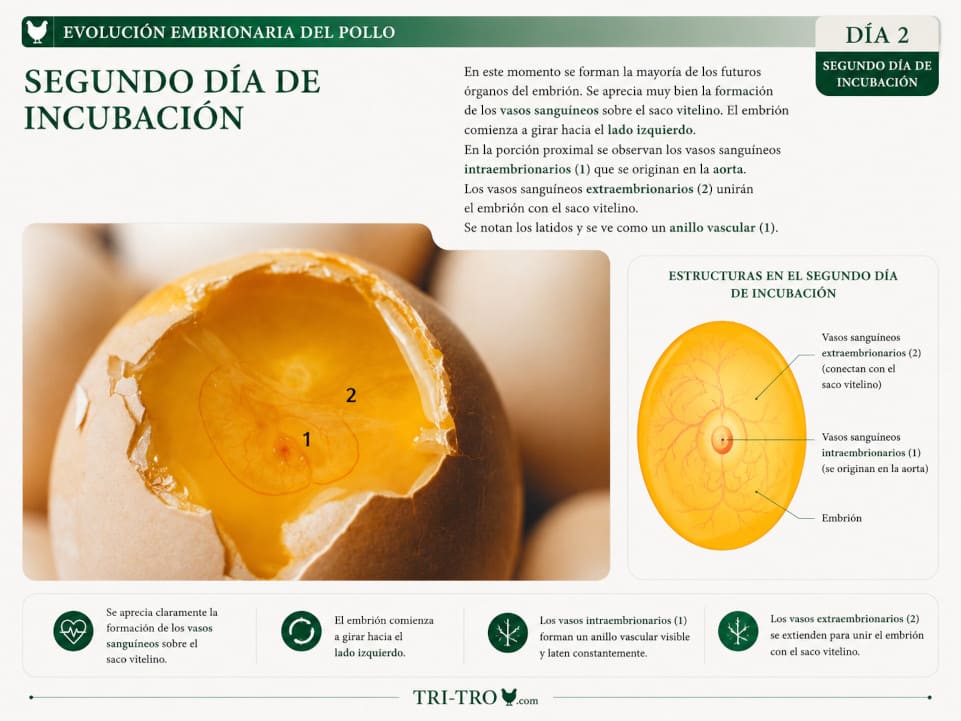
On the second day of incubation, many of the embryo’s future organs begin to form. Blood vessels become more visible on the yolk sac, and the heart begins to beat.
What happens on the second day of incubation?
The embryonic circulatory system begins to develop rapidly. Intraembryonic and extraembryonic blood vessels facilitate the exchange of nutrients between the embryo and the yolk sac, which is essential for its growth.
⚠️ Important point regarding incubation: During this initial phase, vascular development and the first heartbeats are highly sensitive to sudden changes in temperature and ventilation inside the incubator.
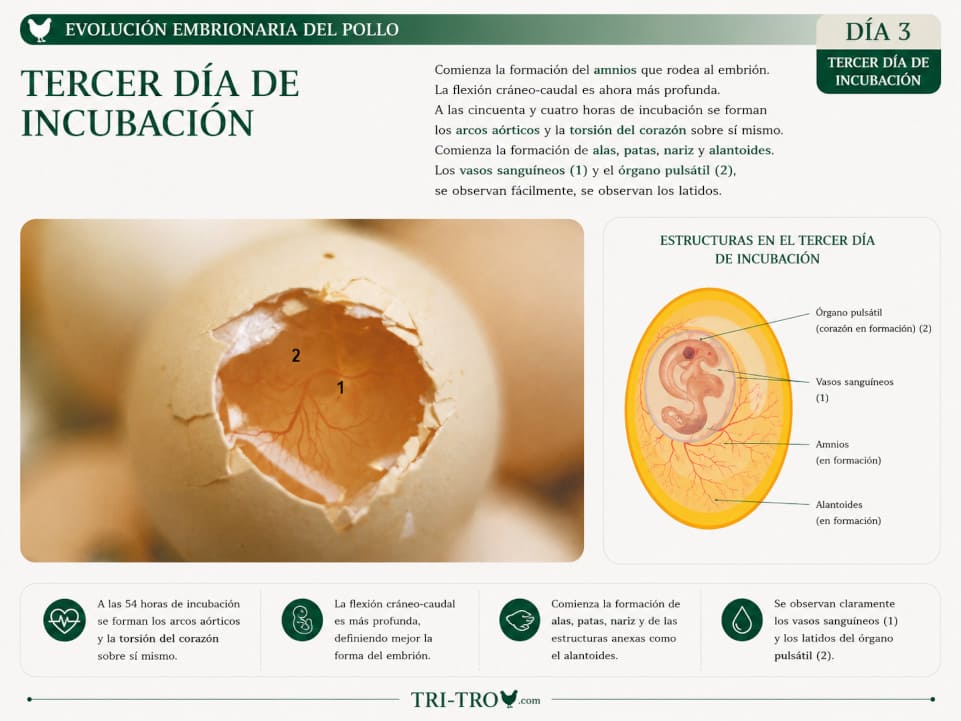
On the third day of incubation, the embryo undergoes significant anatomical development. The first aortic arches form, the heart begins to twist, and the initial structures of the wings, legs, and nose appear.
What happens on the third day of incubation?
The embryonic circulatory system develops rapidly, and blood vessels become increasingly visible on the yolk sac. The formation of the amnion and allantois also begins; these structures are essential for the embryo’s protection and respiration.
⚠️ Important point regarding incubation: At this stage, the embryonic heart is already showing visible activity, and the vascular system begins to expand rapidly. Adequate ventilation promotes proper gas exchange within the egg.
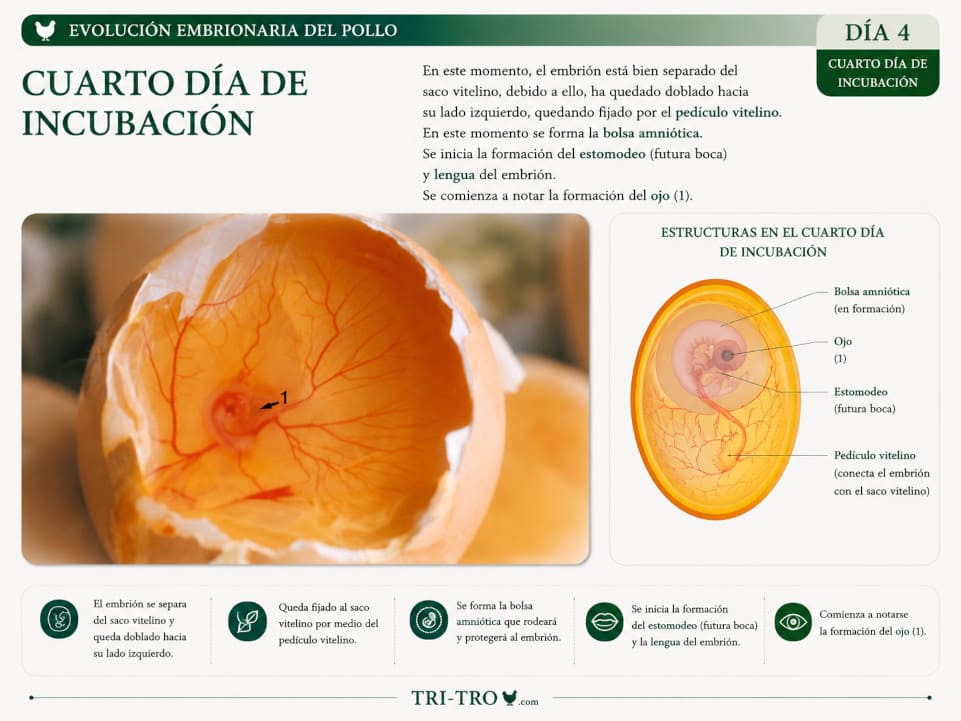
On the fourth day of incubation, the embryo begins to separate clearly from the yolk sac and adopts a position bent toward the left side. Important structures such as the amniotic sac, the future mouth, and the embryonic eye also begin to develop.
What happens on the fourth day of incubation?
The amniotic sac begins to surround the embryo and acts as a protective covering as it grows. The yolk stalk attaches the embryo to the yolk sac, which provides essential nutrients during the early stages of development.
⚠️ Important point regarding incubation: Rapid vascular and embryonic growth progressively increases oxygen demand within the egg. Adequate ventilation promotes proper embryonic development.
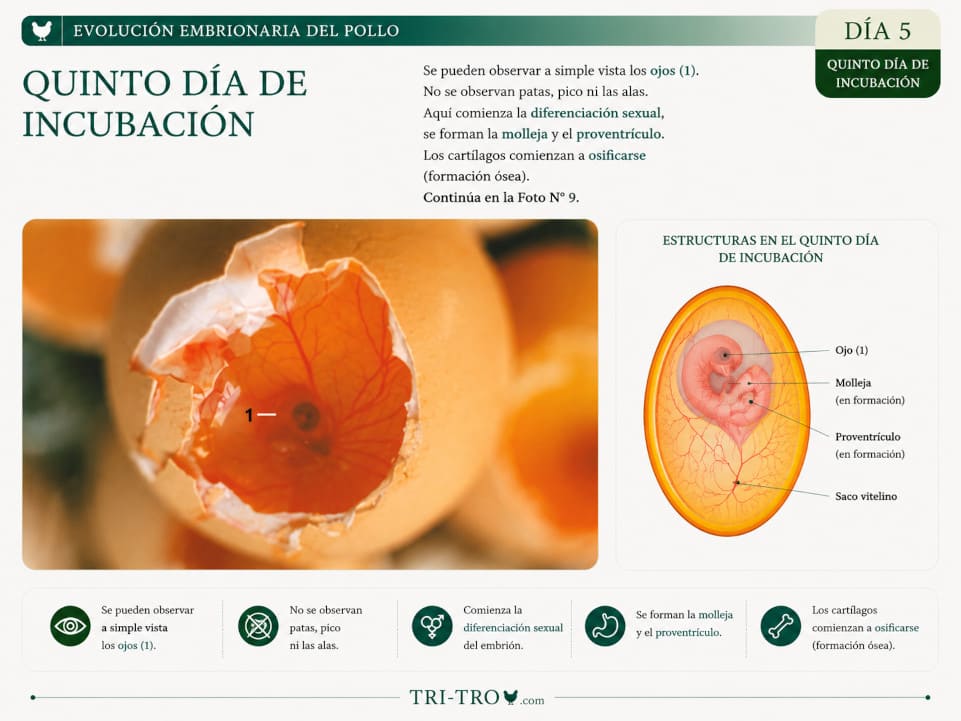
On the fifth day of incubation, embryonic development progresses rapidly, and the eyes become clearly visible. The formation of important digestive structures also begins, as do the first stages of ossification of the embryonic skeleton.
What happens on the fifth day of incubation?
During this stage, digestive organs such as the gizzard and the proventriculus begin to develop. The embryo's growth becomes increasingly evident, and the skeletal system begins to form.
⚠️ Important point regarding incubation: As the embryo's metabolism increases, oxygen exchange within the egg becomes increasingly important for the embryo's proper development.
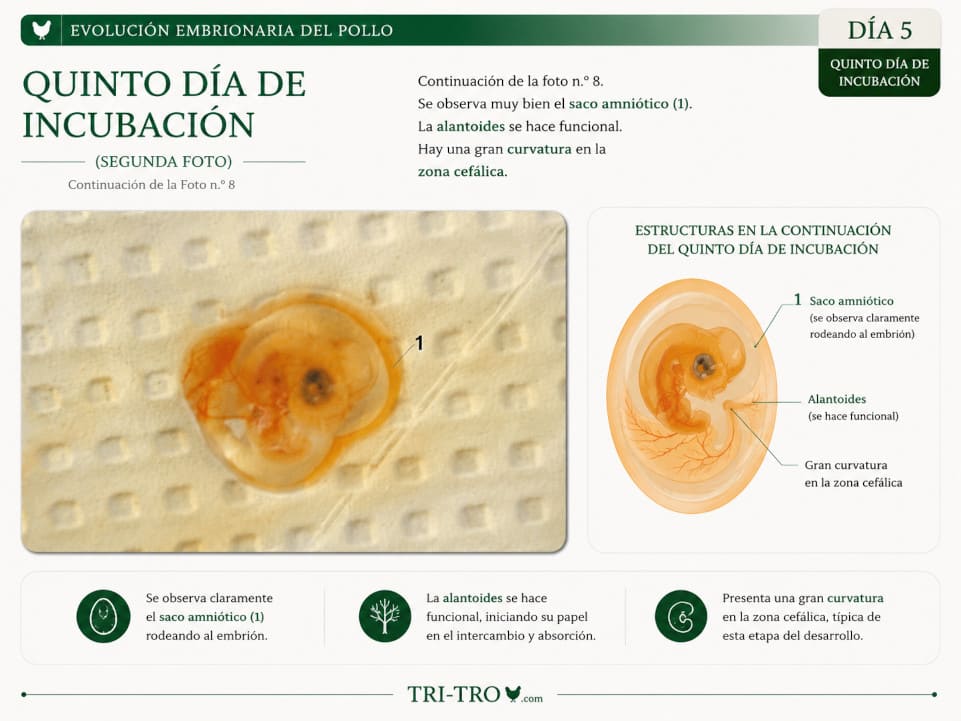
In the second image from the fifth day, the amniotic sac surrounding the embryo is clearly visible. The allantois begins to function and gradually plays a role in exchange and absorption processes.
What is the function of the allantois?
The allantois is a critical embryonic structure during incubation. It plays a role in gas exchange and in the accumulation of metabolic waste from the embryo as it develops.
⚠️ Important point regarding incubation: During this stage, embryonic growth is very rapid, and proper temperature and ventilation control promote the proper development of the embryonic membranes.
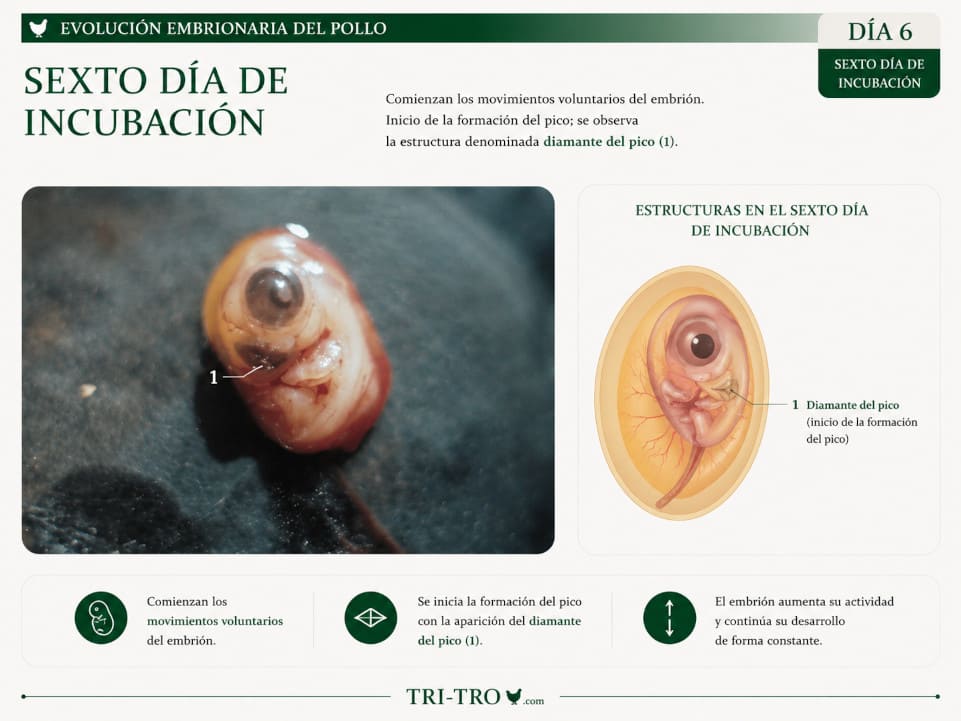
On the sixth day of incubation, the embryo begins to make its first voluntary movements. The beak also begins to form, and the so-called “beak diamond” appears—a structure essential for the chick's future hatching.
What is a beak diamond?
The beak diamond, also known as the egg tooth, is a small, temporary horny structure located at the tip of the beak. Later on, it will enable the chick to break through the shell during hatching.
⚠️ Important point regarding incubation: From this stage onward, the embryo’s activity and growth increase significantly. Maintaining a stable temperature promotes the proper development of embryonic structures.
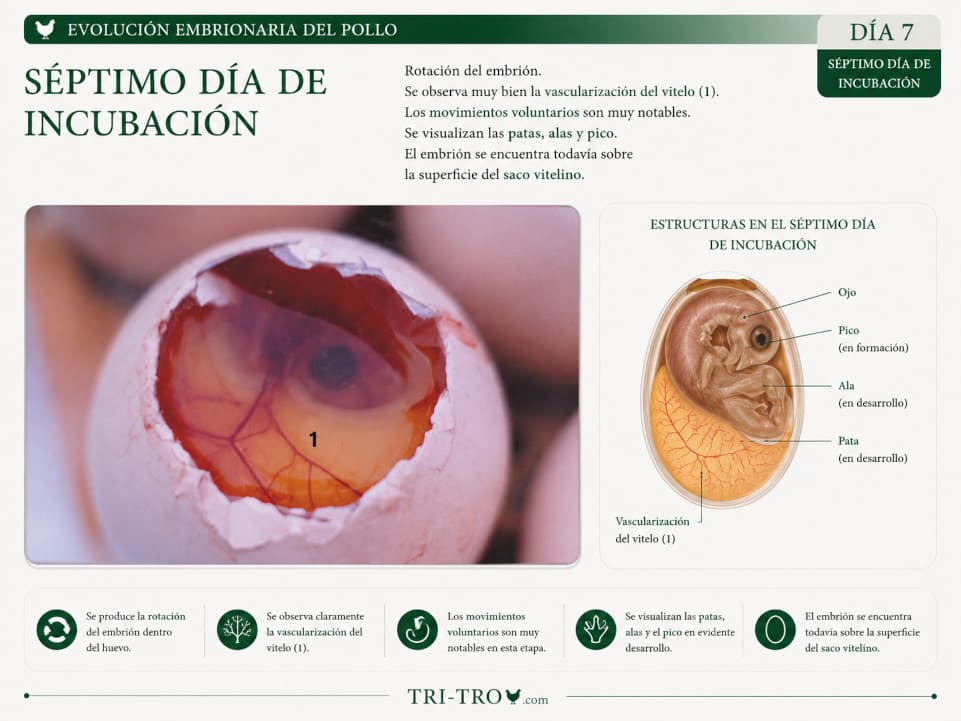
On the seventh day of incubation, the embryo continues to grow rapidly, and structures such as the beak, wings, and legs begin to become clearly distinguishable. The vascularization of the yolk sac becomes very evident, and the embryo’s movements are increasingly noticeable.
What happens on the seventh day of incubation?
At this stage, the embryo still remains on the surface of the yolk sac, from which it obtains the nutrients essential for its development. The vascular system continues to expand, and the embryo’s growth becomes increasingly visible.
⚠️ Important point regarding incubation: The increase in embryonic metabolism progressively raises oxygen requirements. Adequate ventilation promotes proper vascular and embryonic development.
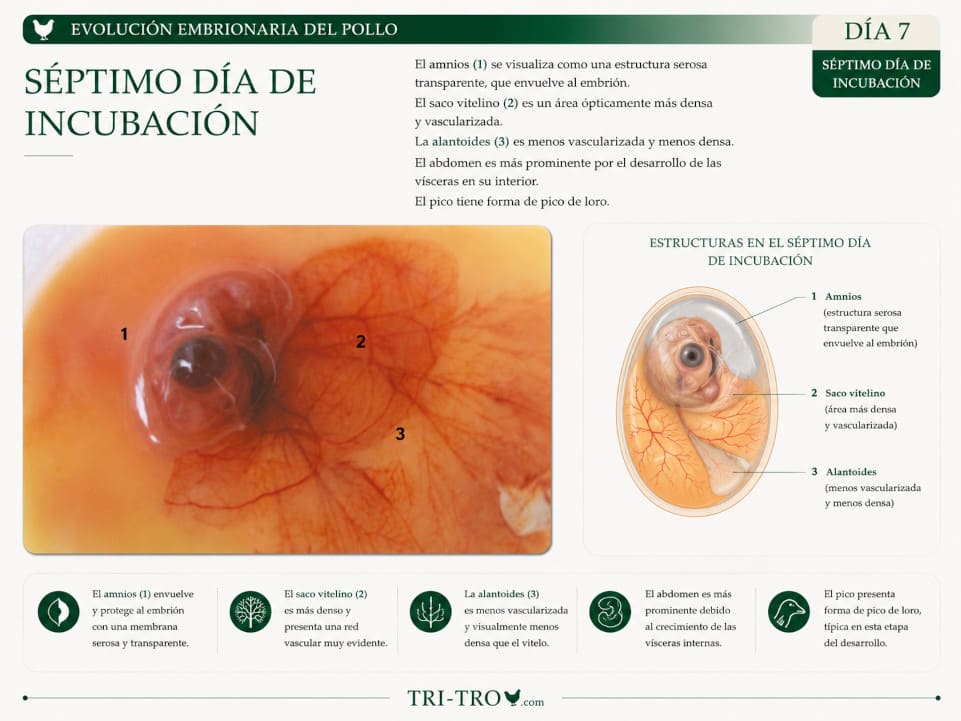
The second image from the seventh day shows a close-up of the amniotic sac surrounding the embryo and the differences between the yolk sac and the allantois. The abdomen is becoming more prominent due to the development of the internal organs.

What is the function of the amnion?
At this stage, the embryo still remains on the surface of the yolk sac, from which it obtains the nutrients essential for its development. The vascular system continues to expand, and the embryo’s growth becomes increasingly visible.
⚠️ Important point regarding incubation: During this stage, the embryonic membranes and blood vessels grow very rapidly, so maintaining stable incubation conditions is essential.
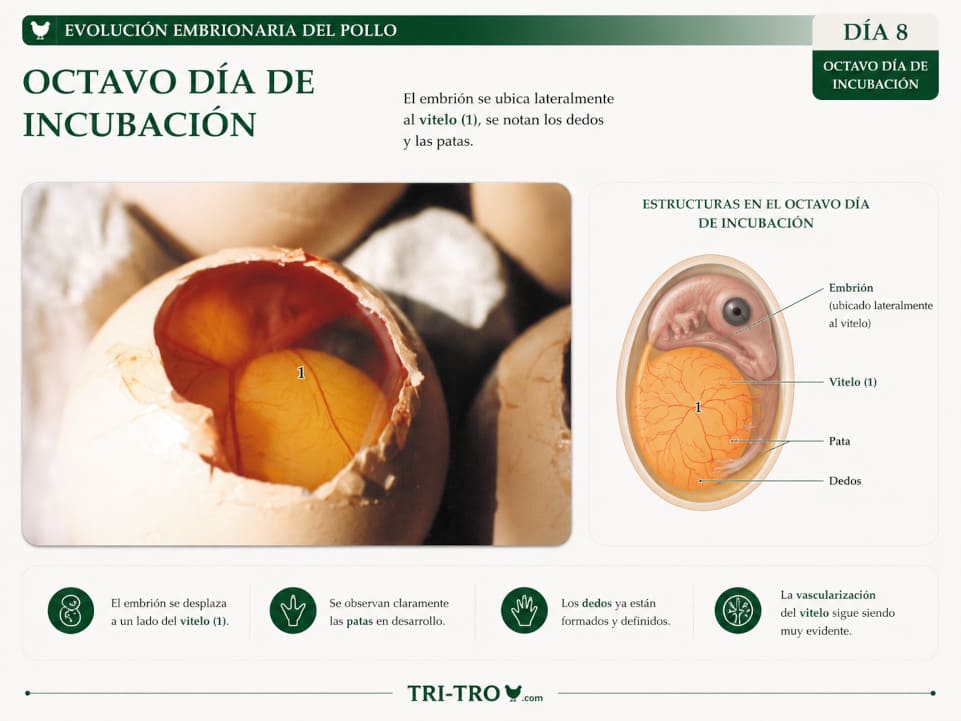
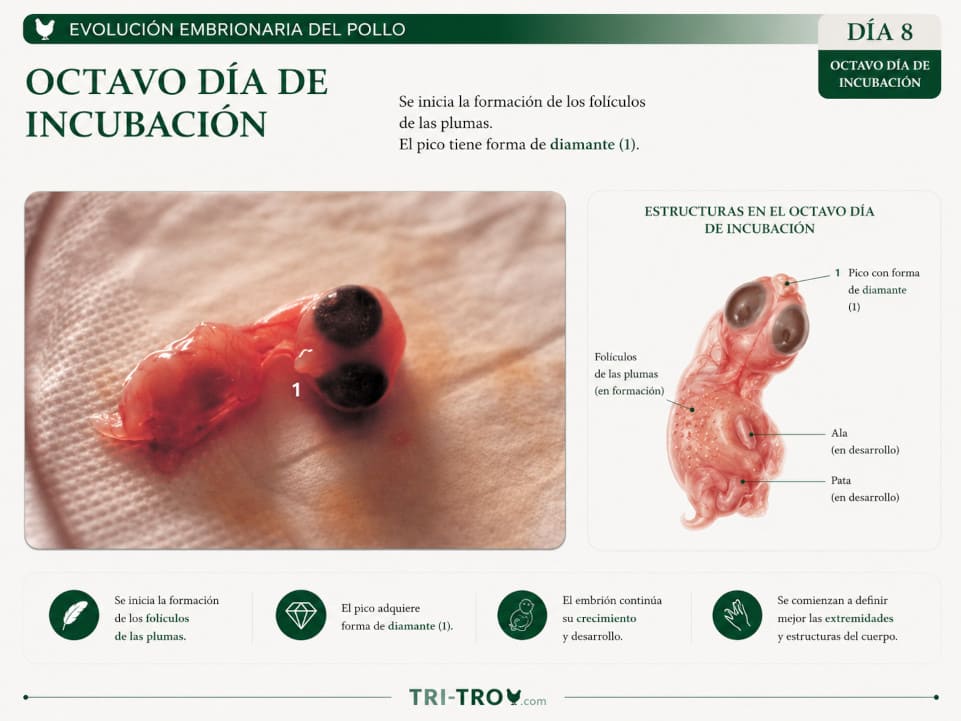
On the eighth day of incubation, the embryo continues to grow rapidly, and feather follicles begin to form. The beak takes on a more defined shape, and the beak's keel becomes clearly visible.
What happens on the eighth day of incubation?
The first downy hair follicles begin to develop on the embryo's skin, and the limbs take on a more defined shape. The embryo now exhibits increasingly recognizable physical characteristics.
⚠️ Important point regarding incubation: Embryonic growth accelerates progressively during this phase. A stable temperature promotes the proper development of bodily structures and future downy follicles.
In the second image from the eighth day, the embryo is seen lying on its side next to the yolk sac. The toes and legs are beginning to become clearly distinguishable, and the vascularization of the yolk sac remains very evident.
What is the function of the yolk sac?
The yolk sac provides essential nutrients for embryonic development and serves as the primary source of energy for much of the incubation period. Its rich blood supply facilitates the exchange of nutrients with the embryo.
⚠️ Important point regarding incubation: During this stage, the embryo grows rapidly and requires increasingly efficient gas exchange within the egg.
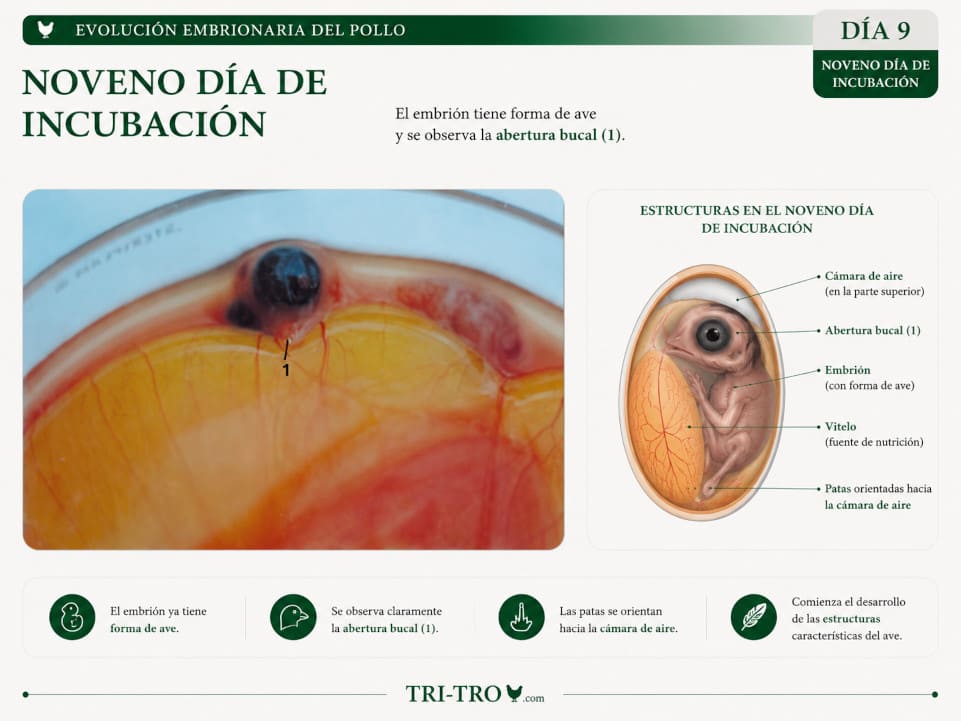
By the ninth day of incubation, the embryo has already taken on a clearly recognizable bird-like form. The mouth opening is now clearly visible, and the limbs continue to develop rapidly.
What happens on the ninth day of incubation?
During this stage, the embryo gradually assumes the position it will adopt in the final stages of incubation. The legs begin to point toward the air chamber, and the body structures become increasingly defined.
⚠️ Important point regarding incubation: Embryonic growth progressively increases the oxygen requirements inside the egg. Adequate ventilation promotes the proper development and positioning of the embryo.
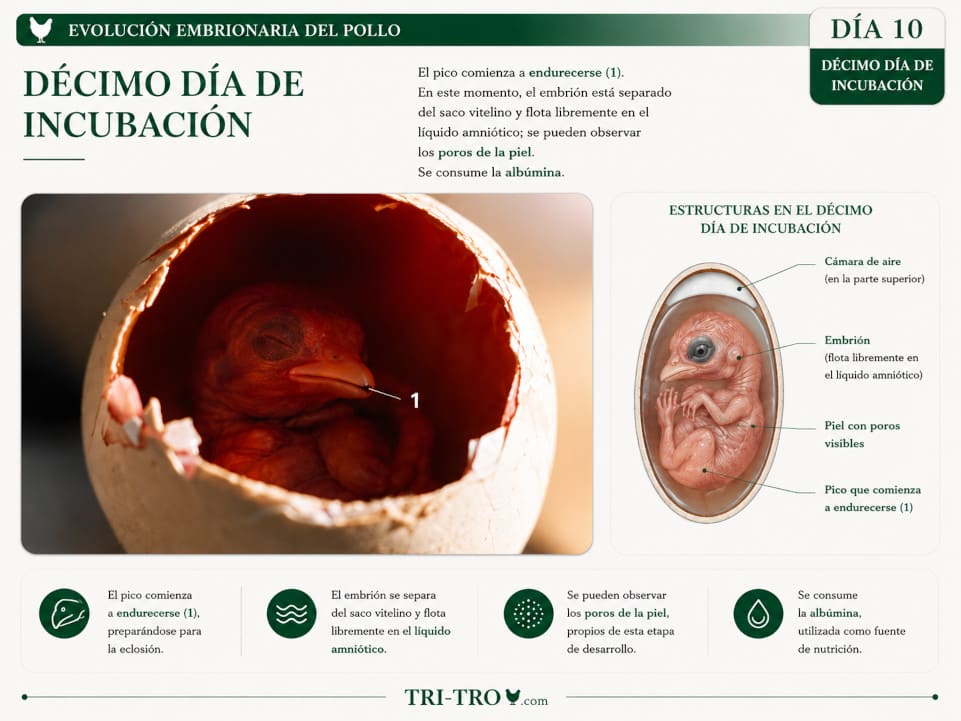
On the tenth day of incubation, the embryo continues to grow rapidly and begins to look more and more like a chick. The beak begins to harden, the skin develops its first visible pores, and the embryo is now floating freely in the amniotic fluid.
What happens on the tenth day of incubation?
At this stage, the yolk sac no longer holds the embryo together, and the embryo floats freely in the amniotic fluid. The albumin has been almost entirely consumed, and physical growth is becoming increasingly evident.
⚠️ Important point regarding incubation: Rapid embryonic growth progressively increases the need for oxygen and ventilation inside the egg. Maintaining stable conditions promotes proper embryonic development.
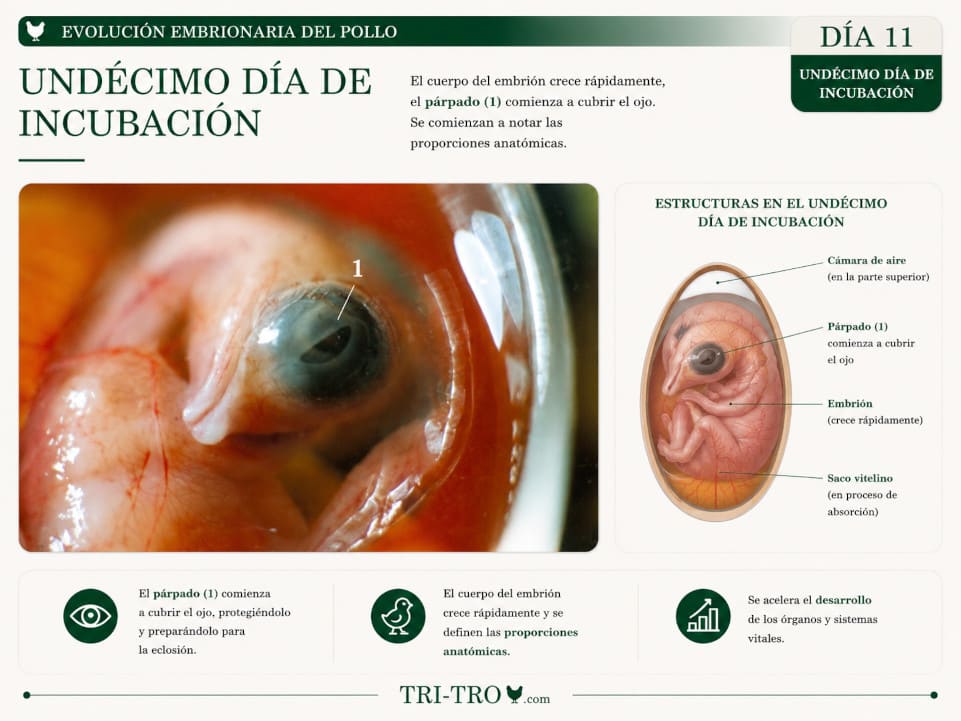
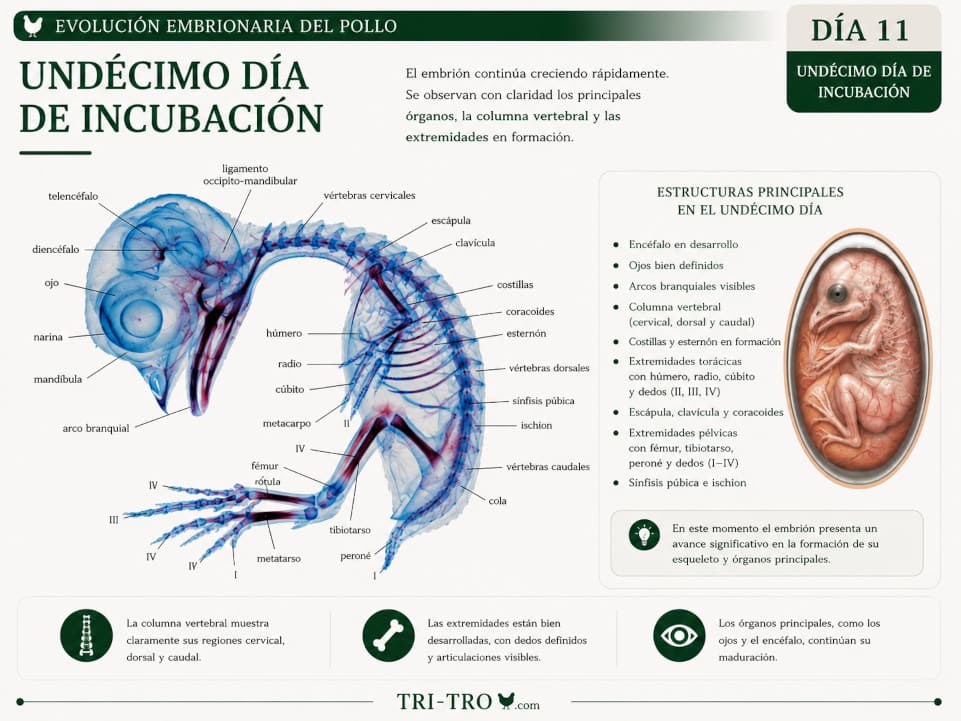
On the eleventh day of incubation, the embryo grows rapidly and takes on increasingly defined body proportions. The eyelid begins to partially cover the eye, and the anatomical structures of the future chick are now clearly recognizable.
What happens on the eleventh day of incubation?
At this stage, the development of organs and systems accelerates significantly. The yolk sac continues to provide essential nutrients as the embryo grows rapidly inside the egg.
⚠️ Important point regarding incubation: Embryonic growth is accelerating, and oxygen consumption is gradually increasing. Adequate ventilation supports proper embryonic development.
What can you see in this picture?
In this preparation, the soft tissues have been partially dissolved using chemicals to more clearly reveal the development of the spinal column and the embryonic bones. A row of bluish rings can be seen in the neck, corresponding to the future cervical vertebrae.
⚠️ Important point regarding incubation: During this stage, the development of the embryo’s skeletal and muscular systems accelerates. Body growth increases rapidly, and the demand for nutrients and oxygen continues to rise.
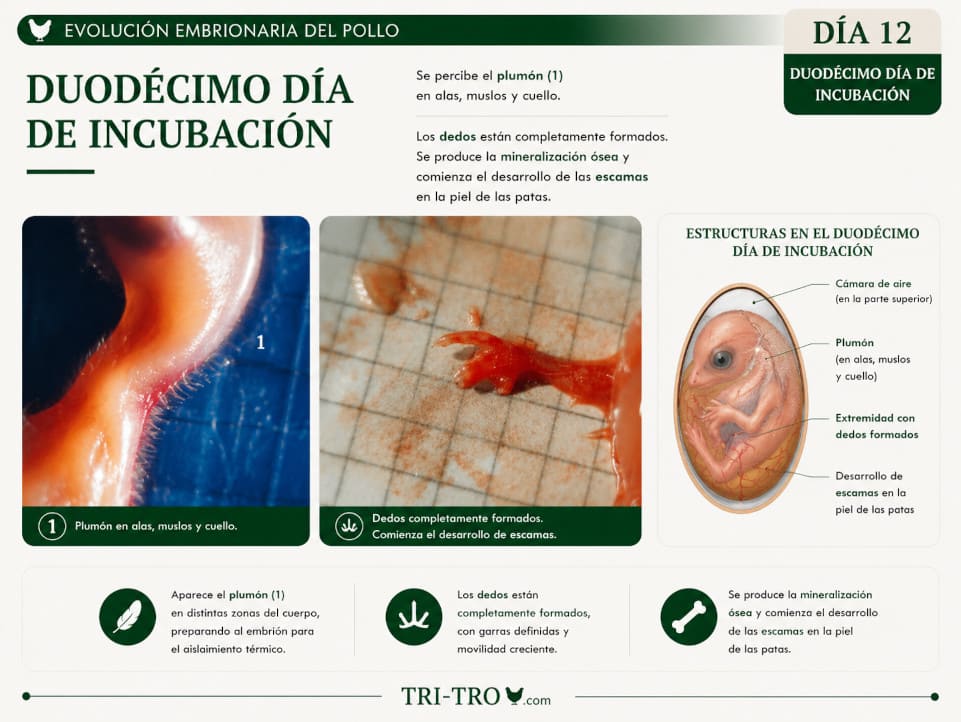
On the twelfth day of incubation, the embryo continues to grow rapidly, and the first down feathers begin to be clearly visible in various areas of the body. The toes are now fully formed, and scales begin to develop on the skin of the legs.
What happens on the twelfth day of incubation?
During this stage, bone mineralization accelerates, and the embryo begins to look more and more like a chick. Down begins to cover certain parts of the body, while the limbs and claws become fully formed.
⚠️ Important point regarding incubation: The development of feathers and bone structures reflects the rapid embryonic growth during this stage. The embryo progressively increases its metabolic activity and oxygen requirements.
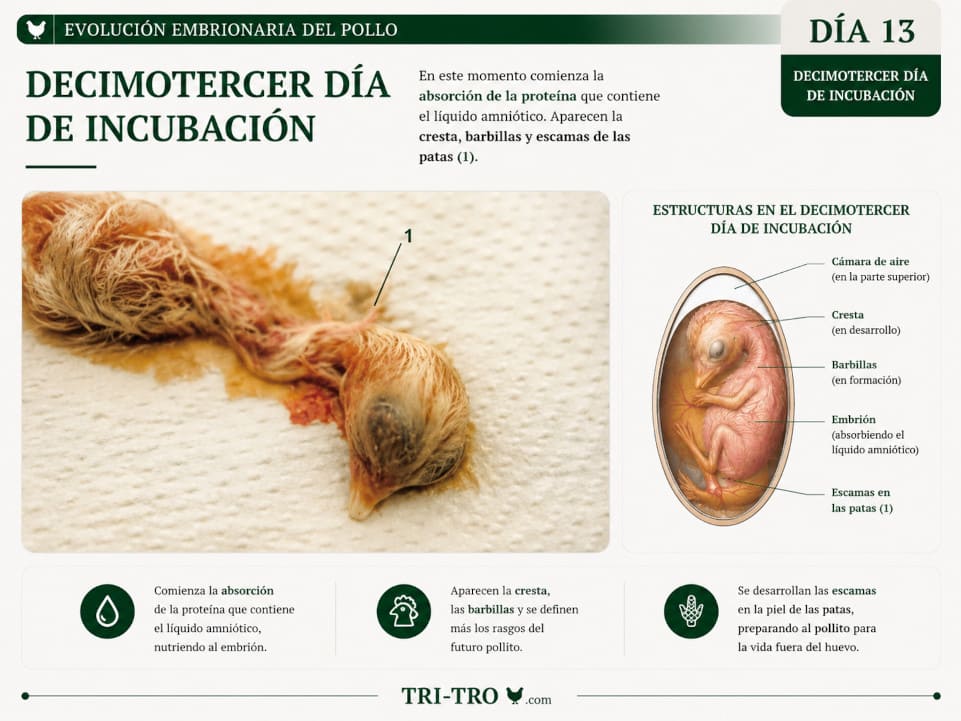
By the thirteenth day of incubation, the embryo has developed a thick layer of down and is beginning to look more and more like a chick. The crest, wattles, and other characteristic external features are starting to become visible.
What changes occur during this stage?
At this advanced stage of embryonic development, the chick's body is covered with down over most of its surface. Body growth is very rapid, and external structures continue to develop progressively.
⚠️ Important point regarding incubation: At this stage, the embryo takes up more and more space inside the egg, and its metabolic activity increases rapidly. The development of external structures such as down, legs, and scales indicates significant progress toward hatching.
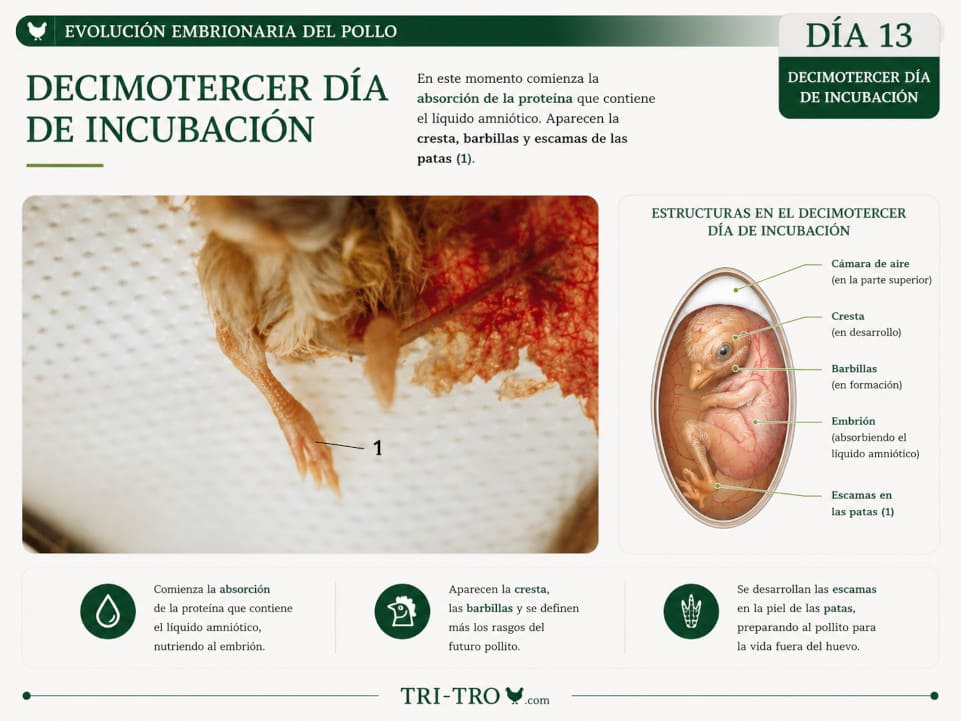
The embryo's legs and toes are fully formed, and the characteristic scales of the skin begin to develop. The claws and joints are already clearly visible at this stage of incubation.
What can be seen on the embryo's legs?
By the thirteenth day, the limbs have reached a high degree of anatomical development. Embryonic scales begin to form on the skin of the legs, preparing the future chick for life outside the egg.
⚠️ Important point regarding incubation: At this stage, the embryo takes up more and more space inside the egg, and its metabolic activity increases rapidly. The development of external structures such as down, legs, and scales indicates significant progress toward hatching.
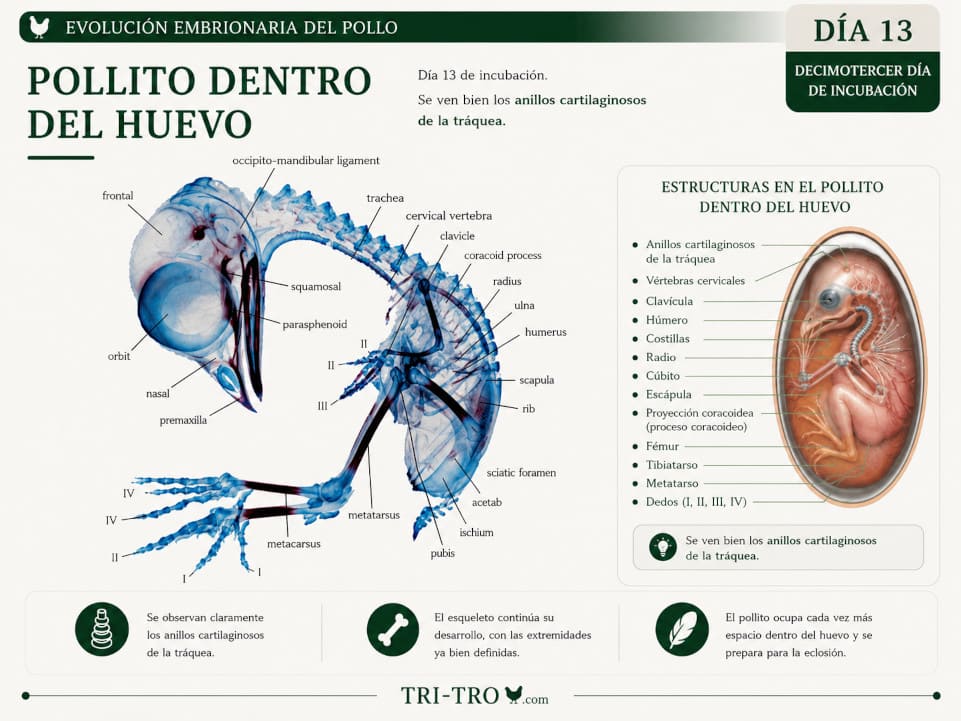
By the thirteenth day of incubation, the embryo has developed a thick layer of down and is beginning to look more and more like a chick. The crest, wattles, and other characteristic external features are starting to become visible.
What can be seen in this anatomical specimen?
The soft tissues have been partially made transparent to allow observation of the major embryonic structures. The cervical vertebrae, ribs, limbs, and trachea—with its characteristic developing cartilaginous rings—are clearly visible.
⚠️ Important point regarding incubation: At this stage, the embryo’s bone and cartilage development progresses rapidly. The chick takes up more and more space inside the egg and continues to prepare for hatching.
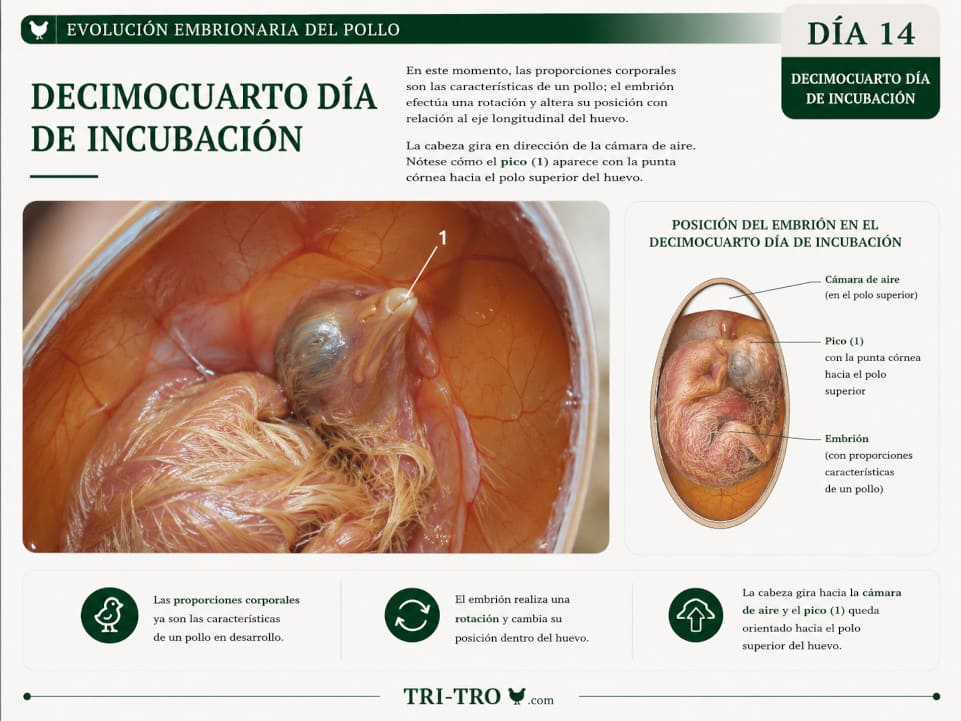
By the fourteenth day of incubation, the embryo has already developed the body proportions characteristic of a chick. The body occupies most of the interior of the egg, and the head begins to turn toward the air cell, preparing for the final stages of embryonic development.
What happens on the fourteenth day of incubation?
At this stage, the embryo changes position within the egg, and the horny beak points toward the upper pole, where the air cell is located. Down feathers cover much of the body, and the organs continue to mature rapidly.
⚠️ Important point regarding incubation: The embryo takes up more and more space inside the egg, and its oxygen consumption increases significantly. Proper ventilation and humidity are essential during this advanced stage of incubation.
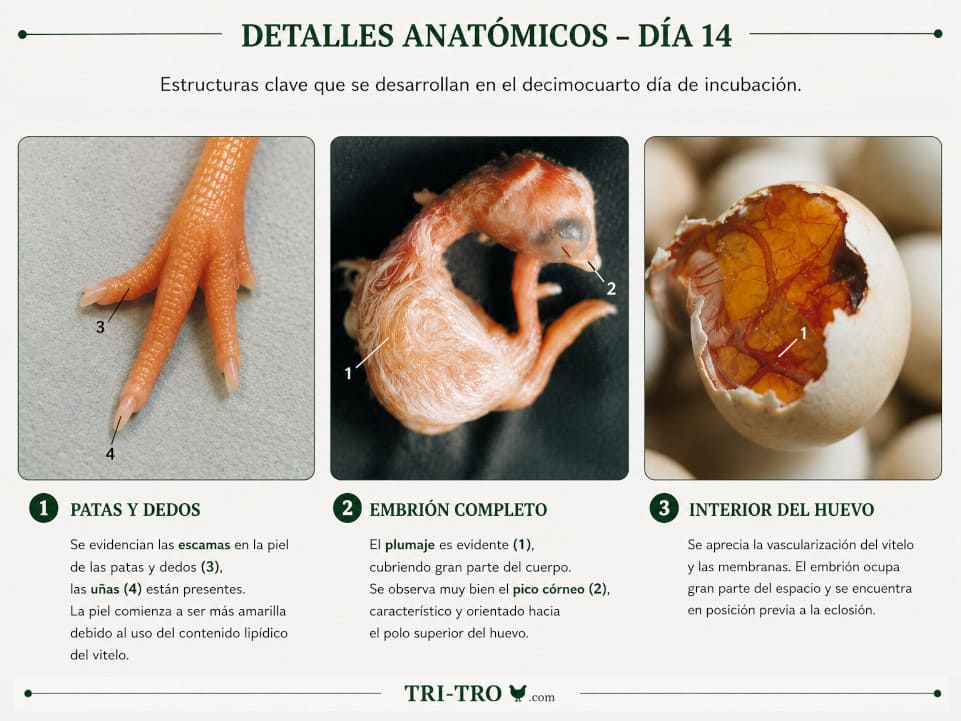
By the fourteenth day of incubation, the embryo has reached an advanced stage of anatomical development. Feathers cover much of the body, the legs and toes already display their characteristic scales, and the embryo occupies a large portion of the egg’s interior.
What structures are developed on day 14?
At this stage, the horn-like protrusion, the claws, and the scales on the legs are clearly visible. The vascular system continues to develop rapidly, and the embryo gradually assumes the pre-hatching position.
⚠️ Important point regarding incubation: The rapid growth of the embryo progressively reduces the available space inside the egg. Ventilation and gas exchange become increasingly important during this advanced stage of incubation.
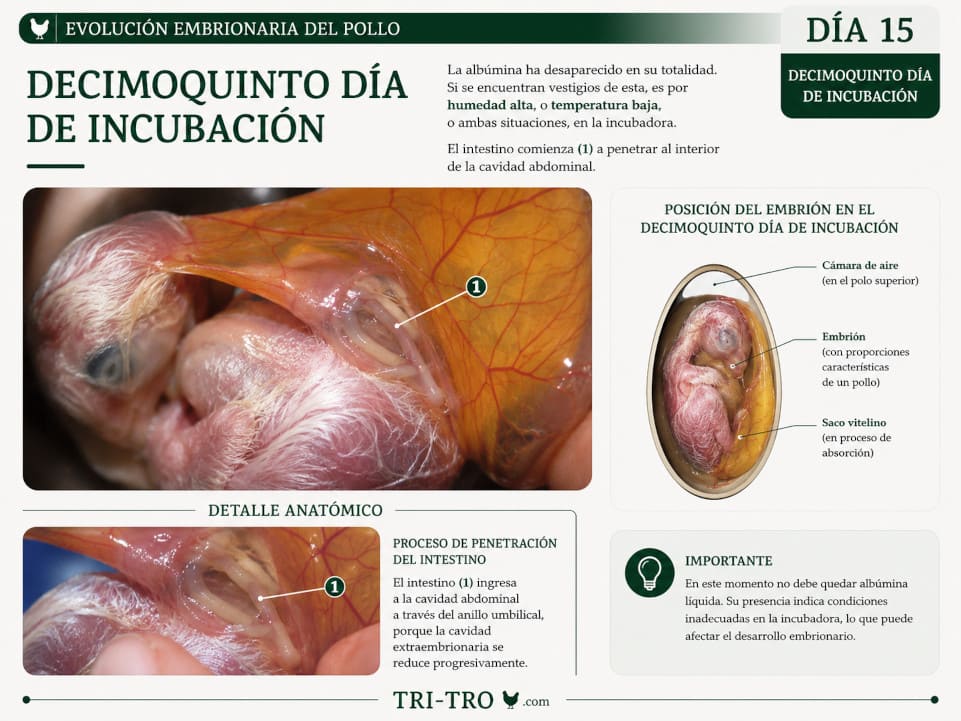
By the fifteenth day of incubation, the embryo occupies most of the egg’s internal space and continues to mature rapidly. The albumen has almost completely disappeared, and the intestine begins to enter the abdominal cavity through the umbilical ring.
What happens on the fifteenth day of incubation?
At this stage, the yolk sac remains the embryo’s primary source of nutrients. The intestine begins to retract into the abdominal cavity, while the organs and body structures continue to develop prior to hatching.
⚠️ Important point regarding incubation: The presence of liquid albumin at this stage may indicate excessive moisture, insufficient temperature, or incubation problems. Proper gas exchange and gradual water loss are essential for normal embryonic development.
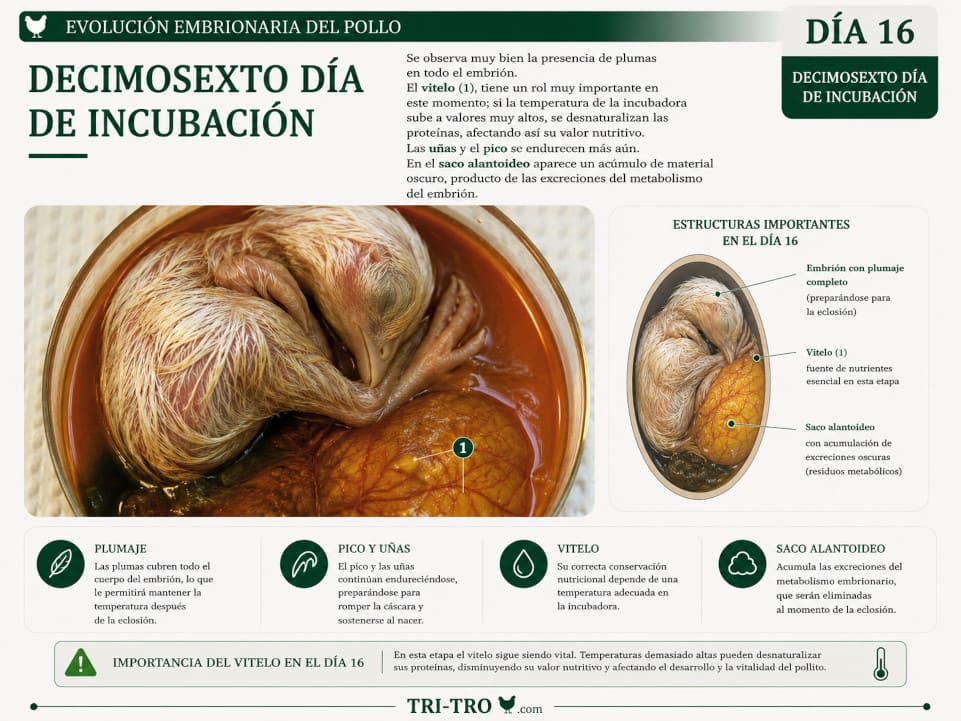
By the sixteenth day of incubation, the embryo has developed a thick layer of down that covers almost its entire body. The beak and claws continue to harden, while the yolk continues to provide the nutrients needed to complete development before hatching.
What happens on the sixteenth day of incubation?
At this advanced stage, the embryo occupies almost the entire interior of the egg and gradually assumes its final position for hatching. The allantoic sac accumulates metabolic waste, and the body systems continue to mature rapidly.
⚠️ Important point regarding incubation: The yolk remains an essential source of energy and nutrients. Excessively high temperatures can denature its proteins and negatively affect the chick’s final development.
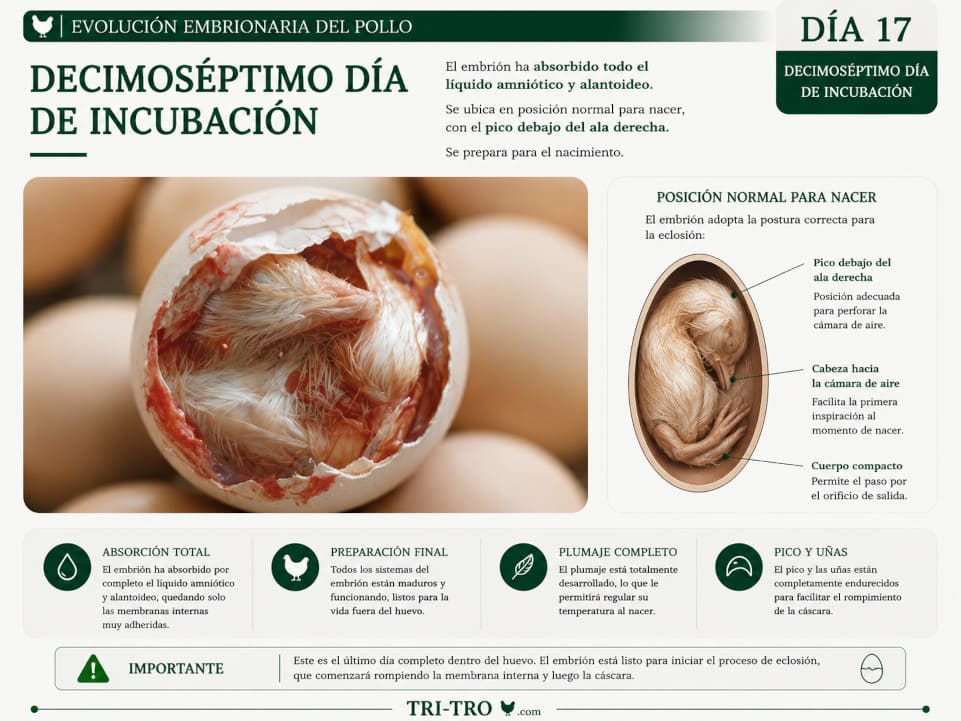
By the seventeenth day of incubation, the embryo has completely absorbed the amniotic and allantoic fluids. The chick assumes its final position for hatching, with its head facing the air sac and its beak tucked under its right wing.
What happens on the seventeenth day of incubation?
At this advanced stage, the embryo occupies almost the entire interior of the egg and gradually assumes its final position for hatching. The allantoic sac accumulates metabolic waste, and the body systems continue to mature rapidly.
⚠️ Important point regarding incubation: The correct position of the embryo is essential for hatching. The beak must be oriented toward the air sac to allow for the first breath before breaking through the shell.
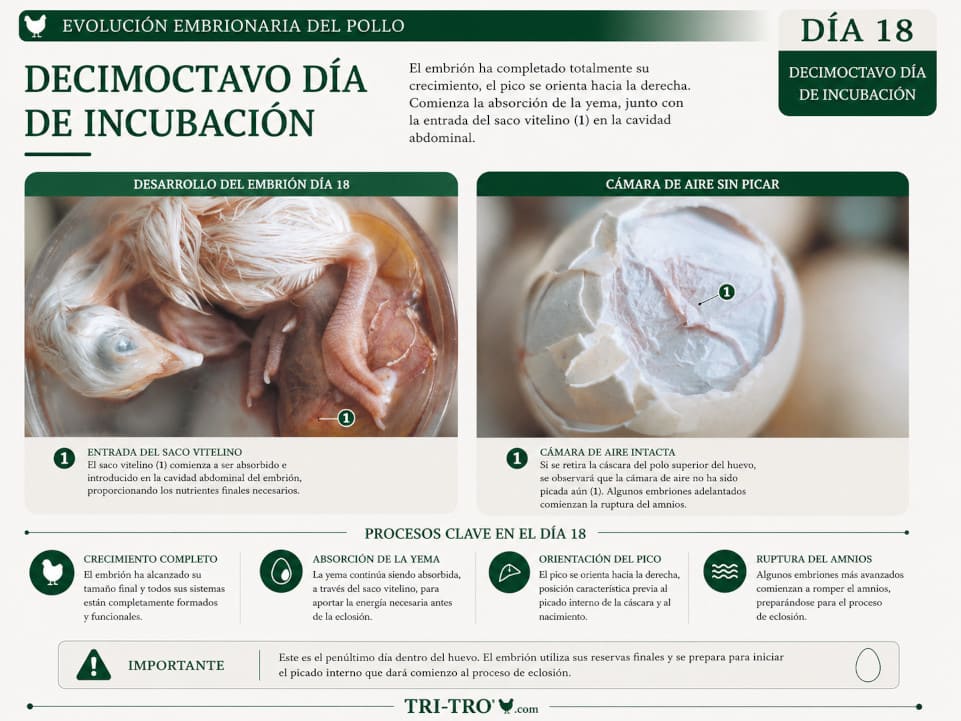
By the eighteenth day of incubation, the embryo has nearly completed its development. The yolk sac begins to retract into the abdominal cavity, and the chick assumes the final position needed to begin the hatching process.
What happens on the eighteenth day of incubation?
In this final stage, the embryo uses the last of the yolk’s nutrient reserves and turns its beak toward the air sac. Some chicks begin to break through the inner amnion in preparation for pecking through the shell from the inside.
⚠️ Important point regarding incubation: Starting on the 18th, you should stop turning the eggs in the incubator. The embryo needs to remain stable in the correct position to peck through the shell from the inside and prepare for hatching.
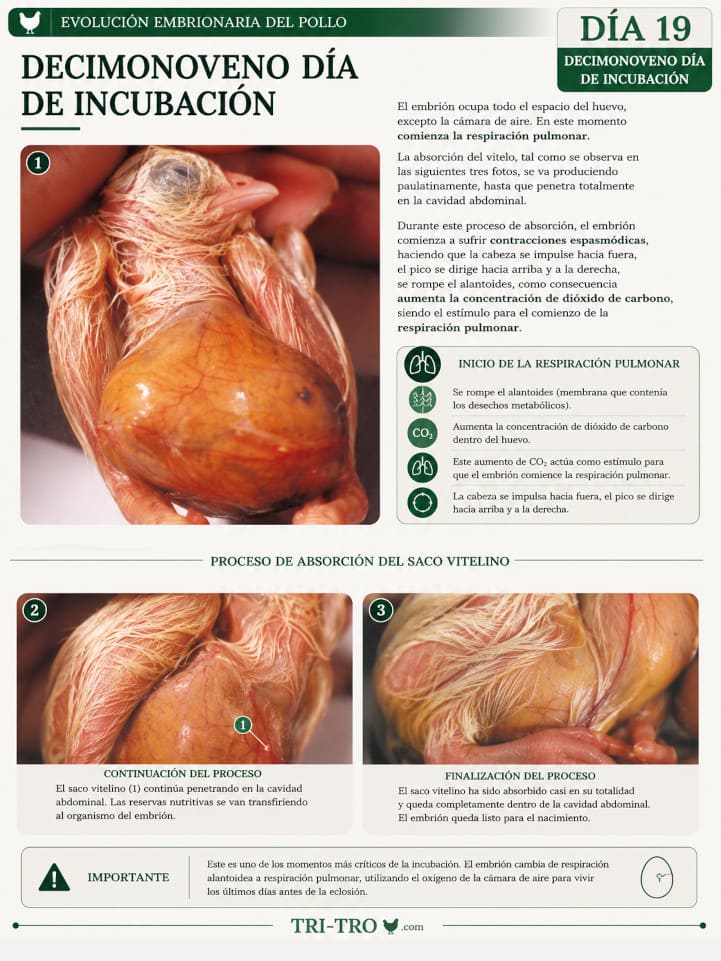
By the nineteenth day of incubation, the embryo occupies virtually the entire interior of the egg, except for the air cell. The yolk sac continues to be absorbed into the abdominal cavity as the chick begins to breathe through its lungs before hatching.
What happens on the nineteenth day of incubation?
During this critical phase, the embryo breaks through the allantois and begins to use oxygen from the air sac to breathe. Embryonic contractions and head movements prepare the chick to begin pecking through the shell from the inside.
⚠️ Important point regarding incubation: The onset of pulmonary respiration marks one of the most important moments in the entire incubation period. Adequate ventilation is essential to ensure proper gas exchange before birth.
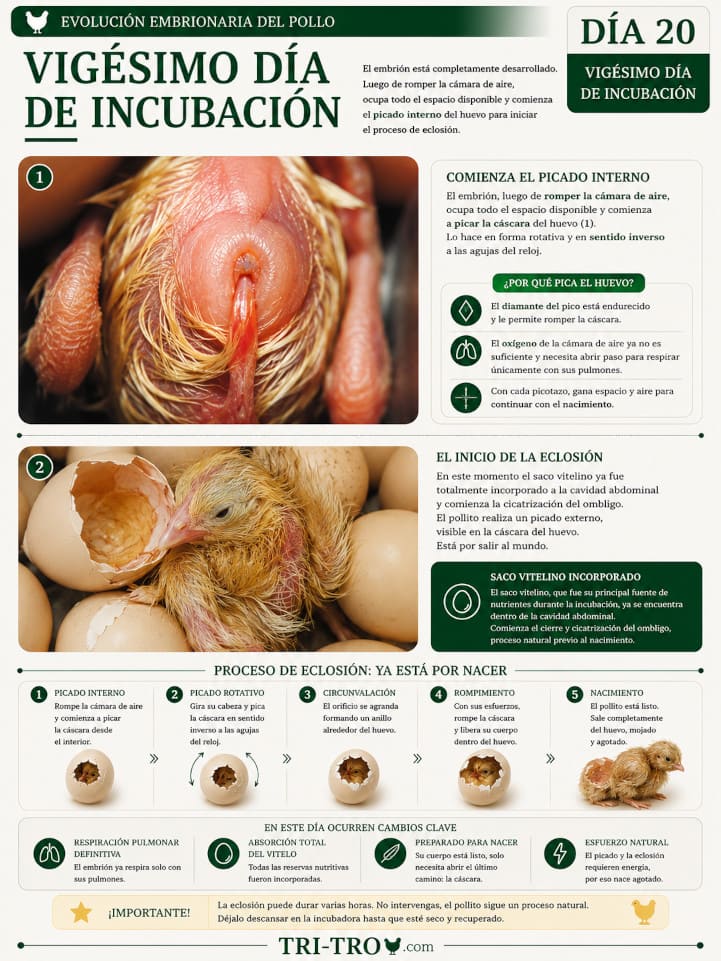
On the twentieth day of incubation, the chick begins the hatching process. After breaking through the air sac, it starts pecking from the inside at the shell and relies solely on its lungs to breathe as it prepares to emerge from the egg.
What happens on the nineteenth day of incubation?
At this stage, the yolk sac has been completely absorbed into the abdominal cavity, and the navel begins to heal. The chick rotates inside the egg to gradually break the shell and facilitate hatching.
⚠️ Important point regarding incubation: The hatching process can take several hours. You should not help the chick hatch unless absolutely necessary, as it needs to fully absorb the yolk and adapt its respiratory system.
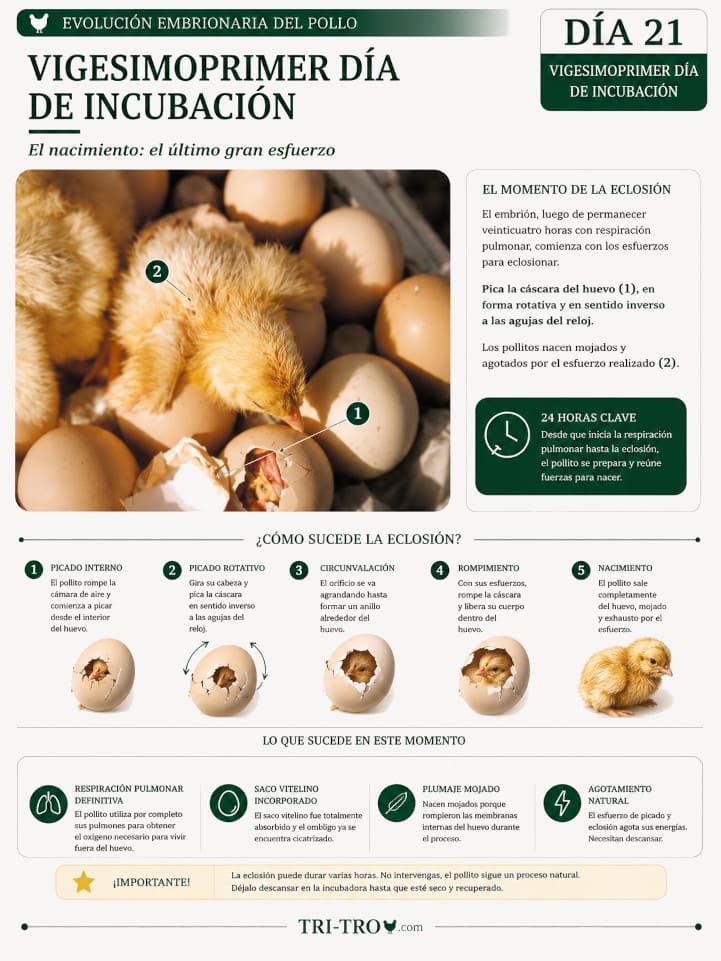
On the twenty-first day of incubation, hatching is complete, and the chick is born. After breaking through the shell with twisting movements and repeated efforts, the chick emerges exhausted, wet, and fully formed
What happens when a chick is born?
The chick fully uses its lungs and finishes absorbing the yolk sac before leaving the egg. After hatching, it rests for several hours while its down begins to dry and its body adjusts to life outside the egg.
⚠️ Important point regarding incubation: After hatching, the chick needs warmth, rest, and time to recover from the effort of hatching. It should not be removed from the incubator immediately until its down is dry and the chick is stable.
During the final hours of incubation, the chick makes muscular and rotational movements inside the egg to break through the shell and complete the hatching process. If you want to understand the entire process leading up to birth, you can consult the comprehensive guide on incubation and embryonic development.
This animation shows us the process of embryonic development inside the egg until hatching; the images are amazing and very informative.
Bibliography:
Chicken incubation and embryonic development have been among the areas I have documented most extensively over the years at TRI-TRO. With more than 27 years of experience as a hobbyist and breeder, direct observation, hands-on experience, and anatomical photography allow me to show, step by step, how a chick develops inside the egg until the moment of hatching.