Egg collector or egg trap, chicken trap

Selection of the chickens by putting:

Although the morphological characters or external can serve a guideline to select the best layers, are not always truthful, so that it is necessary to put in practice a method that, at first glance, it seems somewhat difficult to perform. 

Select the hens for putting total, taking account of the eggs each hen lays in a monthly basis to delete without explanations which do not get, and those that produce few eggs. In a lot of hens are good, medium and poor layers, and between the first will be exemplary and remarkable to excellent.
 
But the aviculturist, still, when it comes to take the brooder or carry the eggs to incubate, gives equal value to all the eggs, equating to those from the good layers with posts on medium and bad. And this should not be done, because these latter nullifies the benefit that leave the good hens.

That's why, in the hen house, must be implemented in the system to keep track daily of the number of eggs which are laid by the hens individually.

That the chicken to give more or fewer eggs depends on many causes, among others, of the character physiological or internal, which determine a set of eggs very variable in the number, quality, size, and, evenin the settings, things that are transmitted by inheritance from parents to children, grandchildren, etc

The chickens born in the spring, they begin to make in September-October without interrupting the sunset during the winter, holding in the spring and continue their task even in the summer moving evening, they are, undoubtedly, exemplary, outstanding.

But if the other sisters of race, and age may also start putting at the same time, but in winter, interrupting part of the production, they are continuing in the spring, but as soon as they arrive the first heats of summer begin to move or peel.

They are birds that don't deserve the honor of being hosted more time in the coop, and shall remove them as soon as possible, so that these bad qualities are not transmitted to the children, to lay eggs and incubate of these hens.

And much less should have roosters children of those hens for not to extend those undesirable qualities. The hens are good are the ones that should be kept for their eggs to hatch and give us pullets that will improve the set of their mothers and cocks with characters.

Making Winter:

The start of winter is a quality that is very remarkable, that determines that the hens den more-or-less eggs from October to February inclusive, catalogándose as good those of October to the end of January put more than 30 eggs.

Or the of November to end of February, more than 40 as a medium-sized, to give less, and as bad, which doesn't put any.

If we do not use the roost logger is done in the following way:

  • If you put it in October, you will be placed, for example, a ribbon bow white.

  • If it also puts in November incarnate.

  • If he continues the production in December, put another ribbon bow in black.

  • And if you still laborious in January, added another ribbon bow yellow.

  • Now, if instead of starting in September or October, it does so in the middle of this or early November and continues without interruption, it will take the ties incarnate, black, yellow, and a fourth brown, blue, etc

By this simple procedure we will know what are the best layers, so that they do not have all the signs at the end of the test cited in brackets that they were glad month whose ribbon bow does not represent you, and if you don't take any, there is no need to save them.

However, it has been a great way to practice selection, based on the number of eggs laid per hen during its first year of implementation, which comprises;

Since that makes the first egg, the dick until it takes three hundred and sixty-five days of having given.

For this reason, the hen lays more eggs during the first year but not during the second, contrary to what is said and believe in most of the rural sectors.

In the early century looked like a chimera that the hens could give a daily egg, according to the saying: “Bird-beak does not make the owner rich” but today the reality is very different as shown in the data that is leading to acquaint themselves with the results obtained by increasing the number of chickens that lay an egg daily.

And if the aviculturist, amateur, cannot hope to possess birds of this type, for now, or why not pretend that your chickens, few or many, not only to pass, but that duplicate, at least, these ludicrous productions average current of your chickens, we have at least select our chicken coop.

To do this, look at this link, which will give you some good guidelines to make a selection on your chickens and calves. The Selection in Poultry and its sections.


 

Selección de los gallos:

Hens who have been best layers for putting winter and total will be allocated to reproductive, giving it a rooster, not the more “cute”, “loudmouth” or arrogant, but another, also strenuous, but who is the child of excellent egg laying, winter, and total.
 

These roosters players can acquire in, chicken houses, farms or absolute solvency, chosen from among those copies reserved for exploitation, but that, by excess of numbers or by some morphological defect, what is discarded.

 While it would be preferable to acquire, perfect, and at times whose age ranges between two and three months, for recriarlos at home and adapt to the environment, but having them always separated from the hens until the opportune moment.

These copies are price they are somewhat higher, but they are the ones that will improve our birds, and that is why it must be demanded that they come from hens whose winter clutches have exceeded 40 eggs and 200 eggs in total.

Because as it is this quality, which is transmitted most intently of the rooster to the daughters, not increase the yields of these coupled with cocks of the lowest quality.

The players could also be purchased in official institutions, or by the Associations of breeds. These roosters, to cross with the hens selected, will improve the production of their daughters, and persisting provided in this rule, nothing expensive, aviculturist, or enthusiast, it will greatly improve, and after a short time the production egg basket of its rustic and beloved chickens.

This is all so very interesting that, even in the event that you do not take the log of start of winter, and the total of the hens, as has been explained, and only regarded to be attached, will produce a noticeable improvement in the start-half of our chicken coop.

It has been translated, in short, more income, both economic as what we look for in the improvement of the race.

There are some interesting sections that can be used to select your hens through molting, knowing what is good or bad egg laying. Molting in hens, classification and shedding of the wing hens.


Nesting boxes start:

Para llevar cuenta de la producción de cada gallina, no hay como llevar el registro, desterrando el uso de los cestos, cajas de madera, colocados en cualquier rincón del corral o gallinero, y adoptando los nidales registradores.

Can easily be built a few nesting boxes with different materials, fiberboard, solid wood, glued, to leave no loophole for the parasites, plastic or galvanized material.

It is enough to give to each department or nest inner dimensions of 35 x 35 x 35 cm, with an entrance door sliding or rocker that closes when the chicken between.

Cuando tengamos preparados los nidales, en proporción de unos 30 por cada 100 gallinas, lo que tenemos que hacer nada más es anillar todas las pollitas de cuatro a seis meses con las anillas numeradas que se venden en el comercio avícola o en tu asociación y dejar las portezuelas abiertas para que se vayan habituando a este sistema.

Un par de veces por la mañana y otras tantas por la tarde se revisan los nidales, sacando a las gallinas encerradas y anotando en una libreta el número de la gallina, tomando el número de su anilla, fecha y peso del huevo (con un lapicero le ponemos al huevo el número de la anilla y luego se pesan), apuntándolo en un listado.

This simple way you discover good layers and the bad; which occur leaving benefits and what to eat and not working.

Independientemente de esto, nos sirve más adelante para seleccionar las mejores gallinas para nuestra línea de reproductores; en ello veremos el peso, color y formas de los huevos de cada una de nuestras gallinas. Este proceso es parte esencial para todo aquel que quiera tener un buen corral.

There is another system of record with nesting boxes due to a clever system devised by an aviculturist galician, which consists in placing the nesting boxes built in the center of the local or chicken coop, being divided himself into two halves, and the space of the division that is not covered nesting boxes are put chicken wire or other material.

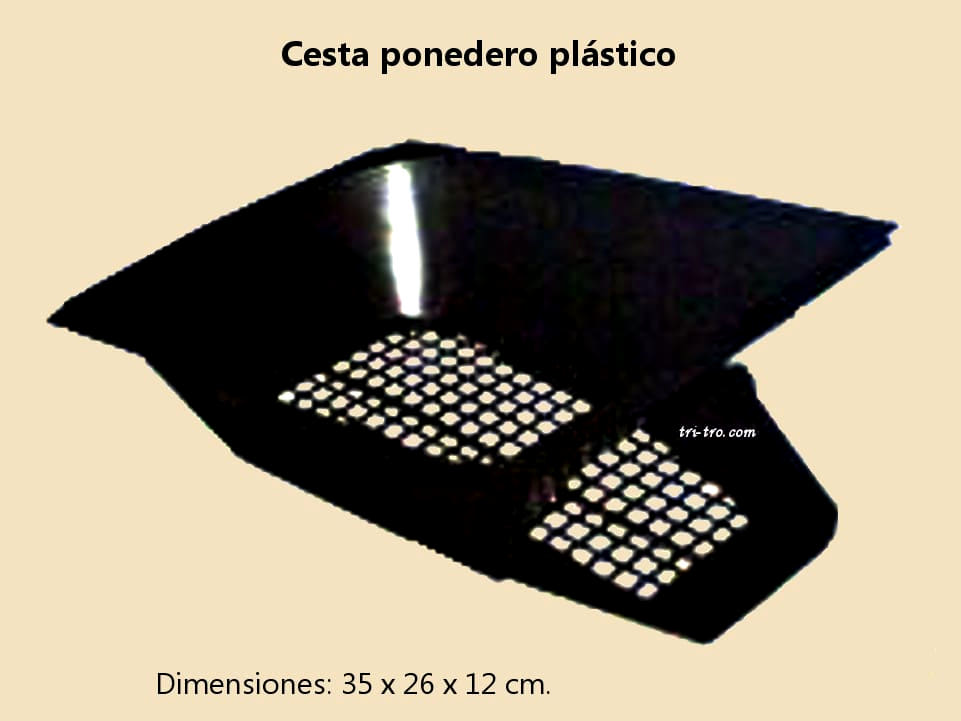
Plastic nesting basket

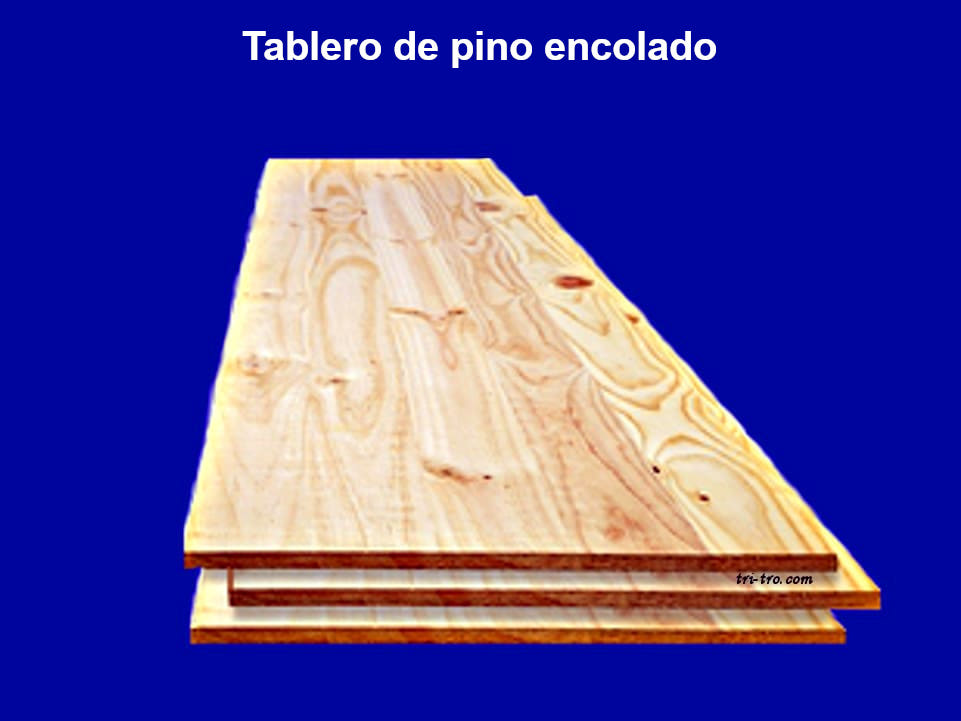
Board of pine 200 x 50 x 1.8 cm

Este sistema, desde luego, solo sirve para gallineros con poco número de gallinas, porque hay que colocar tantos nidales o huecos como gallinas. Estos nidales tienen la parte posterior abierta o, por lo menos, han de llevar un espacio libre por el que pueda salir la gallina libremente.

In the morning shut the hens in the part of the local or roost the roost is the sliding door or closure that is left broken.

Cuando la gallina va a poner, queda encerrada y, cuando pone el huevo, sale sola al otro lado o departamento en el que se colocan comederos con harinas.

With this system it is not necessary to check the nesting boxes, but just write down the numbers of hens that are found in this second department that was left in the morning without hens.

The number of eggs laid daily basis will be equal to the number of chickens on it, being rarely fail this equivalence.

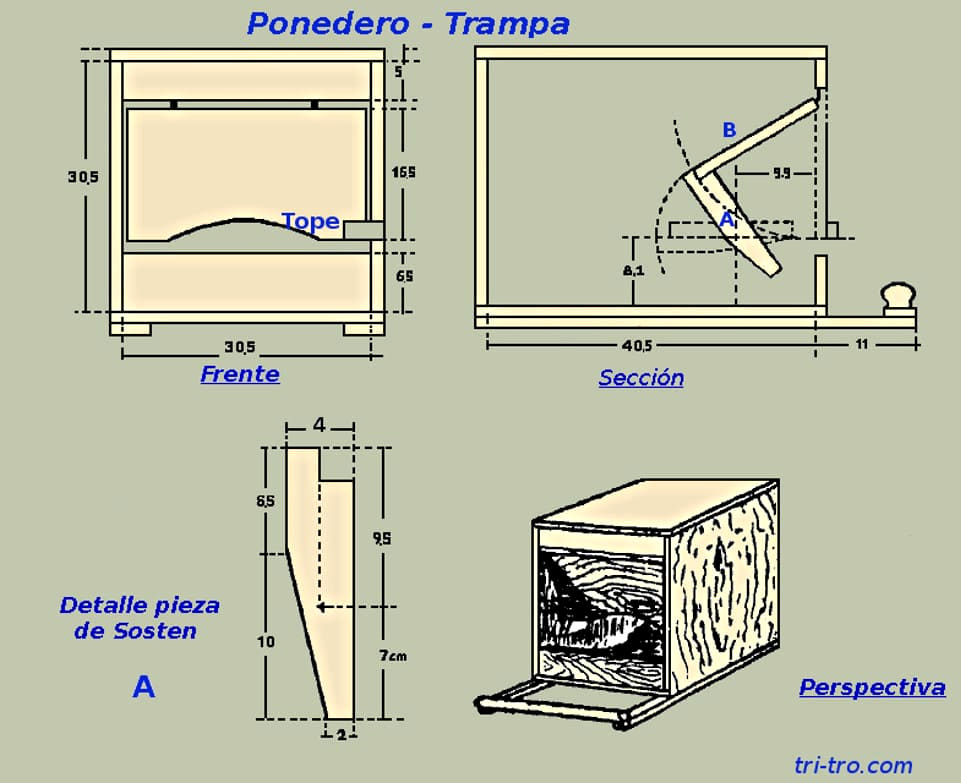
In the image above is shown, with appropriate measures, one of the models Connecticut, easy construction.

The piece A it is placed in the inner part of one of the sides, with the axis of rotation to the distance indicated.

Para que permanezca abierto, se apoya la trampilla B on the workpiece, as shown in the figure. When a hen, when you enter, stands with his back to the hatch, whose own weight holds the piece. Athis tour and, once inside the bird, the hatch finds no obstacle to quit, being held by the end of the same piece.

En el vídeo que os pongo más abajo, su realizador ha puesto las medidas que le han parecido mejor para su construcción; él lo ha hecho para la raza de gallinas de Mos; eso queda para cada uno qué medidas utilizar.

Si os fijáis, la gallina para entrar al nidal debe tener una zona de apoyo, como está reflejado en el esquema de arriba, o bien, si se ponen varios nidales registradores en línea, tendremos que poner un tablero por debajo para hacer la misma función.

Otra opción es, al mismo tiempo, recoger los huevos en una zona en la que la gallina no lo pueda picar; es hacer en la parte de abajo una inclinación de la última tabla, continuando hasta la zona donde se posa la gallina para entrar al nidal.

And follow below up to 12 or 15 cm, leaving a space of height so that the eggs roll well of 10 cm for hen normal and 8 cm for Kikas. We can also increase in the base this basket, see photo.

Material for construction:

Despiece: Esto es opcional; cada uno puede hacer el despiece que crea conveniente, dependiendo de la raza que quiere criar. En la foto de arriba se ha utilizado tablero de pino; son medidas interiores y estas de aquí corresponden al vídeo de:

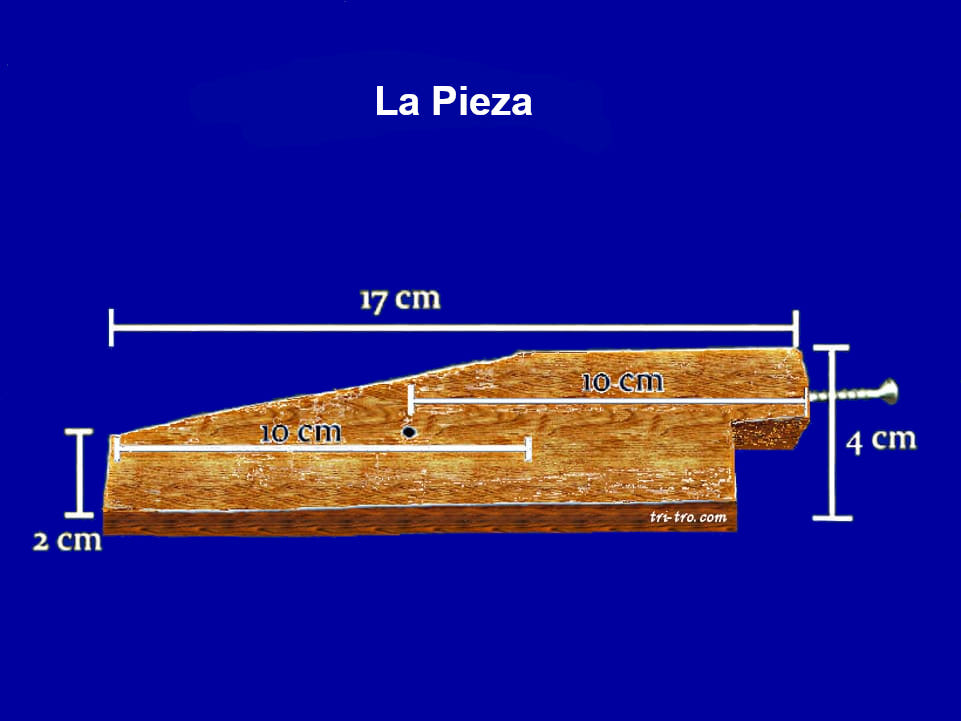
huertodeladiscordia.blogspot.com; con ello elegiremos mejor y lo más importante son las medidas de la pieza de sostén para que funcione correctamente.

40 x 45 cm = 2 pieces.

35 x 45 cm = 2 pieces.

31 x 39 cm = 1 piece.

25 x 31 cm = 1 piece.

  8 x 31 cm = 1 piece.

  5 x 31 cm = 1 piece.

  4 x 17 cm = support piece.

Trap door support piece 

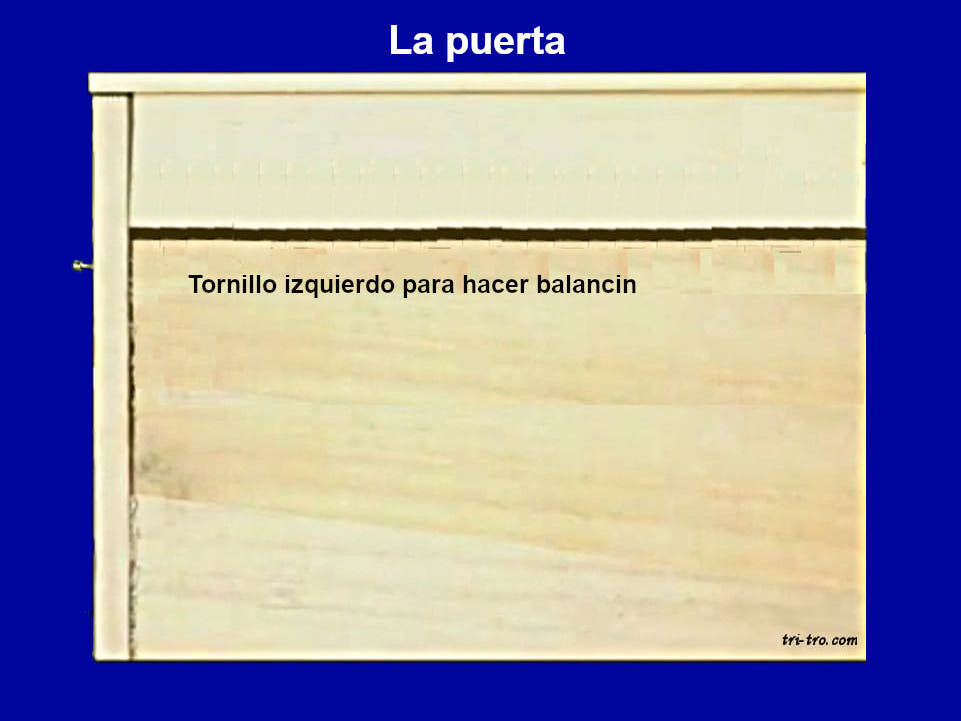
Left screw to make rocker arm

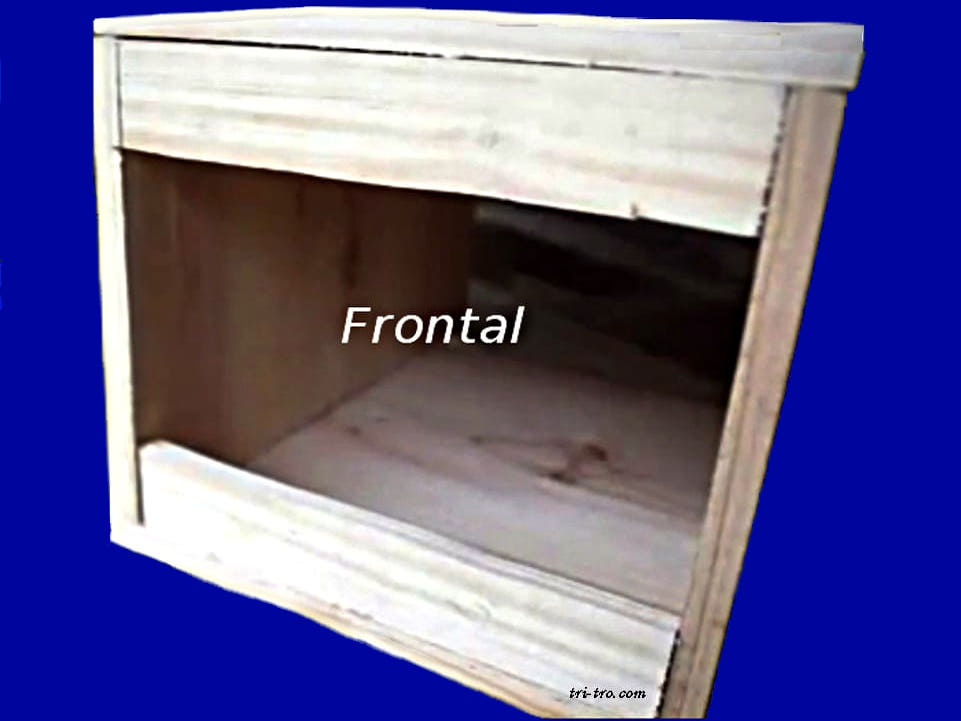
Front nidal registrar

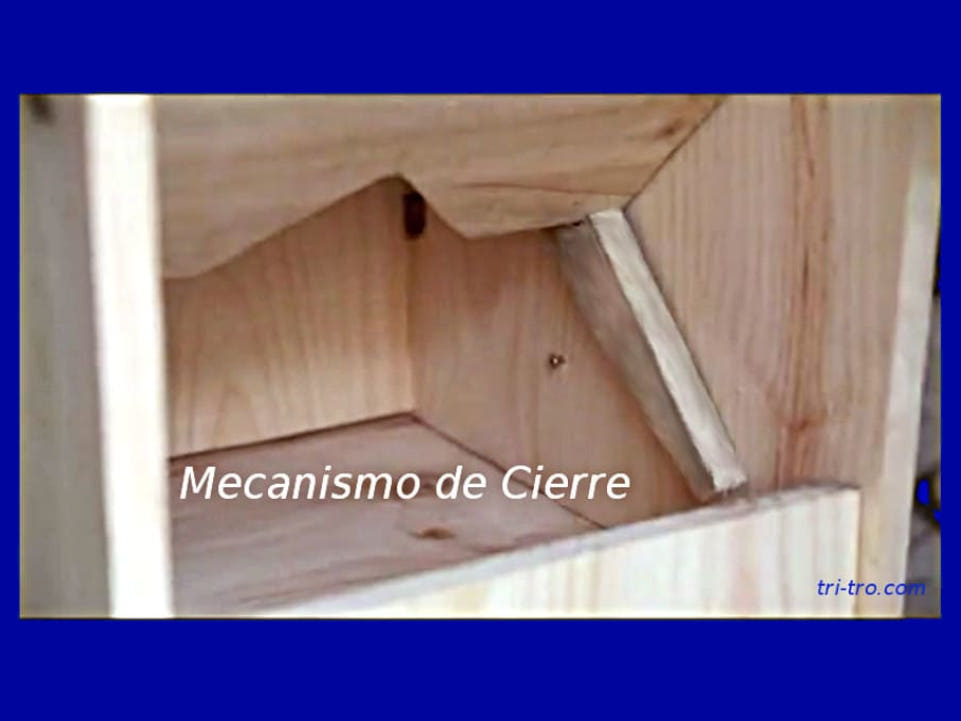
Locking mechanism of the roost

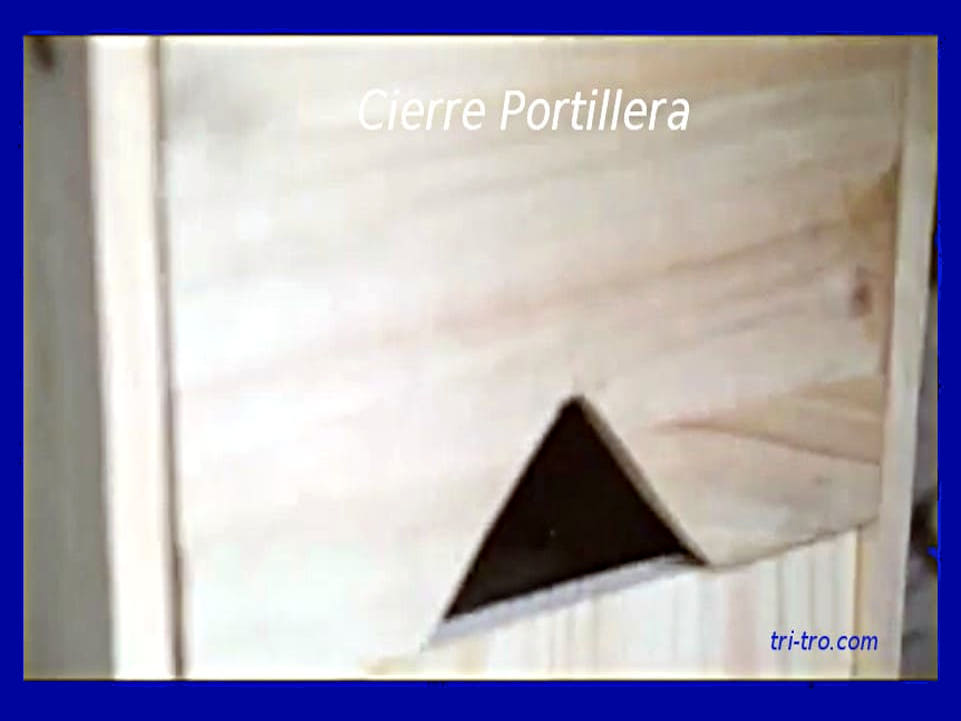
Hatch closure for nesting box

A Video:

Aquí os dejo este vídeo muy explicativo, gracias a su autor, que lo ha puesto para todos y poder hacer su construcción.

Ponedero registrador o ponedero, trampa para gallinas. Medidas para gallinas de mos. 

Hope you enjoy it.

Another system of Roost-Trap:

Construction of the Roost Trap for chickens

First procedure to select the layers.

Annotation daily from the start-with the support of the roost trap or aerie registrar. Already did the device, you will have thought of, and with him a few expenses that I'm not willing to do that… little by little, my friend, that you wouldn't have to ruin, keep reading and in the end, we'll talk.

The roost logger or aerie trap, it boils down to a box with a door that closes automatically when you enter the chicken, which stays locked until we will release it. Its construction can not be easier.

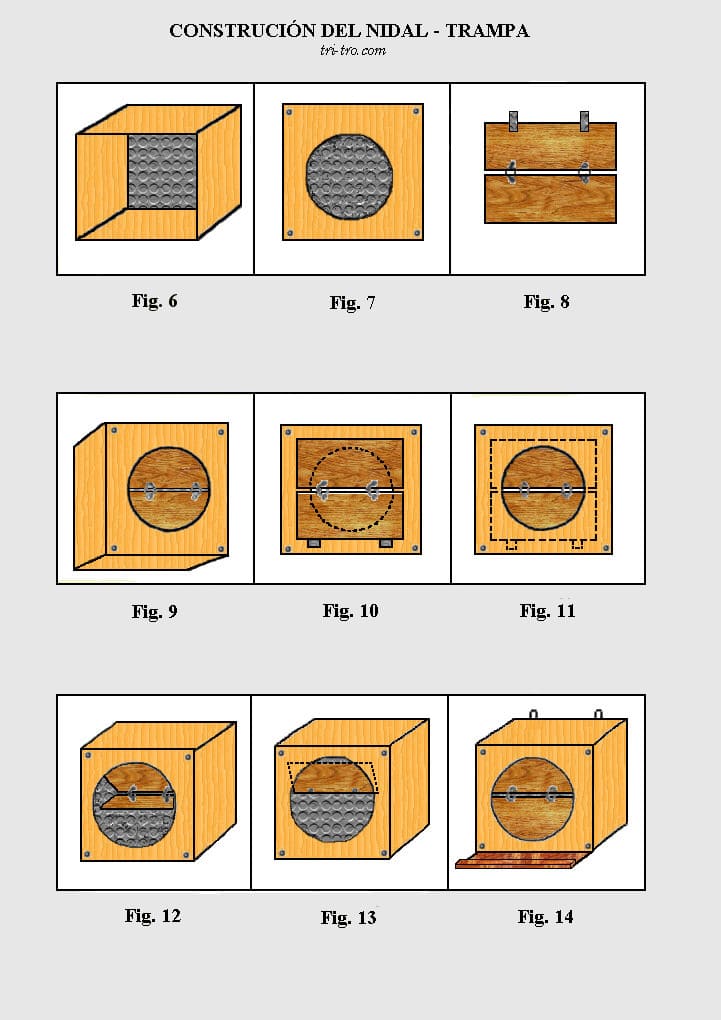
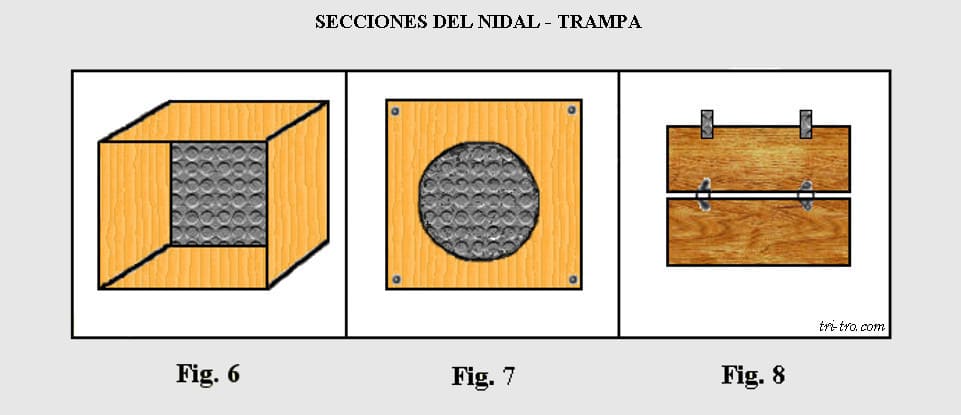
Look for a drawer without a lid, or build one whose opening is 35 cm in box, approximately, Or, and this is another option, built to work, with a brick (about 50 cm from the soil), a gap of 35 cm high, with so many other wide by 40 background, revocándolo internally with plaster (Fig. 6).

Now build the front of the roost, that is the part that closes by itself to enter the chicken.

To do this, get a piece of Ocume wood, or a well-joined board, not too thick, and try to cut it so that it just covers the opening of the drawer or hole.

Trace your center of a circle of 24 cm diameter, and with the help of a jigsaw or scroll saw, make a round opening, following the line drawn. (Fig. 7). Already has where to enter the chicken on the roost logger. 

Nest trap sections, figure 6, 7, and 8

Proporcionarte ahora dos tablillas de 28 cm de largo por 14 cm de ancho. A una de ellas hazle dos agujeros cerca de uno de los bordes y en la otra le sujetas dos trozos de badana, lona, goma, correa de persiana plana, etc.

The other one you also pierce near one edge, so that the holes correspond to those of the first one. Join the two slats with some wire rings, but without joining them completely and in such a way that they can easily approach each other as if they were the covers of a bookFig. 8).

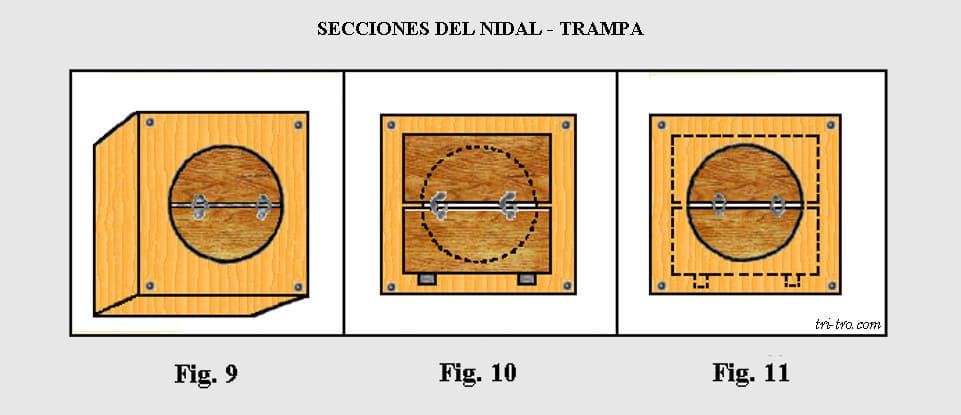
Nest trap sections, figure 9, 10 and 11

As the catch is made. Down behind the roundel of entry, nailing it or holding it by the sheepskin, so that it is covered the circular hole. (Fig. 9) and (Fig. 10).

Coloca luego todo el frente que hemos construido, de manera que tape la abertura del nidal (Fig. 11), sujetándolo por medio de tornillos. Ahora solo queda explicarte cómo funciona el nidal trampa.

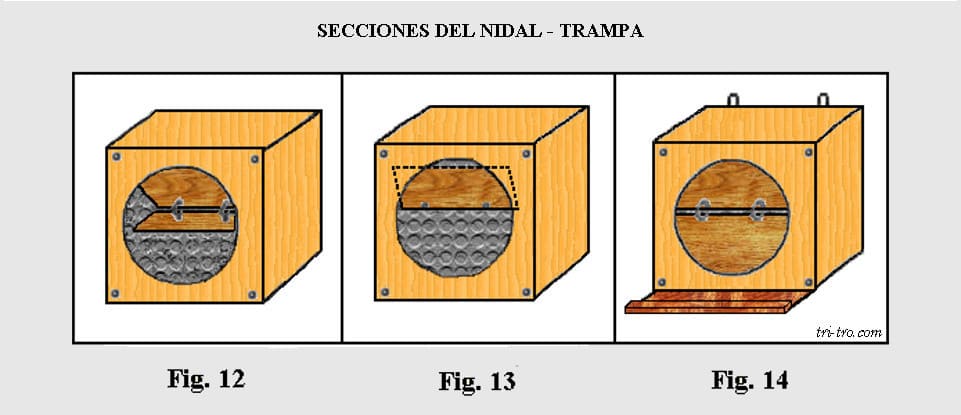
Nest trap sections, figure 12, 13 and 14

Bend forward and upward the table below, so that only left open the bottom half of the circular aperture through which passes the henFig. 12) and (Fig. 13).

When you enter this, it pushes with the upper part of your body the slats bent, but barely just passed, it falls by itself, down, and cover completely the entrance of the nest, preventing the departure of the bird until they let us go to release it. (Fig. 14).

If the splint did not fall with sufficient force to hammer some weight at the free edge.

The roost is already finished, or nearly finished. It is only to have a table for the chicken between comfortably, put a chip of pine, straw, in the background, and on it an egg made of plaster or wood painted white.

Y ahora, considera lo escaso del trabajo y el gasto; mira a continuación la utilidad que ambas cosas tan mínimas reportan a tu gallinero o galpón, para hacer un control de las buenas ponedoras y desechar las malas. 


You may be interested in these other sections


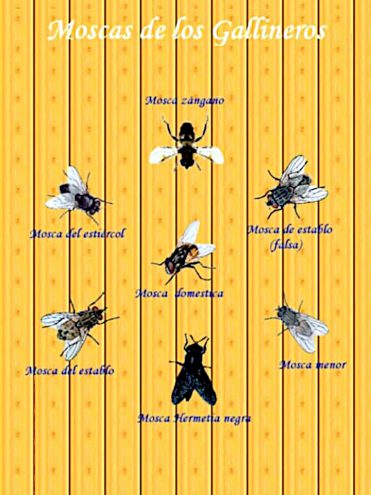
Flies on Chickens

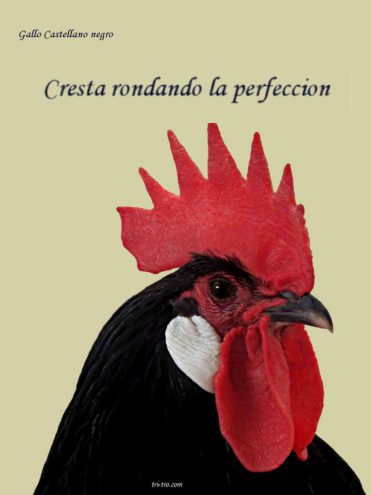
Cock defects crest and face

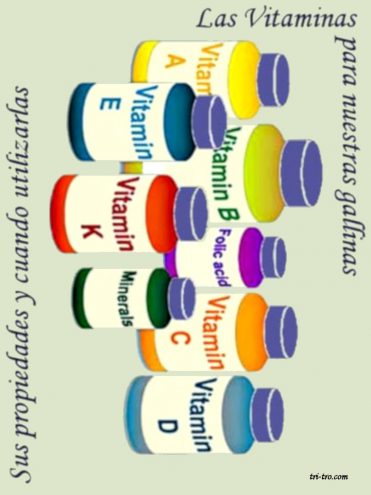
Vitamins for chickens


Do you want to share or comment on your social networks

Scan to visit TRI-TRO
Escanea para visitar. TRI-TRO