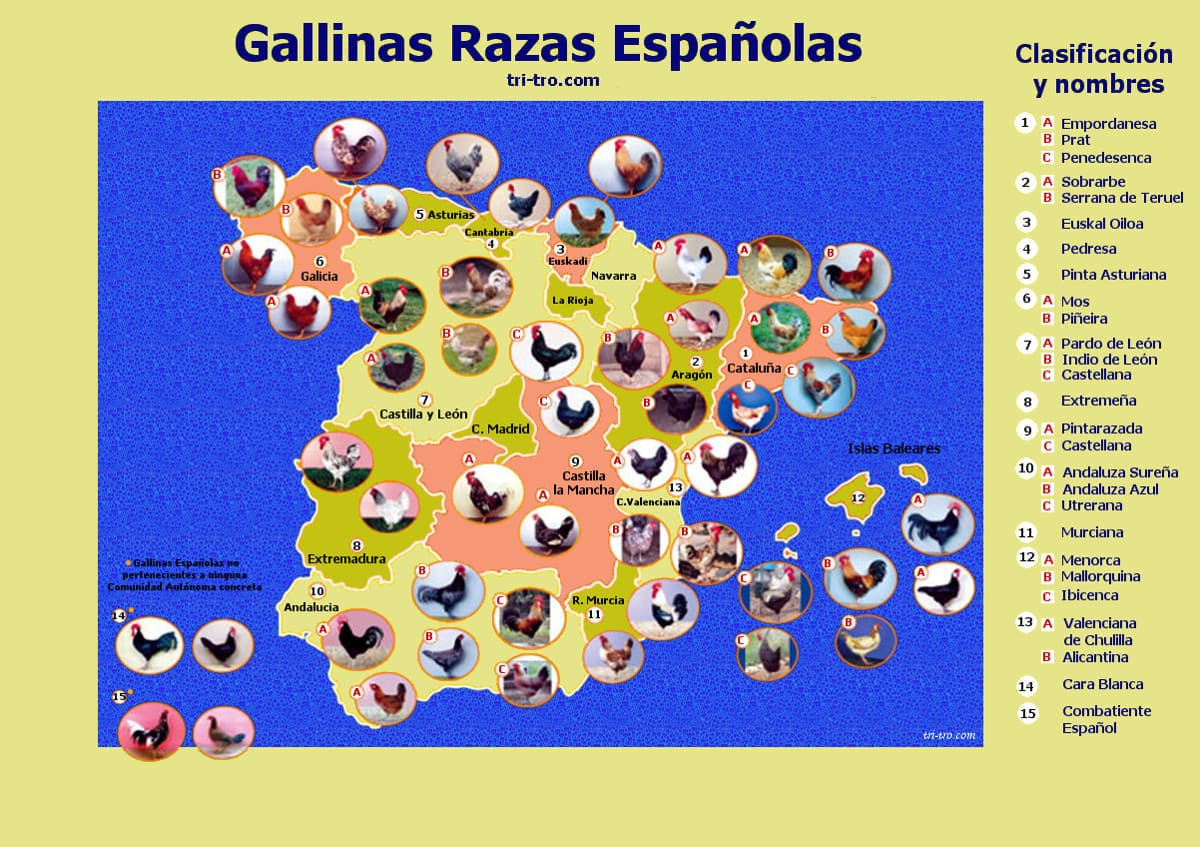
Spanish chicken breeds: distribution.
Here you have the photo Chickens Breeds Spanish download PDF.
Poultry farming, its meaning is most characteristic of, is the practice of taking care of and raising birdsso domestic, with different uses or purposes, and all the culture that exists around this activity parenting.
Poultry farming generally focuses not only on raising birds, but also on preserving their breeds, power a balanced diet, treating illnesses, preserving their habitat… This method of raising poultry has other aspects, such as:
Within the poultry is also included, poultry production, or transformation, to get meat, feathers, or eggs. In poultry farming, recreational, with the breeding of species for a matter of hobby, as the silvestrismo, the colombofilia, the canaricultura or the breeding of exotic species, parrots, or other.
Setting the focus on diversity de razas, en quienes la corpulencia, conformación, fecundidad y aptitudes para el cebo son tan variables, se encontraría cualquiera inclinado a creer en el gran influjo de los climas o de las latitudes en que viven y se perpetúan.
Without denying of the fact of an absolute way these influences, more obscure and less certain than is usually believed, and after view of the question under all the concepts, up to the power and careaccording to the towns or nations.
It has been concluded that the influence of climate is more mythical than real, and that the precious species found in locations so different in temperature and geography natural or nature of the ground, from elections well understood, good and abundant food and crosses well directed.
And that, on the contrary, the pettiness of some local breeds, his little aptitude for the incubation, posture, fattening, and others, come from or are due to breeding without selection, admitting in pens or cages as it is presented.
Those in charge of the poultry pens, lacking proper training and unfamiliar with household economics, view the selection of eggs and chicks with indifference, and do not hesitate to sell the best products to egg shops for consumption, all for a profit that is as ruinous as it is ill-calculated.
This fact—that climate has little influence on the beauty of poultry breeds—is most clearly evident in the exotic species imported to Europe many years ago.
Since their introduction, they have been subject to a careful selection of breeding stock of both sexes, resulting in improved rather than degenerate types, and have given rise to new subbreeds or strains obtained through crossbreeding that now enjoy a well-earned and deserved reputation.
It must be acknowledged, however, that the art of breeding, improving, and perfecting breeds requires more extensive and in-depth care and knowledge than is commonly believed. This knowledge is drawn from various branches of the physical and physiological sciences. Perhaps we will be told that these sciences are not within the reach of all breeders; which would be true were it not for the fact that it is up to the masters of the art to establish the principles and rules, and to the breeders to put them into practice.
We will also be told, and rightly so, that farmers, breeders, and hobbyists have always been reluctant to put into practice the rules recommended by experts in the field (breed specialists). This, unfortunately, is true, but the cause lies in their complete ignorance of the most basic concepts of these arts, which they will one day have to practice.
It is often overlooked that the combination of theory and practice alone can provide results satisfactory results and serve as the true focus of breeding our breeds. The results of this union can be compared to routine, blind, and mechanical practice, likened to the wild tree, which yields—and can yield nothing more than—rough, tart fruit; when combined with theory or practiced according to scientific principles, we obtain the grafted tree that gives us an uninterrupted succession of good, tasty fruit, for this is what we must keep in mind for our birds; it is a process of selection and selection.
It is clearly stated that, among all birds poultry, the most useful and easy de criar es la gallina, y de haberla encontrado en todos los tiempos y en todas las localidades, ya que el hombre ha procurado y procura criarla siempre que tiene proporción. Cada raza de gallina puede requerir diferentes condiciones de espacio y refugio en el gallinero, por lo que es importante adaptar su diseño a sus necesidades.
As well as we still do not know in which country of the world is breeding naturally the grain, which is enhanced by the cropping is our food more common, in the same way you can't say, as already indicated, in what city or country you live in the hen and is perpetuated without the need of the needs of man; and to see it surrounded by so many enemies and so few media of defense, it seems almost impossible that he can live outside of its protection.
For more influx that has the art on the products of nature, and confess that we, the breeders, we can only modify and no way to create them.
Thus, the bird’s original species exists or has existed, but centuries of domestication have so altered it from its original form that it is impossible to find. The origin of Spanish chickens is also unknown; it was undoubtedly altered by the breeds introduced by those who, over so many centuries and under such varied circumstances, have ruled over Spanish territory.
Neat and, so to speak, grown chicken for the man, it has more varieties than any other species, despite the fact that you have been deprived so many times of chickens is beautiful.
Beautiful types who have perhaps improved the breed, by killing the calls cantadoras, the fruit of a concern unfounded, because of the proverbs ancient as the chicken that sings, a priest who dance and woman who speaks Latin, never come to a good end.
The breeds, types, or varieties we are about to describe are the most notable and widespread; they are preserved either through the strength of their genetic makeup or through the care and effort taken to prevent crossbreeding, thanks to breeders and associations that uphold the values of these breeds.
Well, we’ll continue with the Spanish breeds—24 official ones, plus others currently undergoing recovery and recognition—thanks to those tireless enthusiasts of native chickens, set against the unique landscapes of our Spain. We’ll provide information on each breed, including their characteristics, varieties, photos, videos, associations, and other relevant details.
Usually the difference in the size and not much in terms of coloration, which is very bright in the males:
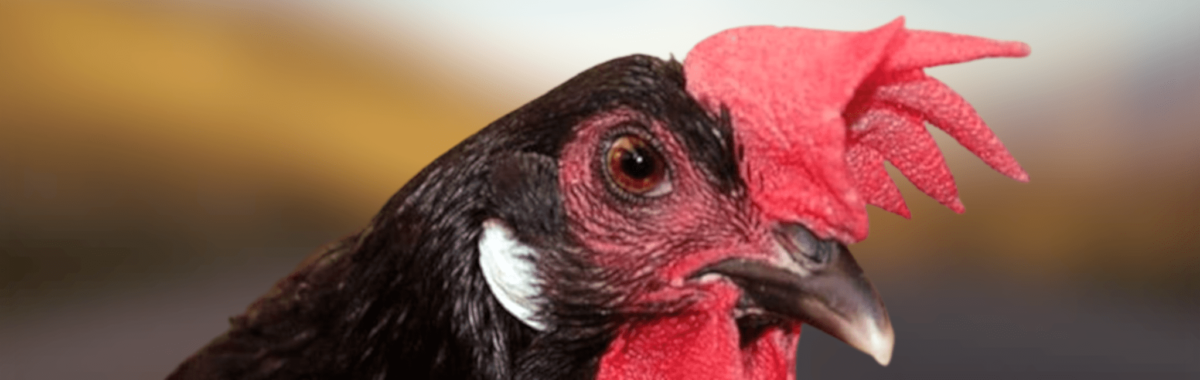
They have a membranous crest on their foreheads, of varying thickness, scarlet in color, and serrated like a saw; two membranes of the same nature and color hanging from the sides of their beaks, called wattles or barbels; and two more beneath their ears, a very beautiful white, known as earlobes.
The male can be distinguished from the female, in addition other characters, in two feathers of the medium the tail feathers, which are very long and curved like a bow, known as sickles; the feathers on the neck and rump, which are very long and narrow, known as capes; and the spurs, although some hens have them as well. You might find it interesting to check out this section. Nomenclature, glossary, chickens.
The chickens from the mountainous regions are smaller than those from the ancient plains of both Castiles, such as the Castilian, Andalusian, La Mancha, and Murcian breeds, etc.
Head small; fine tip, spiky, pink or plumb; crest simple, scalloped, bent or fall over the side; the body small, weak, and as detached; wings large, long, well covers feathered and extending to the base of the tail; the tail is large, either raised or straight, and consists of two rows of feathers.
Chest narrow; belly little bulky; small, pointed thighs; slender legs; the scaly skin covering them is slightly pinkish and usually dark or slate-colored; the claws at the ends of their toes are large, pointed, and steel-like; their plumage is highly variable, as are their size and live weight; black, mottled, more or less light-colored, slate-gray, and those spotted with yellow, white, violet, etc., are common.
Your weight in meat is a thing of a kilo. The epidermis is white. Is list and is always alert; she flies with ease quite a distance; it is always crowing, and went out from here to nominate her chattering.
No other breed sings its song as long and as loudly as this one; it tries to hide its eggs and incubate them alone and in secret, despite being a poor incubator: its clutch is still plentiful, but the eggs are small, white, and contain a lot of white; the yolk is small in proportion. Prefer perches high and hot sites. His love for the children is extreme.
It is one of the best mothers; the view of the danger that threatens their children, gets angry extremely, does not draw back, rushes on the enemy with as much impetuosity is capable; his strength and anger centuplican, with the voice, the beak, and claws, their ruffled feathers, the eye blinking, chasing him at all hazards. The dog, which only his presence frightens off the best chickens, is undertaken by the Brooder that has chickens, with the greatest boldness, and forces him to flee shamefully full of fear.
The hen common not only have the courage to protect his family, but, if necessary, be sacrificed for her. She knows with the greatest activity to procure the necessary food, using in case of need cunning; dedicated to the pillaging and teaches very soon to your family to do the same. Being a mother doesn't agree that any of your colleagues, even if it is of the same family, or even the daughter of the previous year, to come in and remove nor a particle of food to their chicks: not eat until they have made.
Poets have extolled the motherly love of the hen, and have even held her up as an example for humanity.
But we must realize that this one is worth much more, since it is eternal, while that one, though intense, is fleeting.
Born in April, starts the cock to be put in November next. Features a tilt medium to incubation. The rooster crows before they have reached puberty. It is fruitful to the three or four months.
We will gradually be adding all the Spanish breeds.

List of chickens:
The data on this page is based on information from the Spanish Federation of Poultry, Pigeon, and Rabbit Breeders (Fesacocur). The abbreviation “E.E.” in the description of each breed stands for (Entente Européenne d Aviculture et de Cuniculture), which is the association that brings together 32 European countries.
Spanish Ministry of Agriculture, Fisheries, Food, and the Environment (Mapama). Livestock Breeds, Official Catalog of Livestock Breeds in Spain (ARCA).
Thank you to all the breeders that have provided photos of their races that they keep in their chicken coops or pens, excellent specimens, selected after a hard work, and constant, to be delighted with these beautiful photos that you will find in each race, with the name of the breeder in them.
As well as links to various official poultry associations, for anyone interested in raising poultry, wishing to join an association, or requesting more information.
To access more information on each race, click on the images, which will take you to the corresponding page. It will take some time to add them all, so please check the ones that are already listed and look in the “Chickens” submenu. Spanish poultry breeds. Best regards.
It is pending under the Spanish Code: ESGA000, as it was approved by the National Standards Commission (CNE) in Quintana (Burgos) on September 12, 2020.
Varieties: Black speckled: Pinto or Exchequer: White:
Ring: roosters: 20, hens: 18.
Photo: Alicante rooster, breeder Juanito Ramírez.
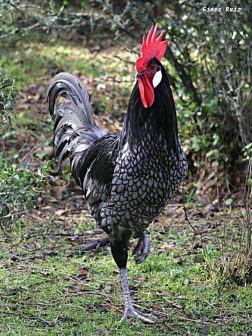
Code For Spain: ESGA001 Spanish Chickens: Andalusian Blue.
Varieties: 1.— Blue edged.
Ring: roosters 18, hens 16.
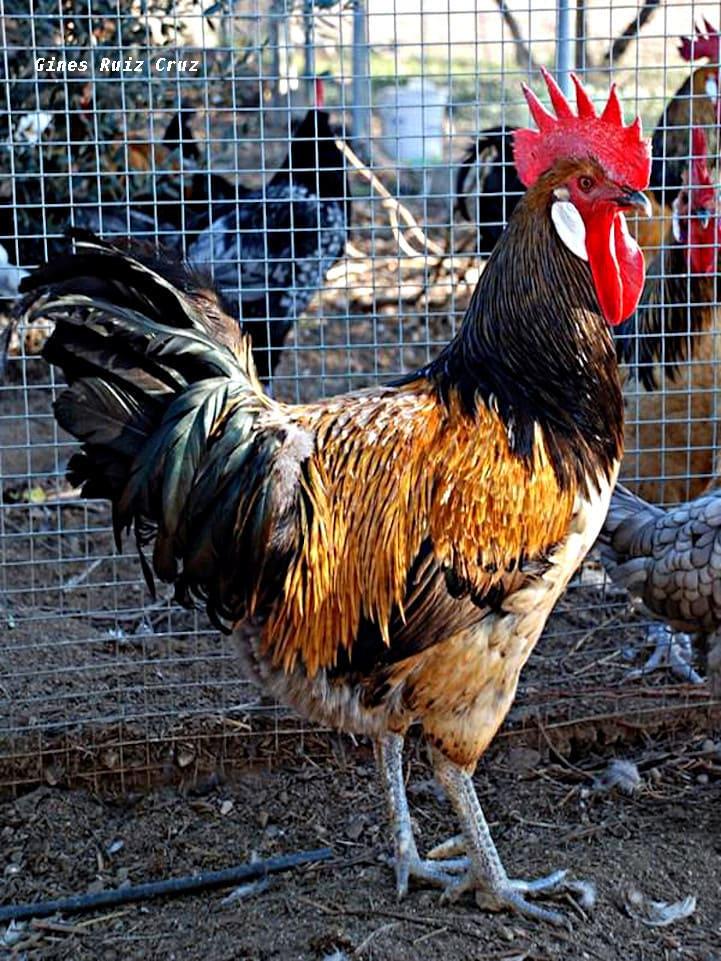
Standards EE: Yes, German Hürner: Andalusian color varieties: 1. Blue-edged. Photo: Andalusian rooster, breeder Ginés Ruiz.
Code For Spain: ESGA002 Spanish Chickens: Catalana del Prat.
Varieties: 1.— Light golden tail is black. 2.— White.
Ring: roosters: 20, hens: 18.
Standards EE: Yes, German Hürner: Prat. Color varieties: 1. Light golden brown. 2. White. Photo: Prat rooster, breeder José M.ª Pastor.
Code For Spain: ESGA003 Spanish Chickens: Black Castilian.
Varieties: 1.— Black.
Ring: roosters 18, hens 16.
Standards EE: Yes, German Hürner: Castilian. Color varieties: 1. Black. Photo: Castilian rooster, breeder Juan Villalón.
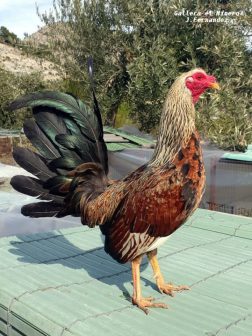
Code For Spain: ESGA004 Spanish Chickens: Spanish fighter. Varieties: 1.— Golden fawn. 2.— Blue-golden fawn. 3.— Silver fawn. 4.— Blue-silver fawn. 5.— Silver fawn with an orange back. 6.— Blue-silver fawn with an orange back. 7.— Predominantly white fawn. 8.— Speckled golden fawn. 9.— Speckled golden blue fawn. 10.— Speckled silver fawn. 11.— Speckled silver blue fawn. 12.— Speckled silver fawn with orange back. 13.— Speckled silver blue fawn with orange back. 14.— Golden wheaten. 15.— Golden blue fawn. 16.— Silver fawn with orange back. 17.— Silver blue fawn with orange back. 18.— Fawn with dominant white. 19.— Cuckoo fawn. 20.— Black. 21.—White. 22.—Blue. 23.—Cuckoo. 24.—Speckled black. 25.—Speckled blue. 26.—Speckled red fawn. 27.—Speckled blue-red fawn. 28.— Speckled golden brown. 29.— Speckled blue-golden brown. 30.— Fawn, black tail. 31.— Copper black. 32.— Copper blue. 33.— Silver-black birch. 34.— Silver-blue birch. Ring: rooster 16, hens 14. Standards EE: Yes European Code: ESGH15 German Hürner: Spanish Fighting Cocks. Color varieties: 34 types. Photo: Spanish Fighting Cock, Gallera el Minero. Josele Fernández.
Code For Spain: ESGA005 Spanish Chickens: Empordanesa.
Varieties: 1.— Aperdizado azul 2.— Blanquirrubia cola negra. 3.— Rubia cola azul. 4.— Blonde with a black tail. 5. Blonde with a white tail. 6.— Fawn. 7.— Red with a black tail.
Ring: roosters: 20, hens: 18.
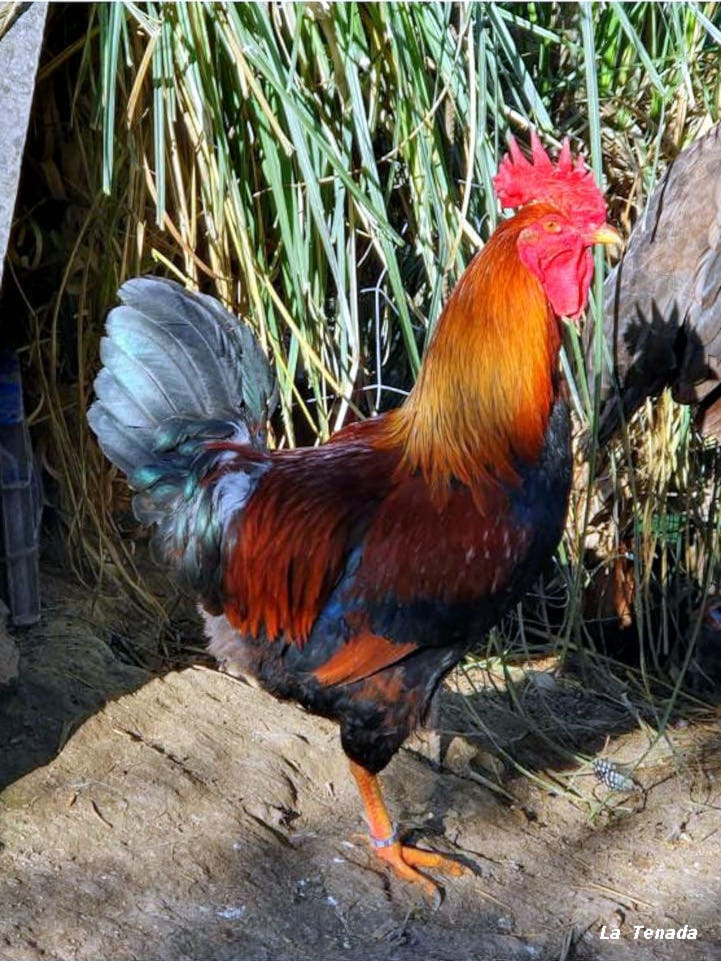
Standards EE: Yes, German Hürner: Empordanese. Color varieties: 7 types. Photo: Empordanese rooster, breeder La Tenada.
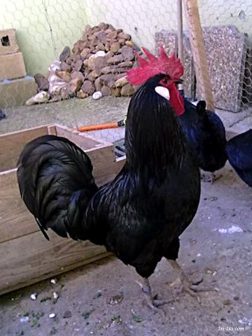
Code For Spain: ESGA006 Spanish Chickens: Spanish White-Face.
Varieties: 1.— Black.
Ring: roosters: 20, hens: 18.
Standards EE: Yes, German Hürner: Spanish color varieties: 1. Black.
Code For Spain: ESGA007 Spanish Chickens: Euskal oiloa.
Varieties: 1.— Betza (black). 2.— Gorria (red with black ermine). Lepasoila (bare neck). 3.— Marradun (red with black ermine and a hood). 4.— Zilarra (white with black ermine).
Ring: roosters: 20, hens: 18.
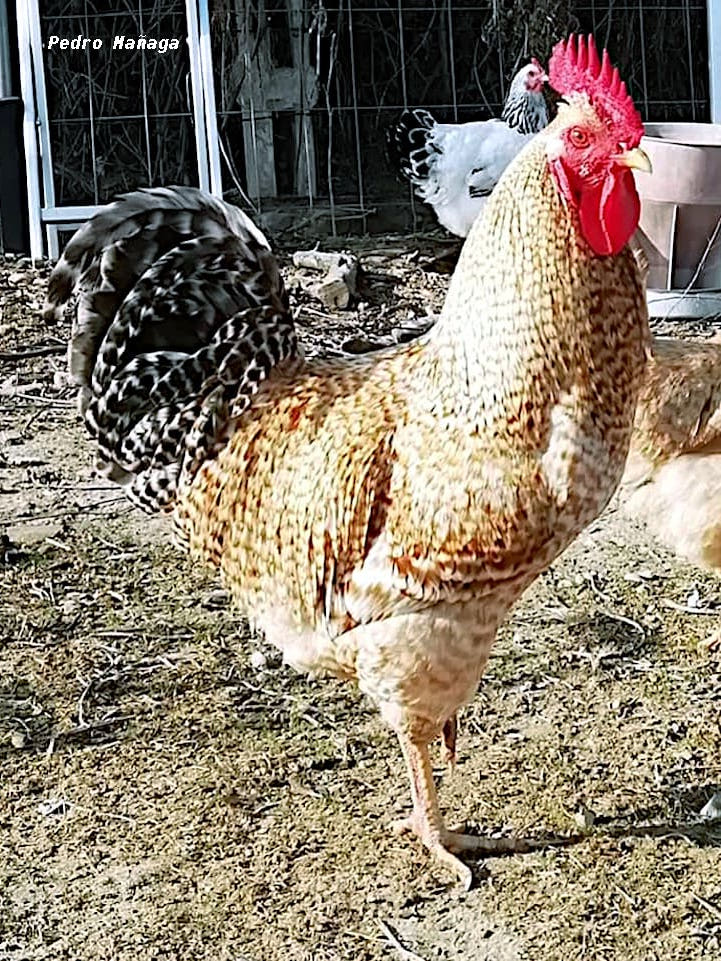
Standards EE: No. Photo: Euskal Oiloa rooster, bred by Pedro Mañaga.
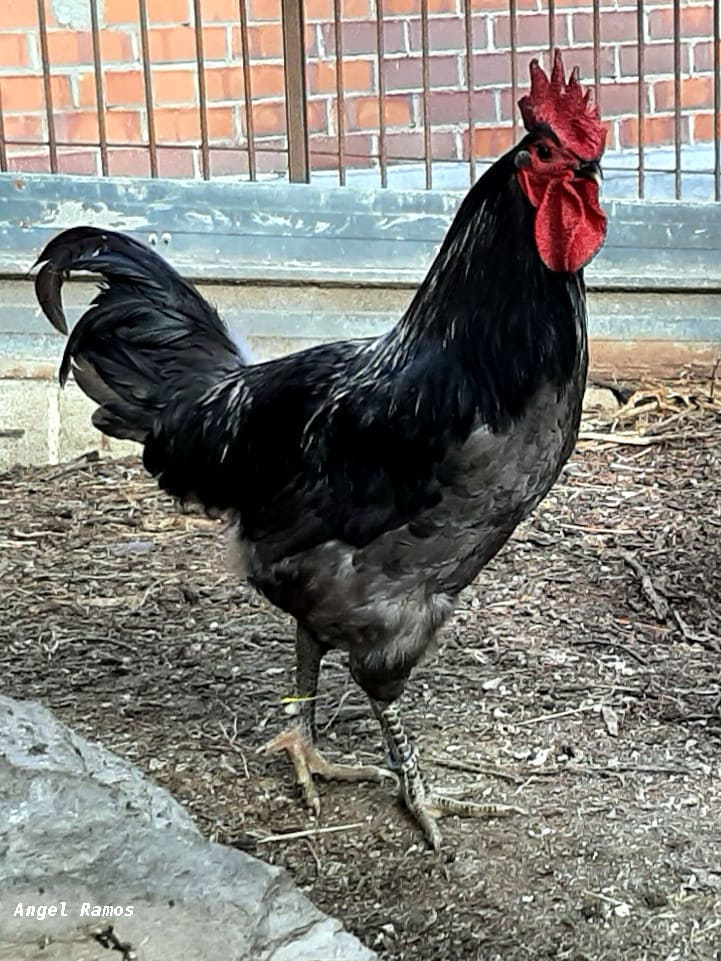
Code For Spain: ESGA008 Spanish Chickens: Extremadura.
Varieties: 1.— Blue. 2.— Black. Varieties that are not supported by the E. E.: the black birds total, and the white dotted grey (dirty white).
Ring: 22 for the roosters, 20 for the hens.
Standards EE: No. Photo: Black Extremaduran rooster, breeder Ángel Ramos.
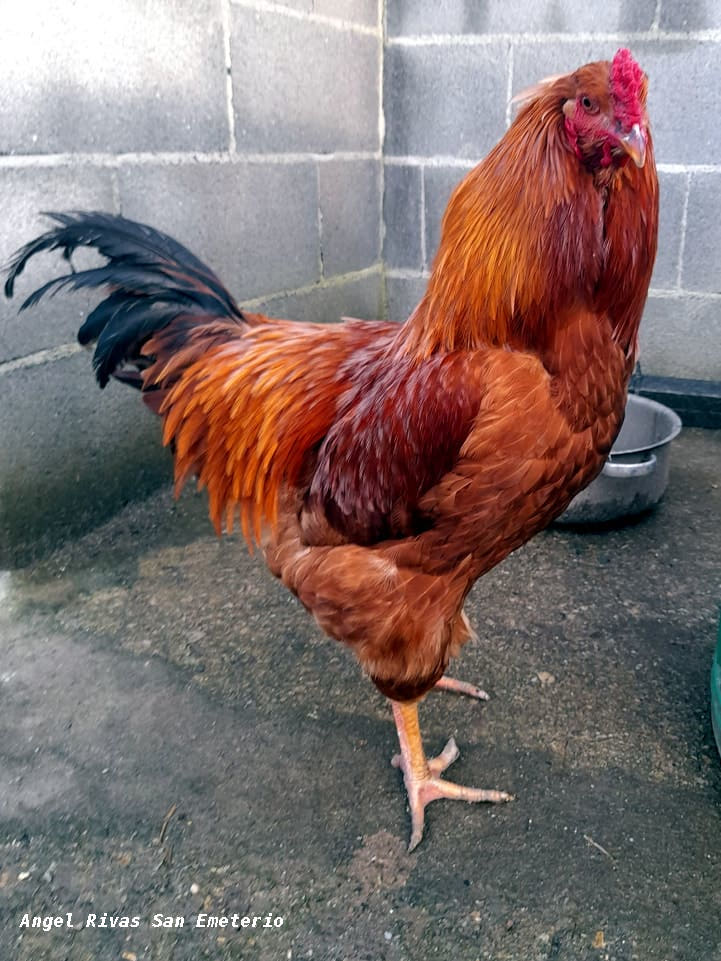
Code For Spain: ESGA009 Spanish Chickens: Galiña de Mos.
Varieties: 1.— Red-tailed blackbird.
Ring: cock 22 hens 20
Standards EE: Yes, photo: Gallo de Mos, bred by Ángel Rivas San Emeterio.
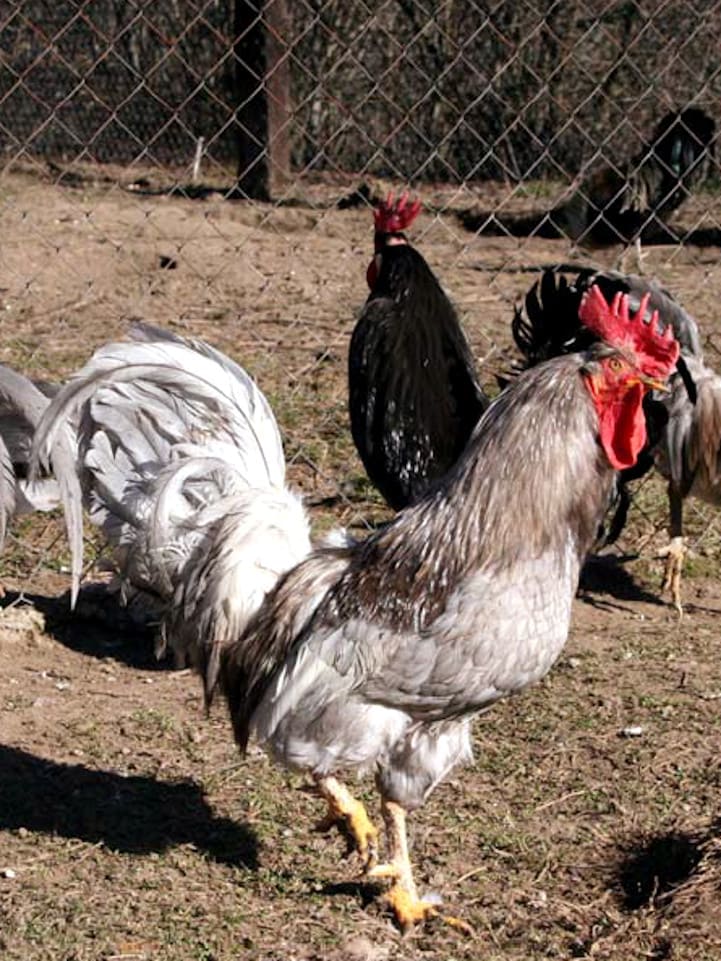
Code For Spain: ESGA010 Spanish Chickens: Indian Rooster of León.
Varieties: 1.— Birch silver blue with chest welt. 2.— Blue. 3.— Birch blue with golden chest welt. 4.— Birch silver blue. 5.— Birch blue gold.
Ring: roosters 18, hens 16.
Standards EE: If
Code For Spain: ESGA012 Spanish Chickens: Mallorcan.
Varieties: 1.— Palla (orange-brown). 2.— Golden fawn. 3.— Silver black. 4.— Cuckoo. 5.— White with black ermine markings.
Ring: roosters: 20, hens: 18.
Standards EE: No
Code For Spain: ESGA013 Spanish Chickens: Menorca.
Varieties: 1.— Blue. 2.— Tawny. 3.— Barred. 4.— Black. 5.— White.
Ring: roosters: 20, hens: 18.
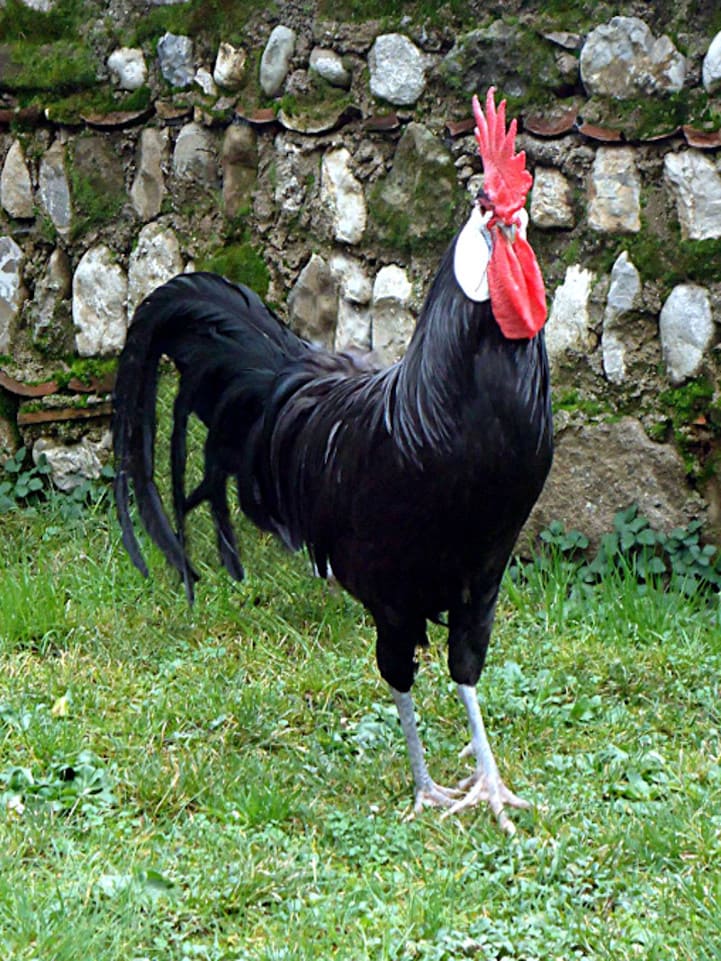
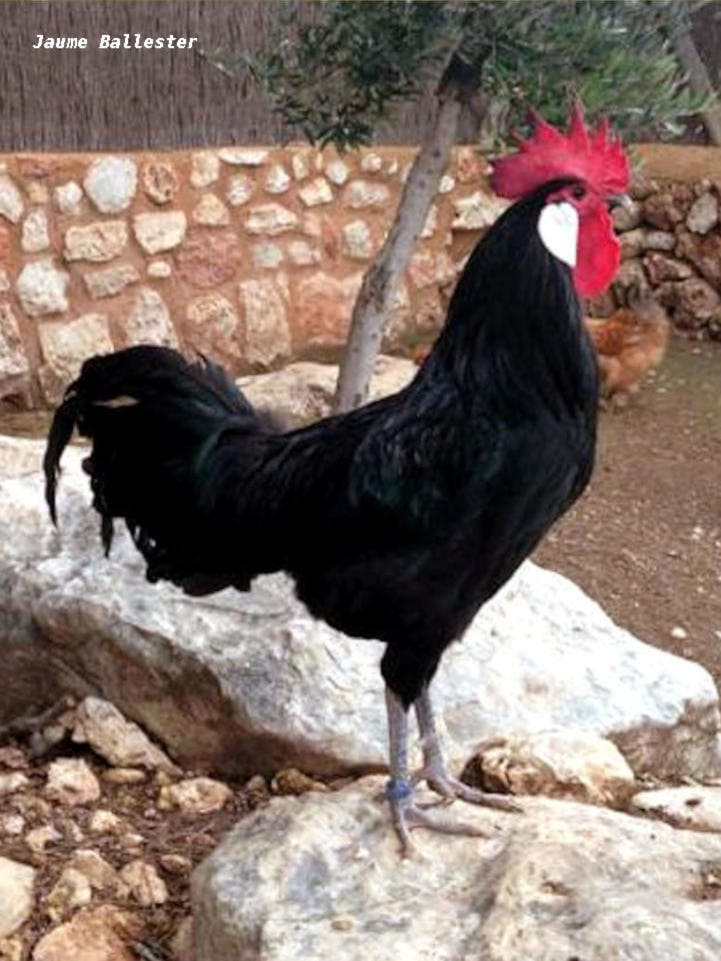
Standards EE: Yes, photo: Black Menorca rooster, breeder Jaume Ballester.
It is pending under the Spanish Code: ESGA000, as it was approved by the National Standards Commission (CNE) in Quintana (Burgos) on September 12, 2020.
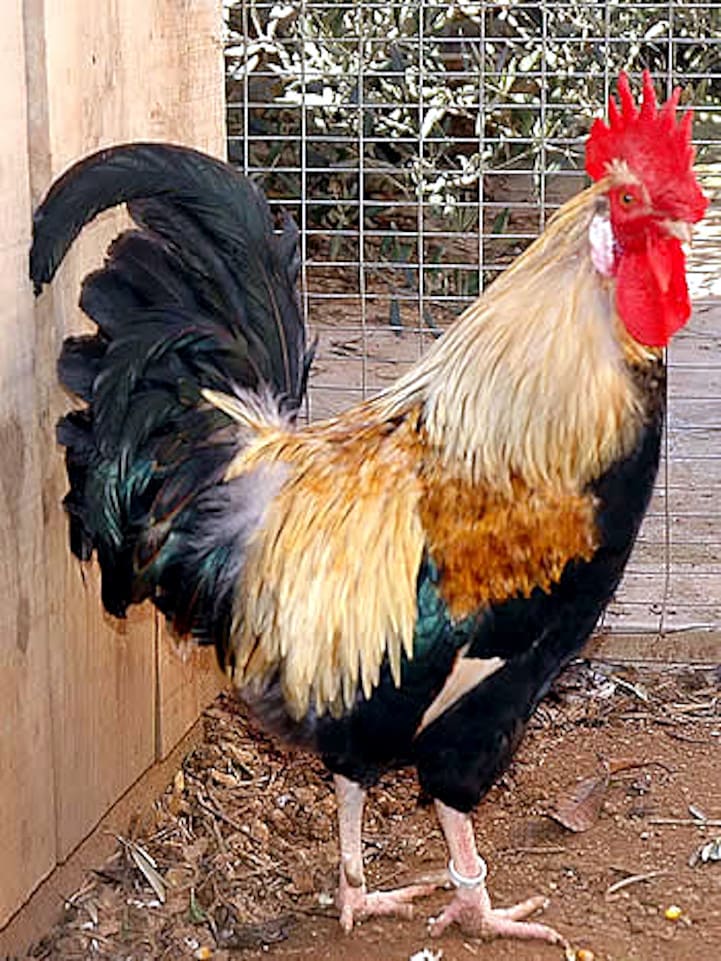
Varieties: 1.— Brunette golden. 2.— Brunette Silver.
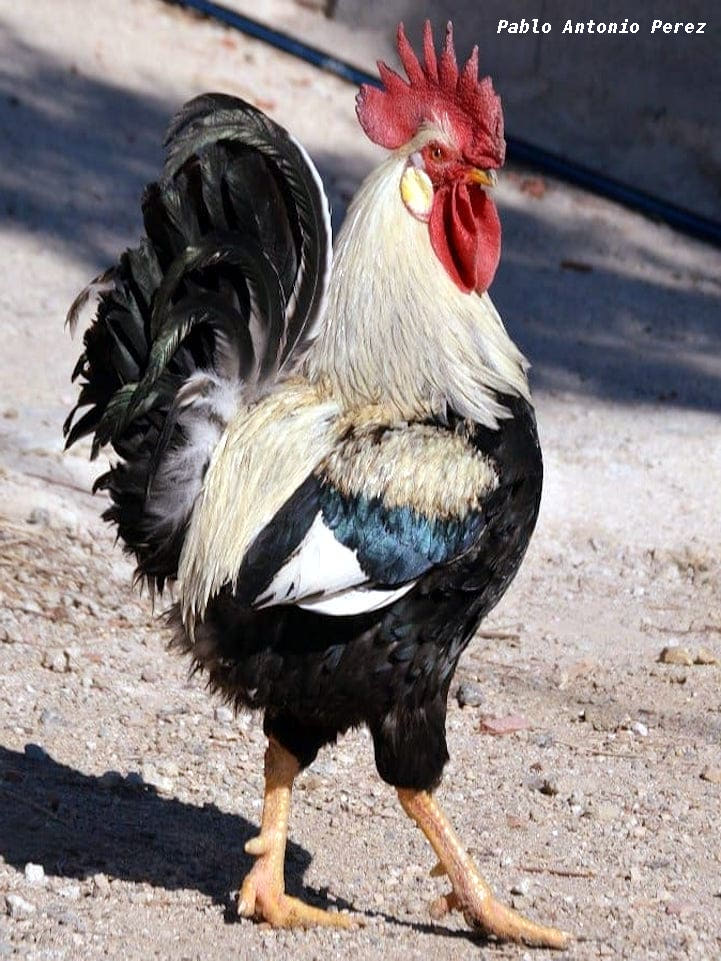
Ring: roosters 20, hens 18. Photo: Murcian rooster, breeder Pablo Antonio Pérez.
Code For Spain: ESGA011 Spanish Chickens: Cock Pardo de León.
Varieties: 1.— Birch black gold. 2.— Birch black silver. 3.— Birch black gold with chest welt. 4.— Birch black silver with chest welt.
Ring: roosters: 20, hens: 18.
Standards EE: If
Code For Spain: ESGA014 Spanish Chickens: Pedresa.
Varieties: 1.— Cuckoo.
Ring: roosters 18, hens 16.
Standards EE: No
Code For Spain: ESGA016 Spanish Chickens: Penedesenca.
Varieties: 1.— Golden fawn 2.— Golden fawn with a stripe. 3.— Golden fawn with a net pattern. 4.— Black.
Ring: roosters 18, hens 16.
Standards EE: If
Is pending in the Code-Spain: ESGA000, as approved by the National Commission Standards (CNE) in Quintana (Burgos) the 12/09/2020, consists of two
Varieties: Aperdizada ancient gold: White:
Ring: roosters 20, hens 18. Photo: Gallo Piñeiro. Juan Carlos Soto Santandre.
Code For Spain: ESGA017 Spanish Chickens: Pita asturiana.
Varieties: 11.— Black (black with white markings). 2.— Fawn (fawn with white markings). 3.— White. 4.— Silver-black. 5.— Tri-color.
Ring: roosters: 20, hens: 18.
Standards EE: No photo: Black Asturian Pita Rooster, breeder José Miguel Saiz Barrientos.
Code For Spain: ESGA018 Spanish Chickens: Serrana of Teruel
Varieties: 1.— White. 2.— Birch blue gold. 3.— White armiñado in black. 4.— Birch black gold. 5.— Birch black golden cuckoo. 6.— Aperdizado. 7.— Red tail black.
Ring: roosters: 20, hens: 18.
Standards EE: No photo: Teruel Mountain Rooster, Teruel Mountain Hen.
Code For Spain: ESGA019 Spanish Chickens: Sobrarbe.
Varieties: 1.— Wheat-colored (golden wheat). 2.— White. 3.— Cuckoo. 4.— White with black markings. 5.— Orange-black birch. 6.— Orange-blue birch.
Ring: roosters 18, hens 16.
Standards EE: If
Code For Spain: ESGA020 Spanish Chickens: Southern.
Varieties: 1.— Black. 2.— Ash (blue). 3.— White. 4.— Franciscan (Cuclillo). 5.— Partridge (golden partridge).
Ring: 22 for the roosters, 20 for the hens.
Standards EE: Not a photo of a southern rooster, but a partridge. Ginés Ruiz Cruz.
Code For Spain: ESGA021 Spanish Chickens: Utrerana.
Varieties: 1.— Black. 2.— White. 3.— Franciscan (Cuckoo). 4.— Partridge (Aperdizado gold).
Ring: roosters 18, hens 16.
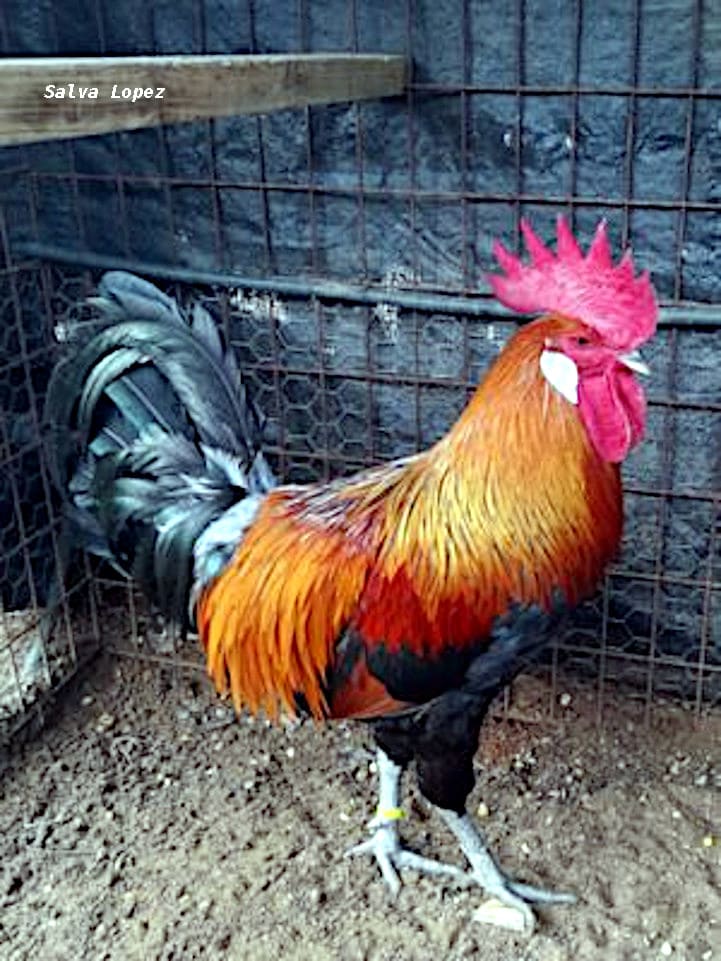
Standards EE: Yes Code EE: ESGH16 Photo: Utrera rooster with a partridge. Salva López.
Code For Spain: ESGA022 Spanish Chickens: Valenciana de Chulilla.
Varieties: 1.— Black and silver.
Ring: roosters 18, hens 16.
Standards EE: Yes Code EE: ESGH17
In this section, we will look at a number of breeds that once existed but have since gone extinct and cannot be revived; we will approach this topic as follows:
1. Breeds that, although you know anything of his creation, and the aviculturist who performed the work, they did not achieve wide distribution.
2. Breeds that do not know its origin or creation, but that is exploited on a small scale during the development of the poultry.
3. Races, more or less, sporadically mentioned in ancient literature, but of which we know almost nothing.
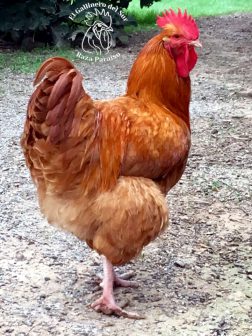
Paraíso Breed: In 1916 and 1917, it became known that Professor Castelló and his sons had begun work on creating a new breed at the Royal Official Spanish School of Poultry Farming and Granja Paraíso in Arenys de Mar (Barcelona), aiming to develop a dual-purpose breed—that is, one that could be readily adapted for either egg production or meat production.
Today in 2021, the creator Tomás López (Pache Keros) After 15 years of dedicated effort, as a lover and enthusiast of poultry farming, and through meticulous 10-generation closed-line breeding, he has succeeded in developing the Paraíso Leonada.
You may be interested in these other sections