When we are in the last incubation process (three days), and we think everything will turn out perfectly, since we're sure they're ready to hatch and we'll have our chicks—but it's not as easy as we think.
The chicks are starting to hatch; there’s always one that hatches early and, with its chirping, encourages the others to hatch, but there are a few embryos that don’t manage to hatch because they adopt certain positions wrong in the egg, called malposition.
Of course, not all of them are fatal, but when we examine those unhatched eggs, we must be able to identify them and, if necessary, make a note of them being asked or when they are a result of some management practices are inadequate.
For experts in ovoscopy, when it comes to eggs that take longer to hatch than their siblings, we can see their position (viewing the embryo from the top of the egg) of the six established the embryo is inside the egg; if not, once the incubation period is over, we will examine the eggs to determine the embryo's position.
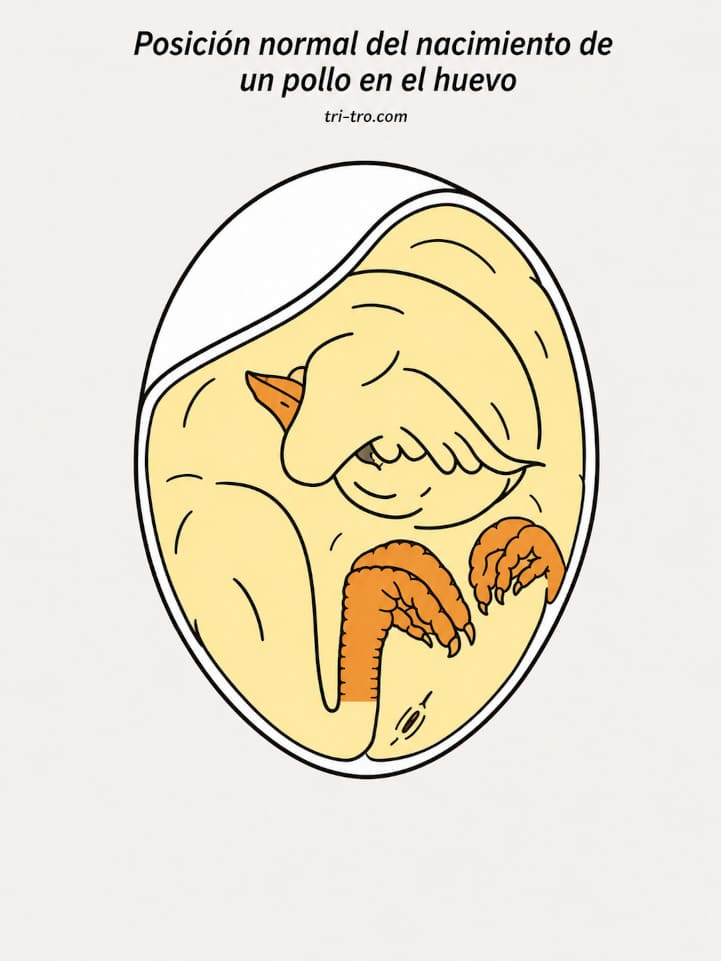
Normal birthing position:
The normal position for hatching, as shown in the photo, is with the embryo’s spine parallel to the egg’s longitudinal axis and the beak positioned beneath the right wing. The tip of the beak points toward the air cell, at the blunt end (air cell of the egg). When the beak is beneath the right wing, the wing keeps the inner membrane of the shell away from the embryo’s face, giving the beak more freedom of movement.
In addition, the wing helps stretch the inner membrane of the shell, making it easier for the beak to break it. In this way, the embryo gains access to the air chamber and begins to oxygenate the lungs. If the embryo has turned the head to the right, it has a good chance of birth; however, the actual percentage of births will be influenced if the head is above or below the right wing.
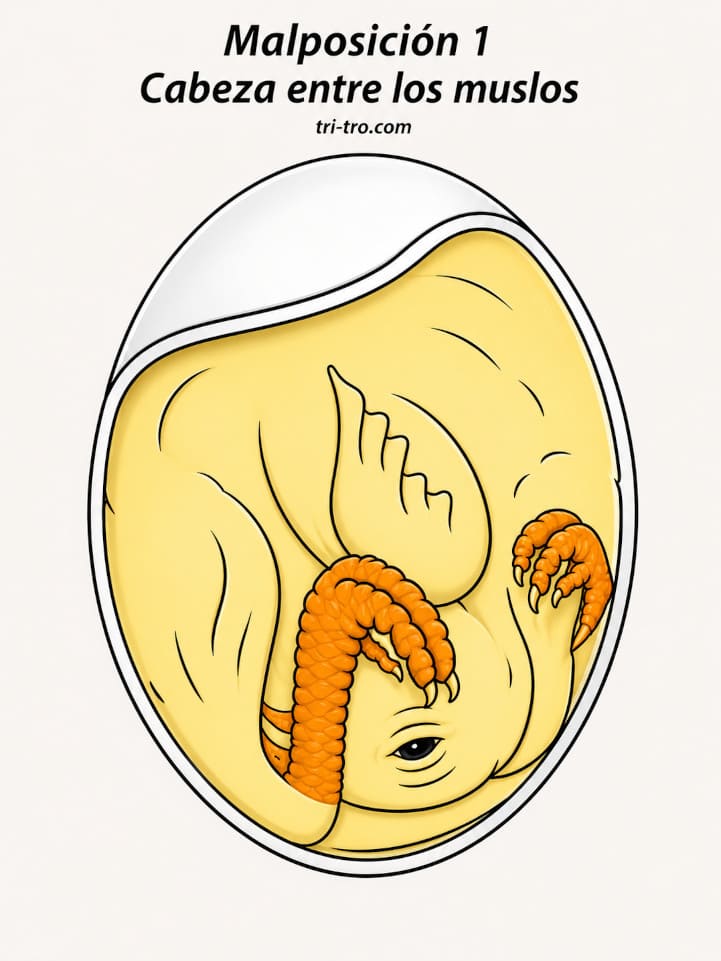
Malposición 1: Cabeza entre los muslos.
Qué ocurre: la cabeza queda atrapada entre las patas y el pollito no consigue orientarse hacia la cámara de aire.
Consecuencia: Suele impedir el picaje interno y reduce mucho las posibilidades de eclosión.
This is the normal position in most embryos by the 18th day of incubation; the head generally begins to turn toward the air chamber; in this way, the embryo assumes the normal position for birth.
On day 19, the embryos with the head between the thighs, to analyze the remains of the birth, surely represent mortality around the 18 days of incubation, or, if they are still alive, it is of embryos with delayed development or growth.
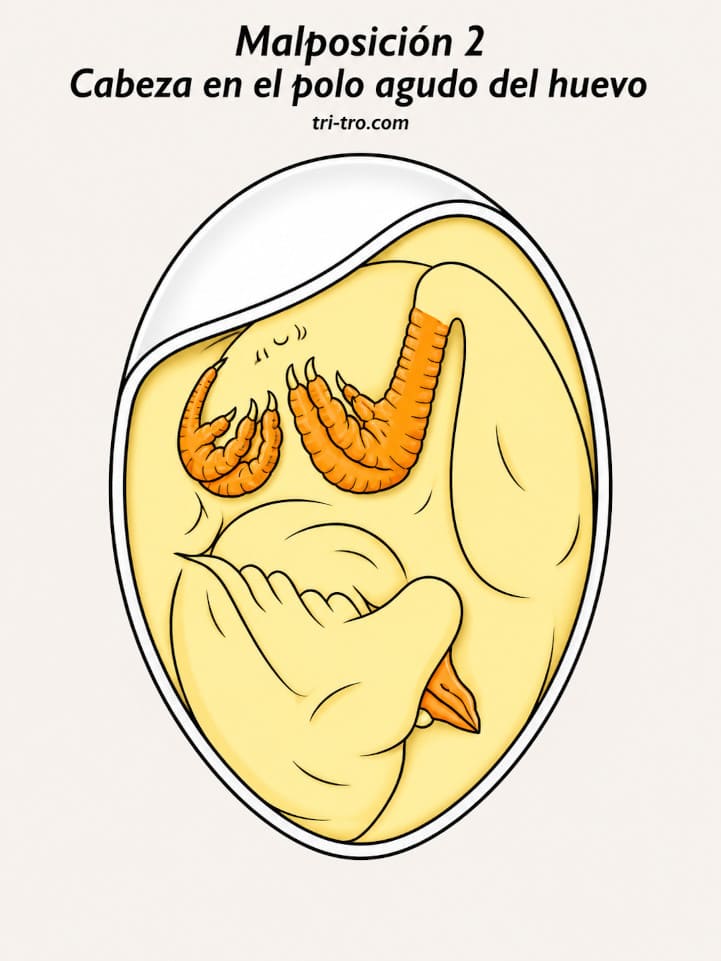
Malposition 2: Head at the pointed end of the egg.
Qué ocurre: el embrión se desarrolla invertido y termina con la cabeza en la parte estrecha del huevo.
Consecuencia: No alcanza correctamente la cámara de aire y suele morir antes de iniciar la eclosión.
These embryos are easily identified because the feet, the yolk sac and the navel, after 18 days, they are immediately visible upon opening the shell above the air chamber.
This position is commonly observed in eggs incubated upside down, and it is also more prevalent in the eggs placed horizontally than in those incubated with the polo large upward. This position may occur in eggs off correctly (particularly in the rounded form), eggs exposed to elevated temperatures in the incubator, or when the angle of the dump is too small.
The frequency of this misplacement is strongly influenced by the percentage of eggs placed upside down (with the sharp end facing up). The ideal thing is that the frequency of this misplacement is less than 10% of the total.
Eggs that are positioned upside down can be repositioned without adverse effects up to the eighth day of incubation. Repositioning the eggs after this point carries the risk of rupturing blood vessels in the chorioallantoic membrane, which is beginning to adhere to the inner membranes of the shell (the inner and outer testaceous membranes). Starting on day nine, embryos that are upside down on day 20 of incubation manage to hatch at a rate close to 80% of normal.
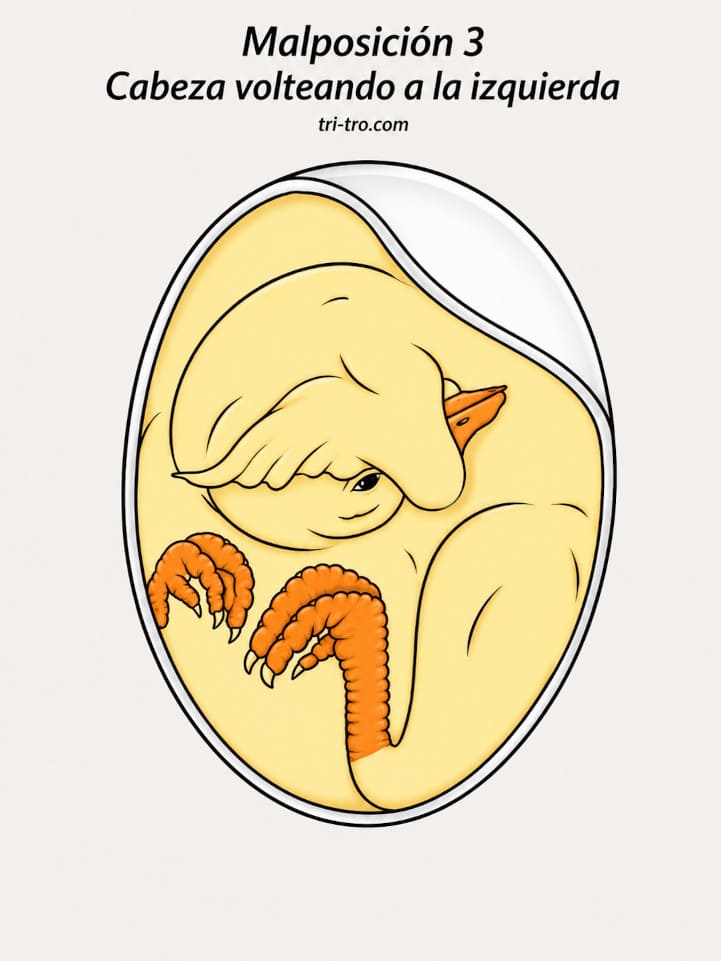
Malposition 3: Head turned to the left.
Qué ocurre: la cabeza se orienta hacia el lado izquierdo del huevo en lugar de colocarse bajo el ala derecha, que es la posición normal para la eclosión.
Consecuencia: El pollito tiene más dificultades para alcanzar la cámara de aire y coordinar los movimientos necesarios para romper la cáscara.
This misplacement is all the more remarkable or more visible in eggs laid with the rounded end facing upward than in those laid horizontally. In many cases, the beak is located above the left wing.
When the embryo turns head to the left, reduced by approximately 20 %, your odds of being born.
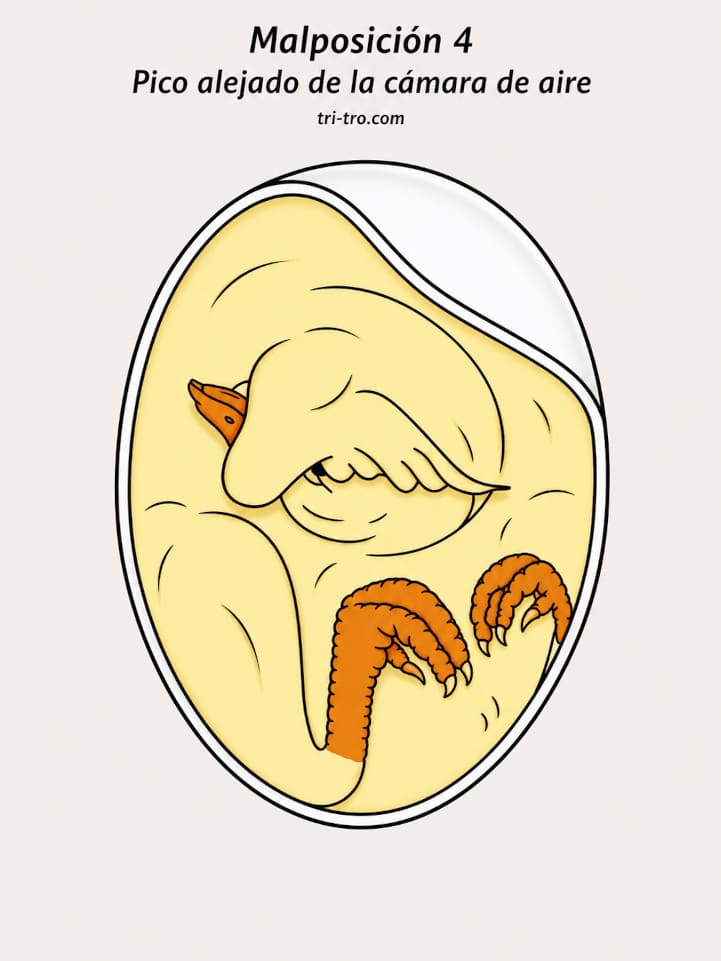
Misalignment 4: Tip away from the air chamber.
Qué ocurre: el pico queda orientado lejos de la cámara de aire y no puede realizar correctamente el picaje interno al final de la incubación.
Consecuencia: El embrión puede quedarse sin oxígeno antes de iniciar la eclosión, reduciendo considerablemente sus posibilidades de supervivencia.
The consequence of this This malposition occurs five times more frequently in eggs incubated horizontally than in those properly positioned with the large end facing upward, and it is believed to be almost always fatal. However, it is difficult to detect this malposition.
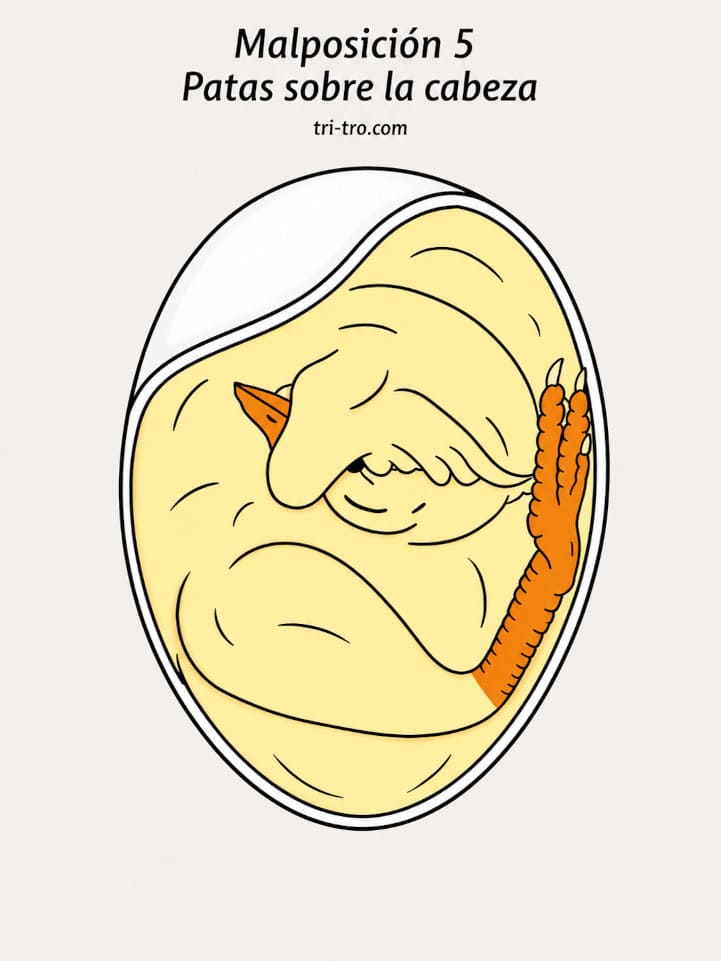
Malposed 5 – Legged on the head.
Qué ocurre: una o ambas patas quedan situadas sobre la cabeza, limitando los movimientos normales del cuello durante la eclosión.
Consecuencia: El pollito tiene dificultades para girar dentro del huevo y romper la cáscara, aumentando el riesgo de quedar atrapado.
Common in one or both legs are trapped between the head and the shell, and hinders the movements of the head to the back to gain momentum, that are required to nibble on the shell with the diamond that has formed at the peak.
The legs are also involved in the rotation end of the embryo, as it cuts the top of the hatch to get out of the egg.
This way, if the position of the legs on the head did not prevent chipping or breakage of the shell, yes it can harm the rotation end and exit of the chicken. Usually, this misplacement is in second place and represents approximately 20% of the total number of malpositioned embryonic.
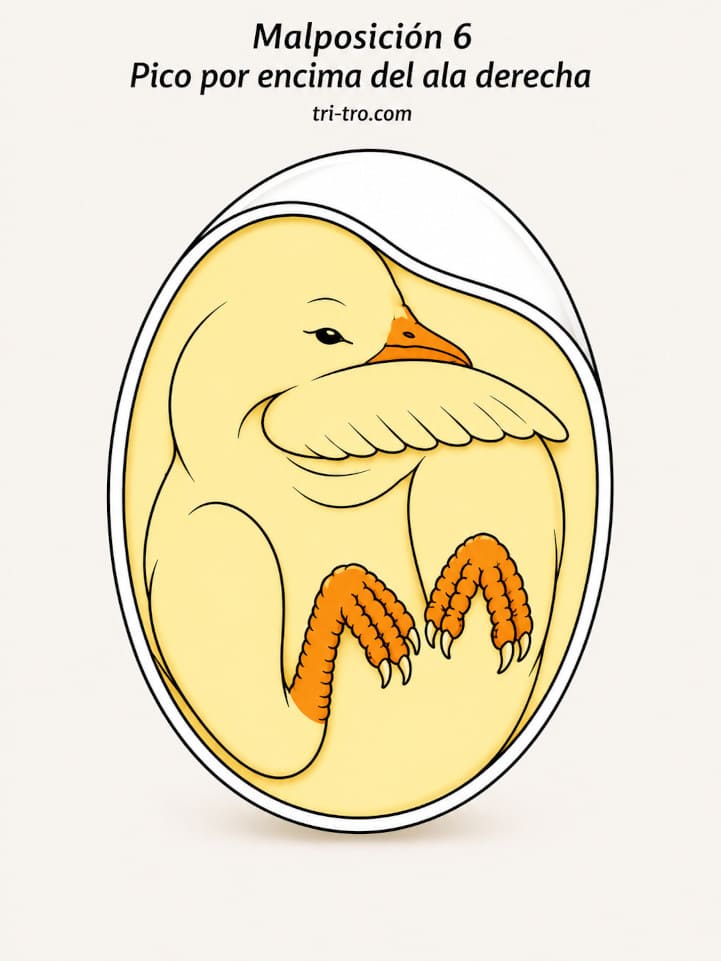
Malposición 6 – Pico por encima del ala derecha.
Qué ocurre: el pico se sitúa sobre el ala derecha en lugar de quedar protegido bajo ella, alterando la posición normal de la cabeza.
Consecuencia: Puede dificultar la orientación hacia la cámara de aire y reducir la eficacia de los movimientos necesarios para iniciar la eclosión.
En esta malposición, el pico queda situado por encima del ala derecha, en lugar de permanecer protegido bajo ella como ocurre durante una eclosión normal. Esta alteración puede dificultar la correcta orientación de la cabeza hacia la cámara de aire y reducir la eficacia de los movimientos de picaje.
Aunque algunos embriones logran nacer en esta posición, el esfuerzo necesario para iniciar la rotura de la cáscara suele ser mayor. Su frecuencia es inferior a la observada en las malposiciones clásicas, por lo que suele detectarse únicamente al analizar huevos no nacidos.
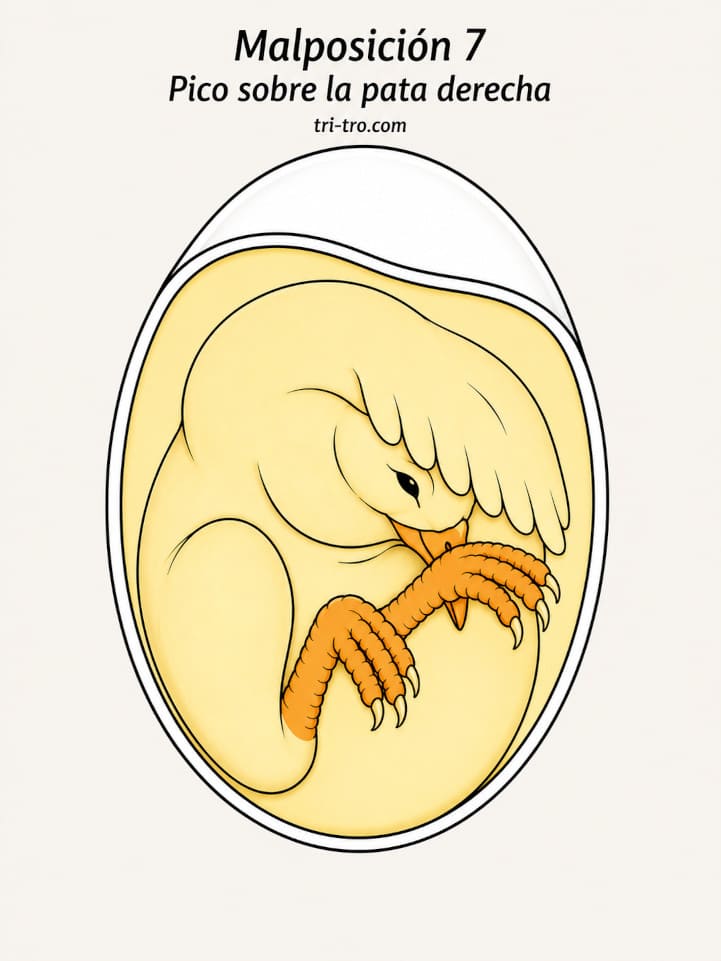
Malposición 7 – Pico sobre la pata derecha.
Qué ocurre: el pico queda apoyado o atrapado sobre la pata derecha, impidiendo que adopte la posición correcta para el picaje interno.
Consecuencia: El pollito puede tener dificultades para acceder a la cámara de aire y para romper la cáscara en las fases finales de la incubación.
En esta posición el pico queda apoyado o atrapado sobre la pata derecha, impidiendo que adopte completamente la postura normal previa al nacimiento. La presencia de la pata delante de la cabeza puede dificultar tanto el acceso a la cámara de aire como los movimientos necesarios para iniciar el picaje interno.
Dependiendo del grado de desplazamiento, algunos pollitos consiguen corregir parcialmente la postura durante los últimos días de incubación. Sin embargo, cuando la posición se mantiene hasta el momento de la eclosión, las probabilidades de nacimiento disminuyen considerablemente.
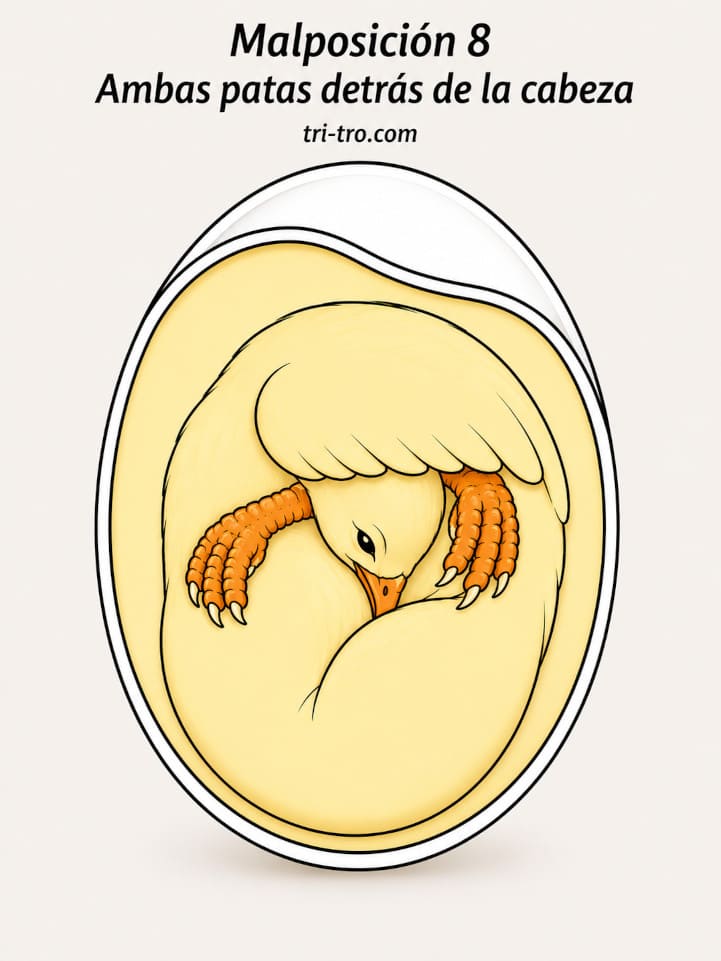
Malposición 8 – Ambas patas detrás de la cabeza.
Qué ocurre: las dos patas quedan desplazadas hacia atrás, situándose detrás de la cabeza en lugar de permanecer plegadas bajo el cuerpo.
Consecuencia: Esta posición limita la capacidad de empuje y rotación del pollito, dificultando seriamente la salida del cascarón.
Note: Es una de las malposiciones más llamativas y menos frecuentes observadas durante el análisis de huevos no nacidos.
Esta malposición se caracteriza porque ambas patas quedan desplazadas hacia atrás, situándose detrás de la cabeza en lugar de permanecer plegadas bajo el cuerpo. Como consecuencia, el embrión pierde gran parte de la capacidad de empuje y rotación que necesita para romper la cáscara durante la eclosión.
Se trata de una posición poco frecuente y llamativa, ya que altera simultáneamente la colocación de las extremidades y de la cabeza. Cuando el pollito no consigue corregirla durante los últimos días de incubación, el nacimiento suele resultar muy difícil sin ayuda externa.
Estas suelen ser las malposiciones registradas más comúnmente, ya que representan más del 70 % o más del total de embriones con posición equivocada. Muchos de estos embriones logran nacer y a menudo se les considera como una variante natural de la posición normal.
However, it has recently been suggested that an excess of embryos in this position can indicate heat stress. The deficiency of linoleic acid has also been linked with this misplacement. In the same embryo can be present, multiple malposition at the same time.
All the eggs that open after the end of the incubation, they have not prospered, should be evaluated for bacterial contamination (for example, if the content is green, black, if it emits a smell rotten or if it explodes when you open it, apart from the position of the embryo). However, the color should not be the only guide, every time that a brown may be due to lack of oxygenation.
The eggs very contaminated often explode when you open them, and in other cases it can be difficult to distinguish the embryo. It is not important to accurately record the time of the death of the embryo in eggs contaminated with the naked eye.
El propósito es registrar el porcentaje total de huevos contaminados y comparar el resultado con las normas de las mejores prácticas. Esto nos permitirá evaluar la eficacia de los handling procedures and disinfection of the eggs and the incubator.
In the records that we can include:
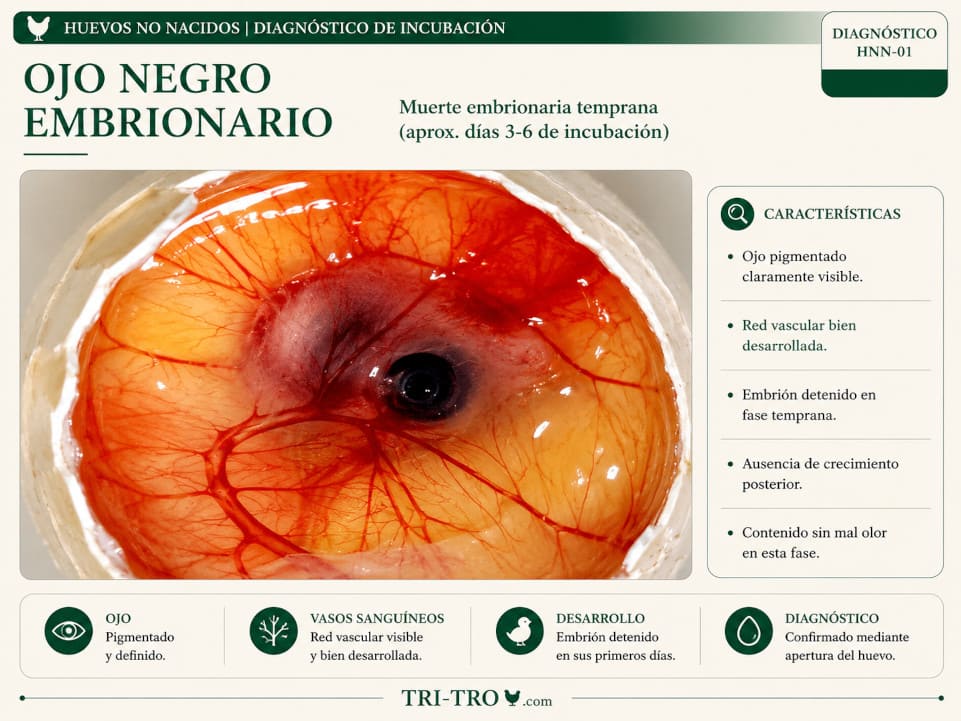
Ojo negro embrionario: el ojo aparece como un punto oscuro muy evidente rodeado por una red de vasos sanguíneos bien desarrollada. También comienzan a distinguirse las primeras estructuras de las alas y las patas.
El denominado «ojo negro» corresponde a una fase temprana del desarrollo embrionario en la que el ojo pigmentado destaca claramente sobre el resto de tejidos. Cuando el embrión muere en esta etapa, el crecimiento se detiene y el huevo conserva este aspecto característico.
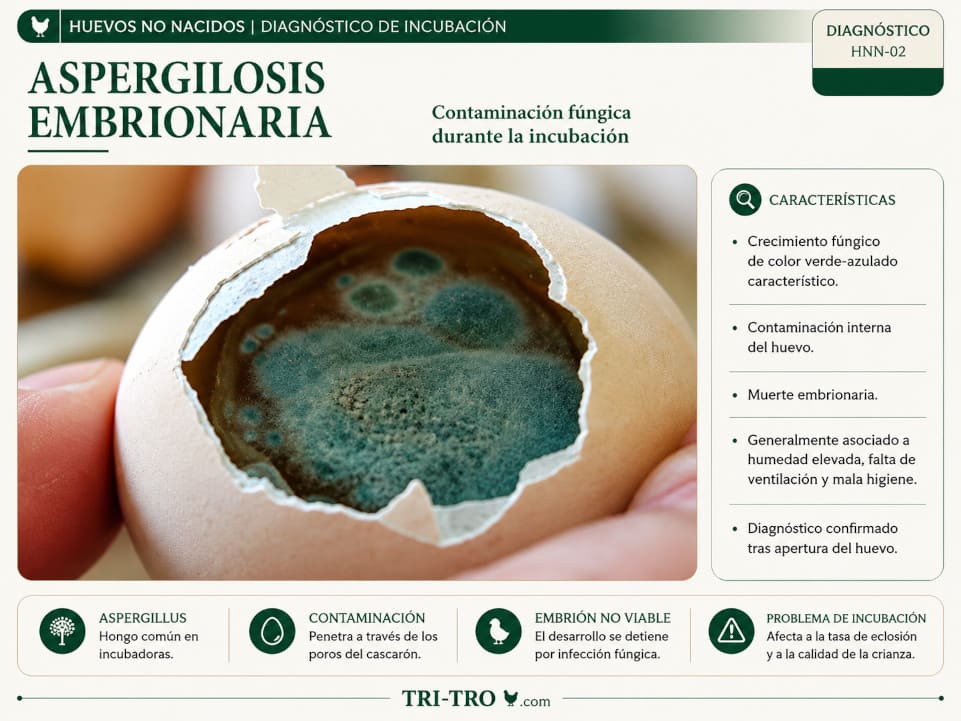
Asperillos represents a special case of pollution, and it can become a serious problem. Always open the eggs with the air chamber and is observed in the growth of fungi in the inner membrane of the shell, this we need to register you as a potential contamination with Asperillos and taking care not to inhale or otherwise disseminate the spores of these fungi.
Ojo negro embrionario
Diagnóstico visual:
El ojo aparece como una estructura negra muy marcada rodeada por vasos sanguíneos visibles. También pueden apreciarse los primeros esbozos de alas y patas, característicos de esta fase temprana del desarrollo embrionario.
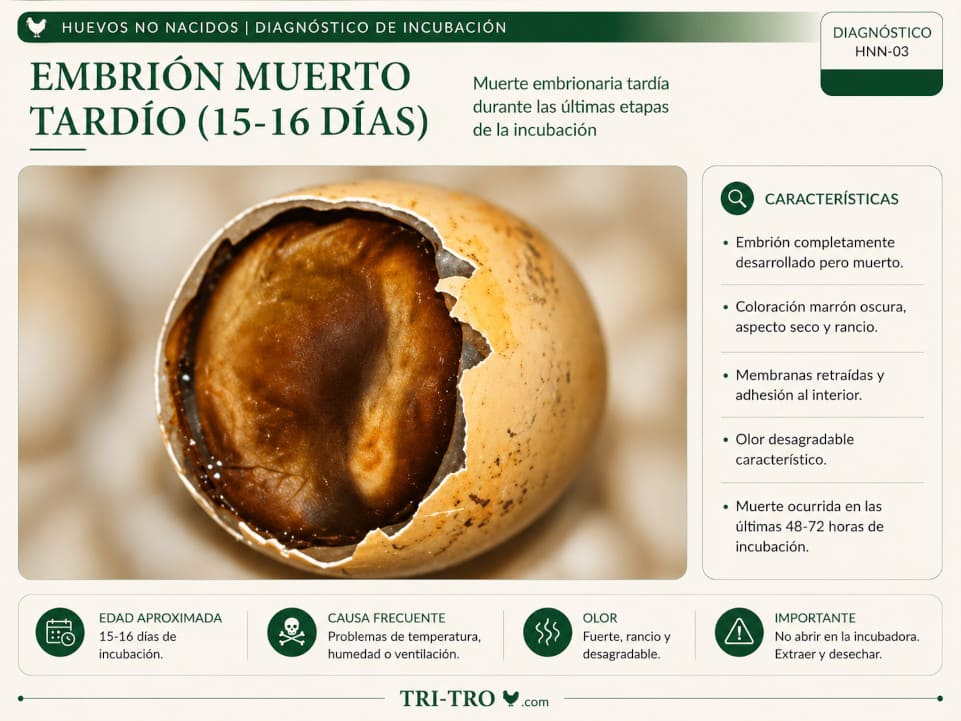
The embryos that died During the feather development stage, they can be easily identified by examining the hatching debris. This embryo died approximately 16 days into incubation.
The contents of the egg is a dark reddish-brown, by the blood of decomposition.
At the stage of development of the plumage.
Diagnóstico visual: El contenido del huevo adquiere una tonalidad marrón rojiza oscura debido a la descomposición de la sangre y los tejidos embrionarios.
The most common problems related to the temperature during the handling of the eggs before placing them in the incubator they are:
Any of these factors increases the “Early death” and the “Mortality Around the Development of the Ring of Blood”. The use of devices for record the temperature data can help to identify the problem areas.
Digital thermometers can also be useful for calculating the conditions of incubation and to identify if there are areas of hot and cold within the incubators, which need correction.
You may be interested in these other sections