Glossary of Hens and Roosters: Essential Poultry Farming Terms

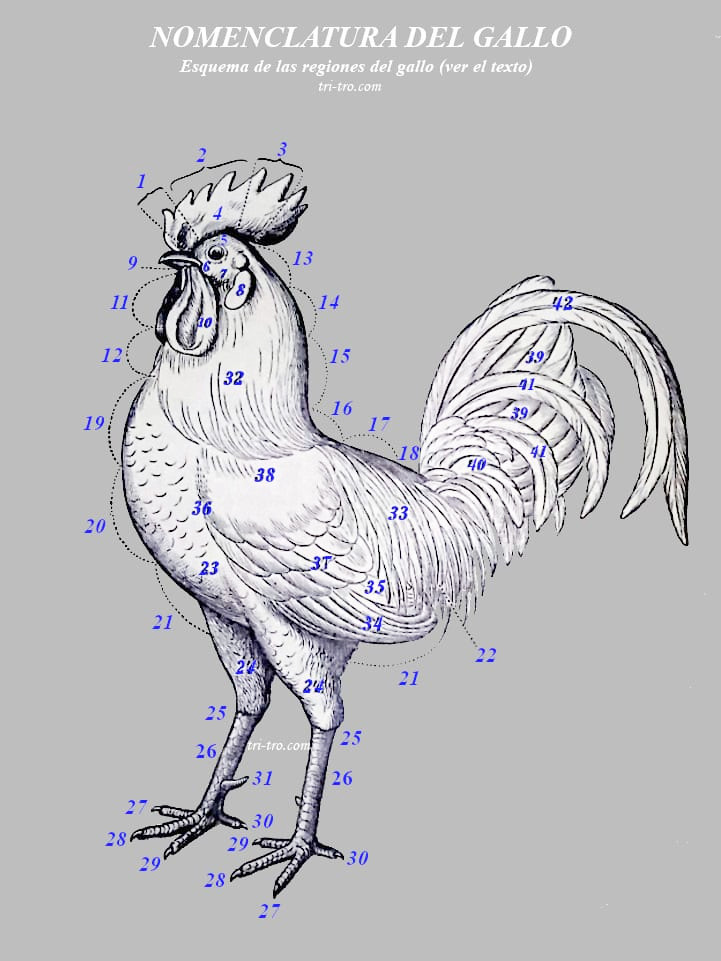
Nomenclature of the rooster.

¿Para qué sirve el glosario o nomenclatura?

The assessment of morphological A hen's appearance is very important when evaluating an excellent bird compared to other birds of the same breed (case of the selection players or competitions and exhibitions) and when it is intended to characterize a new race that is different from the existing ones (to be differentiated from them by one or more features).

In both cases it is necessary to have defined the pattern of the racewith that the bird can be compared and judged, based mainly on the character that best shows the process of breed formation, that is to say, in their size, shape and color.

Although the breeds of chickens are low importance For commercial poultry farmers, who generally know that the laying or broiler hybrids they use are the result of crossbreeding animals of the same or different breeds, there is currently a resurgence of races from the point of view of their conservation and use in the alternative systems of production.

This section describes the different body parts of Spanish chickens. This glossary and terminology will be useful for each of the descriptions used by the poultry judges at shows and exhibitions, as well as breeders and people lovers of these breeds of hens. I have mainly used the recommendations published by:

Grouping Spanish breeders of Birds Selected (1954).

Poultry Club of Great Britain (1954).

American Poultry Association (1953).

ABDOMEN (21): Lower part of the body of the bird, which ranges from the keel to the cloaca.

WING ASLEEP: The flap that does not close completely and therefore does not reach its proper position.

WING DEPARTURE: A wing so irregularly shaped that there is a clearly visible gap between the primary and secondary feathers.

FIN: A tiny cluster of feathers located on the wing joint furthest from the body.

PILLOWCASE: The mass of feathers on the back that covers the start of the queue.

HIPS (17): Back of the spine.

FOREARM: The second section of the forearm, which contains the ulna and radius.

APPENDICES SIDE: They are well-defined pointed growths inserted on one or both sides of the crest.

ARCH OF THE WING: It is the upper portion of the wing that faces the back.

ARCHED: The legs wider apart in the heel than in the knee or the foot.

ARROGANCE: The ideal stance within the style of the master and the appearance of strength, as applied to the fighting race.

SHAFT: The stem of the feather, especially in its solid part, where they grow beards.

SHAFT NUANCED: A heddle that is lighter or darker in color than the fabrics it holds.

SLATE BLUE: A blue gray that is required in the pen and the pen of the Andalusian breed blue. It should not be so dark that it comes close to the black, not so clear that it seems ash.

BANTAM: They are commonly known as bantams; in reality, they are miniatures or a dwarf version of a larger breed.

BEARD: The deck of feathers under the throat and the sides of the face of some races.

CHINS (9, 10): A fleshy, semi-transparent fold hanging on both sides of the face, from the base of the beak to the earlobe. These are two fleshy appendages on either side of the base of the beak (larger in roosters than in hens), usually red in color.

BARRED: The pen with stripes cross of two colors. Its heritage can be sex-linked or not.

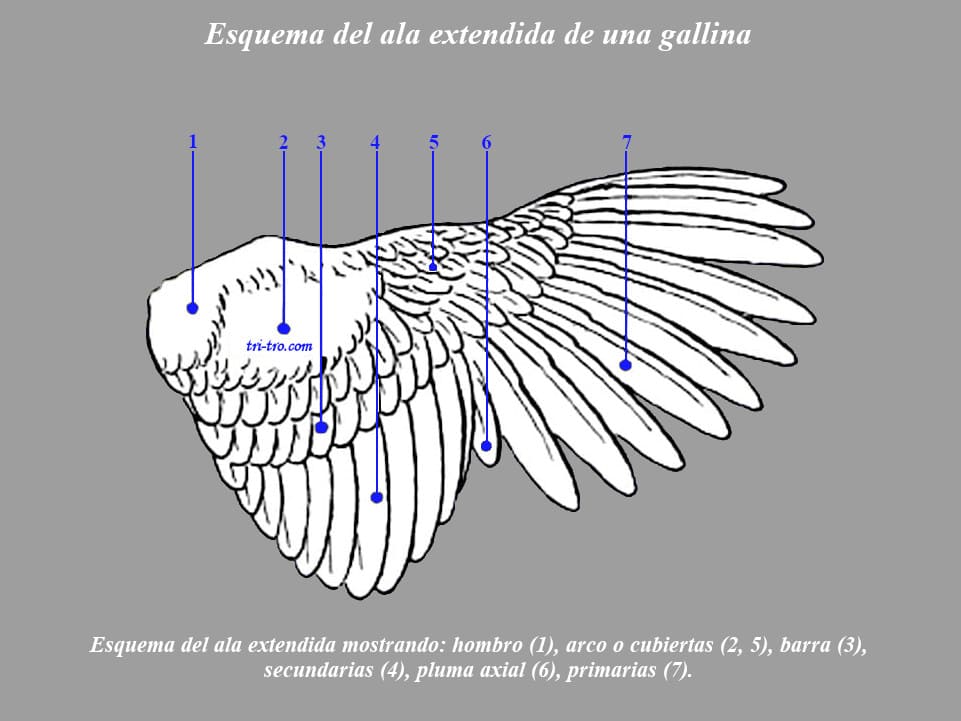
BAR WING: The colored stripe or bar running down the center of the wing, formed by the color or band of the wing coverts. The dark line in the middle of the wing, formed by the inner coverts (in birds with uniform plumage, no difference in the coloration of the wing bar is visible).

BEAM: Plumage list formed by bars or stripes of a different color that extends the alternating direction transverse to the shaft of the pen.

BORDURE: A stripe or line of different color contouring the edge of the pen.

ARM: The first section of the wing from the body, sustained by the humerus bone.

TANNING: Coloration yellowish brown. Constitutes a serious defect in all birds, except the fighters.

BUCHE (12): It serves to store and soften food when the bird's proventriculus and gizzard are full.

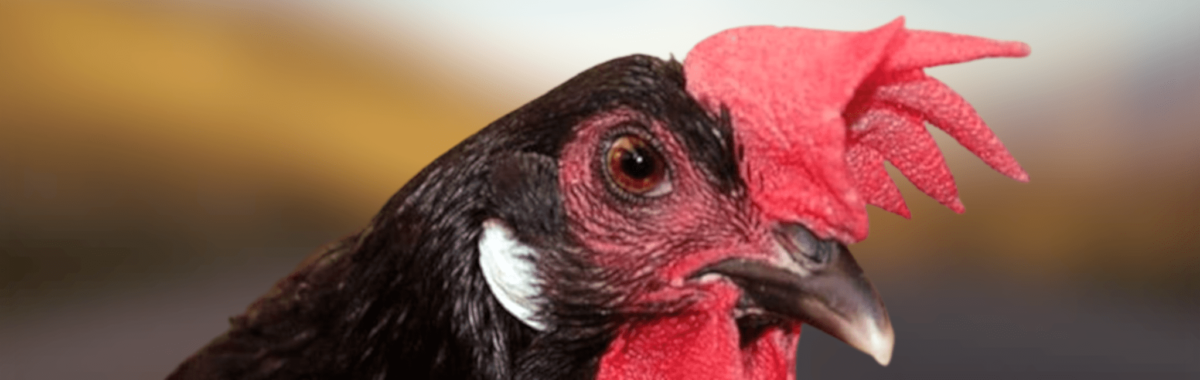
HEAD: Includes the skull, face, crest, eyes, beak, earlobes, and chins.

CAIRELES (32): Feathers long, narrow and pointed that carry the cock in the chair and hung to the sides.

SHIMS: Feathers boast some breeds of birds in the feet and toes. Constitute a serious defect in the breed of legs cleans.

BARREL: The part hollow that forms the base or trunk of the pen.

LAYER: The short feathers of the back, from the bottom of the gorge. Also applies to the whole of the plumage.

FACE (6): It covers both sides of the head, below and around the eyes. It is covered with skin, which in our breeds should always be red (except in the White-faced Spanish breed), smooth, and free of feathers.

CAVITY ORBITAL: Gap formed by the bones of the head which houses the eyeball.

EYEBROWS (5): Top part of the eye.

CLAVICLES OR FORKS: Two thin bones of soldiers in the form of a V with your arms bent outward, which are below the neck. The upper limbs of the V are articulated at the shoulders of the bird. The vertex at the bottom binds to the crest of the sternum.

BLANKETS (37): A small feather that covers the base of the bird's large feathers, the large tail feathers.

BLANKETS TOP OF THE QUEUE (40): Feathers that cover the base of a bird's tail.

TAIL OF A SQUIRREL: A tail that extends forward, extending beyond the vertical line drawn along the tip of the back. One that forms an obtuse angle with the horizontal, slanting toward the head.

CROOKED TAIL: Queue diverted permanently to one side.

STRANGE COLOR: Color of the pen or of the skin, other than the one prescribed by the employer for the region in which it appears, in the race or variety in question.

COLOR GITANO: Dark purple, almost black, on the face, crest, or chin.

SOLID COLOR: Color is uniform, clean, without mixture of any other.

SURFACE COLOR: The that appears, to the view, when the feathers are in their natural position.

CONDITION: State bird's health and cleaning of the plumage, head, and legs.

HAMSTRINGS: The first part of the leg sustained by the bone femur.

OUTLINE HEART: The width of the back behind the wings.

THE DECKS OF THE WING: The small, compact feathers that cover the wing's curve, concealing the base of the secondary feathers' shafts.

CREAM: Yellowish shade in the plumage.

CREST (4): Organ meaty developed in the upper part of the head. The fleshy part on the bird's head (more on the cock in the hen), normally red. Differently according to race.

RIDGE FORKED: Crest simple split vertically in the spur, which is present in double sheet.

CREST FALL: Crest simple tilted on one side. Constitutes a serious defect in the roosters.

SINGLE CREST: It consists of a flap of skin that extends from the base of the beak along the midline of the head, flowing freely backward. Its upper edge is serrated with small points. In roosters, it normally stands erect, while in hens it is folded to one side. This is the characteristic feature of all breeds raised in Spain.

CREST TWISTED: An irregular crest that curves away from the vertical.

BODY: The bird's body; excludes the head, neck, wings, tail, thighs, legs, and toes.

DECKS (40, 34, 35): The feathers covering the tail coverts and the primary and secondary wing feathers.

THE DECKS OF THE QUEUE: The feather curves of the front and sides of the tail.

THE DECKS OF THE FLIGHT: Short feathers that are born on the base of the primaries of the wing.

NECK (15): Next part of the neck until the start of the trunk from the back of the bird.

FINGER DUCK: Finger later carried forward.

FINGERS (27, 28, 29, 30): The four ends of the tarsus. There are four in Mediterranean breeds: one toward the rear, called the posterior, and three toward the front, which are designated external, middle, and internal, according to their position on each leg of the bird. 

SERRATED: Forming mounting on the edge, like a saw.

 
DISQUALIFICATION: Deformity or serious defect that prevents the bird to enter in competition or be exposed.
 

DESCRESTAR: Ablation of the crest, dewlap, and earlobes, leaving the head smooth.

DESTARAR: Deduct from the score corresponding to each section of the bird, according to its pattern, the value of the defects observed in the specimen that is examined.

BACKS (13): The upper part of the body, from the neck to the tail.

IN-TEETH: A V-shaped notch between the tips of a single ridge.

CAPE (32): The feathers on a bird's neck, which differ between roosters (long, narrow, and pointed) and hens (oval). See GOLA or BUSHING.

ENAMEL: White surface covering the earlobes in Mediterranean birds.

BACK (16): Also called back.

SPUR OF THE RIDGE: Posterior lobe of the crest simple after the last tip, which extends backward without adherence to the head.

SPUR (31): The bulging cornea of the tarsus of the rooster.

SPUR: Combat weapon of the roosters. It consists of a bulging cornea that is born in the inner side of the tarsus, and in its lower third. In the females usually take the form of a button.

STERNUM: See KEEL.

TAG: Abnormal growth and superfluous, which disfigures the body where it appears.

TAB: The printed card where the judge noted the score awarded to each bird exposed.

FRAUD: Any attempt to mislead the jury.

FRONT (1): of the crest.

FRONT WING: The front edge of the wing at the height of the back.

GALLINO: A rooster that resembles a hen due to its plumage. A male with female plumage (oval feathers instead of pointed feathers on the cape, wattles, sickles, and wing bow).

ROOSTER: Male with a year or more old.

HEN: Female, after his first entry, usually of a year and a half.

THROAT (11): The upper front of the neck of the bird.

ROTATION: The rooster's plumage consists of the throat, back, wing feathers, wing arch, and wing triangle, which are predominantly white, and the breast, body, wing bar, tail, and down, which are black. If the light color is silvery white, it is called a white giro; if it is creamy white, it is called a black giro.

GOLA or BUSHING (32): Plumage of the neck in the male is composed of long feathers with narrow-terminated tips.

MEALY: A color that appears to be dusted with flour. It applies to red or fawn birds whose basic color is dotted with a lighter color.

SICKLES OR FLOWS: Long feathers and curved, the tail of the rooster. There are two and form the upper tail.

SICKLES OLDER (42): The pair central feathers long and curved, to the tail of the rooster.

SICKLES MINORS (41): The remaining long, curved feathers on the rooster's tail (rooster coverts), which cover the tail feathers.

SHOULDER: Joint of the wing with the body. The top of the union of the wing and the body.

LACEADO: In plumage, each feather appears bordered with a band of different color. The pen with a border around, a different color than the rest.

LANCEOLATE: When the flange previous stops in the center of each feather a figure in the form of tip of the spear.

LACEADA DOUBLE: (in females only): A feather with a border around the edge and a concentric inner stripe.

GRIFFON: The yellow-orange color of the plumage.

SEQUIN GIVES: The pen is red or white with a black spot at the end

LISTED: (females only): A feather with two-colored transverse or concentric stripes running along the feather's outline.

LUSTER: Brightness of the plumage.

HAND: End of the wing, where are born the primary feathers.

MANTLE: The feathers of the cape, tassels, and bow of the rooster's wing.

BRAND: The pattern of a bird's feathers (barred, striped, laced, double laced, sequined, speckled, dotted).

MARK FINGER: Deformation of the ridge that produces a concavity on one side and a convexity on the opposite side.

CHEEK (7): Part or area of the face.

WING MEMBRANE: Triangle of skin that connects the wing to the body, only visible when the wing is extended.

WEBBING: Skin that connects the toes to their tips in web-footed birds and only at their base in chickens. When this membrane extends further, it constitutes a serious defect.

BOW: The plume of feathers on the head, associated with a modification of the bones front of the skull.

SPOTTED: The pen is black with a white spot on the end. If the pen is red, a black bar separating the two colors.

NECK rest (13): Back of the head. 

MOZZETTA (32): Cape that covers the chest and back.

MOVES: Replacement annual of the feathers. Lasts 8 weeks.

THIGH (24): The part of the leg covering of feathers above the tarsus. The lower (tibia) is from the tarsus to the knee, and the upper or against your thigh (femur) from the knee to the body.

OCCIPUT (3): Of the crest.

OREJILLAS (8): A fold of bare skin located on the face below the ear. The folds of skin on either side of the head, below the ear canal. They are usually oval or round in shape, and may be white, red, blue, purple, or cream-colored.

EARPHONE HOLE: The small opening on each side of the head, above the earlobes, covered with a tuft of feathers.

Outline of the wing extended, a chicken

NOSTRIL: The openings of the respiratory system located at the base of the upper mandible of the beak.

PARTNER: The male and female of the same age and race.

LEG: The thigh, lower leg, foot, and toes.

PATIABIERTO: Animal that presents the arched legs.

LEGS ROADS: Fingers and feet feathered as they appear in certain breeds. In the Mediterranean is a serious defect, and may because for disqualification.

LEGS OF LIME: Look for scabies confers to the feet and toes of birds affected by this disease.

PATI-ZAMBO: Animal whose legs are approximated with excess on the heels, and away out on the feet.

CHEST (19, 20): The front of the body, from the keel up to the neck, upper and lower.

SCRUFF (14): Next part to the nape of the neck.

PENTADÁCTILAS: Hens with five toes on each foot. It is a serious defect in our races.

SMALL FLOWS: Feathers curves of the tail that appear on the sides and underneath of the large gorges.

PROFILE: Figure of the bird seen from the side.

PEAK: Organ formed by two jaws covered with horny substance. The nostrils open in the upper jaw. The corner of the beak is the point where the two jaws meet.

The beak's color ranges from pinkish white to black, including shades of cream, yellow, reddish, and horn-gray. The two horny mandibles on the face.

DUCK TOE: Finger back towards the front, until almost touching the third finger.

PIGÓSTILO: The bone plane finished in tip that forms the end of the spine.

PAINTED: Default plumage when you hold paint or stain color other than their own.

LEG (24): The lower leg is the part of the lower limb that begins at the knee joint. 

CAMPUS: One male and four females of the same age and race.

PEN: Natural covering of birds, epidermal formations that make up a bird's plumage. A typical feather consists of a shaft and barbs. The shaft is divided into the calamus (the hollow basal part) and the rachis (where the barbs are inserted). The barbs give rise to barbules, and these in turn give rise to barbicels (small hooks that hold the barbules together). Down (without barbicels) emerges from the lower part of the rachis.

FEATHERS AXILLARY: Feathers attached to the wing axilla. The short feather between the primary and secondary wing feathers.

FEATHER SEX: The feather's pointed tip of the cock (tippet, caireles, arch of the wing, sickles) different to the oval of the chicken.

FLIGHT FEATHERS: Primary and secondary used to fly, but hidden, totally or partially when the wing is at rest.

FEATHER TWISTED: Pen barrel or shaft spot for deviation or twisting.

DOWN: The first set of feathers on chicks at birth. The collection of small, soft feathers that grow in various parts of the adult bird’s body. The term also refers to the loose, unfused barbs found on the underside of each feather, between the shaft and the vane.

CHICKS: Birds in their first age, which did not distinguish the sexes.

CHICKEN – COCK: It is so called the young bird from start to differentiate the sexes until they meet the year,

PORT: Attitude or bearing of the bird.

PRIMARY: Feathers long and strong that are born at the end of the wing; they are the main feathers of the flight. The feathers of the flight are 10 and are located on the hand of the wing.

WING TIP: The tip of the primaries.

DOTTED (only in females): Feather with spots of dark color on a lighter background.

KEEL 0 STERNUM: Flat bone cartilage that holds the breast of the bird. Presents a septum outgoing bone (center of the chest), which runs along its mid-line, forming the true keel.

RUMP (18, 22): The end of the spine where the tail feathers originate. The bony protuberance at the rear of the body from which the tail feathers grow. It comprises the five caudal vertebrae and the pygostyle. Absent in ratites.

RACE: A group of animals related by origin that share a strong resemblance in their fundamental morphological characteristics. In poultry farming, this concept is broader than that of a variety; therefore, there may be two or more varieties within a single breed, but not the other way around.

RECTRICES OR RECTRICES (39): Feather's straight and strong tail, contained within the gorges and covers.

T-SHIRTS PRIMARY (34): Primary feathers, large or wing feathers.

T-SHIRTS SECONDARY (35): Secondary feathers, small or wing feathers.

T-SHIRTS BASTARD (36): Feathers that come out of the first finger of the wing.

RÉMIGES OR T-SHIRTS SCAPULAR (38): The lining of the shoulder of the bird.

EDGED:Drawing the pen that consists of a border of a different color.

RICO: Applies to the color of the feathers when it is clean and bright.

CURLY: The pen of some breeds, curved outward and forward, pointing towards the head.

KNEE (25): The union between the upper thigh and the lower.

DOTTED with: The pen with irregular spots of a different color than the rest.

BLOOD OR LINEAGE: A family of birds reproduced without contributions strange for several generations, and that manifests particular differences that distinguish it from other individuals of their race, or variety.

SECONDARY: Long feathers inserted in the second portion of the wing or forearm. It are partially visible when the wing is folded. Are the pens, adjacent to the primary, visible when the wing is closed (triangle). They tend to be 14 and are located on the forearm.

SILKY: The pen of some breeds, similar to the down feathers of normal.

CHAIR (33): The rear half of the back, supported by the sacrum and covered with feathers (which are short in females) and with hackles in roosters; the rear part of a rooster's back.

SYMMETRY: Harmonic distribution in the proportions of all parts of the specimen that is examined, in accordance with the pattern of the race or variety, to which it belongs.

SUBCOLOR. BACKGROUND COLOR: Colorful down. The color of the bottom (down) of the feathers of a bird as an adult.

SUBCUBIERTAS OF THE WING: The feathers that they wear the wing by its internal face.

TARA: Defect, or points deducted for each fault in the specimen.

HEEL (25): Articulation of the thigh and tarsus. The joint between the thigh and tarsus.

HOCK OR SHANK (26): Section of the leg from the upper thigh to the foot, covered in scales, and always free of feathers on the breeds of the Mediterranean.

TILDE: Small black spots at the end of the feathers of the ruff in certain breeds; moles of a different color from the rest of the pen.

RECTRICES (39): The long feathers and straight lines of the tail, localized under the sickles and the covers of the rooster, and under the covers of the hen, are 14.

TRIANGLE WING: The underside of the wing, consisting of the triangular sections of the wing below the spar, is formed by the visible portion of the secondary feathers when the wing is folded.

TRIO: A male and two females of the same age and race.

VARIETY: A set of animals within a breed differ from the other by one or more external character side, between which tends to mean mainly the color of the plumage. The subvariety is a subdivision of the variety, characterized typically by the shape of the crest.

BELLY (21): Lower part of the body of the bird, which ranges from the keel to the cloaca.

VERTEX (2): Of the crest.

ZAMBAS: The legs closer together in the heel, in the foot and knee.


You may be interested in these other sections


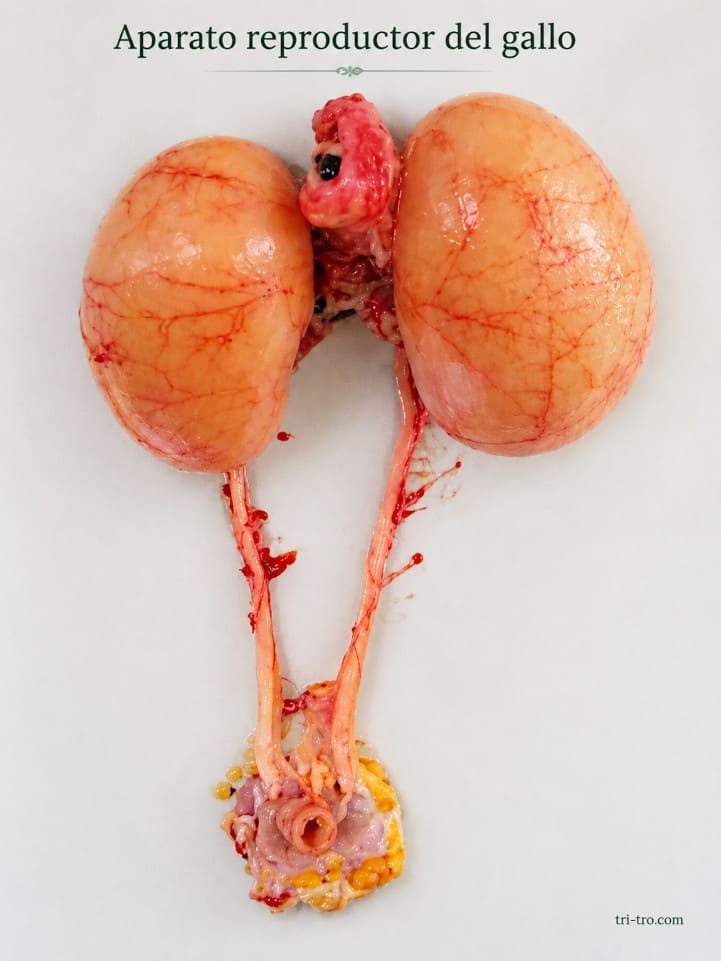
The Rooster's Reproductive System: Parts and Function

Gallus Sonneratii, another species of the genus Gallus

Legacy of Gabriel Alonso de Herrera


Do you want to share or comment on your social networks

Scan to visit TRI-TRO
Escanea para visitar. TRI-TRO