Wing molting in chickens is a method traditionally used to assess a hen's laying ability. By observing the condition and arrangement of the wing feathers, it is possible to determine whether a hen has been a good layer or not.
This system is based on the direct relationship between egg production and feather wear, particularly in the primary wing feathers.
Everyone knows that birds molt their feathers every year, just as furry animals shed their fur. This is a physiological process that is most effective when the birds are in the best of health and full of vigor.
This is something worth considering in poultry farming, because the condition of a hen’s molting process, the time it begins, and how quickly or slowly it progresses can reveal several interesting and practical insights.
It is well known that high-producing hens begin to molt very late (in October or November in the Northern Hemisphere and in April or May in the Southern Hemisphere). Their molting period is brief. In contrast, low-producing hens begin to molt in late spring or summer, and the process usually lasts ten to twelve weeks.
This is already common knowledge, but what is not usually known is how to assess the molting status of a hen that is in plain sight or in your hand; depending on the month in which you examine her and the condition of the feathers on her wings, you can deduce some interesting things. Let’s interpret this and try to understand it as best we can.
Molting begins with the feathers on the top of the head and the uppermost feathers on the neck, as well as a few on the body, and then spreads to the wings and tail, eventually covering the entire body as the bird enters what we call the full molting phase.
Although the shedding of the first feathers on the head and neck already indicates that molting has begun, the observations provided here as a practical guide should focus on the wing feathers; this is where we will concentrate our attention, starting by noting that these feathers come in two types, one called rémiges or t-shirts primary and other calls rémiges or t-shirts high schools.
They are implemented on the finger or phalanx long hand-in-hand and are the most drive and sustain the flight of birds, and the rémiges secondary, on the ulna and the radius.
In the part of the wing that corresponds to the thumb in birds, there are a few feathers called secondary feathers that must serve some purpose in flight, while the other feathers on the wing are the inner and outer flight feathers, but they have no effect on flight.
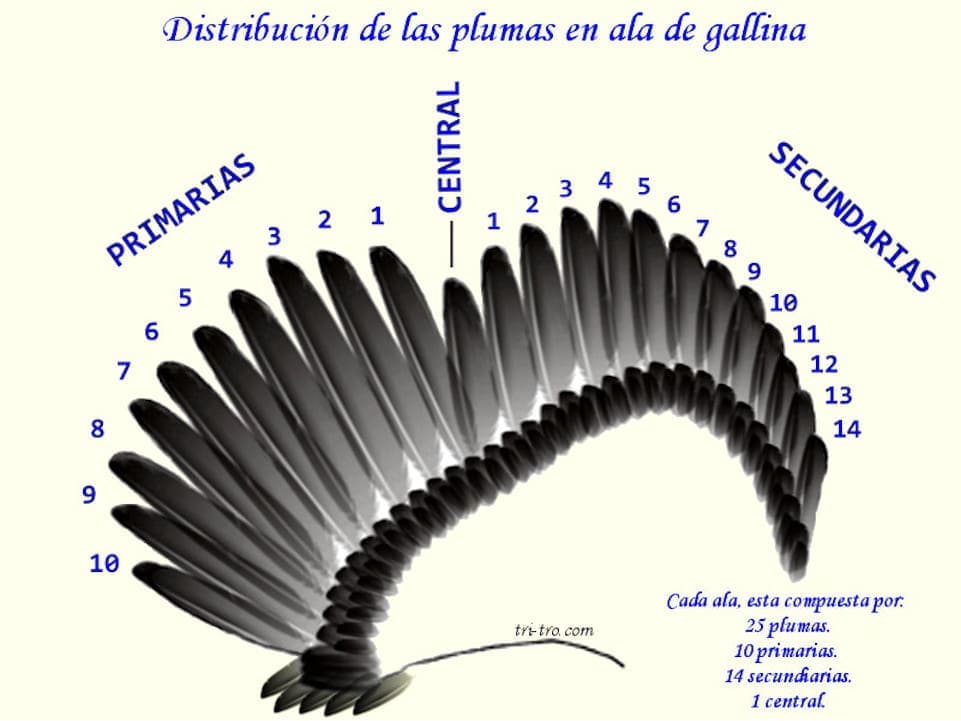
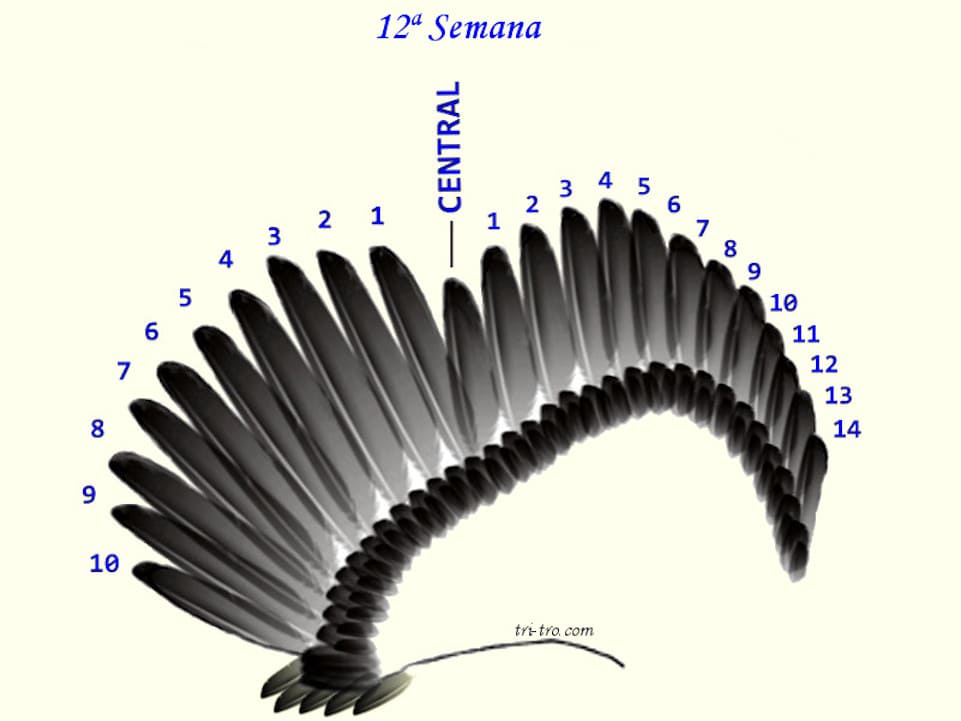
Chickens have twenty-five feathers in each of the wings, and of these, ten are rémiges primary, fourteen are secondary and one pen station, which separates the two categories.
As for the tail, the number of tail feathers varies by breed, with roosters of Mediterranean or southern breeds having the most.
The rectrices they are in fixed number on both cocks as in chickens and they are fourteen, seven for each side. When molting begins on the wings, it also begins on the tail, with the first feathers to fall out being the two central tail feathers in roosters, followed by the lateral tail feathers in both roosters and hens (which lack tail feathers and hackles, or weeping feathers, which in roosters hang or dangle laterally in the saddle region or on the lower back).
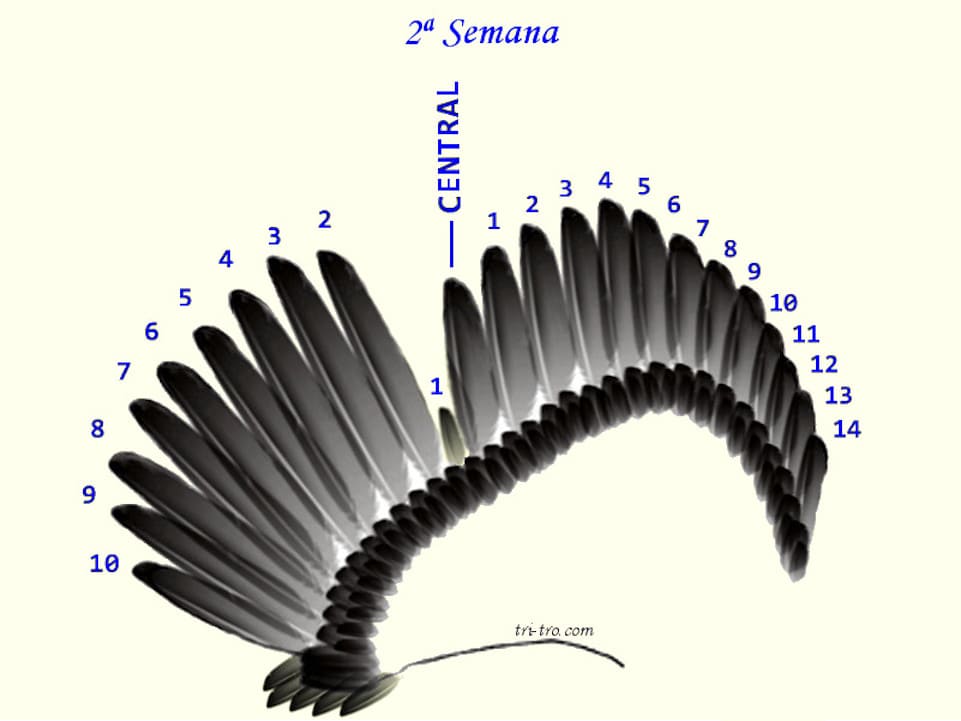
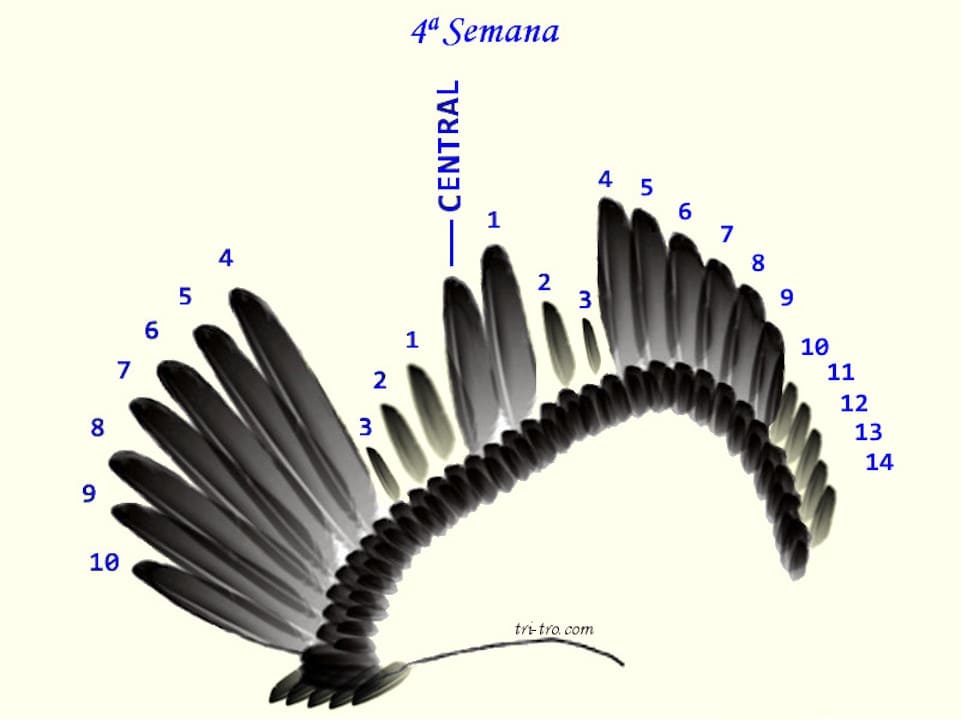
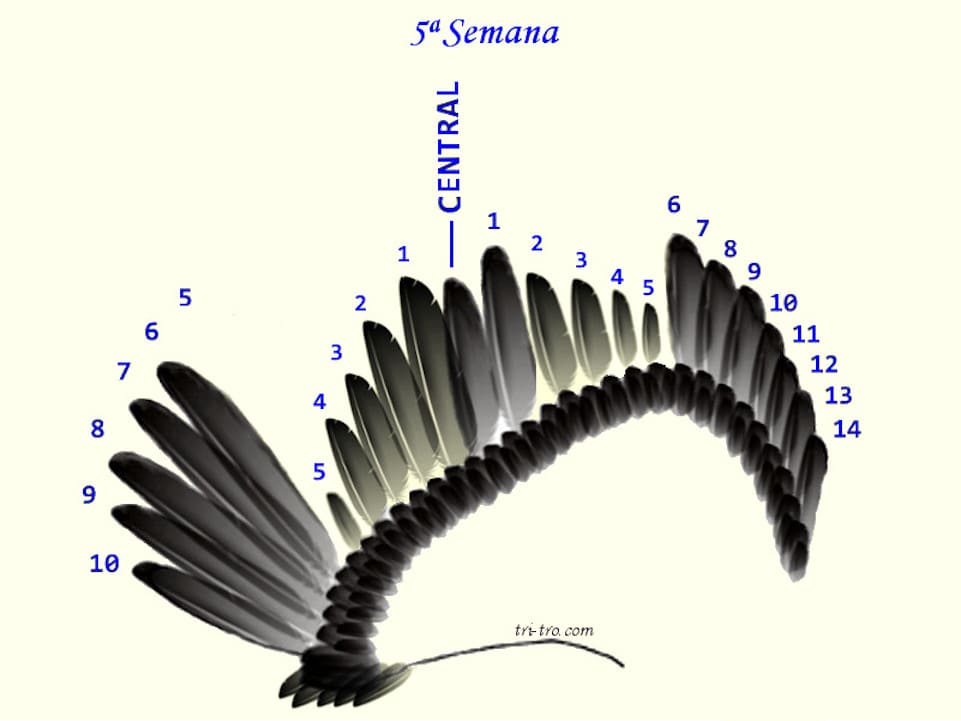
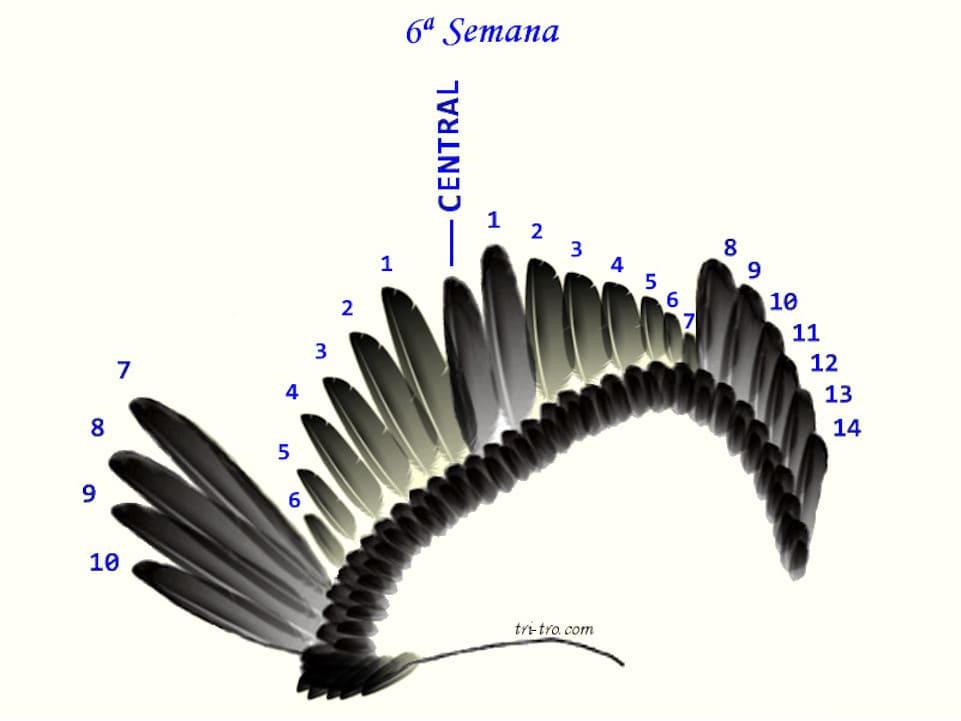
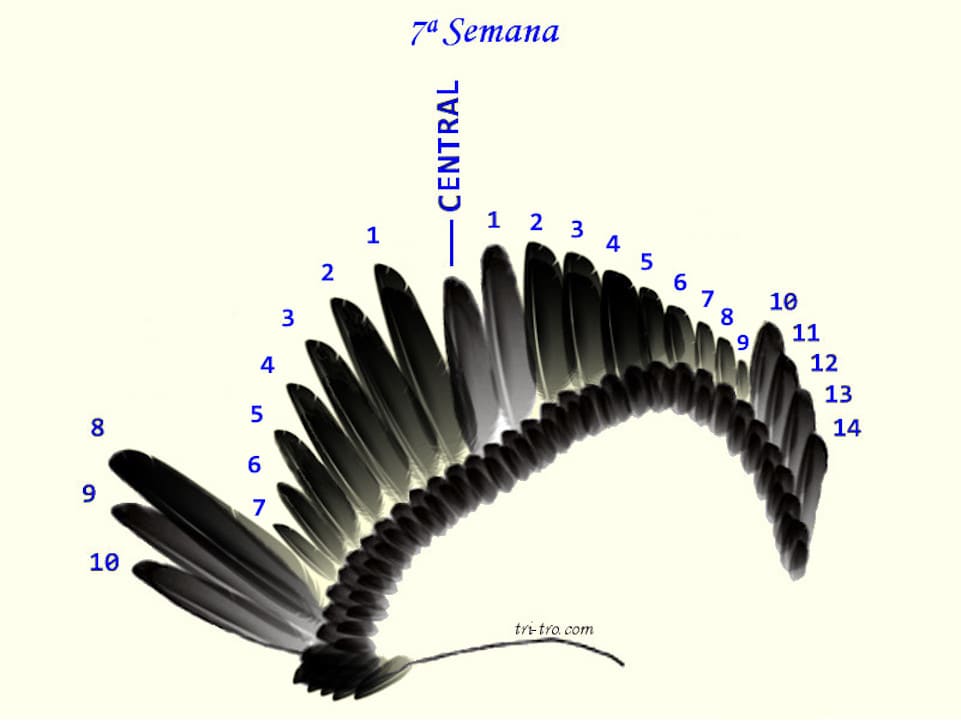
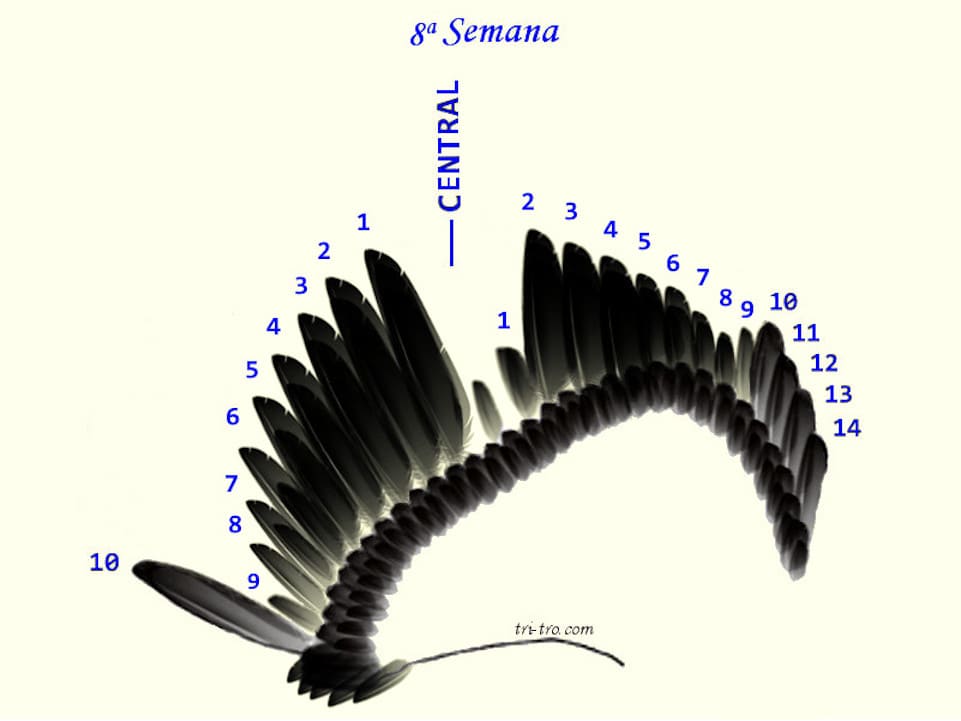
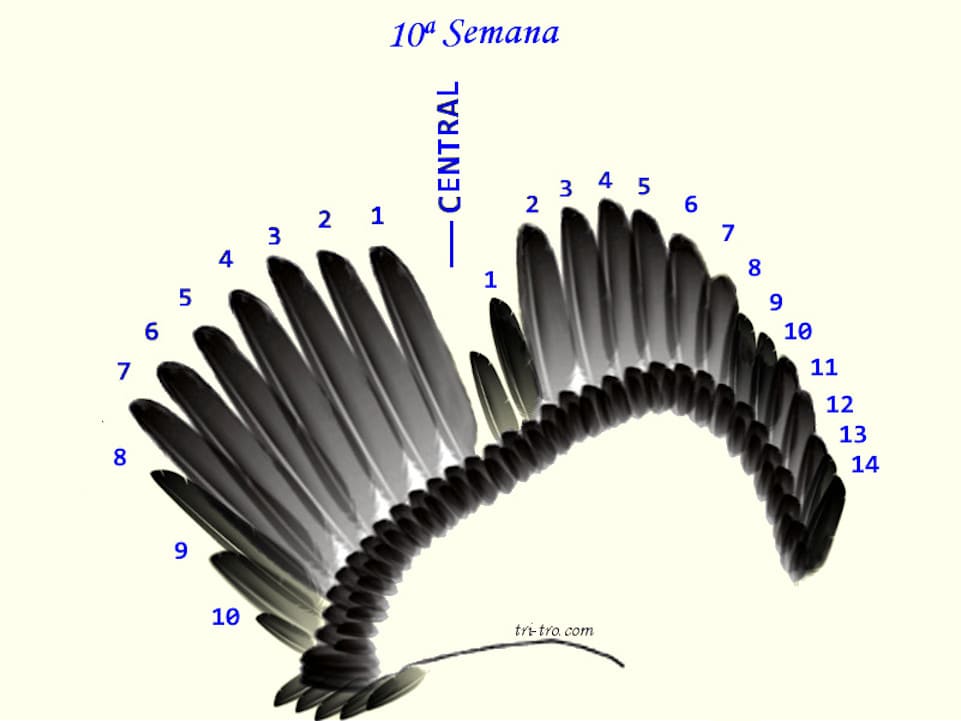
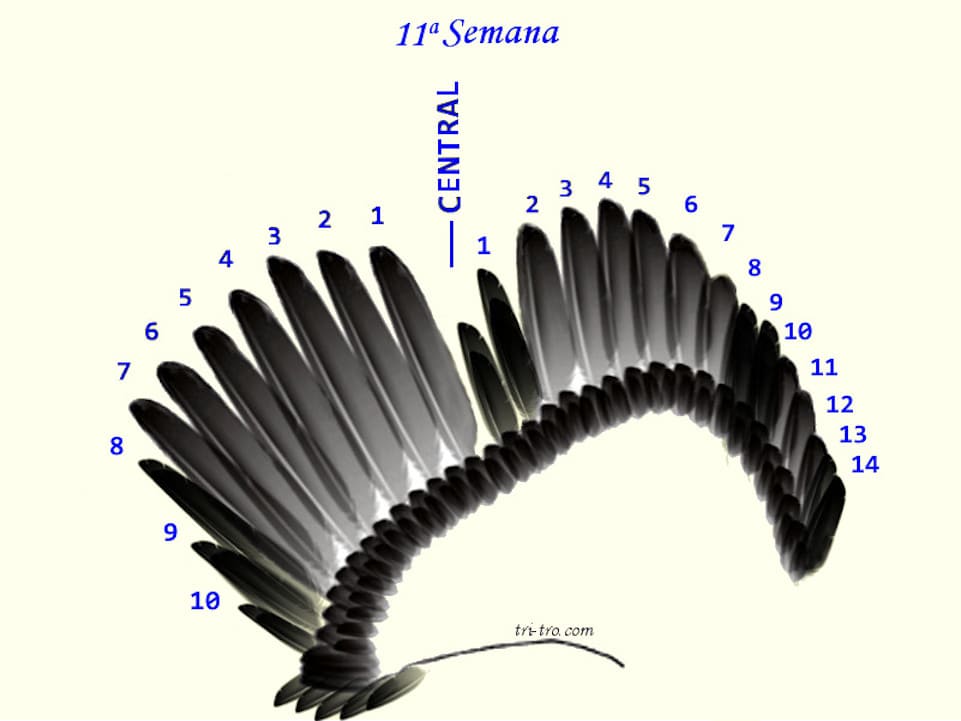
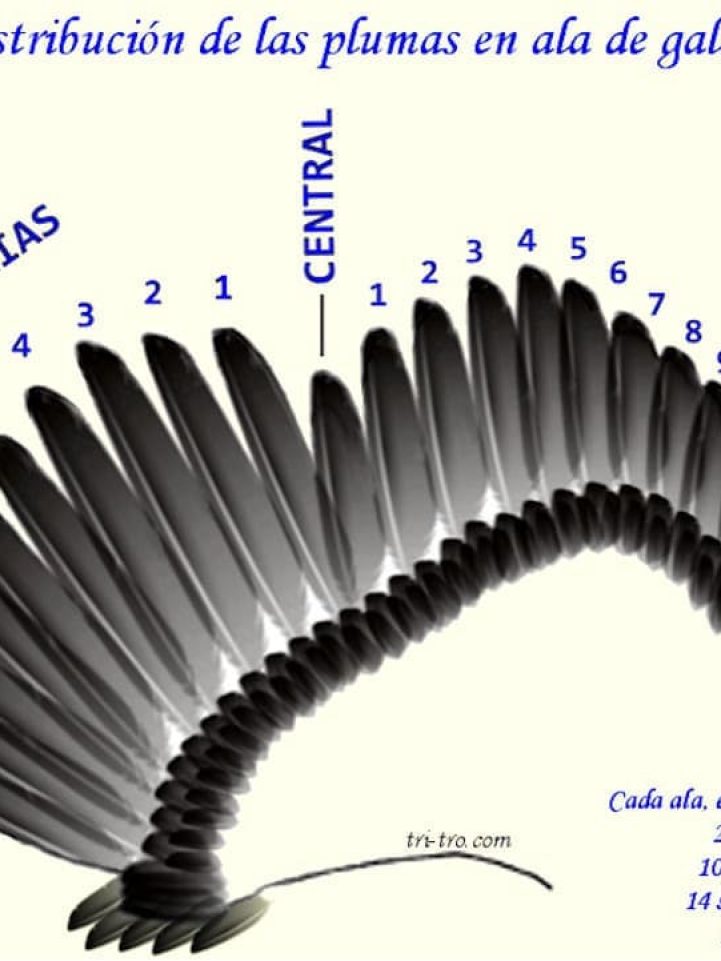
When examining the feathers on the wings—which are the best indicator of the molting status of the bird we are observing—we should pay attention to the order shown in the following illustrations.
Start by dropping the rémiges, secondary, numbers. 11, 12, 13 and 14;
Then the two secondaries fall 10and after, in order, and almost at the same time, a primary and a secondary for the order 2, 3, 4, 5, 6, 7, 8, 9 and 1.
When it falls off the secondary number 1falls are also the pen central.
It is important to remember that a feather never falls out unless the new one next to it is already halfway grown. Without this mechanism, wisely designed by Nature, there would be large gaps in the wing, and the bird would be unable to fly.
Having said this, we should add that, although flight is not the usual means of locomotion for chickens—because they have almost lost this ability after so many generations of domestication—they did, however, fly like other birds when they lived in the wild, and those still living in the Asian and Oceanic jungles continue to fly in this way; indeed, even among domestic breeds, there are flying varieties, such as the Castellana, and in all of them, short flights always serve as an aid to their movements or their momentum.
From the time the first feathers fall out until the last ones shed, a period of varying length elapses, depending on the animal’s physiological and pathological condition; this period is related to its vitality. Consequently, since the state's production depends largely on this, the two may be related.
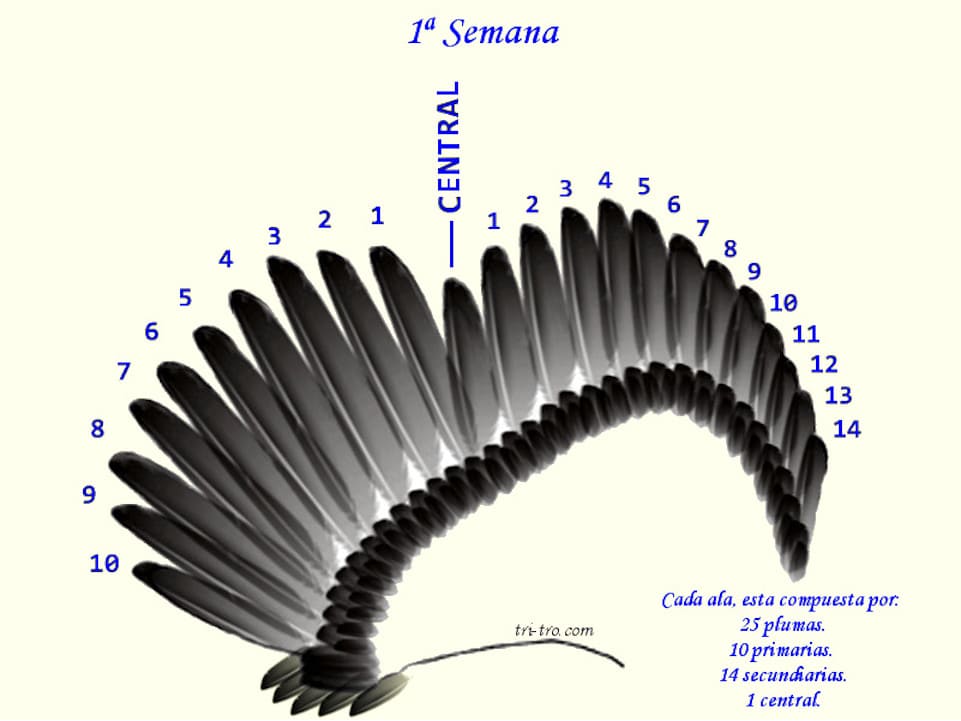
This period normally lasts no more than twelve weeks, or three months. In hens, week by week, feather loss is observed in the pattern and order shown in the illustrative charts. This was established by Professor Rice, first vice president for the Americas of the World Association of Scientific Poultry Science, and published in the Bulletin of Cornell University (Ithaca, N.Y.).
We must understand, however, that in each hen this shedding of feathers varies in terms of when it occurs, and therefore the molting period lasts for a shorter or longer time; the order in which the feathers fall is fixed and always the same.
With all of this in mind—or at least as a starting point—let’s now consider what guidance the moult provides in assessing a bird’s value based on its production, that is, in selecting it for that purpose when its egg-laying record has not been recorded.
In laying chickens, the condition of the wing feathers allows for an estimation of their production level. Chickens that have laid more eggs show greater wear and more advanced molting in their primary feathers.
Conversely, chickens with lower egg production retain more old feathers that have not been shed. This method allows the breeder to make a practical selection of the best layers without the need for records.
The condition of the plumage is also a key factor in the evaluation of hens, as reflected in the criteria for prosecution.
In the first place, it is worth mentioning here things are already well-known by all or not, such as the following, which will give us a pattern of information:
1.ª The hens that are left very plucked for several weeks due to molting are the ones that lay the fewest eggs.
2.ª That the laying chickens continue to lay eggs While the primary feathers molt, they continue to lay eggs, stopping only for a few weeks during the peak of the molting season; the secondary feathers, however, stop laying eggs as soon as molting begins.
3.ª That the best hens are those that, by the time they stop molting, they have already shed 20% of their feathers—both those on their wings and tail and those on their body
4.ª It is important to note that even after the wings and tail have molted, the hen continues to lay eggs, which is a sign of her status as a good layer.
Based on the percentage of molted feathers on the wings,
The following conclusions have been reached:
1.º In chickens that did not lay more than 100 eggs in a year, when they stopped laying, they had either lost no wing feathers at all, or at most, 6% of them—that is, only three feathers between both wings (which have 50 feathers in total).
2.º That hens which laid between 101 and 140 eggs had lost 2 to 4 percent of their feathers by the time they stopped laying—that is, one or two feathers from each wing.
3.º In the hens that laid between 141 and 120 eggs, egg-laying ceased once they had lost 4 to 21% of their feathers, corresponding to 7 to 10 feathers between both wings.
4.º That in older chickens, which had reached a production rate of more than 220 eggs per year, laying did not cease until they had lost 28 to 37 percent of their feathers, of which 14 to 18 or 19 were from the two wings.
Although temperature, diet, and the time of year have a significant influence on molting, it has nevertheless been observed that hens that are slow to begin molting shed their entire plumage more quickly; consequently, since they continue laying for a longer period, it stands to reason that they produce more eggs than those that began molting early.
In contrast, the chickens molting late (October or November) you do not give the eggs in these months.
As early as 1940, our forebears in poultry farming published the results of their observations on this topic in the Bulletin of the Poultry Science Section at Cornell University, involving three groups of hens; see photo.
1st Week
2nd Week
3rd Week
4 th Week
5th Week
6th Week
7 th Week
8th Week
9 th Week
10 th Week
11 th Week
12 th Week
These observations of the blades are truly important because they confirm the reality of what was mentioned earlier, and we need to pay close attention to them in order to fully understand the process of the pen that moves.
As for the growth of new feathers, it can be said that about six weeks elapse from the time a new feather begins to emerge until it has fully developed—that is, until it stops growing—and this is true for all hens, whether they are good layers or poor layers, and applies equally to both the total duration of feather growth and the rate at which it occurs.
However, if, when considering the duration of a hen’s molting period, we take as our starting point the time that elapses from when the first feather falls out until the moment when the last newly grown feather stops growing, this does not allow us to draw practical conclusions regarding her egg-laying.
But if, instead of looking at it from this perspective, we admit The molting period is the time when, as a result of molting, the hen stops laying eggs; at that point, the situation changes, and this has significant implications for both industrial and practical purposes.
So considered the thing, there is no doubt that the lower is the amount of time the hen has been without eggs, the greater number of these in the year, and this has proven to professor James Rice, and may establish the following result:
We are going to present the conclusions we dare to ask, from what we have observed of us in our chicken coops or barns, that without a doubt will give us a lot of information of our birds:
1.º The aviculturist who has not practiced the log posture During the shedding season, you can use this as an opportunity to cull the plants, allowing you to discard the poor ones and keep the good ones—and, of course, the best ones—for the following year.
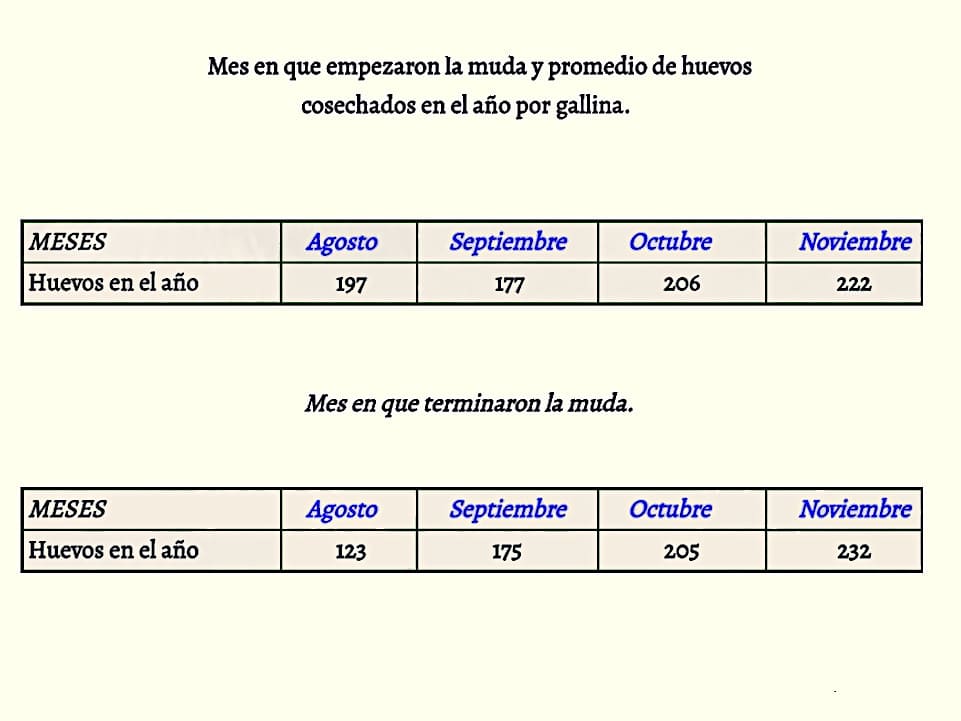
2.º That hens which are moved prematurely, and in August that it already ended, as long as they are of the race selected (this has to be understood always), these are hens that, counting from their first egg, should have laid between 120 and 130 eggs in the following twelve months; and if they begin molting in August, they should have laid between 190 and 200 eggs; therefore, there is a difference between the two figures.
At this point and throughout the rest of this text, bird enthusiasts or breeders who are not from Europe will need to substitute the months I mention with those corresponding to the Southern Hemisphere, where July corresponds to our January.
3.º Whether the molting period begins or ends in September, October, or November, the hens can therefore be considered superior; those that begin molting or finish laying in November are superior to those from October, and those from October are superior to those from September.
4.º When December arrives, one should preferably keep the hens that, due to molting, went without laying for fewer days—not only because this indicates that they went through the process very quickly, but also because it is a quality of the high layersthe keep on giving eggs during the molt, stopping only for a month and a half or two months, at most.
5.º To know the status of the move in an animal, enough with the examination of their wingsand compare it with any of the phases of the move represented in the graphs, deducting from this the time they still have left to finish the moult (molt normal twelve weeks), and, consequently, the eggs that the hen can be expected.
6.º That there is a strong relationship between the delay with which a hen starts to move and the time taken to complete, with the number of eggs that given in the twelve months of posture, and later, with his start-annual.
7.º Please note that everything we've discussed refers to hens that move in normal statethat is, healthy and vigorous hens—but not weak hens, those that have suffered from poor rearing, or those that were poorly fed, and above all, those that are sick or were sick shortly before the normal molting period began, because in these hens the process may manifest itself differently, although the order in which the feathers fall out remains constant.
8.º That, for these conclusions to reflect reality, the poultry farmer must not have resorted to any of the methods available to him for to anticipate or delay the move, such as the inclusion of high-nitrogen ingredients (proteins) in the first case, and low-nitrogen ingredients in the second. A lot or a little grain; a lot or a little animal-based ingredients; a lot or a little vegetables, etc.
9.º Whether hens are kept in small coops, in large pens, or free-range also has a significant impact on whether molting occurs earlier or later; hens that enjoy full freedom in the countryside typically molt more quickly and normally than those kept in complete confinement.
Note how much can be deduced from the molting of hens—a topic that is rarely covered in poultry farming books, yet one that I believe is of great importance and deserves the attention of all serious poultry farmers and enthusiasts, as it can guide them in the practice of selection in order huevero and practical, when you have not practiced the registration of the position.
At this point, I hope you’ve found all this information useful—there isn’t much documentation on the subject, and it’s been a pleasure for me to share it with all of you.
Now we must cull our hens—those that don’t produce enough to cover their feed costs—and keep for next year those that, as evidenced by their molting, are good layers; we must cherish them as if they were pure gold.
Understanding wing molting enables breeders to improve the selection of their hens and optimize egg production in a practical way.

Wing molting is a method used to assess a hen's productive status by observing changes in and wear on the wing feathers.
High-producing laying hens exhibit more advanced molting in the primary wing feathers due to the increased wear caused by continuous egg-laying
Old feathers that haven't been shed usually indicate reduced egg-laying activity, since the hen hasn't undergone the same physiological wear and tear.
Yes, it is a traditional method used by breeders, although it should be supplemented with other criteria for a more comprehensive evaluation.
You may be interested in these other sections