Parasitic diseases

A visual guide to identifying the most common flies in the chicken coop and preventing pests that affect chickens.

Problems Caused by Flies in Chicken Coops

Belong to the order Diptera are characterized by sucking or piercing mouthparts and by having two wings in their adult form.

The presence of flies in the chicken coops is usually due to the massive presence of various species, although the most important we will see below.

In general, they are becoming increasingly common in large flocks of laying hens, broiler chickens, or breeding hens kept in confined settings on poultry farms.

This results in a significant decline in animal production and exacerbates the challenges associated with managing and disposing of chicken manure.

These insects lay thousands of eggs in manure and pits; a single kilogram of chicken manure can contain up to 5,000 larvae, from which larvae emerge that, after several days, develop into adult flies.

These flies can cause a degradation of the comfort conditions of the hens, causing them to stress, by altering the environment of the farm or hen house and causing serious inconvenience to the caregiver, that is to say, to us.

Flies landing in water tanks, drinking troughs, or feeders should be considered a major means of transmitting germs.

Diseases they can transmit

Flies are carriers and transmitters of various diseases and pathogens, such as bacteria.

  • I. Salmonellosis.
  • II. E. coli enteritis.
  • III. Protozoa.
  • IV. Virus In the section on diseases chicken, you can check them out.

These can be reproduced abundantly in the wet terrain and with a great intensity that is directly related to the temperature of the atmosphere of the local.

Generally, the floors in barns and chicken coops are kept dry to prevent flies from breeding; however, leaks from waterers and poor drainage can keep the manure damp. 

And in cases where improper grading of the site allows surface water to seep in, this creates ideal conditions for flies to breed.

It is important to remember that damp accumulations of manure or chicken droppings (laying hens excrete about 5% of their body weight daily) often cause serious fly problems. The accumulation of manure under slatted floors in breeding houses or under cages in commercial egg production facilities provides an ideal habitat for fly breeding.

Glossary of the fly:

To better understand the parts and names of, that is made up of a fly.

Head: it Is dominated by two large compound eyes, purple-brown, which occupy each side of the head. The surface of each eye is divided into approximately 4,000 facets, each hexagonal-shaped spot. Each facet is a visual unit so that the fly perceives a mosaic of a scene or image.

On the top of its head (vertex), between its compound eyes, it has three simple eyes (ocelli), arranged in a triangle. Below its head, between its eyes, it has a pair of partial antennae, in a depression.

The upper area of the bases of the antennae and below the ocelli is very narrow in male flies and relatively wide in females. Therefore, in the males, the compound eyes seem to be very together (holópticos), while in females they seem to be very far apart (dicóptico).

The differences in the mouthparts of flies

The fly's mouth and its parts:

Below the antenna projecting the tongue, or proboscis. The tube extends and retracts easily, standing out from the basal part of the proboscis is the pair of maxillary palps.

The end of the proboscis is a fleshy structure bilobulada (lip) or “suction oral” with extensive mountain ranges (pseudotachea), which are the channels of food that lead to the opening of the mouth. The labellum is fleshy pressing against any food.

The pseudo-tracheae on every lip are oriented toward the opening of the alimentary canal (mouth) and remain dilated, thanks to the presence of rings quitinosos, which determine the size of the particles in food that can be ingested (0,0003 – 0,004 mm diameter).

Some larger particles can be ingested directly in the feed channel, without passing through the pseudo-tracheae.

Alternatively, it uses its prosomal teeth to scrape the surface of the food and then moisten it with regurgitated saliva and liquid vomit, so that the liquefied material can be ingested.

Spitting up by feeding on leaves spots of light color, which, together with the faecal stains are dark, it causes the contamination of the surfaces.

The mouthparts of the housefly are called sponge suction due to the fleshy structure and the method of blending the food before ingestion.

The muscular action of the pharynx is used to take food by suction.

In the photo you can see the different mouthparts with which to feed the flies, and the two forms that have.

Antennas: The antennae are sensory structures important that they are used to detect the movement of the air, and odors.

The olfactory receptors are located in several wells that are located ventrally in the basal third of the third segment of the antenna.

The antenna is of three segments with an edge amino acids, projecting dorsally from the third segment.

A U-shaped groove around the lateral and dorsal part of the depression that houses the pair of antennae is the frontal lunula, which is the suture through which the ptilinum everted when the fly emerged from the pupa.

Chest: It is the second major region of the body of the insect, the bearer of the appendices locomotive.

The thorax is enlarged and contains the extensive musculature necessary for the movement of the wings.

The two wings are characteristics of Díptera and are attached to the mesotórax.

Below and behind the point where each wing joins, there is a bulbous stem structure called a halter. The halter is richly innervated and is a balance organ that helps maintain balance during flight.

Abdomen: It is the third major region of the body of the insect, compound typically nine to eleven rings, or segments, and devoid of legs in the adult stage.

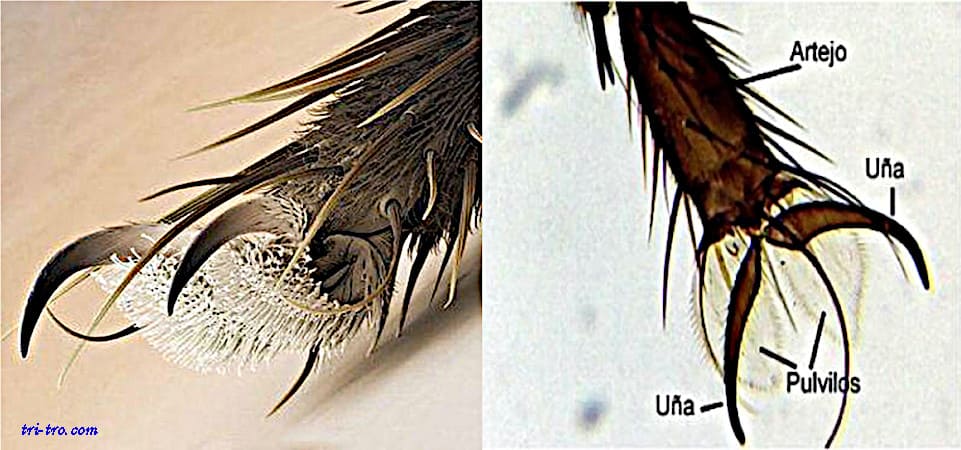
Extension of the leg of a fly under a microscope. Source: funny-Housefly-fly-foot-microscopic-image.

Pins: In addition, the three pairs of legs are attached to the thorax, each consisting of five segments: coxa, trochanter, femur, tibia, and tarsus.

The last section (tarsus) is divided into five segments. These joints allow the tip of the leg to assume a wide variety of angles of support.

At the tip of the tarsus, there is a pair of claws or nails, and in the middle, two flattened pads (called pulvilli) on each side. The pulvilli are glandular, covered with tiny glandular hairs, creating a sticky surface that allows the animal to cling to even the smoothest surfaces, even the other way around.

Escúchelo: third sclerite of the mesonotum and metanotum; in some species, it is also visible on the pronotum.

Egg-laying: act of laying eggs.

Holoptics: The male's eyes are set close together.

Brochures: The eyes of the female are more separated.

Blood-feeding: Blood-feeding (fly stable).

Life cycle of the fly:

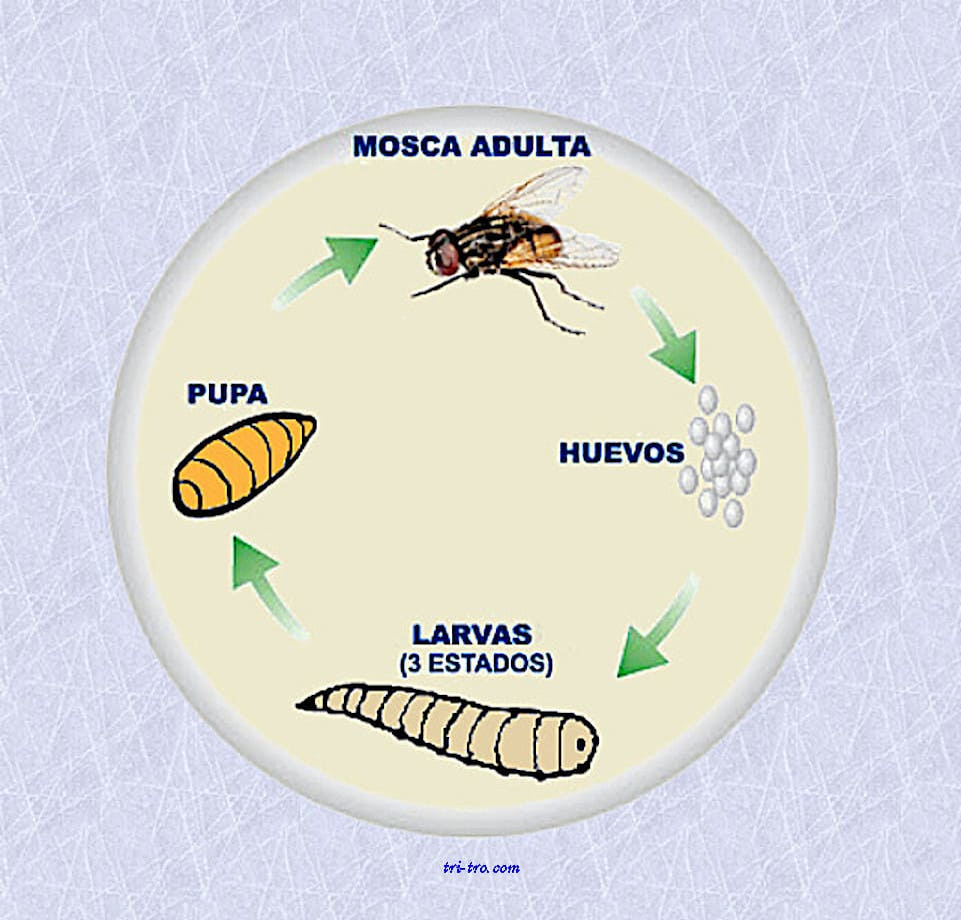
Life cycle of the fly

Flies undergo complete metamorphosis.

that consists of four distinct phases:

  • The egg.
  • The larva.
  • The pupa.
  • The adult.

Flies in poultry facilities:

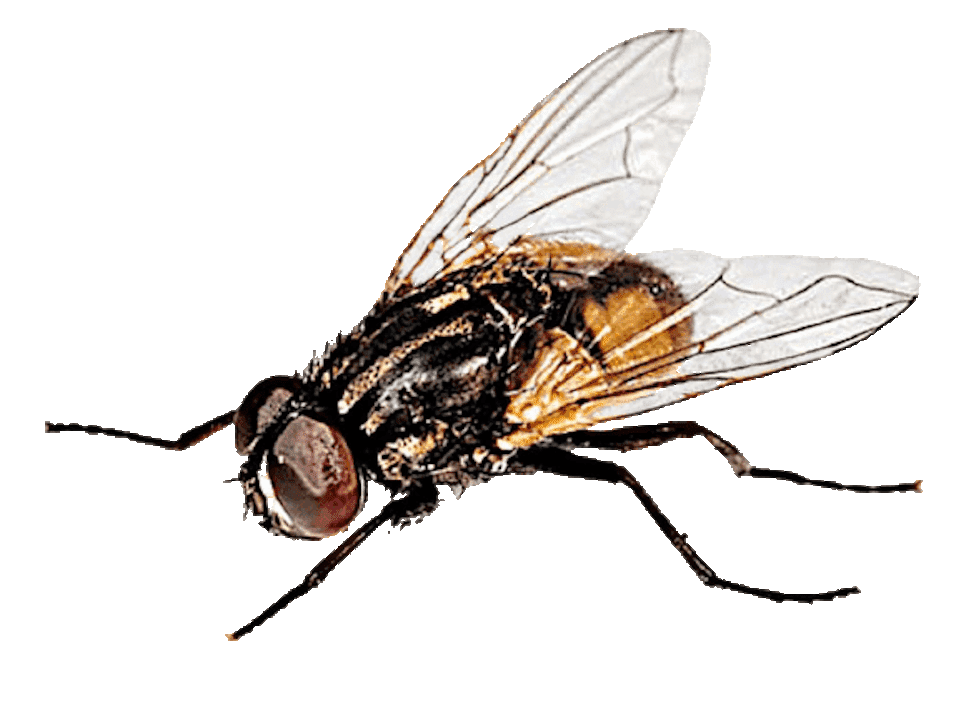
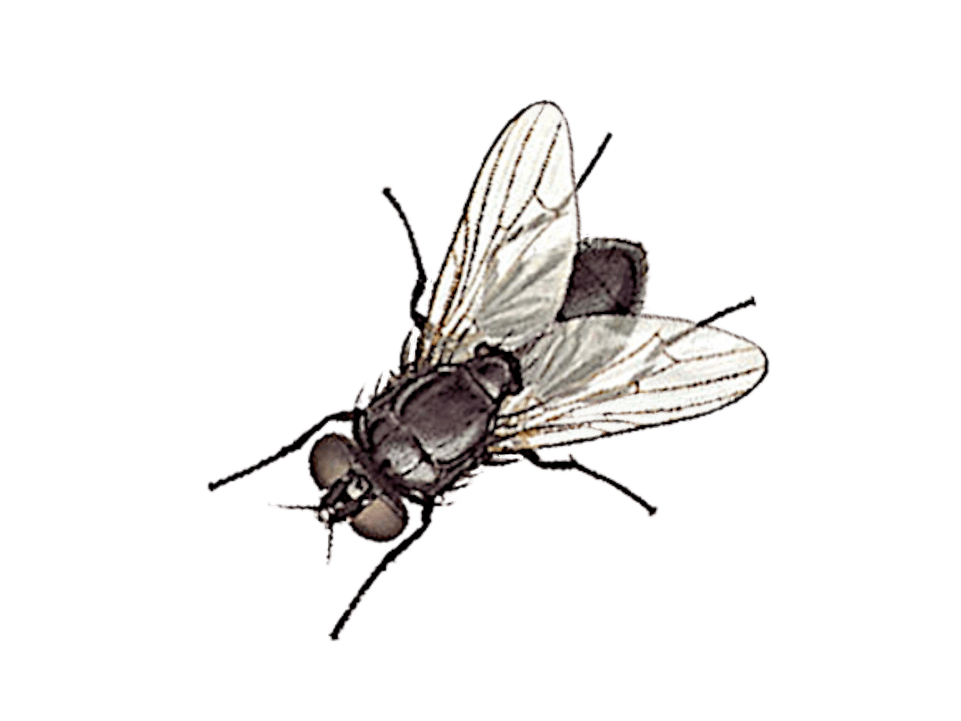
The common housefly

Family: Muscidae. 

(Musca domestic).

Fly domestic minor

Family: Muscidae. 

Fannia canicularis (L.)).

Fly grinder or of the stables

Family: Muscidae.

( Stomoxys calcitrans (L.)).

Fly false stables

Family: Muscidae.

Muscina stabulans (Fallén.)).

Black fly of the manure

Family: Muscidae.

(Ophyra spp).

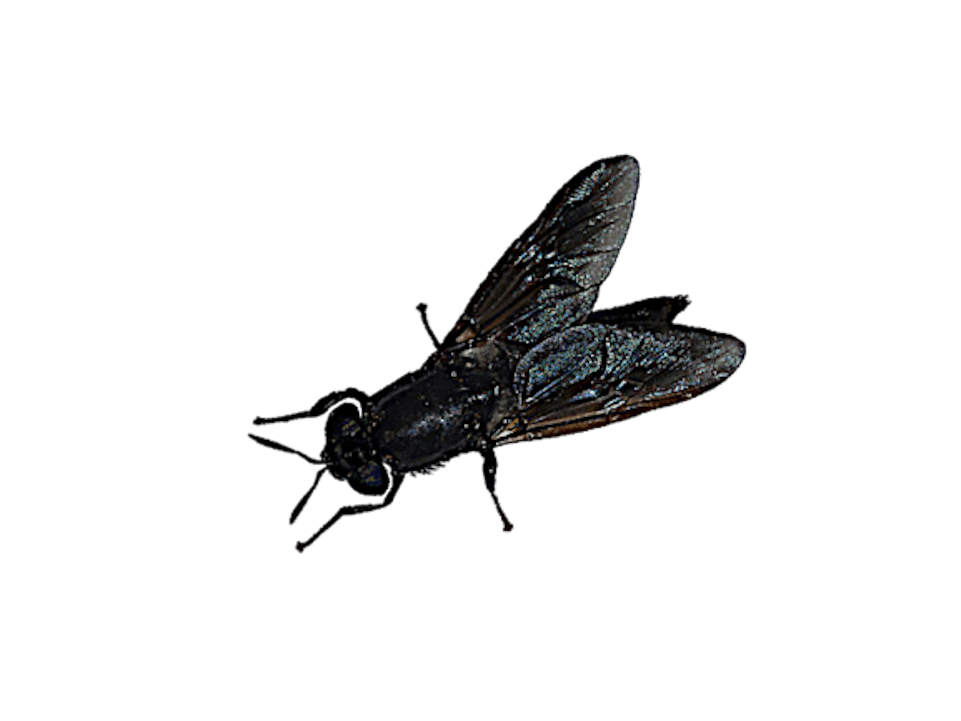
Soldier fly black

Family: Stratiomyidae.

Hermetia illucens ).

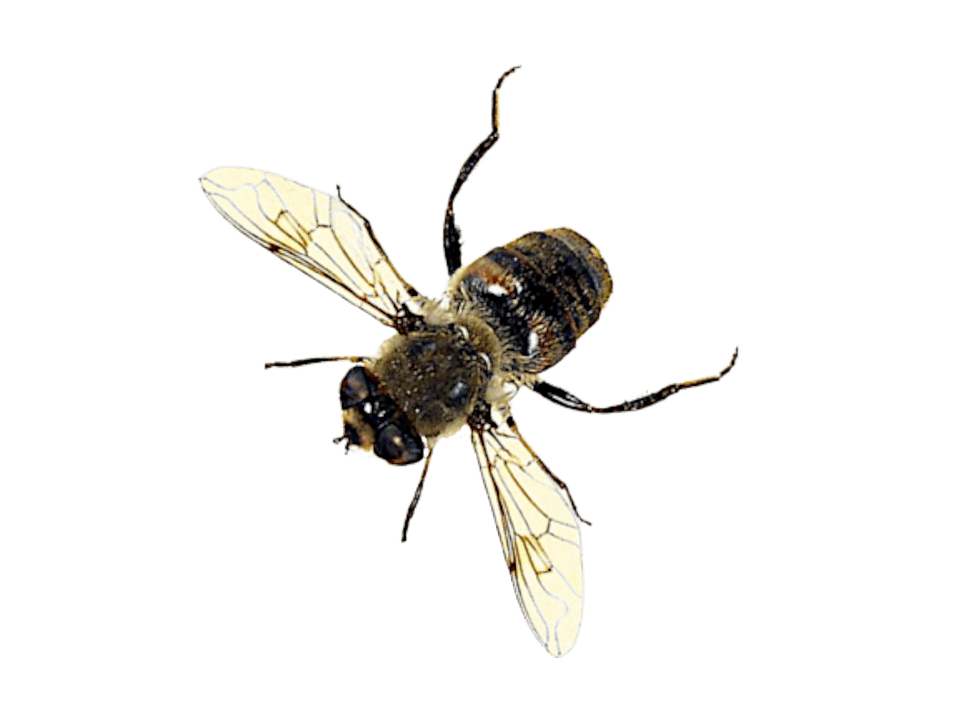
Fly drone

Family: Syrphidae.

Eristalis tenax (L.)).

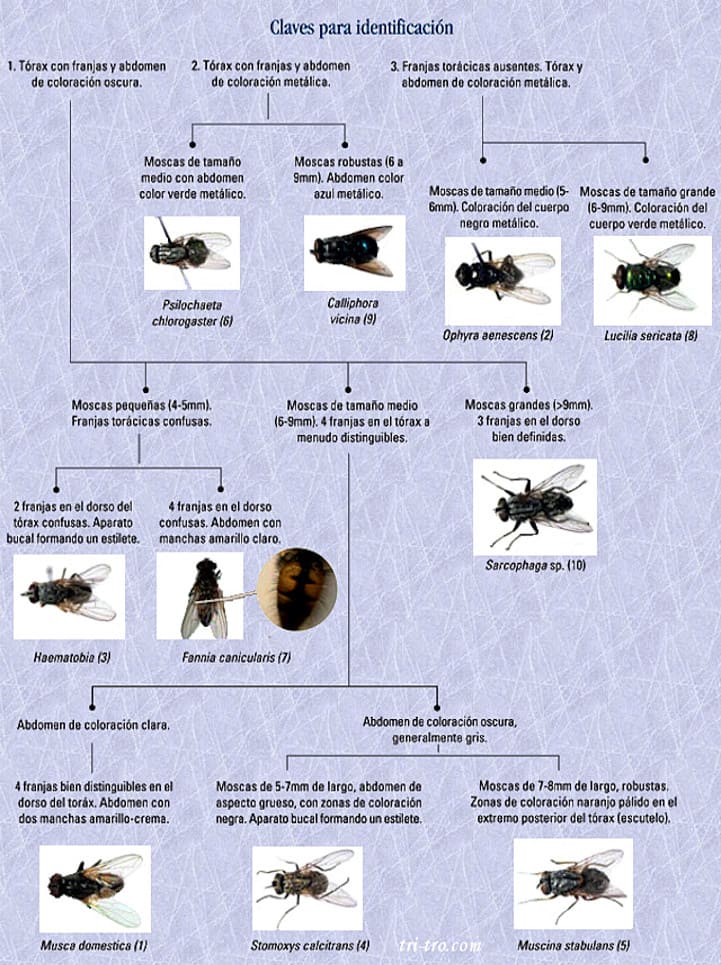
Guide to recognition of the flies:

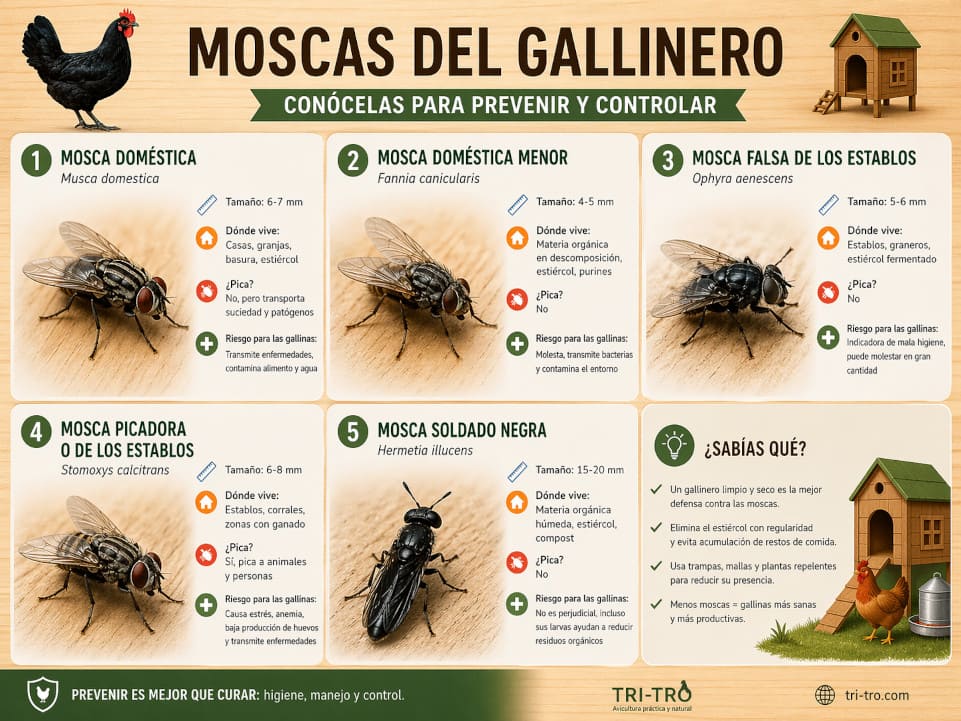
In this photo following see a guide to recognition of the major fly species associated with the production, which consists of two parts.

One of them biological information of the species, while the second is a key pictorial to help identify the different species.

Source: Ing. Agr. Claudio Salas F. and Ing. Agr. M. Sc. Patricia Larraín S.


Guide recognition flies


Literature review:

MERCK & CO. (1995). Manual Merck de Veterinaria . Rahway, N. J., EE. UU.

BUXADÉ, P. (1987). The laying hen . Ed. Mundiprensa. Madrid.

DORN, P. (1987). Manual of avian pathology. Ed. Acribia. Zaragoza.

HOFSTAD, M. S. (1984). Diseases of Poultry . Iowa State University Press, Ames, Iowa.

MAURER, VERONIKA. Contrôle des mouches des étables. Service romand de vulgarisation agricole (Agridea, Lausanne), CFPPA Montmorot et FiBL (Research Institute of Organic Agriculture, Switzerland).

LOFTIN, KELLYet al. Fly control for Organic Dairies. Cooperative Extension Service. Division of agriculture. The University of Arkansas.

D ASSIS FONSECA , E. C. M. (1968) Diptera: Muscidae. Royal Entomological Society of London Handbook

ROZKOSNY, R, GREGOR. F., & Pont, BC (1997) The European Fanniidae (Diptera). Brno: Institute of Landscape Ecology. Séguy, E. (1923)

DIPTÉRES:Anthomyides. Paris: Éditions Faune de France

ZARZUELO, E. (1982). Vade mecum of the pathology, infectious poultry . Ed. Aedos, Barcelona.

CASTELLÓ, F and CASTELLÓ, J. A. (1960). The new art of raising chickens. Ed. Aedos, Barcelona.

OROZCO, F. (1989). Breeds of chickens Spanish. Ed. Mundiprensa. Madrid.

LACADENA, J. R. (1998). Genetics . Ed. AGESA

GATES, M. J. (1992). Genetics, fundamentals and perspectives. Ed. Interamericana McGraw – Hill.

SANCHEZ-MONGE, E. (1969), Genetics . Ed. Espasa – calpe SA

OROZCO,F, and ROBLA, F. (1986). Genetic aspects of the cock of a Lion. XXIV Symposium of the WPSA (Spanish Section): 199 – 212.

HILL, J. L. (1973). Genetics, general and applied . Ed. UTEHA.

CASTELLÓ, J. A., LLEONART, R., FIELD, J. L., OROZCO, F. (1989). Biology of the chicken. Real Escuela de Avicultura.

LLEONART, F., ROCA, E. CALLÍS, M. GURRI, A. PONTES, M. (1991). Hygiene and pathology avian . Real escuela de avicultura.

STURKIE, NB (1968). Physiology Of Avian. Ed. Acribia. Zaragoza.

LOHMANN ANIMAL HEAFTH (2012)


You may be interested in these other sections


Anatomy of the chicken: parts, organs, and functions

Poultry Slaughter Form: What It Is and How to Use It

Castilian Black Hen: an elegant, egg-laying Spanish breed


Do you want to share or comment on your social networks

Scan to visit TRI-TRO
Escanea para visitar. TRI-TRO