Bacterial Diseases:

Syndrome of swollen head in birds

Syndrome infectious from the swollen head (SICH):

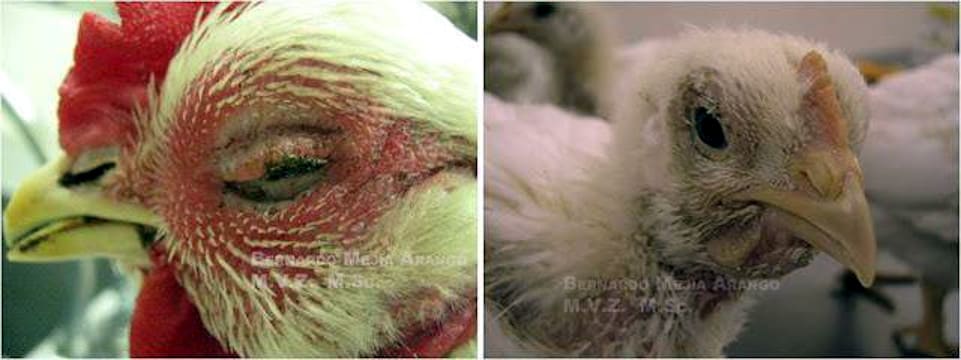
Called in English “Swollen Head Syndrome”. It is a disease whose epidemiology is not clear. It is characterized by its chronic course and by the appearance of edema in the head, which gives the birds a distinctive look.

There is a set of signs, symptoms, and injuries that can be produced naturally or experimentally by different causative agents (bacteria or viruses).

The edema of the face, or of the head: 

Cellulitis, histologically characterized by diffuse fibrinopurulent inflammation with focal granulomatous lesions in the subcutaneous tissue of the head—and particularly in the periocular region, which gives this condition its name (SCH)—is caused by more than one causative agent.

It is likely that the initial lesions are caused by a respiratory virus.

There is strong evidence linking turkey rhinotracheitis virus (TRT) (now known as metapneumovirus) to SCH in chickens, and in some cases, viruses isolated from chickens are indistinguishable from those isolated from turkeys.

However, the etiology of SCH in chickens is not fully understood. SHS in chickens occurs only in a small number of birds in affected flocks, and the TRT virus has been isolated from flocks of chickens without SCH. SCH-free chickens may have antibodies against TRT.

The initial symptoms include mild sneezing, with the condition progressing to eyelid swelling, severe swelling around the eyes, sinusitis…

Affected birds lose their appetite and often scratch. Sometimes the birds adopt abnormal head postures.

(cocked, low or rigid) and a state of decay general variable. The prevention of the disease goes by a few appropriate hygiene measures.

The probable causes of SCH:

(to) A single primary infection with a metapneumovirus, achieved only in experimental settings; although this situation is unlikely to occur naturally,

(b) Primary infection with metapneumovirus and secondary infection with E. coli. E. coli is a secondary pathogen frequently isolated from internal organs, the middle ear, the meninges, and the brain during outbreaks of SCH in broiler chickens and heavy breeders with antibodies against metapneumovirus.

(c.) Mixed infection involving certain strains of the infectious bronchitis virus and pathogenic strains of E. coli.

(d) A primary viral infection caused by a respiratory virus complicated by E. coli and/or Ornithobacterium rhinotracheale (ORT).

Syndrome of swollen head in birds

Reflections from a veterinary zootechnician:

Here is a post by Dr. Bernardo Mejía Arango, a veterinarian, zootechnician, histopathologist, and holder of a master’s degree in Animal Pathology. It’s well worth reading—what better source of information could there be than a specialist? You can find more photos and details on his blog via the link below.
 
Photographs and images: Bernardo Mejía Arango; are protected by copyright. Any use or reproduction requires prior authorization, according to Mr. Bernardo.
 
The swelling macroscopically identified as a swollen head is primarily due to facial, cranial, or craniofacial cellulitis, which can range from a relatively mild form of inflammation characterized solely by a clear exudate, to severe fibrinopurulent inflammation of the entire subcutaneous tissue of the head, including the facial area, the cutaneous area of the lower beak, and/or inflammation with different characteristics in the eyelids and/or cephalic appendages, especially the chins.
 
Another condition associated with swollen-head syndrome is inflammation of the infraorbital sinuses, which can be acute (catarrhal) or chronic (caseous). Catarrhal tracheitis may or may not be present in cases of swollen-head syndrome.
 
Regardless of the type of bird affected (breeding birds, laying hens at various stages of growth, broiler chickens), what ultimately determines the infection and spread of the disease within a flock—at least in my view, given the frequency of swollen-head cases reported over the past four years—is the management of the birds and the housing conditions.
 
In cases of swollen head syndrome, where metapneumovirus is presumed to be involved, the infection is always associated with others that are, in order of frequency, highly prevalent: infections with Avibacterium paragallinarum, Gallibacterium anatis, Escherichia coli, and infections with the infectious bronchitis virus and avian poxvirus.
 
We must not overlook the laryngotracheitis virus. Other implicated agents include Mycoplasma (gallisepticum and synoviae), Pasteurella multocida, and Ornithobacterium rhinotracheale. Of the agents mentioned, the “most common” bacteria are Avibacterium and Gallibacterium. I put “most common” in quotes because etiological agents such as Mycoplasma and viruses are not routinely investigated (in terms of isolation) in Level 1 diagnostic laboratories, such as Mycoplasma.
 
I am extremely concerned about metapneumovirus, because the very conditions of isolation and the challenges associated with serological testing prevent the numerous non-purulent inflammatory conditions (primarily lymphocytic) observed in necropsies—along with the resulting histopathological evaluations across all production stages—from being attributed to avian metapneumovirus, even though they are almost certainly of viral origin.
 
We’ve stopped there: at the morphological damage, without going any further. We’ve grown accustomed to living with swollen head syndrome, and my hypothesis is that the same is true for metapneumovirus. Although the review found that heavy breeding hens are more susceptible, the frequency of cases, based on the cases treated, is higher in broiler chickens, perhaps due to the stressful conditions in which the chickens are raised. Information on morbidity and mortality varies from one author to another and from one production system to another.
 
Based on histological examination of the respiratory tract organs, macroscopic and microscopic lesions are almost always found, including nonspecific inflammatory responses and total or partial desquamation of the respiratory tract epithelium. When considered alongside the data discussed in the section on metapneumovirus, these histopathological findings suggest that the following factors play an important role in its pathogenesis:
 
  • High levels of ammonia.
  • High population densities: These lead to elevated ammonia levels, which cause ciliostasis and a reduction in the number of cilia or their complete loss, as occurs in many cases; this facilitates the entry of metapneumovirus into the animal’s body (as well as other pathogens).
  • Large amounts of dust in the atmosphere of the chicken coop.
  • Cold.
  • Short rest periods between batches.
  • Immunosuppressive conditions (Gumboro disease, infectious avian anemia, avian leukosis, and mycotoxicosis, among others).
  • Mixed infections.

It is difficult—I would say impossible—to determine the definitive cause of the initial infection in cases of swollen head syndrome, for the reason mentioned earlier; by the time the birds arrive for diagnosis, they are suffering from a severe complication involving multiple causative agents.

In practice, I believe the problem is more common and more severe in broiler chickens, due to stressful conditions—both environmental and other factors related to chicken rearing and fattening. Generally speaking, there are more field cases in broiler chickens than in pullets (young and/or laying hens) and breeding hens.

The clinical signs in cases of swollen head:

  • Swollen head.
  • Blefaritis y/o blefaroconjuntivitis.
  • Depression.
  • Decrease in the consumption of food.
  • Diarrhea.
  • Slight increase in mortality.
The nervous symptoms in cases of swollen head, not to be in my concept of infection of the nervous system with a virus because I did not find any publication that supports this.

The cases reviewed, personally, correspond to a tick-borne encephalitis purulenta, indicative of a bacterial infection.

The first few times, that were exposed to the infection in the conferences of avian pathology on the subject, including exhibitors who came from the United States, showed a bird with nervous symptoms and showed as exclusively infected by Metapneumovirus.

In the light of what we know today, the neurological symptoms in cases of swollen head and in many who are not, are associated with infections of the middle ear, internal, and in general, with the bones of the skull, with bacteria among which plays a first Gallibacterium Anatis.

Probably due to the lack of experience and the ill-formed concept that will record the students in the Faculties of Veterinary Medicine, that every case of pathology of birds that curse with nervous symptoms, is Newcastle, you can often incur a false alarm, when a necropsy on that note otitis media and/or osteitis purulent, is already indicating that most probably of inflammatory lesions of the central nervous system, caused by a bacterium.

The lesions in the cases of syndrome of swollen head are clear: cellulite craniofacial type purulent or fibrinopurulenta, an injury that almost do not report the scholars of the topic; it can also be seen sinusitis, tracheitis, acute, often accompanied by aerosaculitis, and ovo peritonitis in the case of the laying and breeding. In my personal experience, I have not seen pneumonia, hemorrhagic, is described in some articles in the literature reviews.

What often happens is that the cases of swollen head is not always present with sinus tract infection.

There are cases of facial swelling or craniofacial without evidence of gross cellulite, as such; the subcutaneous swelling (described in some articles) in the cases of swollen head I have not seen it as a simple edema, when you get the cases to investigate swollen head, in a 100 % of the cases the purulent inflammation or fibrinopurulenta in the subcutaneous tissue of the head and sometimes the head and neck is very evident.

That is why it is recommended that, in these cases, research more advanced techniques which can confirm or rule out the presence of Metapneumovirus.

Which of the infectious agents, isolated or reported, you enter first?

What conditions facilitate the entry into the body and the onset of the problem?

These questions are not resolved; in general terms is not known, the pathogenesis.

The following are items derived from our experience in relation to the syndrome of swollen head:

There are many etiological agents involved:

In the differential diagnosis:

  • Avibacterium paragallinarum.
  • Gallibacterium Anatis.
  • Escherichia coli.
  • Virus of infectious bronchitis.
  • Virus of Newcastle disease.

Among others, not to mention the avian influenza, fortunately still exotic in Colombia (at least I think so, I hope not to be wrong). We can say nothing about Metapneumovirus.

— In the chicken farm, the diagnosis of swollen head is common.

— There is a working laboratory to support an investigation or follow-up of infections of the field in the case of syndrome of swollen head.

— We know what are the predisposing conditions for this syndrome of swollen head. We don't know what it is the primary agent and do not know how to act, and at the level of what tissue, to trigger the infection, and the condition is known as “swollen head”.

— The literature reviews indicate that the antibodies generated after infection, are not effective for the control of the breathing process and maternal immunity is ineffective against a challenge early.

— The verification of the literature suggests that the circulating antibodies do protect the oviduct after an infection in laying birds.

— Definitely, by far, the best way to stop the problem while it is clarified well the pathogenesis of the problem, is biosecurity.

— Always (And since I participated in the state programs of prevention of the entry of avian influenza in the country) has been concerned about the role of wild birds, some of which still come in contact with the flocks of birds commercial.

— We do not know when and where the problem begins infectious referred to as syndrome of swollen head: which agent acts first and what is the route of entry.

— Likewise, we don't know where it ends, because in laboratory conditions can isolate many agents and can be issued as many diagnostic necropsies and histopathology, few conclusive, others do not.

– In practice, this is not of great help to the Veterinarian for the management of situations in the field.

Video:


Literature review:

MERCK & CO. (1995). Manual Merck de Veterinaria. Rahway, N. J., EE. UU.

BUXADÉ, P. (1987). The laying hen. Ed. Mundiprensa. Madrid.

DORN, P. (1987). Manual of avian pathology. Ed. Acribia. Zaragoza.

HOFSTAD, M. S. (1984). Diseases of Poultry. Iowa State University Press, Ames, Iowa.

ZARZUELO, E. (1982). Vade mecum of the pathology, infectious poultry. Ed. Aedos, Barcelona.

CASTELLÓ, F. and CASTELLÓ, J. A. (1960). The New Art of Raising Chickens. Aedos, Barcelona.

OROZCO, F. (1989). Breeds of chickens Spanish. Ed. Mundiprensa. Madrid.

LACADENA, J. R. (1998). Genetics. Ed. AGESA

PUERTAS, M.J. (1992). Genetics: Fundamentals and Perspectives. McGraw-Hill Interamericana.

SANCHEZ-MONGE, E. (1969), Genetics. Espasa-Calpe S.A.

OROZCO, F. and ROBLA, F. (1986). Genetic aspects of the León rooster. 24th Symposium of the WPSA (Spanish Section): 199–212.

HILL, J. L. (1973). Genetics, general and applied. Ed. UTEHA.

CASTELLÓ, J. A., LLEONART, R., FIELD, J. L., OROZCO, F. (1989). Biology of the chicken. Real Escuela de Avicultura.

LLEONART, F., ROCA, E., CALLÍS, M., GURRI, A., PONTES, M. (1991). Poultry Hygiene and Pathology. Royal School of Poultry Science.

STURKIE, P.D. (1968). Avian Physiology. Acribia Publishers. Zaragoza.

LOHMANN ANIMAL HEALTH (2012)

Mr. Bernardo Mejía Arango


You may be interested in these other sections


The Rooster's Reproductive System: Parts and Function

Gallus lafayettii: Origin and Characteristics of the Ceylon Fowl

Exploring the Anatomy of the Domestic Rooster


Do you want to share or comment on your social networks

Scan to visit TRI-TRO
Escanea para visitar. TRI-TRO