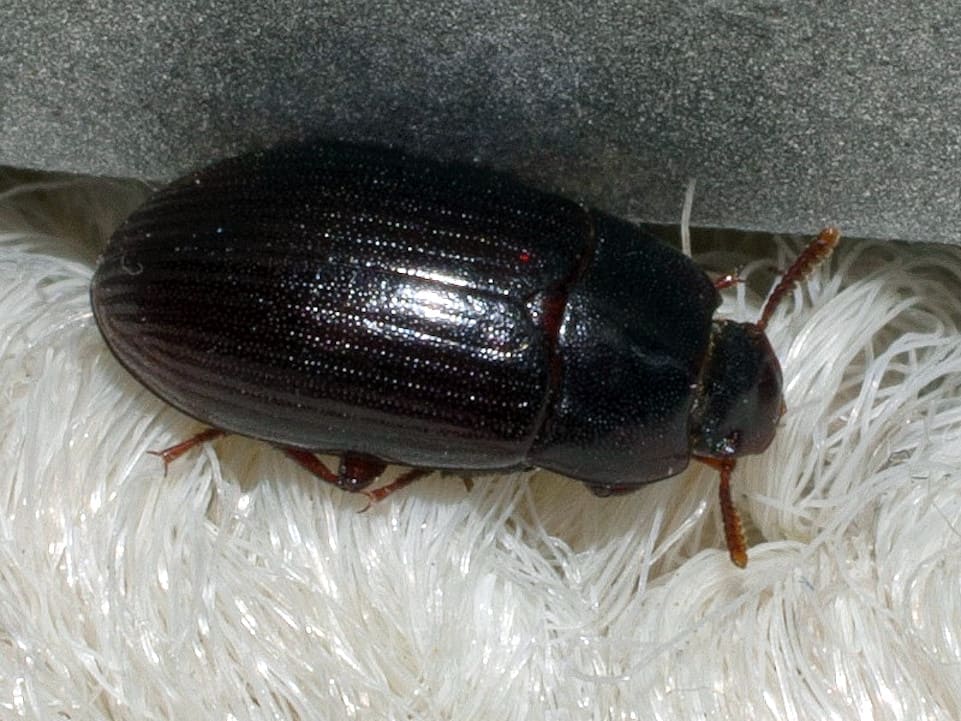
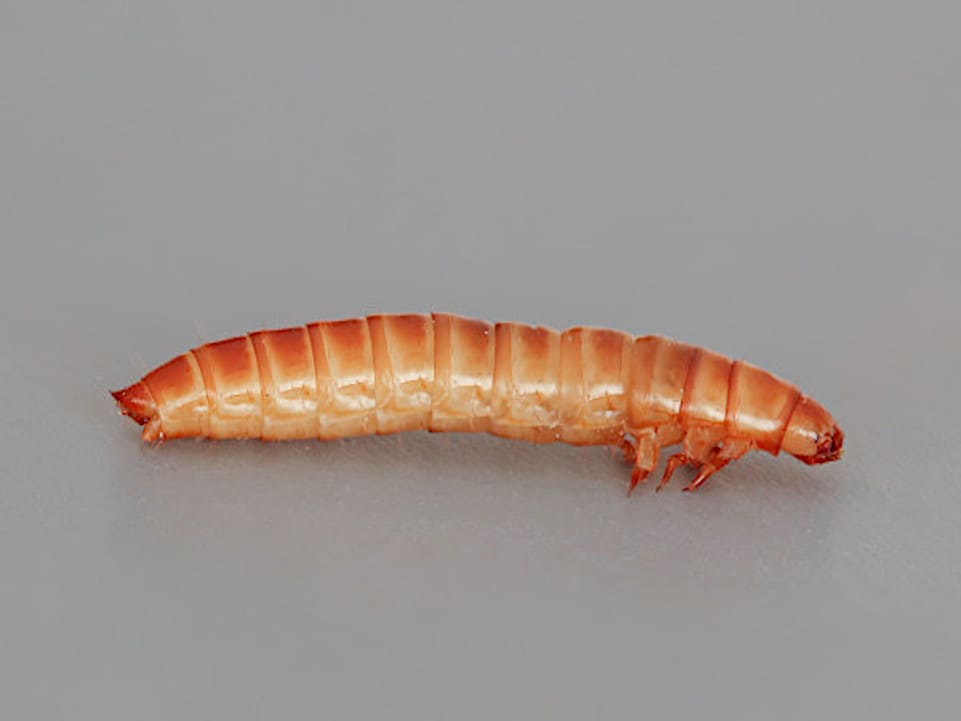
The Alphitobius diaperinus or beetle dung it is the plague is most common in backyard production of meat in the whole world.
In our farming system (chicken coops or barns), this disease cannot occur, since the birds are currently raised on natural soil or concrete rather than on any type of substrate; in other words, the environment lacks the habitat conditions, humidity, and heat necessary for the disease to develop.
Common name: bed beetle, dung beetle. The Alphitobius diaperinus It is an insect of the order Coleoptera. Its name derives from the Greek words *koleos*, meaning “case,” and *pteron*, meaning “wings,” that is, “case-shaped wings.”
It has adapted very well to the litter in poultry farms, thanks to the availability of food, heat, and moisture there. The larvae damage the birds’ skin and tissues, causing stress, bleeding, anemia, infections, and, in some cases, death.
Is a major carrier of disease, being an intermediate host of multiple intestinal parasites.
Vector significant of most diseases of poultry:
- Marek's disease (virus).
- Salmonella typhimurium (bacteria).
- Escherichia coli (bacteria).
- Aspergillus spp. (fungus).
- Staphylococcus spp. (bacteria).
- Eimeria spp. (coccidial parasite).
- Subulura brumpti (parasitic nematode worms),
- Ascaridia galli (parasitic nematode worms).
- Heterakis gallinae (parasitic nematode worms).
- Capillaria spp. (parasitic nematode worms).
- Syngamus trachea (parasitic tracheal worm).
- Tapeworms such as: Raillietina spp., Davainea spp., Choanotaenia spp., since birds frequently ingest larvae and beetles.
Reproduction and life cycle:
After mating, a female Alphitobius diaperinus can lay more than 2,000 eggs naturally on the ground (with an average of 200–400 eggs per clutch). Eggs are laid in cracks found on the floor or walls of farms, as well as on manure, under feeders, and near water lines. They hatch within 2 to 7 days, or within two weeks under extreme conditions.
Adults can live for 3 to 20 months; adult females lay eggs throughout their lives in cycles of 1 to 5 days. Larvae develop over 4 to 7 days and reach adulthood in 10 to 40 days, depending on temperature, humidity, and the availability of food.
The optimal conditions for the development of Alphitobius diaperinus are 33°C and 95% relative humidity. At 21°C, its life cycle ranges from 60 to 85 days and lasts approximately 46 days at 32°C. The larvae do not survive at 10°C, but there are reports that adults can withstand temperatures below 0°C. When relative humidity is below 70%, both adults and larvae require water to survive.
Unlike other types of beetles, Alphitobius diaperinus is highly mobile and elusive, with a long lifespan of over a year; furthermore, it is very mobile and can easily spread to other farms by flying, through feed, or by hitching a ride on rats’ scrotums, making rodent control highly recommended.
Larvae:
It goes through 5 to 7 larval stages that can last anywhere from 3 weeks to 3 months, depending on environmental conditions; its cuticle is white at first and darkens as it molts to grow.
The larvae of Alphitobius diaperinus feed on worms, mold, dead animals, and the feathers, larvae, and eggs of their own species (cannibalism); they exhibit chewing behavior.
These are, without a doubt, the pathogenic factors that most severely affect poultry, as they exert a direct mechanical effect on the birds, causing localized lesions that serve as entry points for pathogens, and inflicting significant stress on the birds due to irritation or itching, which directly impacts both egg and meat production.
One of the harmful effects of the presence of Alphitobius diaperinus occurs in buildings, as late-stage larvae search for places to pupate; these are also the only larvae that bore into insulation materials, particularly polystyrene, polyurethane, fiberglass, nylon, and wood.
The larva hides to pupate. This is an immobile stage, during which it is protected from chemical treatments and harsh environmental conditions. Over the course of 1 to 3 weeks, the adult emerges at its full size, copper-colored at first, and turning black with age. They live for 2 months to 1 year and may be present in several consecutive rearing cycles.
Their behavior is very characteristic, as they congregate in large groups in the interior of the bed to find a mate, and bury themselves in it as a means of escape. They are nocturnal by nature, although active for 24 hours a day.
They are attracted by heat, moisture, and the organic matter they feed on. They follow the birds during the production period, settling inside the litter, along the perimeter of the walls, and migrating after a few days to the area beneath the feed lines, where they find food and shelter. Finally, they hide in cracks in the ground and insulation materials as soon as the birds leave the barn and the litter temperature drops.