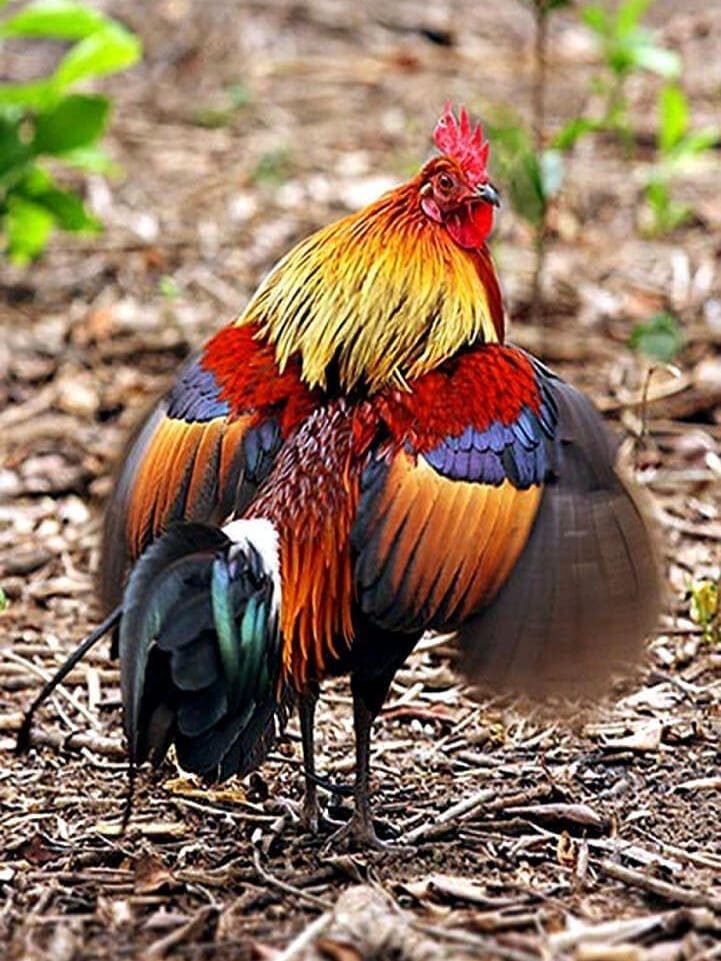
This allows us to assume that these three breeds of Java, Sonnerati, and Malaya, in turn, dwarf, medium, and giant, respectively, could very well have given rise to a breed of domestic fowl corresponding to these three sizes, but perhaps it is nothing more than pure conjecture, and only the title of hypothesis can be settled upon.
What is certain is that those other savage races, maybe even the same ones the naturalists have come to know, had to get acquainted so that, by accepting gradually their care, they abandoned their nomadic ways for sedentary ones and ended up having a more complete domesticity.
We have assumed that this change in customs did not occur overnight, because some ancient writers who returned to those lands… claim to have seen numerous flocks of wild roosters and chickens taking shelter at night under the roofs of huts, which had been set up for that purpose next to the houses or shacks where they were usually fed at dusk.
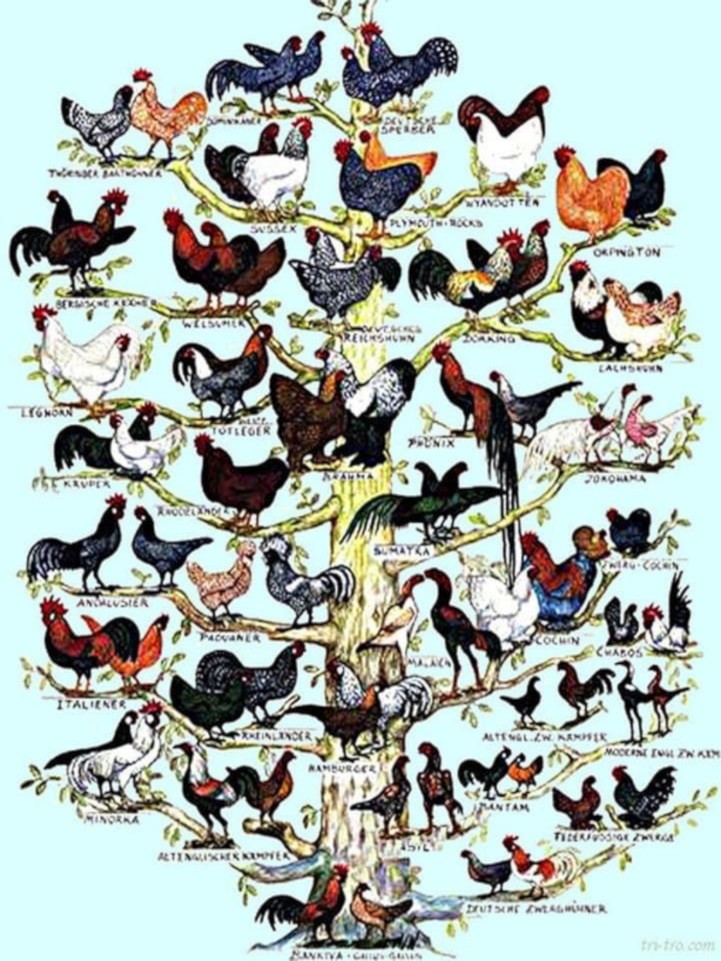
This was the first sign of their predisposition to abandon their wild ways, a tendency that the climate and diet gradually reinforced, to the point of achieving not only their complete domestication but also a change in their form and proportions. Thus, the dream of enthusiasts and poultry breeders has been realized: to create such a wide variety of breeds that today it is nearly impossible to know all the varieties that exist in both the Old and New Worlds.
As far as Europe and even our own regions are concerned, we can say that a historically proven fact, as mentioned earlier, is that in the Celtiberian region numerous flocks of roosters and chickens were raised, undoubtedly descended from the wild variety found in the Pyrenees. And from which, even today, a more or less degenerate specimen is occasionally hunted; but in the end, it is a wild variety, which proves that in times past, when hunting was less restricted, it must have been abundant.
This, we repeat, was the reason for the name change to Gaul, as it was the only civilized country that knew of the species, since Rome and Greece had already been raising it since ancient times. But yes, because the Celtiberian tribes were the most advanced in terms of agriculture, they knew before those and other peoples—who appeared to be more civilized—what could be expected of the chicken and what it was capable of producing.
Greek, Roman, and Egyptian writers claim that, centuries before the birth of Christ, they had mastered the art of artificially incubating chicken eggs. Although it is known that Egypt later adopted the idea from China and Persia—which, in other respects, were ahead of them in artificial incubation—it must be acknowledged that the technique reached its highest degree of perfection there, and it has been practiced with unwavering regularity to this day.
The rooster was not always raised for meat::
Peoples Ancient peoples viewed the rooster in various ways. The Hebrews considered it an impure animal—that is, unfit for sacrifice—while the Persians revered it, and the Chinese offered it as a sacrifice, a practice they continue to this day.
Among the Celts, the rooster—a symbol of vigilance, a nocturnal timekeeper that marks the hours with uncanny regularity—was revered as a symbol of the sun; according to some historians, this was due to its proud bearing, the liveliness of its movements, and the fiery intensity of its gaze.
The romans considered roosters to be excellent omens, raising them as birds sacred, and for a long time the Roman people did nothing without consulting them, believing that they could discern in their movements—or in their greater or lesser appetite—the advice they were being given and, consequently, the decision they should make.
Subsequently, the food got the better of the religious fervor, and the story reveals to us that the gallus spado (capon) and the Spadoni chicken (pularda or cock barley) was a delicacy that was a favorite of the rulers of the world, whose customs and the way of considering the bird were fully modified.
Later, both the Greeks and the Romans capitalized on the rooster’s combative nature and, in keeping with the spirit of the times, created the fighting cocks, which are still preserved among our civilized generations. The islands of Rhodes and Kos, Persia, and Media were the great breeding grounds for the early fighting cocks, making a specialty of the breeding of birds of flight, as they have done today, the British and other countries and regions not too far away.
Figure of the cock It has stood out at various points in the history of certain peoples, and some adopted it as a symbol of courage and vitality, such as the Greeks, who dedicated it to their gods of war. Others made offerings to Aesculapius, the god of medicine, upon recovering from a long or painful illness.
Some adopted it as a symbol on their coats of arms, including the ancient Gauls and the modern French, who used it as their national emblem in 1789 and 1830.
Ourselves, christians, we cannot help but see the rooster as a character in one of the most touching scenes of the sacred Passion of Christ, which made Peter realize his wrongdoing and warned him of his mistake by the song of the rooster, whose effigy never ceases to accompany the first apostle and a pope.
Thus, as can be seen, the rooster is one of the animals that has featured most prominently throughout history, and it is not for nothing that we show it special affection and attention. But times have changed, and today it is no longer a harbinger or an emblem; for most people, it remains merely a bird for sacrifice—not for the gods, but for their own benefit, due to its many and varied uses.
To tell the truth, in ancient Greece, when paganism reigned in all its glory, there was no shortage of wise men who placed the bird in its rightful place. Old Socrates, a fervent lover of poultry, in fact, he often mocked those who saw roosters and chickens as divine beings, telling them that he loved them because they gave him eggs, just as he loved his wife because she gave him children.
You may be interested in these other sections, which feature authors who have left us their writings—the pioneers of Spanish poultry farming, beginning with the (Spanish) Romans in 40 AD and continuing through to the 18th century (1800).
A Brief History of Egg Production in Spain:
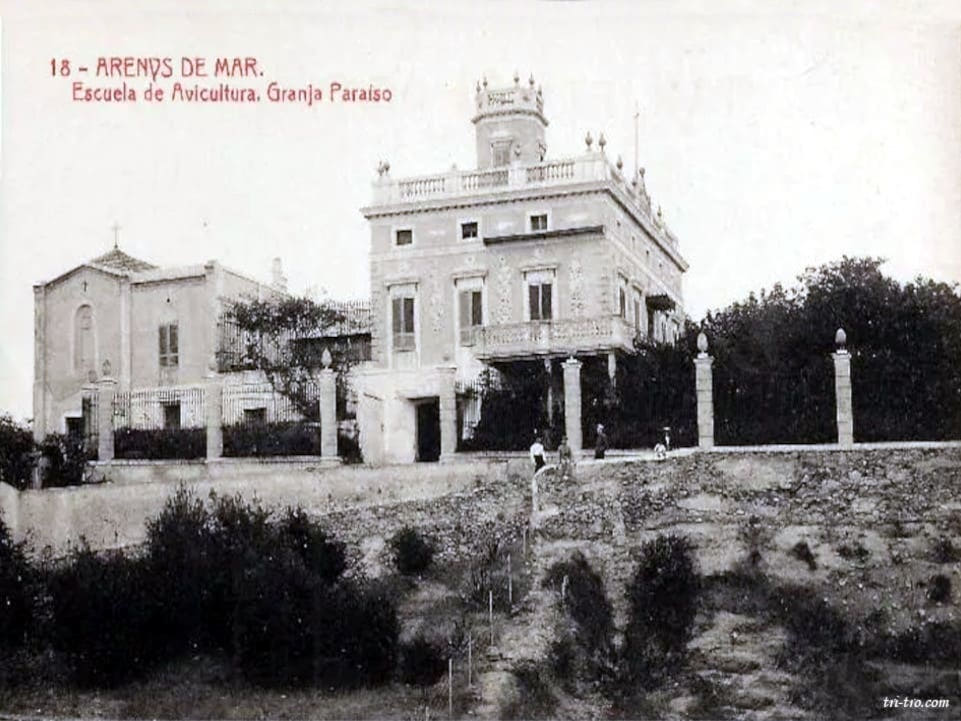
School of Aviculture. Farm Paradise. Arenys de Mar. Barcelona.
It It is estimated that poultry farming originated about 8,000 years ago, when people living in certain regions of China, India, and other parts of Southeast Asia likely began domesticating chickens that lived in the jungle.
Nomadic tribes brought chickens from India, traveling through Mesopotamia until they reached Greece. It was the Celts, later on their conquests, who left chickens behind in the towns they passed through, thereby spreading chickens throughout the European continent.
In the Iron Age, which was supposed to be the period of greatest dispersion of those primitive chickens, taking a subset of around 30 eggs a year.
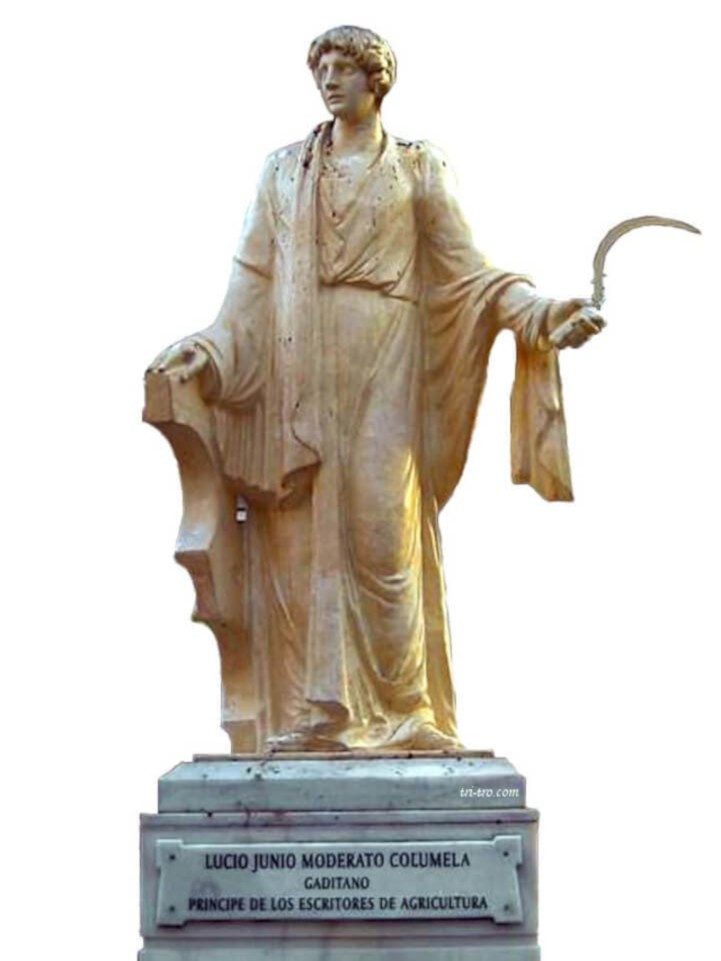
The first treatise on the origins of Spanish poultry farming is generally considered to be that of Cato the Elder, in his manual *De Agri Cultura* (200 B.C.); in it, he refers to the feeding of chickens within the context of agricultural economics and domestic life. In Spain, the documented history of poultry farming begins with Lucius Junius Moderatus Columella, native of Cadiz, being the best agronomic Roman author.
A contemporary of Seneca, he wrote the work *De re rustica,* or *The Twelve Books on Agriculture,* in Latin. In Book VIII of this work, Columella discusses the poultry raised on the farm, attaching great importance to them, for he remarks, "These animals, just like livestock, do not yield a small return to the farmer, because with the birds’ manure he fertilizes not only the vines, which are very delicate, but every plantation or field, and with the birds themselves he provides delicacies for the family home and sumptuous tables."
In the following chapters, he describes the characteristics that laying chickens should have, the location of the chicken coops, how they should be built, and the feed that should be given to the chickens.
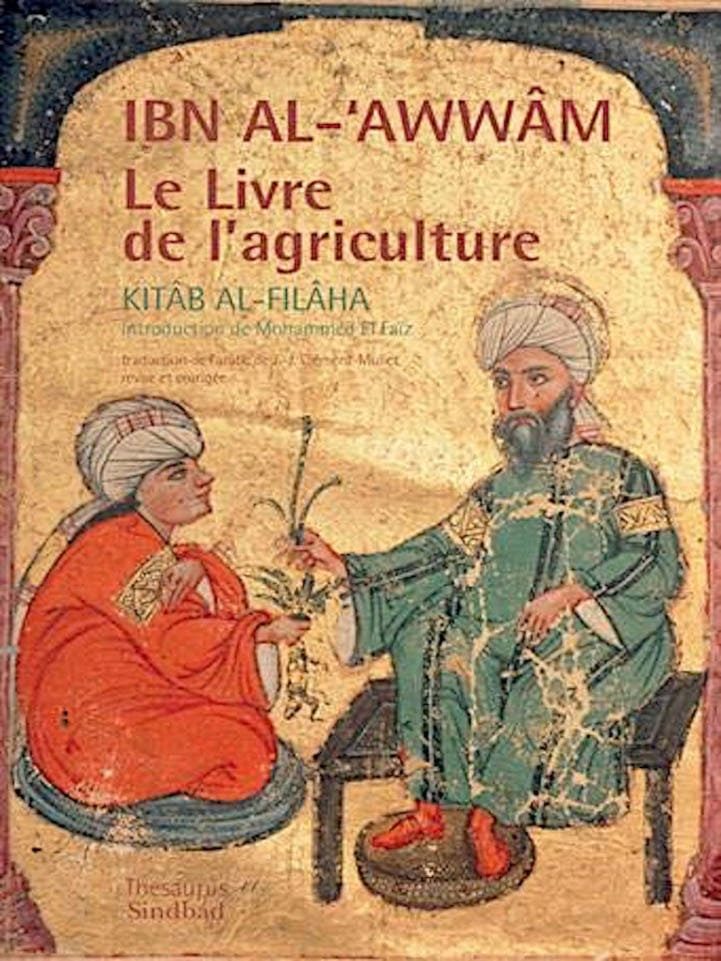
Abu Zacaria Iahia An Andalusian agronomist and Muslim author from Seville, in his *Book of Agriculture*, written in Arabic in the 12th century, refers to *poultry farming*.
Gabriel Alonso de Herrera, in the 16th century, in his work (Treatise on General Agriculture), offers advice on raising chickens at home.
Fray Miguel Agustín, in his *Book of Secrets of Agriculture, Country Life, and Animal Husbandry*, published in Barcelona by Juan Piferrer in 1722, in the section on animal husbandry, which describes how to raise all kinds of domestic animals, both land and fowl.
Francisco Dieste and Buil, in his fascinating *Economic Treatise*, divided into three discourses and reprinted in 1803 and 1930—a work that stands as one of the most comprehensive economic studies produced by the Aragonese during the Enlightenment—in his first discourse, *Raising Chickens and the Considerable Profits They Yield to Their Owners*, which is itself divided into five sections, he tells us how many roosters and chickens we should have, as well as about diseases, expenses, and profits.
Nicolás Casas de Mendoza, in 1843, the founder of modern veterinary medicine, in his *Treatise on Poultry Farming*, addressed the economics, zootechnics, and pathology of poultry, providing a detailed account of the various aspects of these nascent sciences at the time, which proved to be of great importance for the development of industrial poultry farming.
Saints Aran San Augustine, From 1880 to 1970, he was the leading promoter of Spanish animal husbandry in the first half of the 20th century. If anything characterized Santos Arán San Agustín, this illustrious veterinarian from Huesca, it was his ability to communicate knowledge, building on the earlier work of Nicolás Casas Mendoza’s treatises on poultry farming, which he channeled through the publication of numerous books covering all domestic and farmyard animals, culminating in his most emblematic work, the “Biblioteca Pecuaria.”
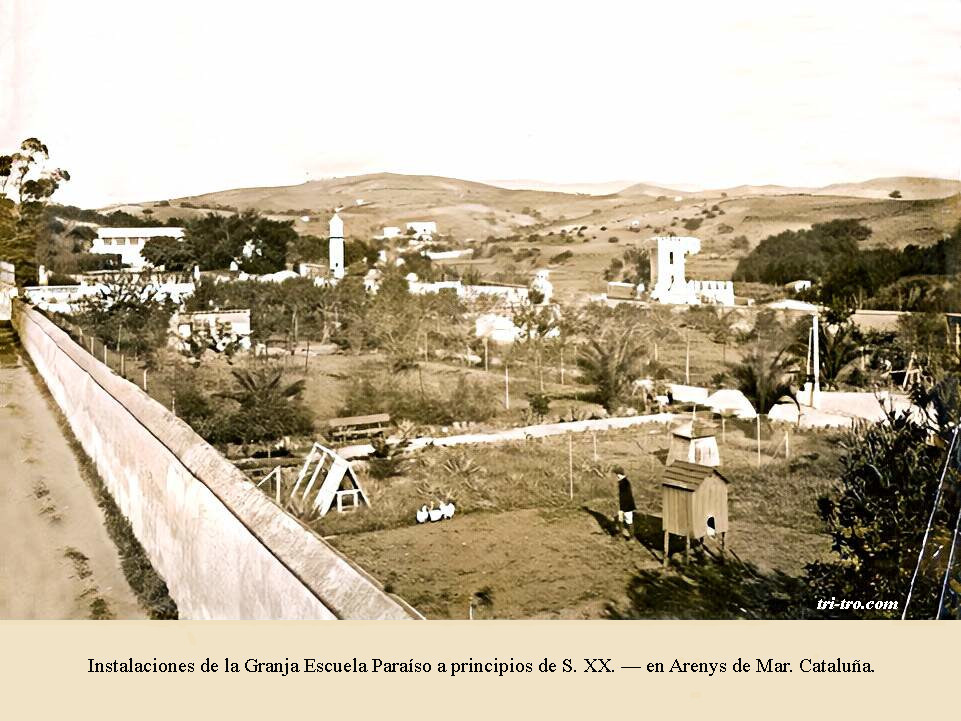
Facilities at the Paraíso Educational Farm in the early 20th century
The arrival of chickens on the Iberian Peninsula
Poultry it remained an activity primarily for personal consumption in rural areas. From the 19th century well into the 20th century, this was the case in the poultry industry in Spain, as well as in other countries.
The chickens foraged for food on their own in the garden and pastures and were given only a few scraps from the household meals and a small amount of grain, while having adequate shelter from the cold during the winter months.
In 1896 he created the Royal School of Poultry Farming in Arenys de Mar (Barcelona); it took its first steps in our country under the guidance and expertise of Mr. Salvador Castelló, who served as a mentor and guide to the most enthusiastic poultry farmers of that era.
Celebration of the International Poultry Exhibition in Madrid in 1902, favored by the creation of which laying breeds from all over the world, already famous for their considerable level of production, participated. Poultry farming at the beginning of the 20th century began with a special boom in industrial poultry farming.
Starting in 1960, intensive poultry farming emerged, along with selective breeding of native chicken breeds, which led to a significant increase in production—from the 100 eggs per year laid by the León breed to 180–200 eggs per year laid by the Castilian, Andalusian, and Prat breeds.
In the United States, genetic selection paved the way for the emergence of professional poultry companies. The industrialization of poultry farming coincided with the introduction of the Leghorn breed (240 eggs/year), a benchmark for current breeds and strains (which can reach production levels of 300–320 eggs per year), as well as advances in both avian pathology and nutrition.
The true development of the Spanish poultry industry, as we know it today, took place between the 1970s and 1980s. By the end of the 20th century, Spanish production had reached nearly 900 million dozen per year, and domestic consumption had grown to become one of the highest in Europe.
The industry is modernizing and adopting advanced technologies on par with the most developed in the world, gradually transitioning from a family-run, self-sufficient Spanish poultry sector to a commercial enterprise. This involves establishing larger-scale farms and integrating all aspects of egg grading, packaging, and marketing, as well as feed production and the mechanization of poultry feed processing, directly into their facilities.
This process, which has run parallel to the evolution of modern food distribution, has led to a concentration of larger suppliers that are equipped to meet the needs of demanding and increasingly well-informed consumers.
In today's poultry industry, the integration of the various links in the supply chain—from the farm to the packing and marketing center—helps reduce costs, ensures control over the egg production process from the very beginning, facilitates traceability, and guarantees freshness.
The egg that the chicken lays each day is now ready, within a few hours, to be shipped to the point of sale, thus retaining its original quality.
At the start of the 21st century, Spain’s laying hen population exceeded 40 million, producing more than 1 billion dozen eggs per year. Our country is one of the leading egg producers in the European Union and meets its domestic demand, while also marketing part of its production on the intra-EU market.