The voice is similar to man, a sound vibration, although his larynx presents notable differences. Remember how you structure the organ vocal in humans?
Between the cavity back of the mouth and the trachea is located a small box, recognized externally in the neck by the projection commonly referred to as "Adam's apple." Above this box is situated, at the time of swallowing the food, a kind of spoon called the epiglottis.
The cavity of this box, known as the glottis, is quite narrow; it connects at the top with the mouth and on the bottom with the trachea through two small stretched slits, which are oriented horizontally back and forth. The two edges of the slit bottom are called vocal cords, which, being tense or relaxed, produce the different sounds of the human voice.
In birds, the upper slit is located considerably far from the vocal cords; this slit, known as the superior larynx, has fixed edges and is not covered by the epiglottis.
In the lower part of the trachea, in the place where it divides to form the bronchi, is a species of rail bone with an over-membrane in the shape of a half moon; on each side, beneath the bone structure, that is to say, at the start of each bronchus, there is a slit whose banks are authentic vocal cords.
The first ring of the bronchi is separated by a membrane from the last small bone at the end of the trachea, and it is within this double structure—known as the lower larynx—that sound is produced in birds, thanks to the complex action of numerous muscles that tighten or relax the vocal cords and membranes of this remarkable mechanism.
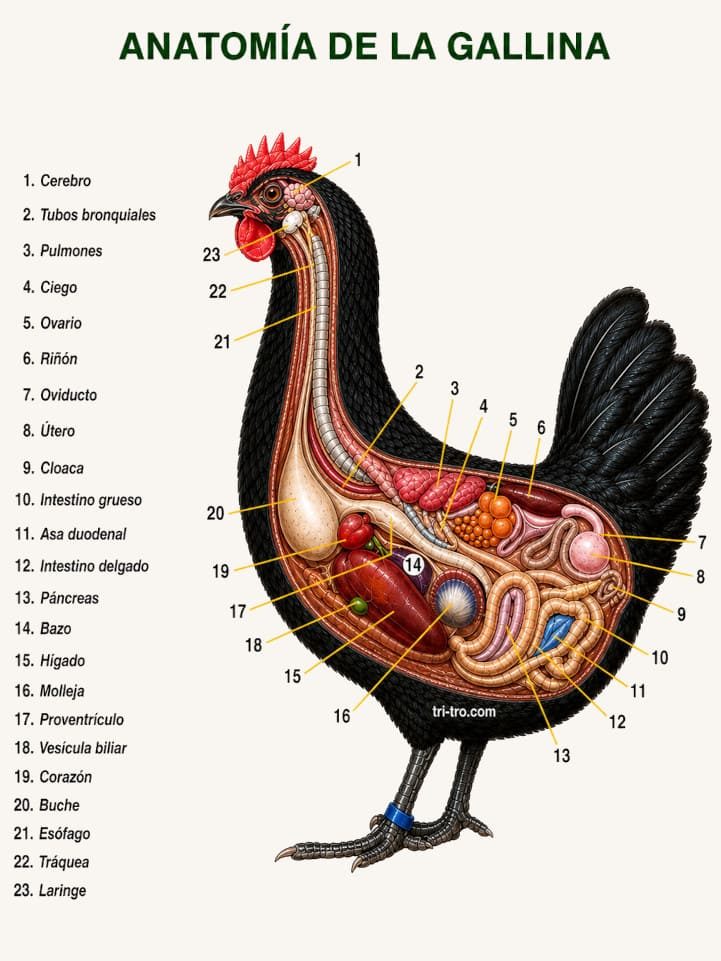
It is easy to understand how the vast volume of air present in the body of the animal contributes significantly to intensify and magnify the voice; as well, the one that described the nightingale as a holder of a voice with feathers captured poetically a reality anatomical. In the section devoted to the. Respiratory system of the Henyou can find a schema.
In conclusion, the trachea and larynx in birds constitute a single entity whose size completely fills the glottis cavity, and instead of a pair of vocal cords, there are two.
Poultry, specifically the henshave a variety of vocalizations to communicate among themselves. There are different nuances in their cacareos that indicate states such as anxiety, stress, warnings, or alarm, as well as pain, reflecting their broad communication.
The males and females of the species poultry have more than twenty kinds of different phone calls, and certain vocalizations vary according to the sex.
Below is an excerpt from a book published in 1899 titled “Profitable Raising of Hens and Other Domestic Fowl” by the veterinarian D. Nicolás Casas de Mendoza, printed in Madrid by Hijos de J. Cuesta, publishers.
The concluding observations performed by the author are really valuable, and, I guess, all of them will be clear to the saying to which it refers.
The text that follows, which I consider to be a poetic beauty undeniable, says the following:
The song of the rooster and the hen has its origin in the division of the trachea, which acts as a channel for phonation, and the larynx, located lower at the entrance to the chest.
The hens emit a vocal response in recognition of the singing badge of the rooster, which at dawn invites them to follow him in search of food in your company.
Within the roost, the rooster, despite being under the domain of domestication, seems not to have forgotten the responsibilities they have to their hens, which are the constant focus of their songs, either to express their pleasure, their concern, or their anxieties.
The hen, when you put an egg, an act that can be considered a delivery along with all the painful implications of motherhood, explodes in cacareos and melodies of joy that are shared by the cock.
The rooster emits three variations in his song, conveying different emotions.
1 º. Love Song: The cock, which is the leader for all the hens, went to bed early and woke up at dawn. His singing varies with the seasons.
This melody reveals his deep love. It is the only domestic bird that emits sounds at night.
2 º. Song of the Posture: After placing an egg from the hen, the rooster celebrates the event. He hurries to follow her and share her joy, replicating their song to tunes of a rhythmic but shrill tone.
3 º. Call-and-response song: When you find something that captures your interest, the rooster calls his hens to show such an object without hiding anything. The first answer is always the one that most interests you, as it acts with total impartiality.
Its call is characterized by frequent repetitions and variations. (tuc-tuc-tuc).
4 º Alarm Cry: The rooster remains alert to the presence of birds of prey in the air, the appearance of unfamiliar animals in the coop or strangers, as well as objects that seem out of place.
In that instant, it alerts you to the hens, making sure that it is close to them to maintain its security. If you believe that the danger is serious and imminent, intensify his cries with greater energy, and soon all the birds around you will also break into the same song. (eeeeeeeiiiii).
5 º. Cry of surprise: When it comes to a simple surprise, your modulation changes:
The rooster repeated briefly in a tone that was down, producing guttural and choppy sounds. (cocoRÓcoco).
6 º. A cry of uncertainty: In situations of doubt about the severity of a hazard, he expressed his insecurity to the hens, emitting sounds seriously, repeatedly, and at intervals without scrolling.
7 º. Cry of pain: To be surprised by a strong pain, screams with the full power of her lungs, as if to complain in a high-pitched tone.
8 º. Imperative tone: As mentioned above, the rooster is dedicated to nurturing and caring for their hens with constancy. If a competitor is about to sneak with the intent to snatch one of them, they use a modulation of a particular voice that seems to warn you about the risk of neglecting their responsibilities.
However, the rooster harbors no grudge against his hens, which is one of his most admirable qualities. He focuses solely on his rival, paying no attention to the one who has been unfaithful to him.
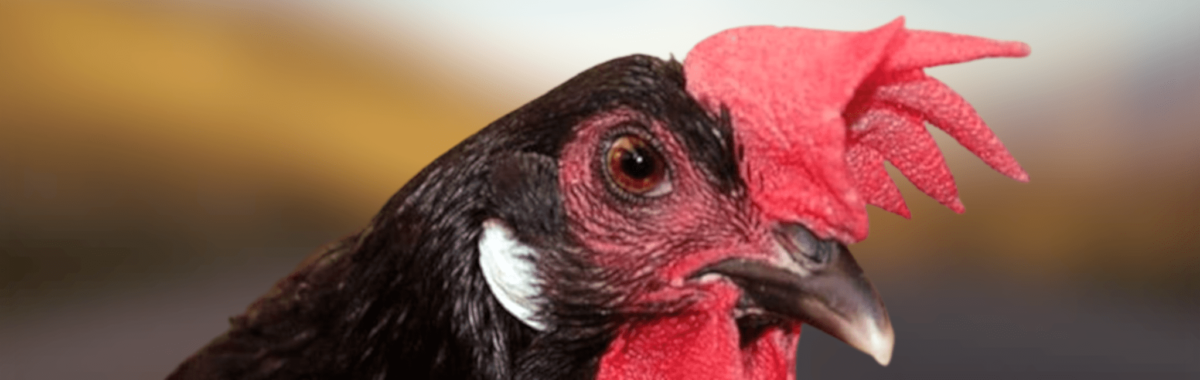
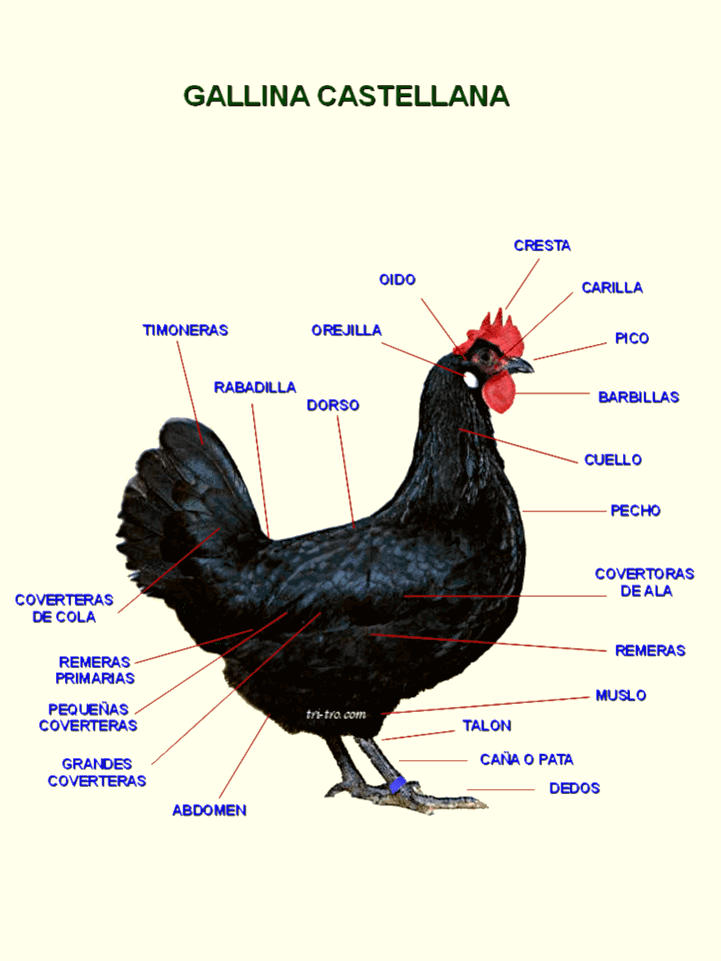
Castilian hen, black breeding.
The tonality of the hen differs markedly from that of the cock.As in all female domestic birds, their sound is softer, which suggests its suitability for motherhood.
First hen singer: The way in which some chickens imitate the sound of the rooster is observed in those who have a year, who lay eggs like the others and who do not present the characteristics of hermaphrodites, as it has come to think about it.
A hen that crows on a farm is invariably put to death because it is considered a bad omen. This belief is nothing more than a myth, like so many others.
Second song of the expulsion or related to the position: This is a specific variation in the vocalization a hen makes when she finishes laying an egg. It is believed that this call lasts longer if the laying process was difficult. (cooo-coooo-cooo), with the duration increasing in proportion to the size of the egg. The Cochinchina hen, which lays frequently even though her eggs are small, makes little or no sound.
Third song cackling: This is the characteristic sound a hen makes; she shows excitement when she is free or when she receives or finds food she likes. She makes “ca-ca-cas” sounds with a tone of satisfaction; ca-ca-cas.
Fourth cloqueo: This sound is made when a hen is driven by instinct to brood or when she is guiding her chicks. A hen’s brooding begins when she starts to brood, at which point she is said to be broody, and does not cease entirely until she prepares to lay again; in other words, she produces the brooding sounds—cloque, clouqite—almost continuously.
The rooster capon that accompanies the chicks are easily taken in the cloqueo, a language that the chicks comprise form exceptionally clear.
Fifth cry of order: Both the hen as the rooster, in search of rest, they manage to capture the attention of the crowd with a brief cry of cro-or-or— that. The brooder also uses this sound to demand silence their chicks, and inducing them to rest beneath his wings.
Sixth piar, pio, pio: This is the sound emitted by the chicks. Keep this vocalization until they reach the age of puberty, an age that varies between the different races.
You can identify other vocalizations of our hens of the following ways.
Post-mating: A rumbling noise that resembles the one that was generated before a fight, when they have just finished.
Only the cock, and only the chicken that stands on end and shake their feathers, they emit a sound that is more akin to a “sigh” of satisfaction after pairing successful, as well as a sigh of relaxation in quiet moments.
This is not a purr, or a song, or a cackle.
On the other hand, this is a more drawn-out, low-pitched chirp that hens make when they are calm. I suppose it serves as a way for them to connect with one another, since I haven’t noticed it occurring in any particular situations, but rather when they aren’t actually engaged in any specific activity.
Chickens, together with the roosters, represent one of the species with greater diversity in their way of life. vocalize, which contradicts the idea that they are animals less intelligent.
The song that emits before laying eggs, when they are in a state of anxiety, differs from the cackling that appears after the start, and we have already managed to identify this behavior.
The first we call "singing," and the second one referred to as a "cackle."
There is another type of vocalization they make when preparing to rest; those already settled emit a clucking sound similar to a soft “pirr,” and this occurs when a new hen approaches to settle in. This is especially evident in chicks, who are often more restless as they look for a place to settle and tend to disturb their companions.
It is important to understand the reason behind their behavior and the sounds they generate.
This phenomenon is known as “make the wheel”in this ritual, the rooster will exhibit to the chicken its beauty and the quality of their genetics, something that, I guess, she plays with ease to prepare for the mating.
These aspects show that what is fascinating is the observation, meticulous and systematic, of the interactions that are constantly being developed in the hen house and its surroundings.
The maternal instinct, which manifests itself in a remarkable way in some breeds of chickens, can be an effective model for society, as is the respect and loyalty that, generally, the hens demonstrate to the cock under whose protection they are.
Among the cautious sayings that attack not only the vulnerable hens but also the faithful companion of the human being, there is none that you own justification for, as has been proven on multiple occasions that the hen is loyal to the cock with which it coexists, even when he is not present.
The bravery and aggressiveness that are exhibit the hens broody When they sense a threat to their offspring, regardless of the size or strength of the adversary, they elicit sympathy even from those who are unfamiliar with poultry farming.
Getting involved in poultry farming is a healthy, honest, and rewarding activity—risk-free and more profitable than it might seem at first glance.
Because who has at least a dozen hens and knows how to take care of them, you will never have to spend money on purchasing eggs, thus avoiding the cost of products of origin-consuming and of questionable quality.

You may be interested in these other sections