Rooster Reproduction Device

The genitals of the rooster:

Despite the extensive experience in the anatomical research of the birds, the genital organs of the majority of avian species remain to be documented properly.

Birds are the only group of vertebrates that exhibits internal fertilization, and in which the majority of the species has lost a phallus or penis intromittent.

An analysis of the anatomical changes in the phallus among species in which it is still present provides us with an opportunity to evaluate evolutionary theories that explain the loss of this organ in the ancestor of modern birds.

A rooster typically expels between 100 million and five billion spermatozoa with each ejaculation, exhibiting higher concentrations at the beginning of the day than at the end, when exhaustion is observed after multiple matings.

The volume of the first ejaculate is close to 1 ml, but after successive ejaculations, this average decreases to 0. 5 ml or less. These figures come from the collection of semen, commonly performed procedures of artificial insemination.

The sperm count per ejaculation, and the volumes of semen tend to be lower in the mating natural in comparison with the semen collection by artificial stimulation and abdominal massage.

The mating activity follows a circadian pattern, peaking at the beginning and at the end of the day.

A rooster can mate between 10 and 30 times in a day, depending on the availability of the hens and the competition with other males. However, the number of spermatozoa per ejaculation is rarely more than 100 million, which is the minimum amount needed to ensure a fertility high.

In the context of the natural mating, there is a better rate of fertility when this is done after the hen has laid an egg in the shell. However, if the hens to mate with frequency, it is unlikely that perceived differences in fertility, regardless of the time that happens the mating.

The cock features a small phallus which was full of lymph to form the intromittent organ. This organ is rudimentary, and, during mating, the penetration is almost non-existent. The hen spreads her vagina during copulation, thus facilitating the transfer of semen into the oviduct. In contrast, ducks, geese, and some other birds have copulation organs more distinctive.

Sequence of behavior:

The intercourse between our birds represents the culmination of a series of behaviors. The cock starts the mating process, exhibiting courtship behavior: deploys a wing and runs a dance in a circle (the wing that is more low will be in the inner part of the circular dance).

The hen crouches down (he bows his head and body) to indicate that it is ready to accept the male. In response, the cock, then proceeds to mount it, and it grabs hold of the ridge, the feathers of the neck, or the skin on the back of the head or neck, easing his grip while positioned on it.

The behavior that follows it is the footprint (the rooster moves quickly on the back of the hen) and, finally, occurs copulation complete that closes the sequence of behaviors. This copulation is complete is when the rooster aligns its tail with a hen and displays the feathers of its tail to the sewers to make contact. At this moment, the semen of the cock is ejected directly into the vagina of the chicken through the cloaca.

In the usual facilities of players that are home to thousands of birds, the complete sequence of behaviors is not always performed, often resulting in the omission of the courtship dance.

Chickens exhibit polygyny; however, certain males and females maintain selective and regular mating partners. Some females in the henhouse avoid specific males, which means they rarely mate with them.


 Care for the breeding male:

The reproductive behavior of the male presents a striking complexity and a great adaptability, which gives you the ability to modify their mating frequency in function of the levels of competition between other males in their social environment.

In the issues addressed previously, we have focused our efforts on getting our breeding to an adequate production of eggs. It is not enough to achieve high peaks of production and maintain a good persistence in our lots, if we fail to achieve competitive levels in terms of fertility and birth rates.

The profitability of our operation also depends on getting lots of breeders that are efficient in the production of newly hatched chicks. Recent research indicates that changes in the structure of the strains selected to promote a significant development of the breast appear to be the most influential factor that contributes to the reduction of fertility.

In this context, in this occasion, we'll direct our attention to the male player.

We will examine different aspects of its behavior and reproductive physiology, with the aim of achieving a better understanding on the part of us and explore how we can apply this knowledge in field conditions to achieve fertility rates and birth competitive.

Conduct reproductive male:

In the presentation given by Inma Estévez (“Management of Breeding Birds to Optimize Fertility,” 46th Scientific Symposium on Poultry Science, Zaragoza, Spain, 2009), the following argument is made: 

(a) It is evident that the issue of low fertility is not due to a reduction of the libido, or an increase in the aggressiveness associated with genetic selection on modern lines. 

(b) The reproductive behavior of the male turns out to be complex and highly adaptable, which makes it possible to adjust the frequency of mating according to the levels of competition among males in their social environment. 

Theoretically, this strategy allows you to maximize your success in the reproduction. Unless it is for very specific situations, a single male (dominant or subdominant), has the capability of doubling the frequency of mating in short periods of time. 

As a result, when females are scarce, males become extremely competitive in their search for mates. If this phenomenon becomes severe, it can lead to high female mortality under field conditions. 

c) The quality of the semen, evaluated in function of broad parameters, neither provides a clear explanation, since it has been observed that the quality and parameters of sperm can fluctuate dramatically for the same male in a short period of time, even among the main players.

d) The visual evaluation of the semen, some centers used to judge the males, it lacks reliability. Despite its apparent volume is large and dense, it may contain a significant proportion of sperm cells dead. It would be advisable to focus on the genetic selection towards males with sperm that present high mobility, given that this feature has a significant impact on fertility. 

(e) Males with higher body weight tend to show a fertility bottom, although sometimes manage to compensate for it by using copulations multiple. 

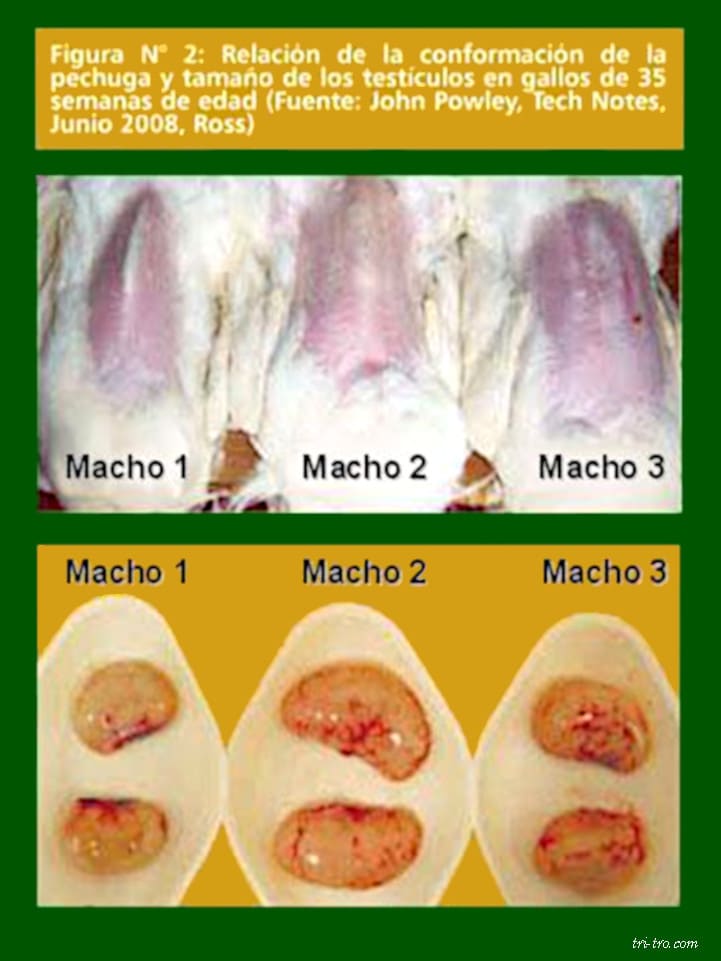
f) It appears, however, that the conformation of the male, particularly the size of your chest, it is a factor even more important than the weight. 

A volume that is relevant in the chest of a male seems to interfere with the effectiveness of the copula and the subsequent transfer of the sperm, and this drawback is related to the characteristics derived from the genetic selection. In connection with what is mentioned by Inma Estévez, it is concluded that the conformation of the rooster is the variable factor that influences the fertility of the group.

Fertility and rooster culling:

The reproductive capacity of the rooster is, in a certain way, limitless: it can mate with the hens up to fifty times in a single day. When you reach the age of puberty, which varies according to the race, the rooster is very active and full of energy; it is considered, and it is right, as the bird more lustful, and its size is proportional to the prominence of his testicles.

Inside your body, the glands produce abundantly a semen fertilizer.

The cock you prefer to carry out their activities in a loving on the outside; for this reason, it is usually the first out of the coop and wait for the chickens in the entry. The notes with a salacious look and greets with their wings, and sing to the chicken of your choice, which crouches in order to facilitate mating. 

He approaches her diagonally, uttering low, rapid vocalizations, grabs her by the crest with his beak, positions himself on top of her by placing his feet at the base of her wings, and completes the act quickly: the hen shakes her whole body the moment the rooster moves away.

When the chicken is ready to receive the cock, bends over, separating the feathers of its tail and makes an effort expulsive of their genitals, which allows the cock to deposit the semen near the entrance of the bag ovarian, located in the upper part of the cloaca, just below the tailbone.

The cock, through the bump of his body, which acts as an intromittent organ, carries out a slight contact at the entrance of the bag ovarian that the chicken provided through his effort expulsive.

After this contact, the male stands up and proclaims his success, loving with the same sounds that used to celebrate his victories.

When the rooster is young and strong, it can be observed that in the mornings, upon waking up, his sexual desire does not subside until he has mated with three, four, or even five hens; once this act is complete, he crows.

After being mated, the hen stands up, ruffles her feathers, shakes them out, and mingles with her companions without showing any sign of gratitude and without arousing even the slightest jealousy among them.

The fertilizing capacity of the cock is so significant that, according to Hervé, could fertilize with a single break all the eggs that a hen would be in a period of six months; however, this calculation has been considered by many observers as exaggerated and fantastic, limited to a month or even a week or ten days.

Given that today it has been decided to increase the artificial incubation of chicken eggs, it is relevant and essential, from an economic perspective, to verify with higher precision that has been carried out. It refers to the number of fertilized eggs after a single mating of the rooster, and experiments, more rigorous, have confirmed that a hen that has been fertilized and then separated from the rooster may be placed between 7 and 10 fertilized eggs; the others are clear or infertile.

However, the cock is so fertile that you can be a parent of more than 200 chicks in a single day.

Despite enormous efforts by physiologists to unravel the mechanism of fertilization, they have not managed to clear up the mystery that still persists. Numerous hypotheses have been formulated, some quite absurd and others more appealing, although none can be considered acceptable due to the objections that can be raised against them.

Currently, it is accepted that the semen of the animal is composed of a number of corpuscles or granules mobile called sperm. These are not small beings, but of true cells generated in the testis, male germ cells that are today known as sperm.

These require you to reach a specific degree of maturity to make it possible for fertilization. The eggs develop in the ovaries of females are also cells, germ cells feminine, that alone, neither the male nor the female, perform some function; it is absolutely essential that join together through the act of sexual reproduction, and this fusion creates the embryonic cell that will give rise to a new individual.

The results observed in the crossing of races and the improvements obtained by the selection of stallions, thus eliminating many morphological defects, along with the hybrid products that possess features of both parents, seem to provide a certain degree of truth to this theory, although he can not say that he understands the essence of fertilization.

Excessive use of reproductive pleasure deteriorates, destroys, and nullifies the rooster; so much so that, after three or four years at most, he is unable to procreate. At this point, he loses his appeal to the hens, as he only manages to tire them out without purpose.

Despite his decline and lack of ability, he continues to observe certain rituals of courtship. Thus, from time to time he is seen mating with some hens, though without success in terms of fertilization; he frequently flaps his wings, sings, guards his coop, and tries to entice his hens to enjoy even the most trivial of discoveries. 

One of their main concerns lies in making flee to its competitors, and its excessive zeal leads him to monitor constantly the cocks more young people, whom he pursues with great ferocity, instigating fights deadly, until it reaches a point in which he is defeated and is forced to escape.

When it reaches this critical point, if you are not offered a sacrifice, the rooster old man experiencing sadness and retreated to a corner, as if he was consumed by fear; it keeps the eyes to squint, with the head and tail low, and the ruffled feathers.

Not much time passes before I die of sadness, without which your chickens to be affected by their pain or are concerned about their misfortune, even though they have dedicated their lives to the hardships that these required and the variety of services it has offered them with as much care and dedication.


Male reproductive system:

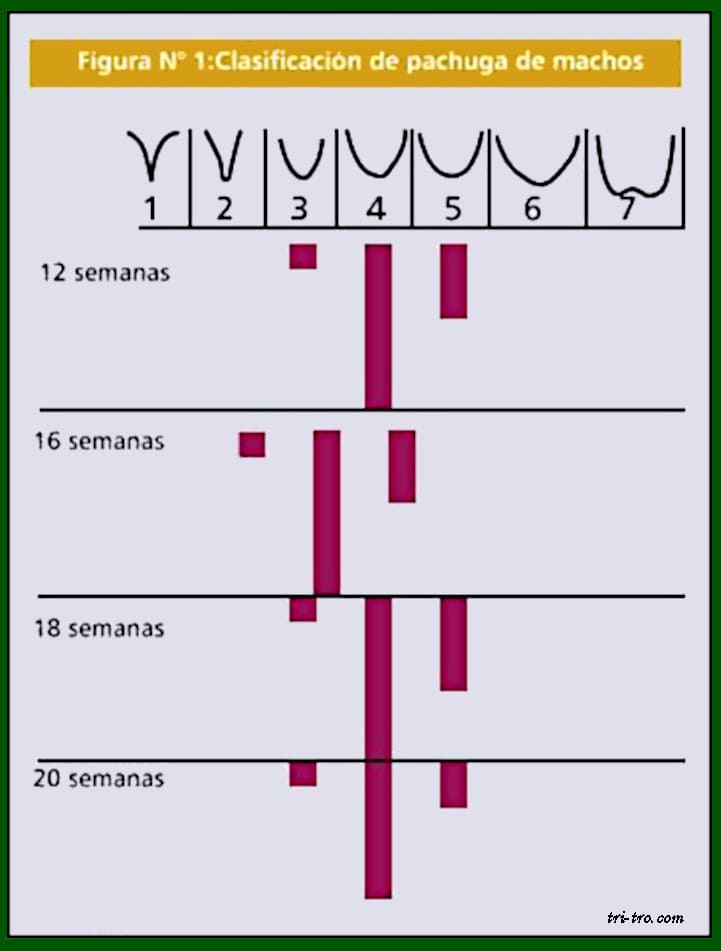
In field conditions, it has been shown that a more favorable fertility curve is obtained with “athletic” males, whose chest conformation is type No. 4; an illustrative table is provided below.

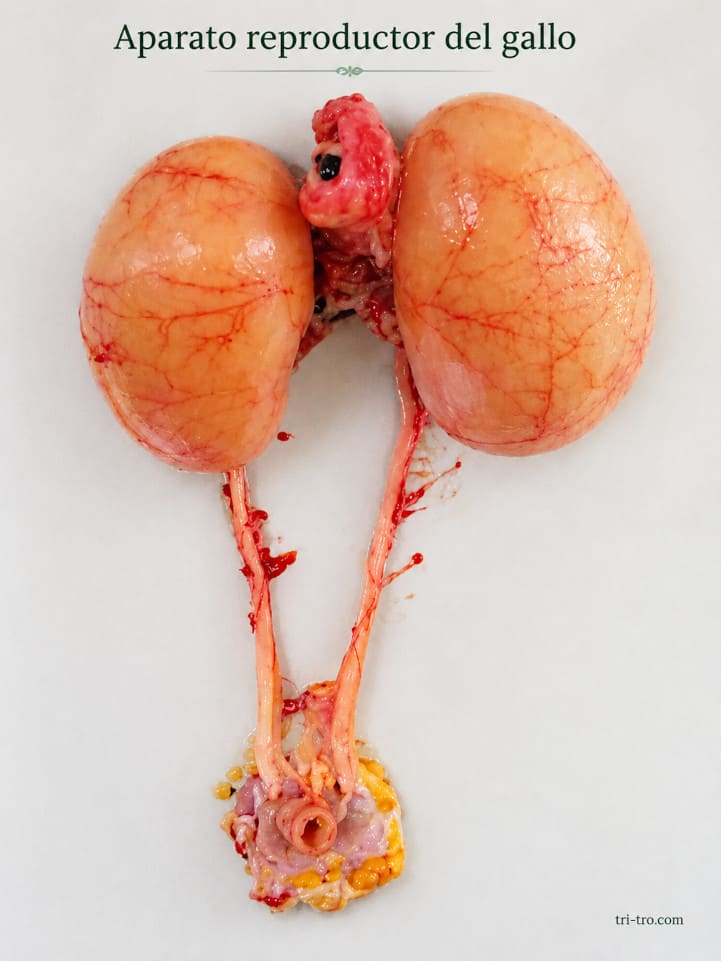
The structure is constituted by the testes, epididymides, vas deferens and the intromittent organ. Lacks glands, genitalia and accessory urethra.

Testes:

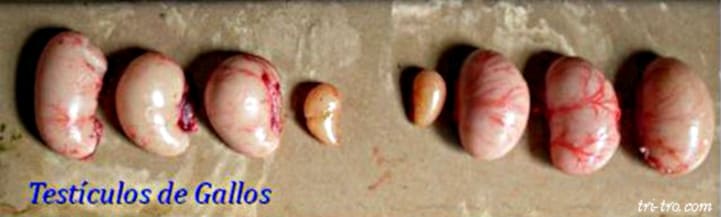
Measure approximately 5 cm in length, with an off-white color during the period of reproductive activity and a reduced size along with a yellowish hue in periods of inactivity breeding or molting. It is located in a way cranial to the kidney and are surrounded by a thin tunica albuginea. Contain seminiferous tubules that are connected with the rete testis.

The size of the testicles is closely linked to fertility, where low fertility correlates with smaller testicles.

The volume of the rooster's ejaculate does not exceed 1 ml. Seminal fluid is produced in the testicles and in the epithelial cells lining the extratesticular ducts.

Testes of Roosters

The epididymis: This body is not segmented into head, body and tail, and is located above the testis, formed by efferent ducts.

The vas deferens: It begins in the caudal part of the epididymis, and accompanies the ureter to the cloaca, where it opens on a papilla located in the lateral wall of the urodeo.

The vas deferens shows a slight bulge in his end known as a receptacle, that during the reproductive activity is full of sperm, with a more detailed description is available in the section of Spermatogenesis.

Testicular development: The size of the testicles is closely linked to fertility, such that low fertility is associated with smaller testicles. It is therefore essential to ensure that bird management does not hinder testicular development at any stage of the roosters' lives.

When the management of the male seeks to foster the growth of testes healthy and adequate, it is essential to understand the critical phases of testicular development.

Between 2 and 15 weeks of age: Takes place on the gonadal development at the cellular level. In this period, Sertoli cells are multiplied, reaching a million for each cell, which will be related to the future fertility of the male, given that these cells provide support and nutrition to the sperm in growth.

It is crucial to prevent inappropriate practices during the first ten weeks that may interfere with the proliferation of Sertoli cells. It is advisable to maintain adequate growth at this stage of the life of the male.

The increase in the size of the testicles is almost imperceptible, with both reaching a total weight of 0.5 g at the end of the 15 weeks.

Between 16 and 24 weeks of age: There is noticeable growth in the testes. At 20 weeks of age, before any light stimulation, the weight varies between 0.5 and 2.0 g. Subsequently, during the three weeks after light stimulation, gonadal growth is considerable.

The hormonal production will start the spermatogenesis, which explains the significant increase in the size of the testicles. When you arrive at 23 weeks, the testes weigh between 12 and 22 g, and begins the development of the vas deferens.

Between 25 and 30 weeks of age: At the stage of 28 to 30 weeks, the testes reach their maximum development and the production of semen.

During this phase, it is critical that the rooster consume between 20 and 22 g of protein to ensure proper production of sperm. It is common to notice a “pause” in the weight gain during this period, a result of intense sexual activity.

It is important to monitor the conformation of the breast to identify those cocks that they can be in terms of thinness, excessive (malnourished) and proceed to your speedy recovery. Malnutrition in the males, if not addressed, will cause a decrease in testicular size and premature reduction in fertility.

At the end of the first 30 weeks of life, it is recommended to maintain a breast grade of 3 or 4. From this point on, the focus will be on maintaining a breast grade of 4.

There is a relationship observable between the weight of the male and the size of their testicles.

Males that are malnourished (breast size 2, excessively thin) or those that are overfed (breast size 6–7, too large, turkey-like) have smaller testicles compared to males with a properly shaped “U”-shaped breast (breast size 4). This statement has been verified in the field and is accurate.

Forms of breasts cock and testicles

Forms of breasts cocks

From the thirty-first week of lifeyou will see a gradual decrease in the size of the testicles and the production of semen. The proper management of the removal of male non-productive and those that are dominant contributes to reducing the losses associated with infertility.

The categorization of males according to their weight in the production facilitates a better uniformity and reduces competition for food. It is recommended that this activity be carried out starting at week 32 of life, with a frequency of every 4 to 6 weeks.

It is essential to perform a palpation of the breasts every 14 days to detect those males that they begin to lose their conformation, and must be moved to the corral of recovery where you will be offered between 3 and 5 grams of additional food when compared to the other, with the aim of helping them to recover.

These males will continue to mating, and should not be housed in pens only for males, because otherwise, your loss would be total.

Clitoris and phallus (penis):

The cloaca is composed of the coprodeo, the urodeo and the proctodeum. Los uréteres desembocan en el urogenital.

The phallus: It is located on the ventral side of the cloaca and has the penis, known as the copulatory papilla, on its inner surface.

Papilla copulativa: The roosters have a sexual organ small that are full of lymph during erection, which comes from folds lymph. This lymphatic fluid is mixed with the sperm in the vas deferens, and both are injected simultaneously along the longitudinal ridge of the penis. The papilla copulativa turkey resembles that of the rooster.

The duck and goose have penises and well-developed, that they are twisted into a spiral, used as organs of penetration.

Mode of operation: The phallic bodies protrude during erection, and when they come together, they form a groove that collects and channels the ejaculate from the vas deferens; this groove consists of a central tubercle and a pair of larger lateral phallic bodies.

The reproductive organ is rudimentary, and, at the time of copulation, is practically not carried out penetration.

During the mating, the hen exposes the vagina, and the phallus (papilla copulativa) applies pressure on the mucosa sewage of the female, which facilitates the transfer of semen into the oviduct.

In day-old chicks, both sexes have a small protrusion of the genital on the location of the penis, being round in males and conical in females, which enables experts to perform the sexing.

Bibliography:

Dyce, K. M., Sack, W. O., and Wensing, C. J. G., 1991. Veterinary Anatomy. Ed. Pan-American.

Ede, D. A., 1965. Anatomy of birds. Ed. Acribia.

Grasse, P. P., 1980. Zoology. Vol. 4: Vertebrates. Reproduction, biology, evolution, and systematics. Ed. Toray-Masson.

Grifols, J. and Molina, R. 1994. Manual of clinical exotic birds. Ed. Grass-Iatros.

Natural History, 1984. Vol. 1. Ed. Ocean-Institute Gallach.

King, G. M. and D. Custance. Colour atlas of vertebrate anatomy: The Pigeon. Pp.: 5.1— 5.17. Ed. Blackwell Scientific Publications.

Krahmer, R., and Schröeder, L. 1979. Anatomy of the domestic animals. Ed. Acribia.

McClelland, J., 1992. Atlas in color of the anatomy of birds. Ed. inter-American.

Nickel, R., 1977: The Anatomy of the Domestic Birds. Ed. Paul Parey.

Sandoval, J., 1976. Veterinary Anatomy. Ed. Modern Printing Press (Córdoba).

Schwarze E. 1980. Compendium of Veterinary Anatomy. Volume V: Anatomy of birds. Ed. Acribia.

Shively, M. J., 1993. Veterinary anatomy, basic, comparative, and clinical. Ed. Manual Moderno.

Sturkie PD, 1967. Physiology of Avian. Ed. Acribia.

Dr. Francisco Gil Cano. 

Professor H. Aguinaga.


You may be interested in these other sections


How to Choose the Right Eggs for Hatching

How do you choose the perfect broody hen for incubation?

Incubating Chicken Eggs: A Complete Guide


You want to share, or comment on your social networks

Scan me