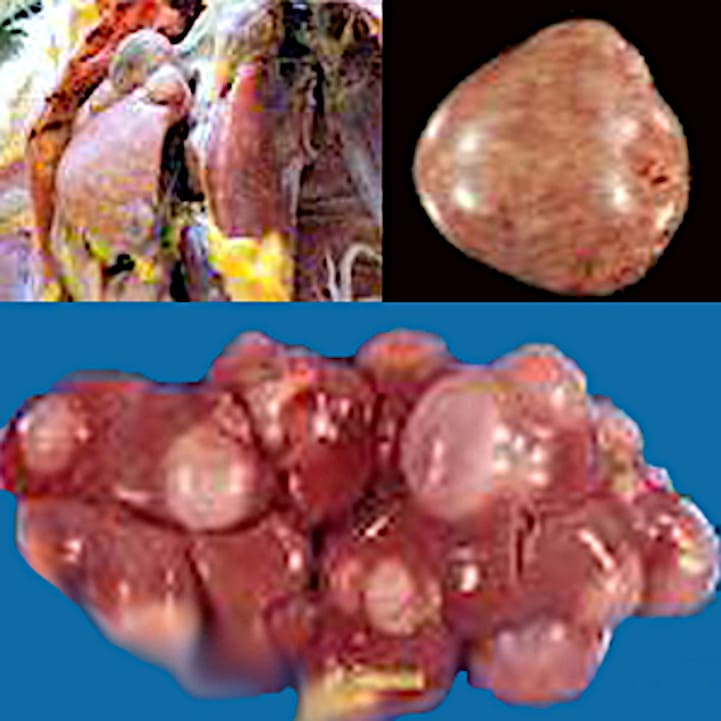
- Spleen.
- Liver.
- Kidney.
- Bursal.
Enlarged liver and visceral lymphomatosis. The symptoms of lymphoid leukosis are entirely nonspecific.
The crest presents pale, and sometimes cyanotic. There is a loss of appetite, wasting, and often weakness of the legs.
The abdomen is enlarged, and the feathers near the cloaca dirty urate.
A large part of the affected animals die suddenly due to rupture of the liver or spleen, without any prior symptoms.
Incidence and presentation:
Mortality from lymphoid leukosis is more common in chickens 16 weeks of age or older. The disease is widespread throughout the world, particularly in the United States and Canada.
Historically, it has been considered in these two countries that virtually all the flocks are exposed to the virus, but the infection has subsided due to working with the players and the infection is maintained in some flocks of poultry egg producers.
Although this form of lymphoid leukosis causes losses in the poultry industry, it is believed that the losses attributed to the disease in previous years were actually caused by the acute form of Marek’s disease and were misdiagnosed.
In our country, this view is well-supported, as the 1960s saw a high incidence of the lymphomatous form of leukosis; however, with the introduction of vaccination against Marek’s disease and advances in differential diagnosis, it has been established that the incidence is low and has been reported only sporadically.
History:
The first report of lymphoid leukosis was published by Roloff in 1868; however, the disease was not sufficiently defined until it was distinguished from Marek's disease in 1962.
Etiology:
Lymphoid leukosis is caused by a retrovirus known as the avian leukosis virus, which has been classified into five subgroups: A, B, C, D, E, and J.
In the United States, subgroup A is the most common and is most frequently associated with lymphoid leukemia; subgroup B viruses are occasionally found, while groups C and D are rare.
The virus of the group And are popular and considered to be endogenous because they are derived from genes provirales permanently integrated and are rarely associated with neoplasms.
These viruses have an antigen-specific group, and can be detected in the albumen of eggs, tissues, and body fluids. These viruses can be grown in chicken embryo fibroblasts, but did not produce cytopathic effects and can be detected by tests for antigens.
Simple tests to detect antigens are recommended and are used for eradication programs in players. Antibody tests are also recommended and are used to monitor the status of the herds in which the virus has been eradicated.
Transmission:
The main route of transmission is via the egg. The frequency of eggs infected is usually low, but the chicks from these eggs are permanently viremic, as they do not develop antibodies (inmunotolerantes) and may die later, or can be kept as carriers and keep the infection to the offspring.
A large part of the chickens descendants of hens virémicas are new carriers of the virus.
These chicks infect other, previously healthy chicks through horizontal transmission, a process that can begin as early as the hatching chamber, primarily through feces, with the virus being transmitted mainly through the air.
Most of the infections occur in the first four weeks of life. The susceptibility decreases with increasing age. Infected animals shed the virus, especially with the runny nose. The nasopharyngeal mucosa is the gateway to more frequent of the virus in chicks.
Infected birds shed the virus for months without showing any signs of illness. Transmission of the virus to eggs decreases as the birds age. Chicks of susceptible age can also be infected by carriers of the virus (humans, rats, birds, etc.).
The results of various studies suggest that blood-feeding ectoparasites (such as mites) play a role as disease vectors. The leukosis virus may also be present in live vaccines when they are produced using embryonated eggs that do not come from disease-free flocks.
Clinical manifestations:
In many cases, birds affected by leukosis do not show any obvious clinical signs. They may exhibit emaciation or cachexia, as well as pale wattles and combs. In some birds, an enlarged abdomen may be observed as a result of a significantly enlarged liver.
Some birds have tumors; these can be felt by palpation, and if the tumors affect the bursa of Fabricius, they can be detected by inserting a finger through the cloaca. In severely affected flocks, there is a decline in egg production.
Pathologic lesions:
No external lesions are observed. Upon necropsy, tumors (lymphomas) are observed in various organs, particularly the liver, spleen, kidneys, ovaries, and bursa of Fabricius. These lymphomas are grayish-white in color and may be diffuse or nodular.
If Fabricio's sac is opened, small nodular lesions can be observed; microscopically, the tumors consist entirely of lymphoblastic cells. These cells are highly likely to express immunoglobulin M (IgM) on their surface.
Diagnosis:
Several factors must be taken into account for the diagnosis:
- Age of the affected birds.
- The course of the disease.
- The detection of microscopic lesions (tumors) in a relatively small number of affected birds.
- Lesions in the bladder are always present, although they are not always obvious, making it necessary to incise the organ and examine its surface epithelium.
- B cells and the surface IgM marker are characteristic of tumors.
This diagnosis can sometimes be difficult because lesions caused by lymphoid leukosis often resemble those caused by Marek's disease and may also be similar to those experimentally induced by the reticuloendotheliosis virus.
Because the leukosis virus is so common in poultry flocks, virological and serological methods are of little help in confirming the diagnosis.
Measures against epizootic:
Given that vertical transmission is the most important, the eradication is the best method for its control. The majority of eradication efforts have been directed towards the inbred lines.
Many herds devoted to the production of eggs have been reduced appreciably vertical transmission in the clean lines and feet of offspring, by examination prior to the production of eggs, eliminating those they think they can transmit the virus to progeny.
Lymphoid leukosis is uncommon in broiler chickens, although eradication programs have been launched in heavy-breed breeders with the aim of increasing productivity in the parent stock.
The genetic resistance to infection with the virus of subgroup is common among players with heavy, though rare in the production of eggs.
Vaccination has been used as a supplementary measure for controlling leukemia, although its effectiveness has not been confirmed. There is no vaccine that can protect against tumor-related mortality.
Vaccines have been used to vaccinate breeding stock in which the virus has been eradicated; this has been done to provide strong immunity to the offspring.