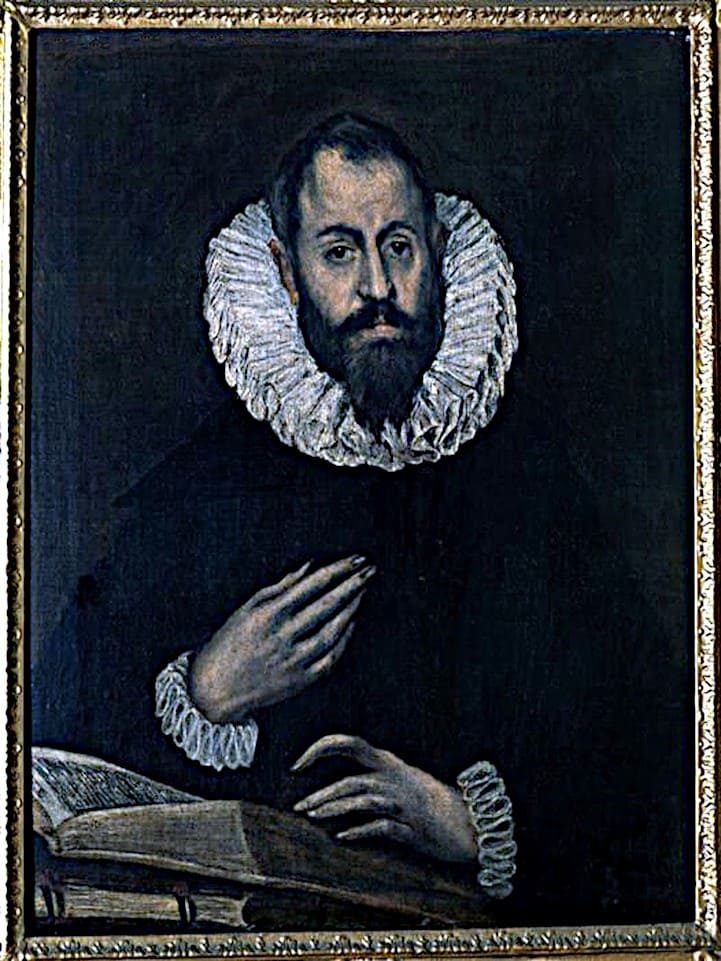
Fray Miguel Agustín, with the concern that exists in the Modern Age by agriculture, which ensured the livelihood of the population, and that was the basis of the economy of the time, was reflected in a series of writings, the so-called treaties of agriculture.
Works of different authors aimed at a different audience, which continued the rich tradition of the classic writers de Re rustica, bringing together the medieval authors of the Christian world and the Islamic world.
Friar Miguel Agustín was born in Banyoles, Girona, in 1560. He served in the Order of St. John of Jerusalem and became prior in the town of Perpignan, France. He died in 1630; he was a prior and a naturalist. He is best known for being a distinguished agronomist who wrote a renowned manual on agronomy.
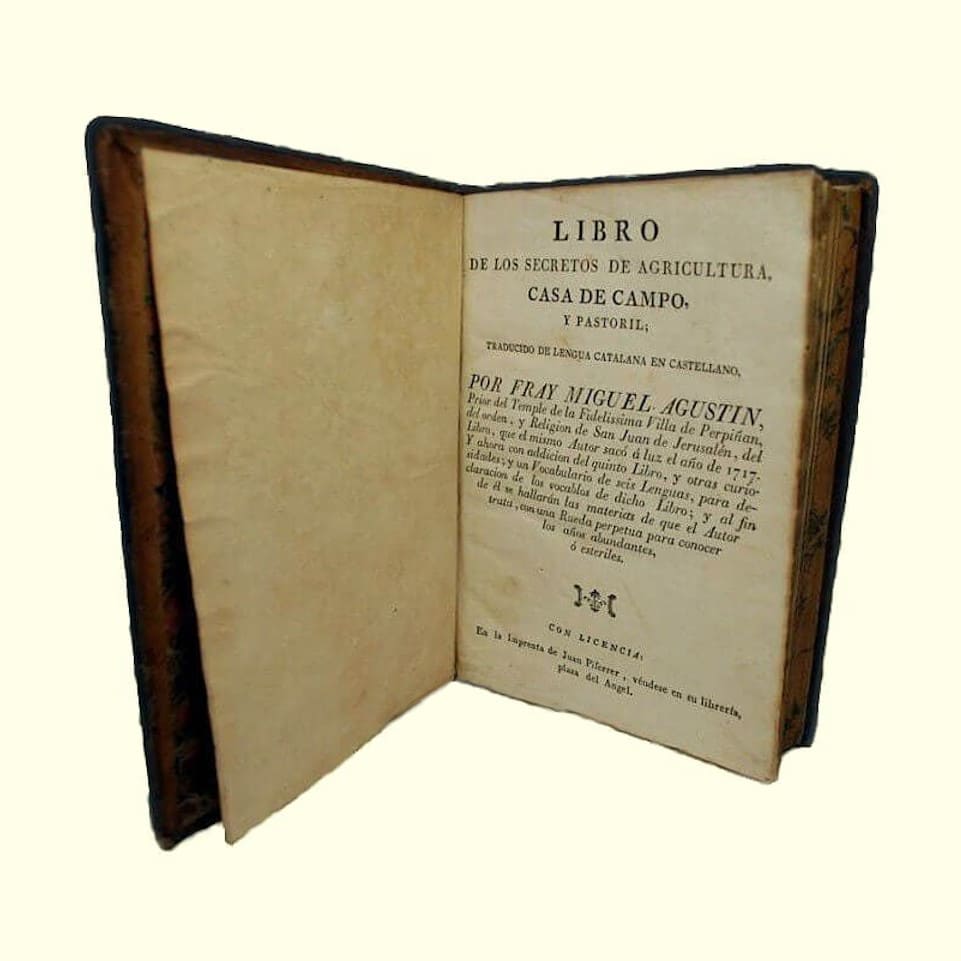
Published for the first time, in Catalan, in 1617, and consists of 194 pages, with the title Llibre dels secrets d agriculture, house rustic and pastoral, one of the contributions to agronomy most significant written in Catalan.
The Polytechnic University of Madrid still retains two copies of this work. The first, belonging to the edition published in Barcelona, in the printing house of Juan Piferrer, 1722, and the second one, corresponding to the edition of J. Ibarra, made in 1761. The two copies are bound in parchment.
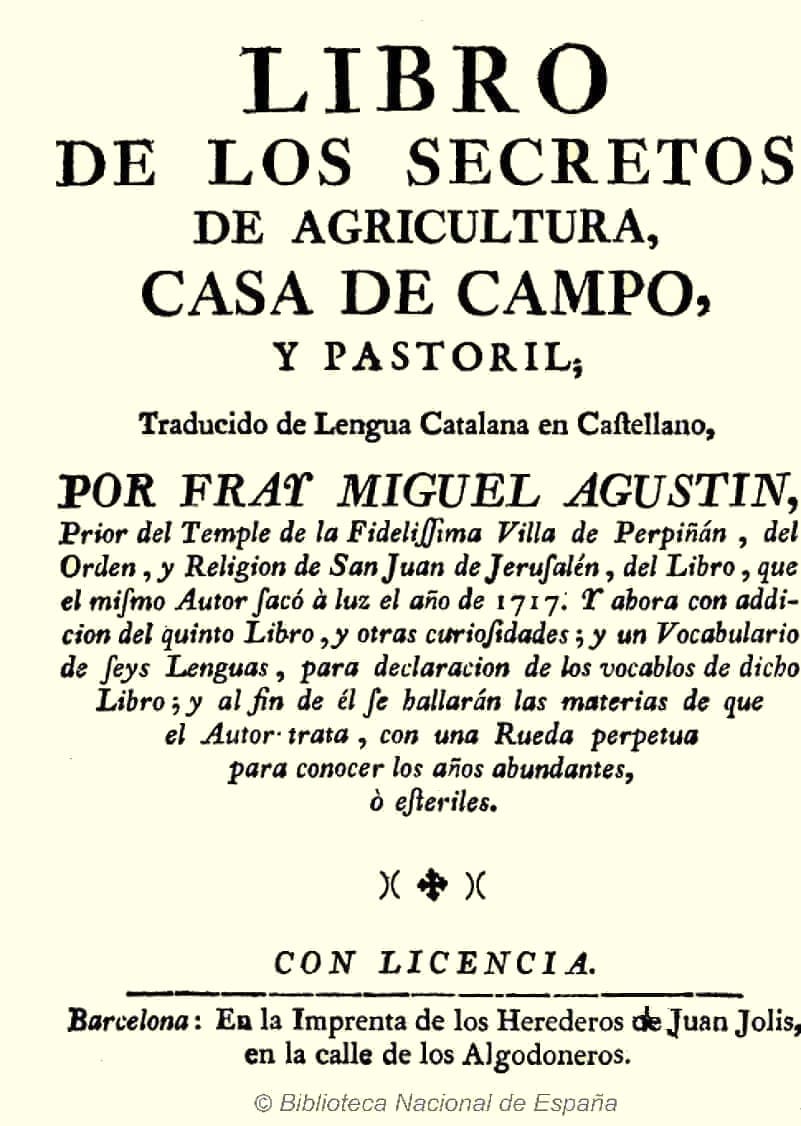
Years later, in 1625, he published this work in Spanish, in Zaragoza, which added a new part on the game and a vocabulary of terms agriculturalconducted in six languages (Spanish, Catalan, Latin, Portuguese, Italian, and French), with the title Book of the secrets of agriculture, cottage and shepherd.
In the successive editions, the text was expanded, moving to more than 500 sheets of paper. The next edition was made in Perpignan in 1626, and then followed by others in Barcelona, Zaragoza.
In this new edition, figure on the cover extended of the work, with the addition of a fifth book, which is about the hunting of animals and a vocabulary in six languages (Spanish, Catalan, Latin, Portuguese, Italian, and French), with reference to the names of the fruits, trees and other herbs.
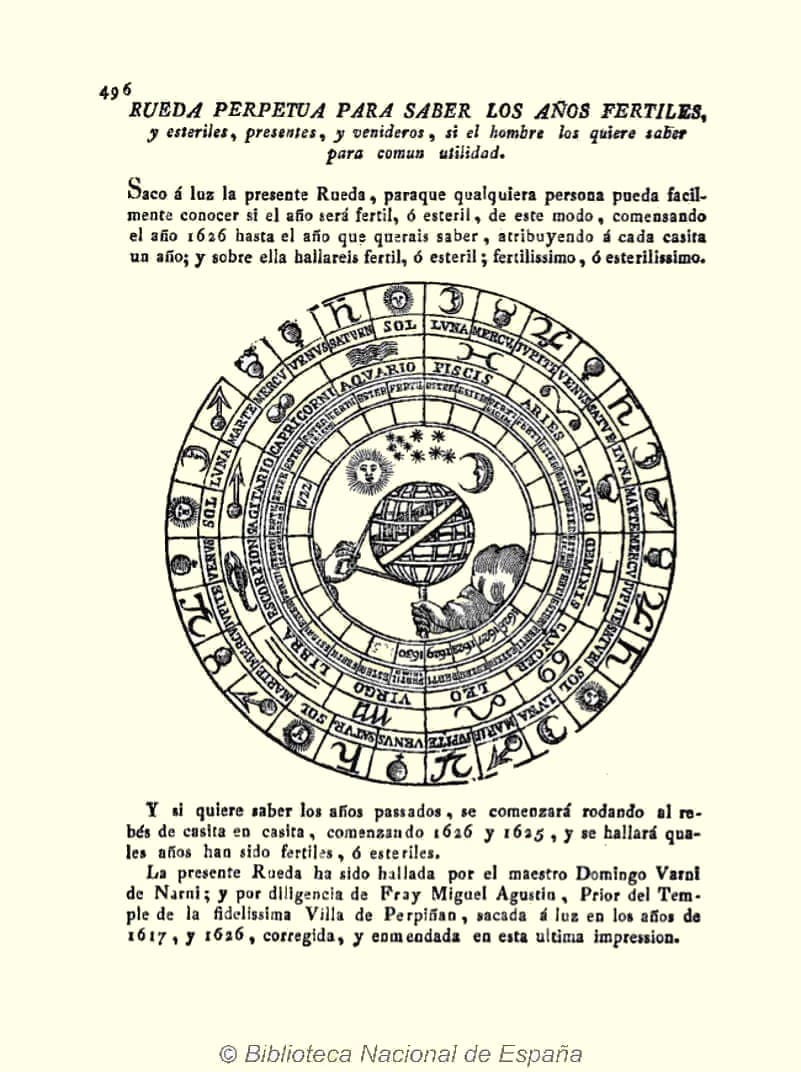
At the end of the book includes a wheel perpetual, with the signs of the planets, zodiacal signs, to have the knowledge of the years of the fertile and sterile, the present and the future, and a subject index.
It is a work well-documented; the work is preceded by an extensive introduction in which the author quotes the great authors, classic and modern (Columela, Justinian, Cicero, Pliny, Pike Belancio or Cardano).
Proves the greatness of agriculture, which teaches the cultivation of the land and how to plant trees; the pastoral activity, which indicates the manner of raising all species of domestic animals, land, and volatile.
The volume or treaty of Miquel Agustin had as a reference, the more direct, the work of Estienne L'agriculture et maison rustique, 1564.

The prompt translation the fact that the book was translated into Spanish attests to the interest this treatise generated, and the succession of more than twenty editions, from the date of its publication until the end of the 18th century, confirms its popularity.
The book was structured in three parts in the first edition; Catalan appears, from the edition of 1626, divided into five books that collected all of the known techniques of the time, activity related to agricultural and pastoral economy.
The work is enriched with a series of illustrations on various subjects as instruments to distill water, proceedings of surveying (in the past, the branch of the topography aimed at the delimitation of surfaces, measurement of areas, and rectification of boundaries), or construction of chimneys.
Antonio Palau, in his Manual del librero hispanoamericano (Manual for Spanish American Booksellers), refers to this book, which was popularly known as El Prior among booksellers and the general public. It was a practical work, sought after by people in rural areas, and became very popular. It dealt with topics related to life in the countryside. Madrid.
His sources are varied, incorporating from the classical treatises of Varrón and Columela, passing by medieval authors, the catalans, as Arnau de Vilanova, including the contributions of the most modern foreign authors as Pietro Crescenzi and Charles Estienne.
Link edit digitized. National library of Spain
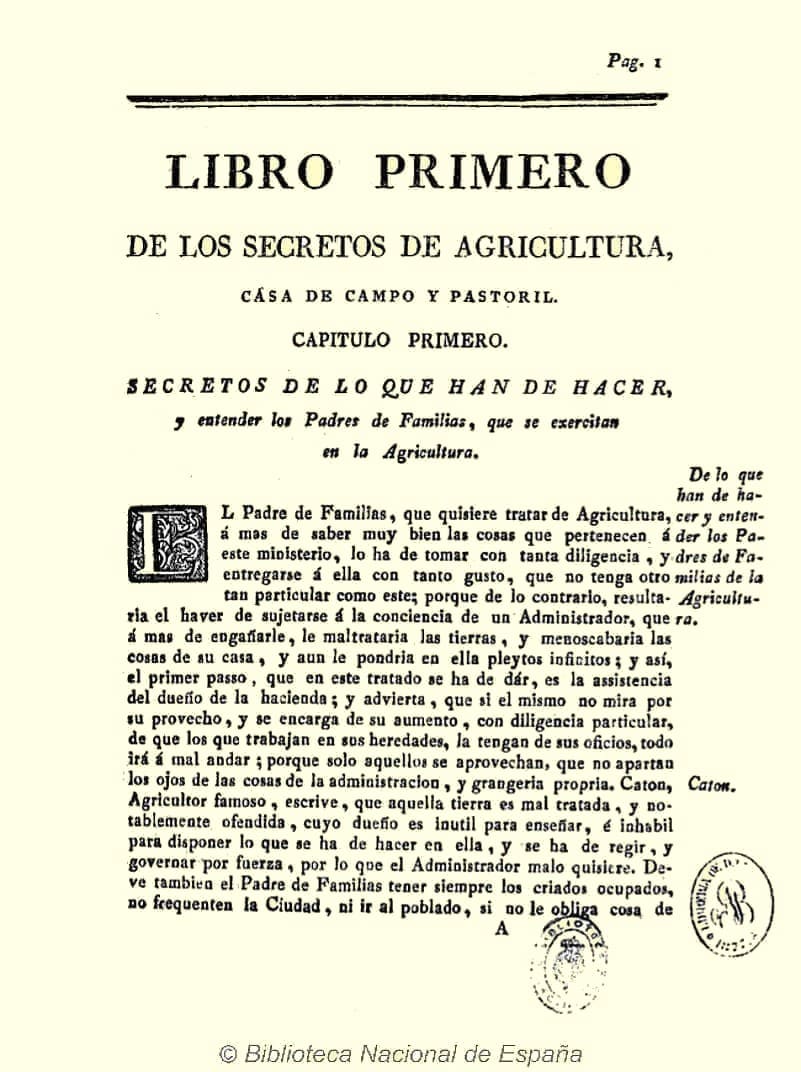
About of the reason of State of the Mother and Father of the Families of the House of Field, daughters and servants, and of the omens of the changes of the times, and what you are working on each month, with the precepts of astrology for the things of the tillage.
The making of the gardens, to sow and plant herbs to eat, as well as that will eat the leaves, roots and fruits, as well as the aromatic and medicinal, and flowers, with their virtues, and of the collection, preserves and jam them; with many curiosities.
* PDF page, and the book *page 17 – 1
About of the fruit trees in particular, and of those who are planted in the garden as out of it; and the planting, and transplanting, pinch, clean, and eating in many ways, with all his virtues; and how they are removed from the garden and field, caterpillars, lice, ants, worms, trees, slugs, moles, mice, snakes, scorpions, and other animals, which do damage to the herbs, trees, and fruits.
And the trees of the forest, and water; and the farming of the lands, wheat, and legumes; and to manure and cultivate, with the rest of the plant and pick up; and of the meadows and grass for grazing animals; and grinding the wheat and preserves, as well in grain and flour, and others, enough to be baked the bread, with other rarities and secrets.
* PDF page, and the book *page 121 – 105
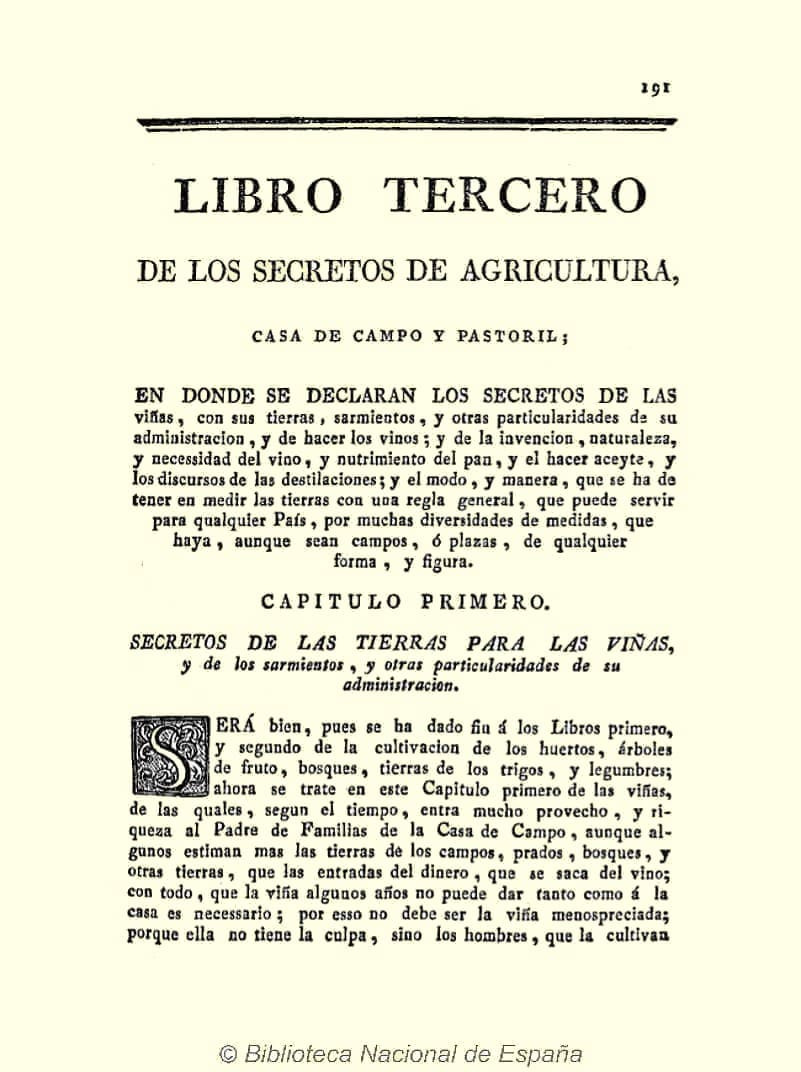
About land of the vines and branches, and its administration; and eating the vines and their diseases and remedies; and the fuck of the grapes and make the wines in many ways, so for the taste as with the other fruits and herbs for diseases; and of the invention, nature, abilities, and differences of wines.
And make the oil of the fruit of the olive tree, and other fruits, seeds, herbs, and flowers; and the short address of the distillation of water simple and compound, with all his virtues; with a royal general to measure the land in any country, even if they are the fields, or spaces of any shape or figure, and with many curiosities.
* PDF page, and the book *page 207 – 191
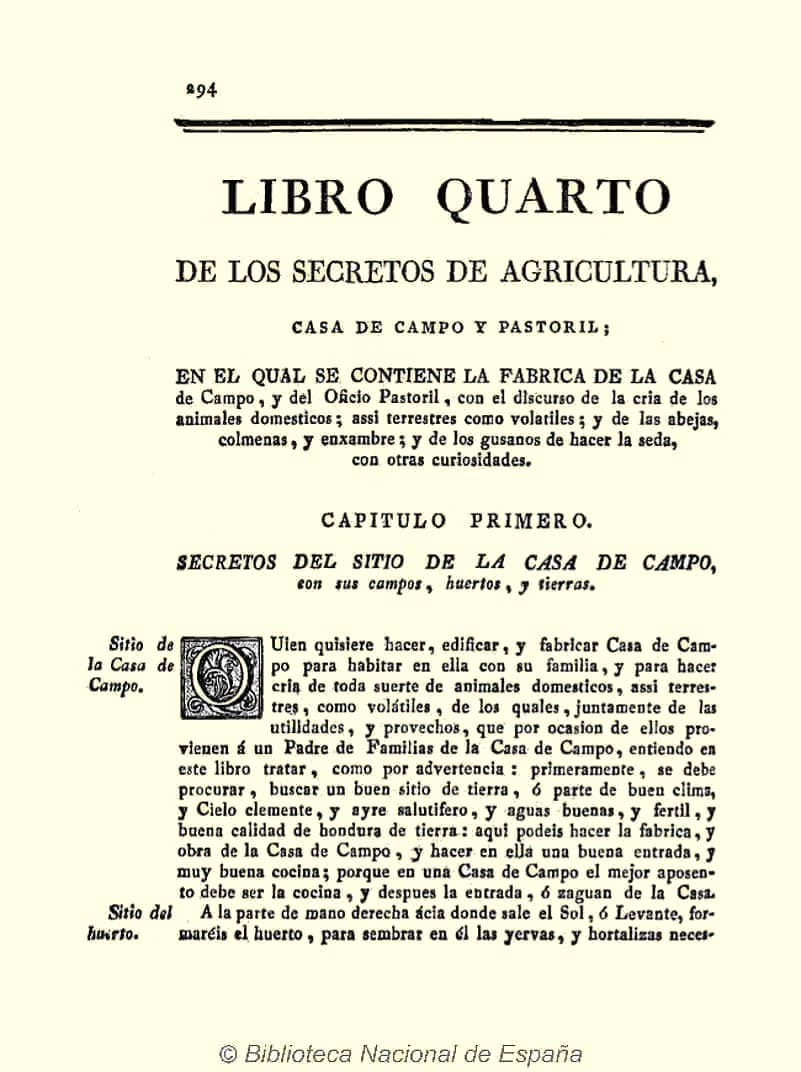
About the site and the factory of the Home Field, with the figures and shapes of fireplaces, so that the smoke does not go back down, by any wind that goeth; and to find the waters of the wells and fountains, and its healthiness and goodness.
And the breeding of all pets, so terrestrial and volatile, with its diseases and cures, and the bees and the worms that made silk, with many curiosities.
* PDF page, and the book *page 310 – 294
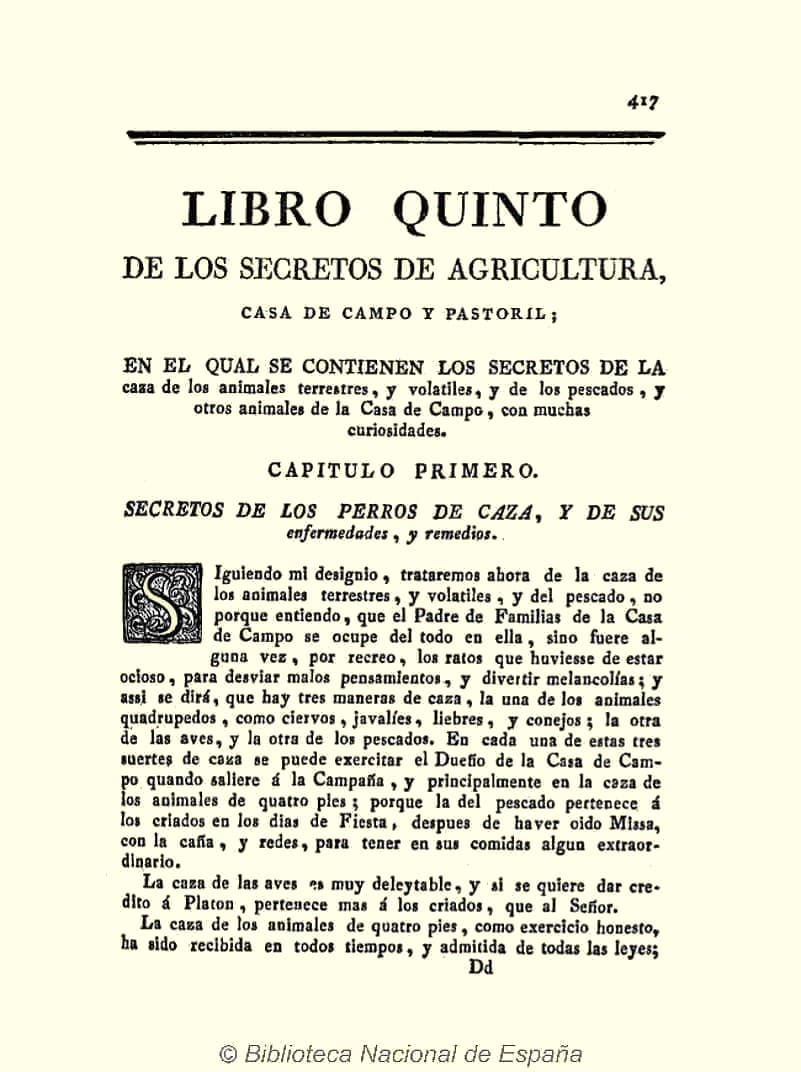
About raise and train dogs for hunting and hunt land animals, and volatile; and the calf and the government of the birds of the halconera, which are ten birds of prey, in general.
And in particular, to hunt and kill the animals of the Field House by the police in it; and of hunting or fishing of fish, with many curiosities; with a vocabulary of six languages, and in the end, a wheel, perpetual, to find the childbearing years and sterile, so come as the past.
* PDF page, and the book *page 433 – 417
You may be interested in these other sections